
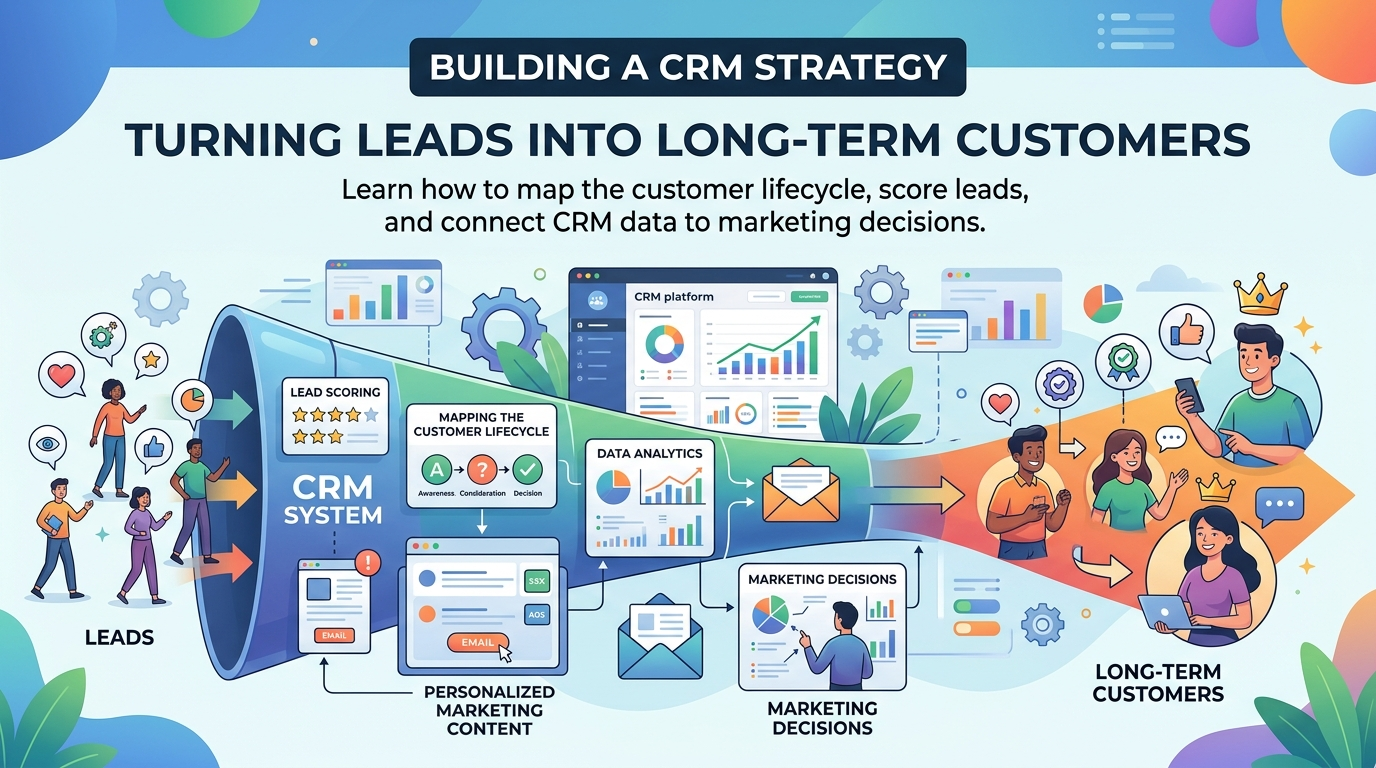
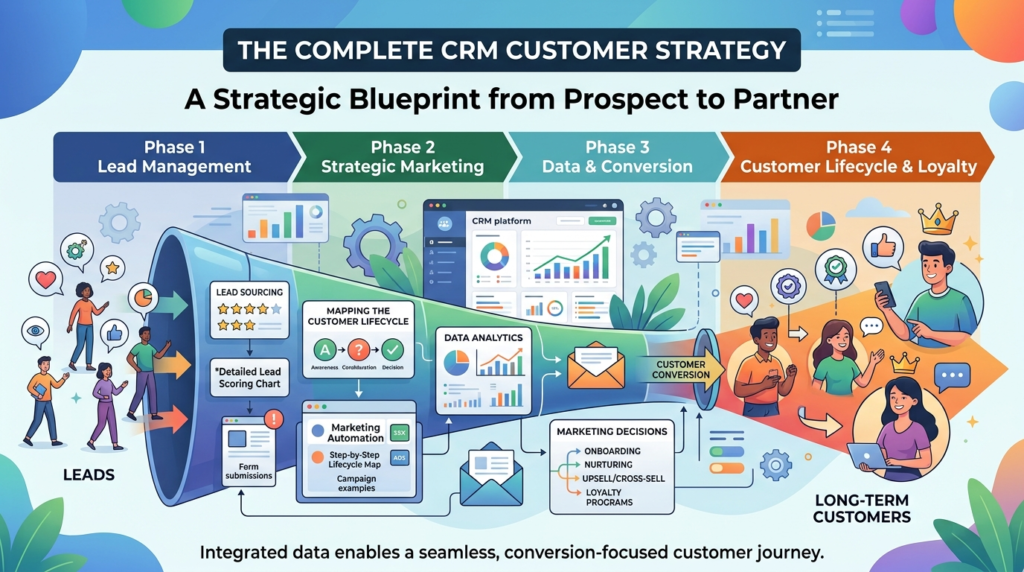
Many businesses buy a CRM, load in their contacts, and assume the hard part is done. What follows is usually a system full of data nobody trusts, a sales team logging activity inconsistently, and a pipeline that looks organized on the surface but reveals nothing useful when someone actually needs an answer about where deals are stalling. A clear strategy for using that system is what separates a business that owns customer relationship management software from a business that actually manages customer relationships, and the difference shows up directly in how consistently leads convert into long-term customers. This article walks through what a real CRM strategy actually involves: mapping the customer lifecycle into meaningful pipeline stages, building a lead scoring approach grounded in real conversion data, and connecting everything back to the marketing decisions that determine which leads even enter the pipeline in the first place.
Why a CRM Strategy Matters Beyond Just Buying Software?
The Difference Between Owning a CRM and Having a Strategy
Owning a CRM means a business has a database where contact records live. Having a clear plan for it means the business has defined exactly what data gets tracked, what each pipeline stage actually represents, who is responsible for updating what, and how the information stored is meant to inform real decisions. The software is the container; the strategy is what determines whether that container holds something genuinely useful or becomes another underused tool the team quietly stops trusting within a few months of implementation.
What Happens Without a Clear Strategy?
A business operating a CRM without a clear plan typically ends up with inconsistent data (different salespeople logging information differently, or not at all), pipeline stages that mean different things to different people, and reporting that looks precise but reflects an inaccurate picture of what is actually happening with leads and customers. This inconsistency compounds over time — a CRM used inconsistently for a year becomes progressively less useful, since decisions based on unreliable data are often worse than decisions made without any data structure at all.
Mapping the Customer Lifecycle
Defining Your Pipeline Stages
A well-defined approach starts with pipeline stages that reflect a business’s actual sales process, not a generic template borrowed from the software’s default setup. Effective stages typically track meaningful shifts in a lead’s status — new lead, qualified, proposal sent, negotiation, closed won or lost — with each stage having a clear, specific definition of what must be true for a lead to sit there, rather than leaving stage assignment to individual salespeople’s subjective judgment.
Aligning Stages With Actual Buyer Behavior
Pipeline stages should reflect how buyers actually move through a decision, not simply how a sales team wants to categorize activity internally. If a business’s actual buyers typically request a demo before ever discussing pricing, the pipeline should reflect that sequence specifically, rather than forcing every lead through a generic stage structure that doesn’t match the business’s real sales dynamics. Reviewing actual closed deals periodically to confirm the pipeline stages still reflect genuine buyer behavior keeps the structure useful rather than letting it drift from reality over time.
Lead Scoring Basics
Assigning Value to Behaviors and Attributes
Lead scoring assigns point values to specific behaviors (visiting a pricing page, opening multiple emails, attending a webinar) and attributes (company size, industry, role) that correlate with a lead’s likelihood of becoming a customer. A well-calibrated scoring model reflects what actually predicts conversion for a specific business, based on reviewing which behaviors and attributes appeared most often among past customers who actually converted, rather than an assumed or generic scoring template that may not reflect that business’s real buyer patterns.
Using Scores to Prioritize Sales Effort
Once a scoring model is in place, it should directly inform how sales effort gets allocated — leads crossing a defined score threshold get prioritized outreach, while lower-scoring leads continue through automated nurturing until they either engage more deeply or clearly indicate they are not a genuine fit. This prioritization prevents a sales team from spending equal time on every lead regardless of actual buying signal strength, concentrating effort where it is statistically most likely to produce results.
Connecting CRM Data to Marketing Decisions
What CRM Data Reveals About Content and Campaigns?
A properly maintained CRM reveals which marketing content and campaigns actually produce leads that convert into customers, not just leads that convert into form submissions. This distinction matters enormously: a campaign generating a high volume of leads that never progress past the pipeline’s early stages is performing far worse than a smaller campaign generating fewer but genuinely qualified leads, and only CRM data connecting the original lead source through to eventual conversion (or lack of it) reveals this difference clearly.
Closing the Loop Between Sales and Marketing
The most valuable CRM strategies close the loop between sales and marketing, feeding information about which leads actually closed (and why, and why others didn’t) back into how marketing plans future campaigns and content. Without this feedback loop, marketing teams often continue investing in channels and content that generate volume without genuine quality, simply because nobody is systematically tracking which sources produce leads that actually become long-term customers versus leads that simply look good in a top-of-funnel report.
Building a Customer Relationship Management Strategy That Survives Growth
Documenting the Strategy So It Outlives Any One Person
A genuine customer relationship management strategy needs to exist as a documented reference, not just an understanding that lives in the head of whoever originally set up the CRM. Writing down pipeline stage definitions, required fields, and scoring criteria in a simple internal document means the strategy survives staff turnover and onboarding new team members becomes a matter of reviewing the document rather than reconstructing tribal knowledge from scratch.
Assigning Clear Ownership for Data Quality
Even a well-designed customer relationship management strategy breaks down if no one is specifically responsible for monitoring data quality over time. Assigning a specific person — often a sales operations role in a larger business, or simply a designated team member in a smaller one — to periodically audit CRM records for consistency and completeness catches small data quality problems before they compound into a system nobody trusts.
Understanding the Full Lead-to-Customer Process
Mapping Every Touchpoint, Not Just the Sale
The lead-to-customer process extends well beyond the moment a deal closes, and a complete CRM strategy tracks the touchpoints that happen both before and after that point — the original marketing channel that generated the lead, every meaningful interaction during the sales conversation, and the onboarding and early retention signals that follow a successful close. Treating the closed sale as the finish line rather than one point in an ongoing relationship misses the retention and expansion opportunities a well-maintained CRM can surface.
Using the Full Process View to Improve Retention
A CRM strategy that captures the complete lead-to-customer process, rather than stopping at the point of sale, gives a business visibility into which early customer behaviors predict long-term retention versus early churn. This visibility allows a business to intervene proactively with customers showing early warning signs, rather than only discovering a retention problem once a customer has already decided to leave.
Frequently Asked Questions
Yes, though it can be simpler at a smaller scale. Even a business with a handful of leads per week benefits from clearly defined pipeline stages and consistent data entry practices, since habits established early are considerably easier to maintain than trying to retrofit structure onto years of inconsistent CRM usage later.
Most effective pipelines use five to seven stages, enough to reflect meaningful shifts in a lead’s status without becoming so granular that maintaining accurate stage assignments becomes burdensome. The right number depends on how complex a business’s actual sales process genuinely is.
Formal lead scoring becomes genuinely valuable once lead volume grows large enough that sales cannot personally review every lead in detail. Smaller businesses with lower lead volume can often prioritize effectively through direct judgment, though even a simple scoring system can help maintain consistency as the team grows.
A quarterly review comparing actual closed deals against the defined pipeline stages and scoring model catches drift before it becomes significant. Buyer behavior and market conditions change over time, and a plan built once and never revisited gradually loses accuracy.
Inconsistent data entry, driven by an unclear strategy for what should be tracked and why, is the most common reason. A business that clearly defines pipeline stages, required data fields, and who is responsible for maintaining them sees considerably more consistent CRM usage than one that simply expects a sales team to figure it out.
Ready to Turn Your CRM Into an Actual Strategy?
A clear plan for CRM usage is what transforms customer data from a maintenance burden into a genuine engine for converting leads into long-term customers. Creative 4 All helps businesses across Lebanon and the GCC build CRM strategies that connect pipeline stages, lead scoring, and marketing decisions into one coherent system. Book a Free Digital Marketing Consultation to see how your current CRM setup could work harder for your business.