
AI automation conversations often stay narrowly focused on a single use case — a chatbot answering customer questions, or an agent following up with sales leads — which understates how much a well-implemented AI agent layer can actually do across an entire business. The same underlying infrastructure that handles a sales follow-up can, with the right configuration, support marketing personalization, customer support triage, and operational scheduling simultaneously. For a business with genuinely distinct sales, marketing, support, and operations functions, understanding this cross-functional potential changes what “AI automation” actually means for the organization. This article walks through concrete use cases for each department, how sharing a single AI agent layer across all of them beats running separate disconnected tools, and a practical way to sequence the rollout without overwhelming the business all at once.
AI Use Cases by Department
Sales: Follow-Up and Lead Qualification
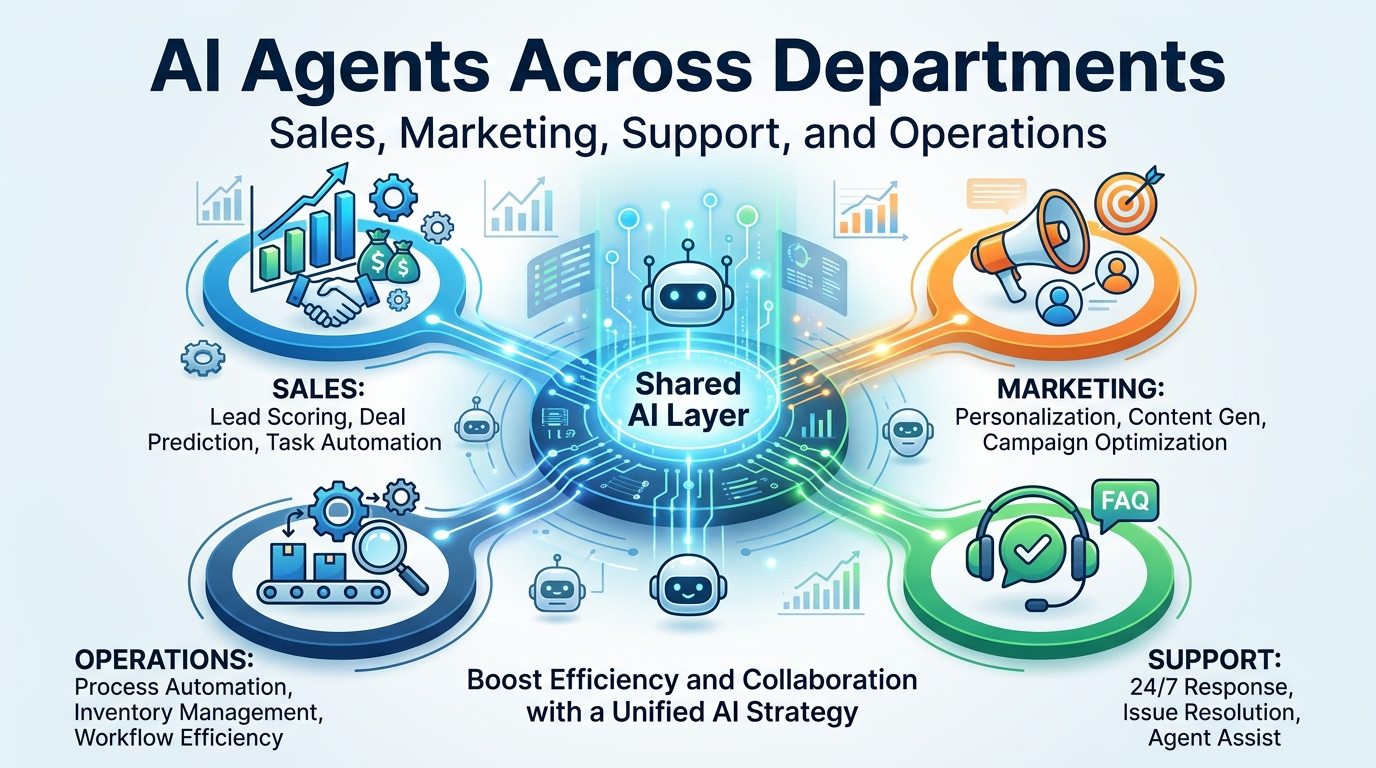
AI for sales teams typically starts with automating the immediate follow-up that happens (or fails to happen) after a lead comes in — an AI agent can send a personalized initial response within minutes, ask qualifying questions to understand a lead’s actual needs, and either schedule a call directly or flag the lead for human follow-up based on how the conversation unfolds. This addresses one of the most common sales failures: a lead going cold simply because the human response time was too slow, not because the lead itself was uninterested.
Marketing: Personalization at Scale
An AI agent supporting marketing can analyze a visitor’s behavior on a website or their engagement history with previous emails to personalize content recommendations, product suggestions, or messaging in real time, at a scale that would be impractical to replicate manually across a large audience. This goes beyond simple rule-based personalization (showing product X because someone viewed category Y) toward genuinely adaptive content selection based on a broader pattern of behavior specific to that individual visitor.
Support: Triage and First-Response
Customer support is one of the clearest cross-functional AI automation wins, since an AI agent can handle first-response triage — answering common questions directly, gathering relevant details before escalating to a human agent, and routing complex issues to the right specialist immediately rather than after a round of manual clarification. This reduces response time for simple questions while actually improving the quality of information a human agent receives when a case does require their attention.
Operations: Scheduling and Resource Coordination
Operations AI applications often go unnoticed compared to customer-facing use cases, but scheduling and resource coordination represent some of the most measurable efficiency gains available. An AI agent can coordinate appointment scheduling across multiple staff calendars, flag resource conflicts before they become a problem, and handle routine coordination tasks (confirming availability, sending reminders, rescheduling around cancellations) that otherwise consume significant administrative time.
Sharing One AI Agent Layer Across Departments
Why a Unified Layer Beats Siloed Tools?
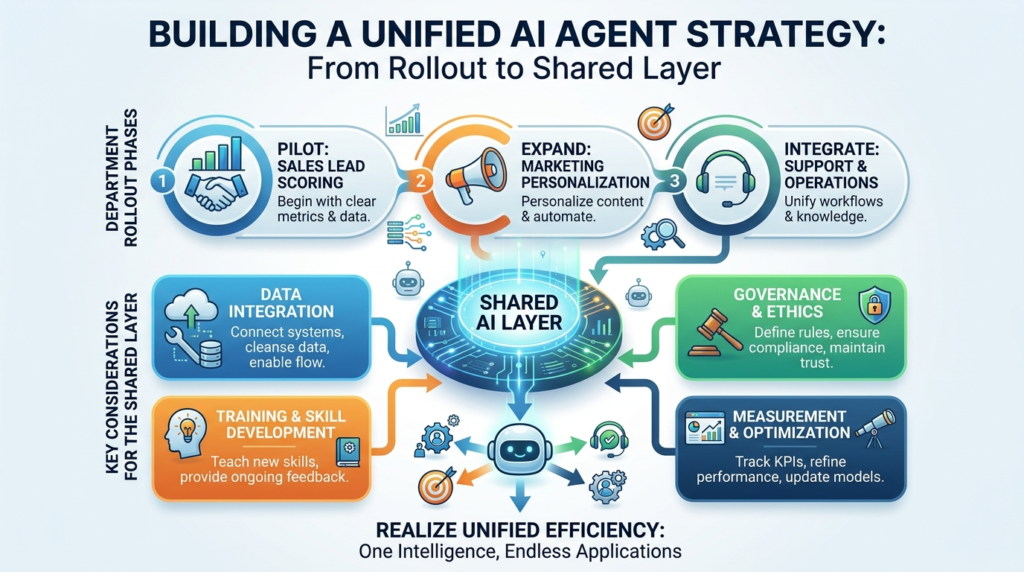
Deploying separate, disconnected AI tools for each department — one vendor for sales, another for support, a third for marketing — creates the same kind of data silos that undermine the value of any disconnected business system. A unified AI agent layer, by contrast, shares customer and operational data across departments automatically: information gathered during a sales conversation informs how marketing personalizes future content, and support interactions feed back into how sales understands a customer’s ongoing relationship with the business.
What Shared Infrastructure Actually Looks Like?
Practically, shared infrastructure means the underlying AI platform, customer data, and core capabilities (natural language understanding, workflow triggers, escalation logic) are built once and configured differently for each department’s specific needs, rather than each department procuring and maintaining an entirely separate system. This approach reduces total implementation and maintenance cost considerably compared to running four or five disconnected departmental tools, while also ensuring a customer’s experience feels coherent across every touchpoint rather than fragmented by which department happens to be interacting with them at a given moment.
Implementation Sequencing Advice
Starting With the Department That Has the Clearest Win
Rather than attempting to implement AI agents across all departments simultaneously, identifying which department has the clearest, most measurable opportunity — often customer support, given how directly response time and first-contact resolution can be measured — provides a focused starting point that proves value quickly and builds organizational confidence before expanding further. This sequencing also surfaces practical lessons about data quality, integration challenges, and team adoption that make subsequent department rollouts considerably smoother.
Expanding Once the First Use Case Proves Value
Once the initial department demonstrates clear results, expanding to additional departments benefits from the infrastructure, data connections, and organizational learning already established during the first implementation. This phased approach, department by department, generally produces better outcomes than a single large simultaneous rollout, since each subsequent department’s implementation can incorporate lessons learned from the ones before it, and the business avoids the risk of a large, complex project failing across every department at once.
Measuring Success Across Each Department
Department-Specific Metrics Worth Tracking
Each department benefits from tracking metrics specific to what AI agents are actually meant to improve there — sales teams should track lead response time and follow-up completion rate, marketing should track engagement and conversion lift from personalized content, support should track first-response time and resolution rate, and operations AI implementations should track scheduling errors avoided and administrative hours saved. Tracking these department-specific outcomes, rather than a single generic “AI performance” metric, reveals exactly where the investment is delivering value and where further tuning is needed.
Comparing Performance Before and After Implementation
A clear before-and-after comparison for each department’s key metrics provides the clearest evidence of whether an AI agent implementation is actually working, rather than relying on subjective impressions of whether things “feel” more efficient. Businesses that skip this measurement step often struggle to justify expanding AI automation to additional departments, since there is no concrete data demonstrating the value the initial implementation actually delivered.
Common Mistakes When Deploying AI for Operations and Beyond
Underestimating Data Quality Requirements
AI for operations and other departmental use cases depends heavily on the quality of the underlying data it draws from — inaccurate scheduling data, incomplete customer records, or inconsistent sales pipeline information all degrade how effectively an AI agent can actually perform its intended function. Businesses that invest in AI automation without first addressing significant data quality problems in their existing systems often find the AI agent inherits and amplifies those existing problems rather than solving them.
Neglecting Change Management With Staff
Even a technically well-implemented AI agent can fail to deliver value if staff in the affected department don’t trust it, understand how to work alongside it, or actively route around it out of habit. Investing time in clear communication about what the AI agent does, what remains a human responsibility, and how staff should escalate edge cases meaningfully improves adoption compared to simply deploying the technology and expecting the team to adapt on their own.
Frequently Asked Questions
Not necessarily separate departments in the organizational sense, but the underlying principle — using shared AI infrastructure across different business functions rather than isolated point solutions — benefits businesses of various sizes. Even a smaller business with staff wearing multiple hats can benefit from a shared AI layer supporting sales, support, and operational tasks simultaneously.
Customer support often shows the fastest measurable return, since response time and resolution rate improvements are straightforward to track and the cost savings from reduced manual triage work are usually immediate and clear.
This varies considerably based on complexity, but a phased approach — one department fully implemented and proven before expanding to the next — typically spans several months across a full rollout, rather than attempting a faster but riskier simultaneous implementation across every function at once.
Yes, and this shared data access is one of the primary advantages of a unified AI agent layer over separate departmental tools, since a customer’s full interaction history becomes available across sales, marketing, support, and operations rather than being trapped in disconnected systems.
Attempting simultaneous implementation across every department significantly increases the risk of a complex, poorly coordinated rollout that fails to deliver value anywhere, compared to a sequenced approach that proves the concept in one area before expanding. Starting focused and expanding based on demonstrated results is generally the safer path.
Ready to Extend AI Automation Across Your Business?
AI agents across business functions deliver the most value when built on shared infrastructure rather than disconnected departmental tools. Creative 4 All helps businesses across Lebanon and the GCC implement cross-functional AI automation, starting with the department offering the clearest win and expanding from there. Book a Free AI Automation Assessment to see which department in your business would benefit most from AI agents first.