
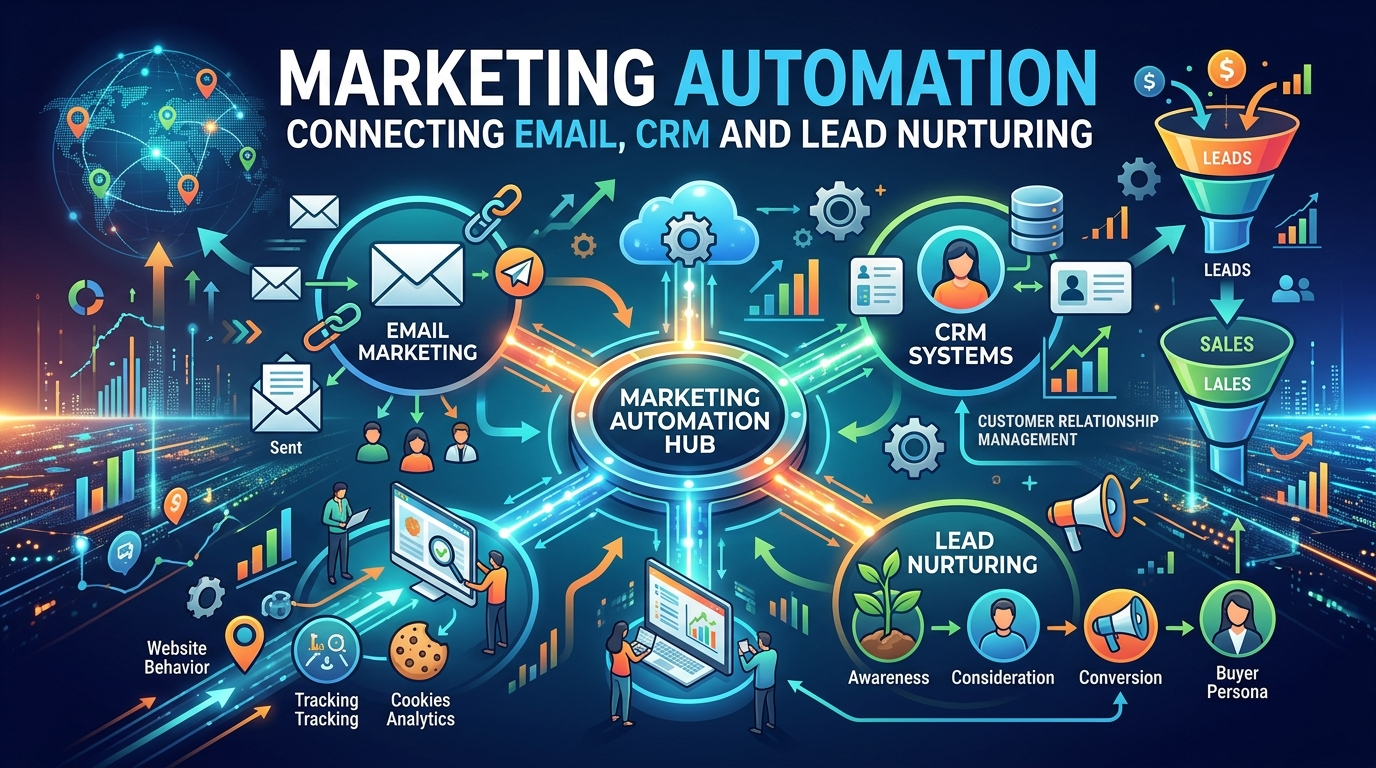
Marketing automation gets treated as a synonym for “scheduled emails” far too often, which undersells what it actually does and leads many businesses to implement only a fraction of its real value. This approach connects email, CRM, and actual website behavior into a single coordinated system, so a lead’s actions — not just a calendar date — determine what they see next. Understanding this fuller picture is the difference between automation that quietly nurtures leads toward a sale and automation that simply sends generic emails on a schedule regardless of whether anyone is actually engaging with them.
What This Approach Actually Automates?
Beyond Just Scheduled Emails
A scheduled email campaign sends the same message to everyone on a list at the same time, regardless of what each recipient has actually done. Real automation platforms go considerably further, triggering specific actions based on specific behavior: a follow-up email sent because someone visited a pricing page, a sales notification triggered because a lead opened three emails in a week, or a different nurture path activated because someone downloaded a specific resource rather than another. The automation is responding to what a person actually does, not simply following a fixed calendar.
The Three Systems That Need to Talk to Each Other
Effective automation depends on three systems working together rather than operating in isolation: the email platform (sending and tracking message engagement), the CRM (storing lead information and sales stage), and the website itself (tracking behavior like page visits, form submissions, and content downloads). When these three systems share data automatically, a lead’s entire journey — from first website visit through email engagement to sales conversation — becomes visible in one place, rather than scattered across disconnected tools that nobody has time to manually cross-reference.
Connecting Email, CRM, and Website Behavior
Lead Scoring: Turning Behavior Into Priority
Lead scoring assigns point values to specific actions a lead takes — visiting a pricing page might be worth more points than reading a blog post, requesting a demo worth considerably more than either — building a cumulative score that reflects how genuinely engaged and sales-ready a specific lead actually is. This scoring, calculated automatically as actions accumulate across email and website behavior, lets a sales team prioritize outreach toward leads showing real buying signals rather than treating every lead in the CRM as equally worth immediate attention.
How Website Actions Trigger CRM Updates?
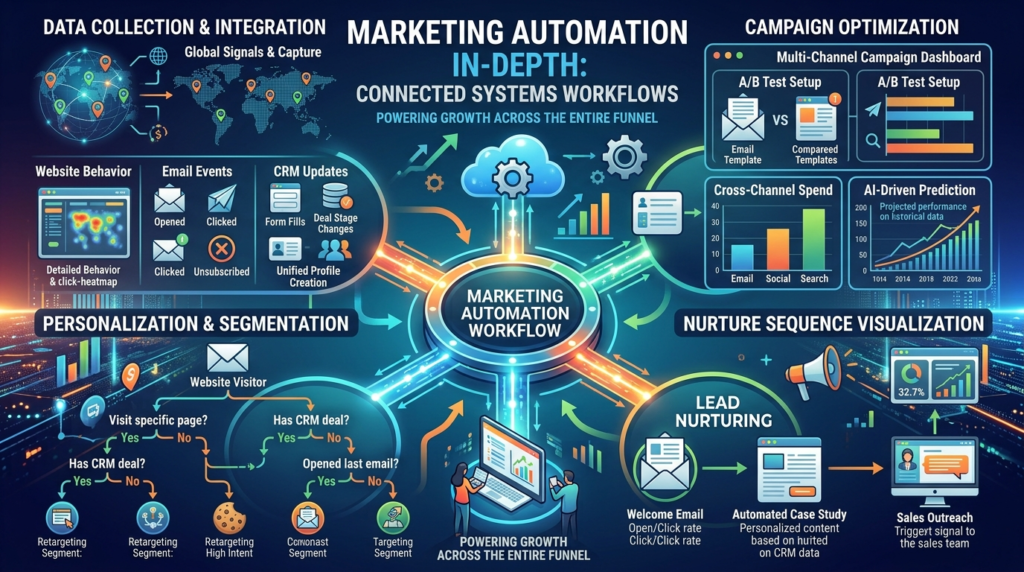
A properly connected system updates CRM records automatically as leads take specific actions on the website — a pricing page visit gets logged, a resource download updates the lead’s stage, a return visit after a period of inactivity flags the lead for renewed attention. This automatic updating means the CRM reflects genuine, current lead behavior rather than only the information captured during an initial form submission, giving sales teams considerably more useful context when reaching out.
Building a Basic Nurture Sequence
Mapping the Sequence to Buyer Stages
An effective nurture sequence maps specific content and messaging to where a lead actually sits in their decision process, rather than sending the same generic content regardless of stage. Early-stage leads (someone who just downloaded a general guide) benefit from educational content building broader awareness of the problem being solved, while later-stage leads (someone who visited pricing pages multiple times) respond better to more direct content — case studies, comparison guides, a direct offer to talk with sales.
A Simple Starter Sequence Example
A workable starting sequence for a business new to this kind of system might look like this: an immediate welcome email after a lead magnet download, a follow-up two days later sharing a relevant case study, a check-in after a week offering to answer questions, and a more direct sales-oriented email after two weeks for leads who have engaged with the previous messages. This sequence does not need to be elaborate to be effective — a simple, well-sequenced set of four or five emails, each triggered by the previous one’s timing rather than sent all at once, consistently outperforms a single generic follow-up email sent to everyone the same way.
Measuring Impact on Conversion Rate
Metrics That Actually Matter
The metrics that genuinely reflect whether this system is working are conversion rate at each stage of the nurture sequence (how many leads move from one stage to the next), email engagement specifically among leads still in an active sequence, and ultimately the percentage of nurtured leads that convert to actual sales conversations or purchases compared to leads who received no structured nurturing at all. Vanity metrics like total emails sent or overall list size say nothing about whether the automation is actually moving leads toward a purchase decision.
When to Refine the Sequence?
A nurture sequence should be reviewed periodically against these conversion metrics, since a sequence performing well when first built can gradually lose effectiveness as the audience, market conditions, or competitive landscape shift. A specific stage in the sequence showing a sharp drop-off in engagement or conversion, compared to the stages before and after it, is usually the clearest signal about exactly where the sequence needs revision, rather than needing to rebuild the entire sequence from scratch.
Choosing the Right Approach to Lead Nurturing Automation
Matching Sequence Complexity to Sales Cycle Length
Lead nurturing automation should reflect how long a business’s typical sales cycle actually runs, rather than following a generic template borrowed from an unrelated industry. A business with a short, simple sales cycle (an impulse or low-consideration purchase) needs a compact sequence focused on quick conversion, while a business selling a considered, higher-value product or service benefits from a longer sequence that builds trust and addresses objections gradually across several weeks or months.
Segmenting Sequences by Lead Source
Not every lead entering a nurture sequence arrived the same way or with the same level of prior context, and treating a lead who downloaded a broad educational guide identically to one who requested a live demo wastes the more specific intent the second lead already demonstrated. Segmenting lead nurturing automation by original source or entry point — a distinct sequence for demo requests versus one for general content downloads — keeps messaging relevant to what each lead actually already knows and wants.
Setting Up Email CRM Integration Correctly
What Data Actually Needs to Flow Between Systems?
A well-configured email CRM integration synchronizes specific, meaningful data points — email opens, clicks, unsubscribes, and which specific nurture sequence a lead is currently in — rather than attempting to sync every possible data field regardless of whether it is actually useful to the sales team reviewing CRM records. Overloading a CRM record with excessive automated data can bury the genuinely useful signals under noise that makes records harder, not easier, to act on quickly.
Common Integration Mistakes to Avoid
A frequent mistake in setting up automated marketing workflows is building overly complex branching logic before validating that a simpler version actually works, resulting in an intricate system that is difficult to troubleshoot when something inevitably breaks. Starting with a straightforward, linear sequence, confirming it performs well, and only then adding conditional branches based on specific behavior produces a more maintainable system than attempting to build maximum sophistication from the very first implementation.
Choosing Marketing Automation Platforms That Fit Your Business
Matching Platform Features to Actual Needs
The marketing automation platforms landscape ranges from simple email-focused tools with light automation features to comprehensive suites handling everything from lead scoring to multi-channel orchestration. A small to mid-sized business is usually better served starting with a platform matched to its current complexity level rather than the most feature-rich option available, since unused advanced features add cost and complexity without corresponding benefit until a business genuinely grows into needing them.
Evaluating Ease of Integration Before Committing
Before committing to a specific platform, confirming that it integrates smoothly with the CRM and website tools a business already uses prevents a common and frustrating scenario: purchasing a capable platform only to discover the integration work required to actually connect it properly costs more time and money than anticipated. Reading integration documentation and, where possible, testing the connection during a trial period before fully committing avoids this costly surprise.
Frequently Asked Questions
No. Most automation platforms are designed to be configured by a single marketer or a small team, and a genuinely effective automated workflow can be built with fairly modest technical resources once the platform is properly connected to a CRM and website tracking.
Email marketing platforms focus specifically on sending and tracking emails. This broader approach extends that by connecting email behavior to CRM data and website activity, allowing automated actions to be triggered by a genuinely broader range of behavior rather than only email opens and clicks.
There is no universal answer, but four to seven emails spread across two to four weeks is a reasonable starting range for most businesses. The right length depends on the typical sales cycle length and how much genuine educational or persuasive content a business has to share at each stage.
Lead scoring assigns point values to specific lead behaviors to identify which leads are most sales-ready. It is genuinely useful once lead volume grows large enough that manually reviewing every lead becomes impractical, though a smaller business with fewer leads can often manage effectively without formal scoring initially.
It can function at a basic level using email platform automation alone, but connecting it to a CRM unlocks considerably more value, since sales teams gain visibility into a lead’s full behavioral history rather than working from CRM records disconnected from actual website and email engagement.
Ready to Connect Your Email, CRM, and Website Into One System?
This system only delivers real value when email, CRM, and website behavior work together rather than as disconnected tools. Creative 4 All builds connected marketing automation systems for businesses across Lebanon and the GCC, from basic nurture sequences to full lead scoring implementations. Request an Email Marketing Audit to see how your current setup could work harder for you.