“Kifak, 3andkon delivery 3a Jounieh? W kam l prix?” Any shop owner in Lebanon will recognise that message instantly: Lebanese Arabic, written in Latin letters with numbers standing in for Arabic sounds, with a French word dropped in the middle. Many chatbots, built and tested on formal Arabic or English, struggle with exactly this kind of message, which is a big problem when it is the most common type your customers send.
An Arabic dialect chatbot is designed for how people in Lebanon and the wider Levant actually write and speak: dialect rather than textbook Arabic, Arabizi as often as Arabic script, and a constant mix of Arabic, French and English. This guide explains why generic bots fail, what it takes to build one that works, how to test it properly and where human staff must stay in the loop.
Why Generic Bots Fail Where an Arabic Dialect Chatbot Succeeds?
Most off-the-shelf bots were designed for one of two scenarios: English conversations, or Arabic written in Modern Standard Arabic (MSA). Lebanese customers rarely write in either. In a single conversation, a customer may type in Lebanese dialect using Arabic script, switch to Arabizi, add an English product name and finish with “merci.”
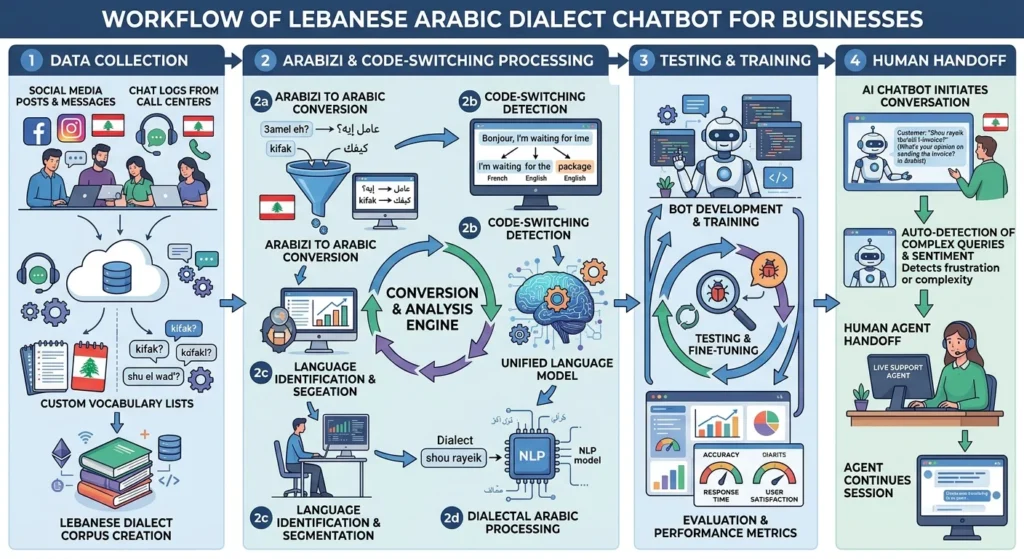
Three features cause most failures. Dialect vocabulary differs sharply from MSA: “shou” for what, “baddi” for I want, “fi” for there is, “hala2” for now. Arabizi, also called Franco-Arabic, uses Latin letters and numbers for Arabic sounds, with no fixed spelling: “kifak,” “kifk” and “keefak” all mean the same thing. And code-switching means words from three languages can appear in one sentence. A bot that only recognises keywords or was built mainly around formal Arabic may misunderstand, answer in the wrong language or simply say “Sorry, I didn’t understand,” which frustrates customers and drives them back to calling.
How Lebanese Customers Actually Write?
Before designing an Arabic dialect chatbot, look at real messages. Export a few hundred anonymised WhatsApp or Instagram conversations and you will usually see the same patterns.
Arabizi Number-Letters
Arabizi replaces Arabic sounds that have no Latin equivalent with numbers that look similar to the Arabic letter. The most common are 2 for the glottal stop (and, in Lebanese speech, the “q” sound often pronounced that way), 3 for ع (ʿayn), 5 for خ, 7 for ح, and 8 or 9 in some spellings for غ and ص. A good Arabizi chatbot must treat “3am” and “am,” or “7elo” and “helo,” as related, and cope with inconsistent spelling.
Mixed Languages in One Message
“Bonjour, baddi reserve table for 4 la bukra” is completely normal. So is a message written fully in English followed by a reply in Arabic script. Customers expect the bot to follow them, ideally answering in the language and register they used.
Voice Notes
Many Lebanese customers prefer voice notes to typing. If your bot runs on WhatsApp, decide early whether it will transcribe and understand voice messages, which adds complexity because speech recognition for Lebanese dialect is less mature than for English or MSA, or whether it will politely ask for a text message or route voice notes to a person.
What Makes an Arabic Dialect Chatbot Work?
Modern large language models (LLMs) understand Arabic dialects and Arabizi far better than the rule-based bots of a few years ago. But the model alone is not enough. A reliable Arabic dialect chatbot combines four elements.
A Capable Language Model, Chosen by Testing
Different AI models handle Lebanese dialect and Arabizi with varying quality, and capabilities change frequently. Choose the model by testing it on your own real messages rather than relying on general benchmarks or marketing claims. Pay attention to whether it understands requests correctly, replies in natural Lebanese-friendly language rather than stiff MSA, and avoids inventing information.
Your Business Knowledge, Not the Model’s Guesses
A model that answers from general knowledge will eventually invent prices, delivery areas or opening hours. The safer approach, often called retrieval-augmented generation, makes the bot answer from your own approved content: price lists, menus, policies, FAQs and product catalogues. Write that knowledge base in clear language and include common dialect and Arabizi phrasings of key questions, so the system can match “fi delivery 3al Metn?” to your delivery policy.
Clear Rules for Language and Tone
Decide how the bot should reply. A common approach for Lebanese businesses is to answer in the customer’s script and language: Arabic script for Arabic-script messages, Arabizi or English for Latin-script messages, French when the customer uses French. Define the brand’s tone too: friendly and informal for a café, more formal for a clinic or law firm. Write a short style guide with examples, and test against it.
Human Handoff
No Lebanese Arabic AI assistant should try to handle everything. Complaints, medical or legal questions, unusual requests, angry customers and anything the bot is not confident about should go to a person, with the conversation history attached so the customer does not have to repeat themselves. Make it easy for customers to ask for a human at any time.
How to Build an Arabic Customer Service Chatbot Step by Step?
If you are planning how to build an Arabic customer service chatbot, the process below avoids the most common mistakes:
- Collect and anonymise real conversations to understand top questions and writing styles.
- Define scope: the five to ten tasks the bot will handle, and what it must hand over.
- Build the knowledge base with approved answers and dialect and Arabizi variations of key questions.
- Test on a held-back set of real messages before any customer sees the bot.
- Launch gradually, monitor conversations weekly and improve answers based on failures.
Most of the effort sits in steps one and two. Businesses that skip them and start by choosing software usually end up with a bot that answers questions nobody asks.
Testing Your Arabic Dialect Chatbot Properly
Testing is where Lebanese projects most often fall short. Testing with neat, formal Arabic sentences written by the project team proves very little. Instead, build a test set of at least a hundred real or realistic messages covering MSA, Lebanese dialect in Arabic script, Arabizi with different spellings, French and English, mixed-language messages, typos, and messages with no punctuation at all.
For each test message, check three things: did the bot understand the intent, was the answer correct according to your knowledge base, and was the language and tone appropriate? Track the share of messages handled correctly and the share handed to a person. Repeat the test whenever you change the model, the knowledge base or the prompt instructions, because improvements in one area can quietly break another.
Arabic Chatbot for Business: Where It Pays Off
An Arabic chatbot for business delivers the most value where the same questions arrive constantly. Restaurants and delivery businesses receive endless questions about menus, delivery areas and timing. Clinics field questions about appointments, locations and preparation instructions. Retailers answer stock, size and price questions all day. Real estate agencies qualify enquiries about areas and budgets. In each case, the bot handles routine questions instantly, day and night, and your team focuses on conversations that need judgment.
Most of these businesses deploy on WhatsApp, where Lebanese customers already are. Our WhatsApp AI chatbot guide covers the setup, and our breakdown of WhatsApp Business API pricing explains the running costs. If you are unsure whether you need a chatbot or something broader, see AI agents vs chatbots vs RPA.
Privacy, Accuracy and Trust
Customers share names, phone numbers, addresses and sometimes health or financial details in chat. Collect only what the bot needs, tell customers they are chatting with an automated assistant, store conversations securely and limit who can access them. Lebanon’s Law No. 81 of 2018 governs personal data processing, and businesses serving Saudi customers must also consider the Kingdom’s Personal Data Protection Law; take advice if you handle sensitive data.
Accuracy is a trust issue too. A bot that confidently gives wrong prices or medical information does more damage than no bot at all. Restrict it to approved knowledge, require handoff for sensitive topics and review conversations regularly. Our article on the ethics and limits of AI automation discusses where automation should stop.
What an Arabic Dialect Chatbot Can and Cannot Do?
Set expectations honestly. A well-built Arabic dialect chatbot can answer routine questions in the customer’s own style, collect order or booking details, check information in connected systems and route complex cases to the right person. It cannot replace genuine expertise, handle every unusual request or guarantee perfect understanding of every spelling and slang term. The goal is not a bot that pretends to be human, but one that resolves most routine conversations quickly and hands the rest over gracefully.
Frequently Asked Questions
Modern AI models understand Lebanese dialect and Arabizi much better than older rule-based bots, but quality varies between models and between businesses. The only reliable way to know is to test candidate models on your own real customer messages before launch.
A common and effective approach is to mirror the customer: reply in Arabic script to Arabic-script messages and in the customer’s Latin-script language otherwise. Define this in a short style guide so replies stay consistent with your brand’s tone.
Start by analysing real anonymised conversations, define a limited scope, build an approved knowledge base that includes dialect and Arabizi variations, test on a set of real messages, then launch gradually with weekly monitoring and clear human handoff.
It can, using speech-to-text, but recognition of Lebanese dialect speech is less reliable than for English or MSA. Many businesses start by asking customers to type or by routing voice notes to staff, then add transcription once text handling works well.
Yes, for routine tasks such as appointments, locations, opening hours and general preparation instructions. Medical, legal or confidential questions should always be handed to qualified staff, and the bot should collect only the personal data it genuinely needs.
Give Your Customers a Bot That Speaks Their Language
Your customers will not change how they write to suit your chatbot. An Arabic dialect chatbot built around real Lebanese messages, approved business knowledge, careful testing and smooth handoff meets them where they are, and turns WhatsApp from a time drain into a reliable service channel.
If you would like to see how a dialect-aware assistant would handle your own customer messages, the Creative 4 All team builds and manages Arabic, Arabizi, French and English chatbots for businesses in Lebanon and the Gulf. Explore our AI chatbot and automation services in Lebanon and book a free consultation or chatbot demo through the form.