In Lebanon, WhatsApp is not just a messaging app; it is the shop counter, the booking line and the customer service desk rolled into one. So when a business outgrows a single phone and starts looking at automation, the first question is always the same: how much will the WhatsApp Business API cost?
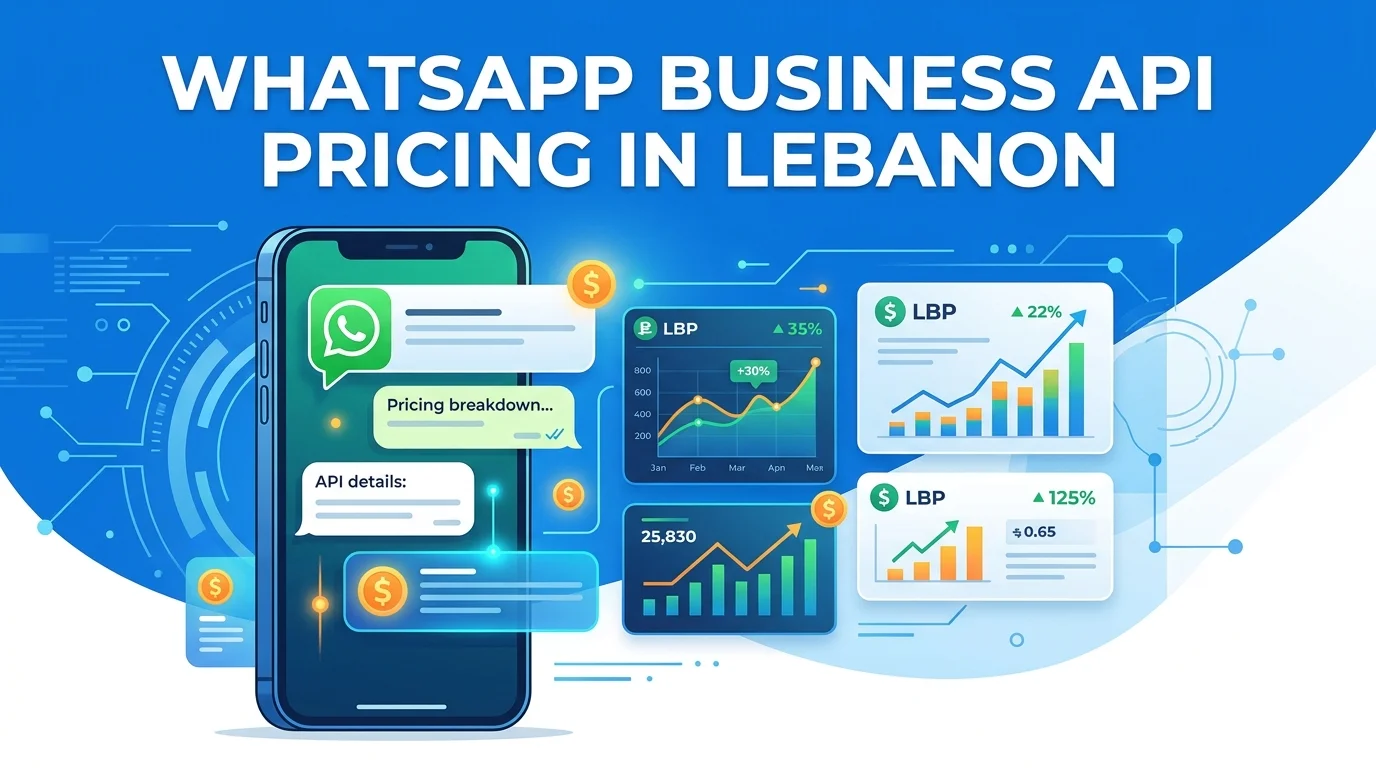
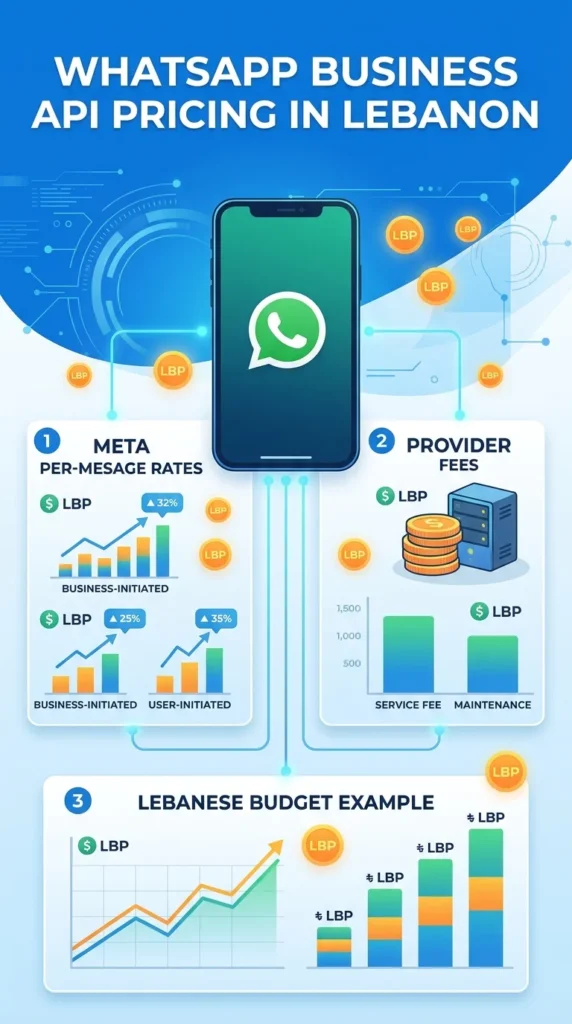
The honest answer is that WhatsApp Business API pricing has three separate layers, and most quotes only show one of them. Meta charges per message, your provider charges for access and tools, and someone has to build and maintain the chatbot or integrations. Meta also changed its pricing again on 1 October 2026, so many guides you will find online are already out of date. This article explains each layer, shows current rates for Lebanon and the Gulf, and walks through a realistic monthly budget.
WhatsApp Business App vs WhatsApp Business API
Before looking at prices, make sure you need the API at all. The free WhatsApp Business app works well for small businesses with one or two people answering messages from a phone. It offers a business profile, quick replies, labels and a catalogue.
The API, officially part of the WhatsApp Business Platform, is designed for businesses that need multiple agents on one number, automated chatbots, integration with a website, CRM or ordering system, or messages sent at scale such as order confirmations and appointment reminders. It has no app of its own; you access it through Meta’s Cloud API directly or, more commonly, through a business solution provider that offers a dashboard and tools. Once you move to the API, you pay for messages, which is where pricing begins.
The Three Layers of WhatsApp Business API Pricing
Think of your total cost in three parts. Ignoring any of them is how budgets go wrong.
- Meta’s message fees: charged per delivered message, by category and by the recipient’s country.
- Provider (BSP) fees: the platform you use to access the API, usually a subscription, a per-message markup or both.
- Build and maintenance: setting up templates, chatbots, integrations and keeping them working.
The first layer is published and predictable. The second varies widely by provider. The third depends entirely on what you want the system to do.
How Meta Charges: Per-Message WhatsApp Business API Pricing
Since 1 July 2025, Meta charges per delivered message rather than per conversation. Every outgoing template message falls into a category, and the rate depends on that category and on the country code of the recipient’s phone number, not on where your business is based.
The Four Message Categories
Marketing messages promote something: offers, new products, abandoned cart reminders, event invitations. They carry the highest rate. Utility messages relate to an existing transaction or request: order confirmations, delivery updates, appointment reminders, invoices. Authentication messages deliver one-time passcodes for login or verification. Service messages are free-form replies your team or chatbot sends when a customer contacts you, within the 24-hour customer service window that opens each time the customer writes.
What Changed on 1 October 2026
Until the end of September 2026, service replies and utility templates sent inside the customer service window were free. From 1 October 2026, Meta’s partners report that replies inside the window are charged at the utility rate after a monthly free allowance of 1,000 service messages per business phone number, and utility templates sent inside the window are charged as well. Marketing rates also rose in several markets, including Saudi Arabia, the UAE and the Rest of Middle East group. Meanwhile, Kuwait, Oman and Iraq were moved out of the Rest of Middle East group to their own rates.
One important exception remains: when a customer starts a chat by clicking a Click-to-WhatsApp ad or a Facebook Page call-to-action, a free entry point window of 72 hours opens, during which messages are not charged. For businesses that advertise on Instagram and Facebook, this can significantly reduce costs.
Current Rates for Lebanon and the Gulf
Lebanon does not have its own rate on Meta’s card; Lebanese numbers are billed at the Rest of Middle East rate. Based on partner-published versions of Meta’s rate card effective 1 October 2026, approximate per-message rates in US dollars are:
| Recipient market | Marketing | Utility, authentication, service |
|---|---|---|
| Lebanon (Rest of Middle East) | about $0.039 | about $0.009 |
| Saudi Arabia | about $0.058 | about $0.011 |
| United Arab Emirates | about $0.058 | about $0.016 |
These WhatsApp Business API pricing figures will change, because Meta usually updates rates at the start of each quarter, and some providers bill in other currencies. Always confirm on Meta’s official pricing page before you finalise a budget. Note that a business in Beirut messaging customers in Riyadh pays the Saudi rate, which matters for Lebanese brands selling into the Gulf.
WhatsApp Conversation Pricing: Why Older Guides Mislead
If you search for WhatsApp conversation pricing, you will still find articles explaining 24-hour conversations charged by category, free service conversations and monthly free tiers of 1,000 conversations. That model applied before July 2025. Since then, billing has been per message, and since October 2026 even replies inside the service window can be charged once the free allowance is used. If a provider’s quote still talks about conversations, ask them to restate it in per-message terms so you can compare it fairly.
WhatsApp BSP Fees: What Providers Charge
A business solution provider (BSP) gives you the tools to use the API: a shared inbox for your team, a chatbot builder, template management, analytics and integrations. WhatsApp BSP fees usually follow one of three models.
Some providers pass Meta’s fee through at cost and add their own small fee per message. Others charge a monthly subscription, often tiered by number of users or features, with Meta’s fees billed separately. A third group bundles everything into a single per-message price, which is simple but makes it hard to see how much is Meta’s fee and how much is the provider’s margin.
When comparing quotes, ask each provider four questions: is Meta’s fee passed through at cost or marked up, what is the monthly platform fee and what does each tier include, are there setup or number-registration fees, and in which currency and by what payment method do they bill? For businesses in Lebanon, that last question can decide the choice, as we explain below.
WhatsApp Chatbot Cost: Build and Maintenance
The third layer is usually the largest at the start. WhatsApp chatbot cost depends on scope rather than on WhatsApp itself. A simple setup with a menu, opening hours, location and a handoff to staff is quick to build. A bot that checks order status in your system, books appointments into a calendar or answers questions from your product catalogue needs integration work. An AI assistant that understands free-text questions in English, Arabic and Arabizi, draws answers from your documents and knows when to hand over to a person requires more design and testing.
Ongoing costs matter too: updating answers and templates, monitoring conversations for failures, adjusting flows after Meta policy changes and, for AI assistants, the cost of the AI model itself. Our guide to AI automation costs explains how to scope and budget these projects, and our WhatsApp AI chatbot guide covers what a good bot should do.
A Worked Budget Example for a Lebanese Business
To see how WhatsApp Business API pricing works in practice, consider a restaurant in Beirut that takes orders on WhatsApp, with all customers on Lebanese numbers. In a typical month it sends 2,000 marketing messages announcing weekly offers, 3,000 utility messages confirming orders and delivery times, and 2,500 service replies to customer questions. Using the approximate Rest of Middle East rates above:
- Marketing: 2,000 × $0.039 ≈ $78
- Utility: 3,000 × $0.009 ≈ $27
- Service: first 1,000 free, then 1,500 × $0.009 ≈ $14
That puts Meta’s fees at roughly $120 per month, before the provider’s subscription or markup and before the one-off cost of building the ordering bot. If many of those customers arrive through Click-to-WhatsApp ads, some messages fall inside the free 72-hour window and the total drops further. If the same restaurant cut its offer broadcasts to opted-in regulars only, it would save on the most expensive category. Our article on AI chatbots for restaurants shows how such a bot can handle orders end to end.
How to Keep WhatsApp API Costs Under Control?
A few habits make the biggest difference to monthly WhatsApp Business API pricing:
- Segment marketing messages and send them only to opted-in customers likely to respond.
- Use Click-to-WhatsApp ads where it fits, to benefit from the free entry point window.
- Resolve questions in fewer messages by designing clear bot flows and rich replies.
- Classify templates correctly, because misclassified marketing content is billed at the marketing rate.
- Review usage monthly in your provider’s dashboard and Meta’s billing reports.
Paying for the WhatsApp API From Lebanon
Practical payment matters as much as price for the WhatsApp API cost in Lebanon. Paying Meta directly usually requires a card that works for international online payments, and since the 2019 financial crisis some Lebanese bank cards have been unreliable for recurring charges. Many Lebanese businesses therefore prefer a provider or agency that bills them in US dollars and handles Meta’s charges on their behalf. Whatever you choose, make sure a failed payment cannot silently stop your messages, especially during busy periods. For the wider payments picture in Lebanon, see our guide to payment gateways in Lebanon.
Frequently Asked Questions
Lebanese numbers are billed at Meta’s Rest of Middle East rate. Under the rate card effective 1 October 2026, partner-published figures put marketing messages at about $0.039 and utility, authentication and service messages at about $0.009 each, before provider fees. Confirm current rates on Meta’s pricing page.
No. The WhatsApp Business app is free, but the API charges per delivered message. Some messages are free, including those inside the 72-hour window after a customer clicks a Click-to-WhatsApp ad and, from October 2026, the first 1,000 service replies per phone number each month.
They are what your business solution provider charges for access to the API and its tools. Providers use monthly subscriptions, per-message markups or bundled prices. Ask whether Meta’s fees are passed through at cost so you can compare offers fairly.
It depends on scope. A simple menu bot with handoff to staff is relatively quick, while bots integrated with ordering, booking or CRM systems, or AI assistants that understand Arabic and Arabizi, require more work. Budget for ongoing maintenance as well as the initial build.
Meta prices by the recipient’s country. Messages to Saudi and UAE numbers have their own, higher rates than the Rest of Middle East group, so Lebanese businesses messaging Gulf customers pay those markets’ rates.
Plan Your WhatsApp Budget With Confidence
WhatsApp Business API pricing looks complicated until you separate it into its three layers: Meta’s per-message fees, your provider’s charges and the cost of building something useful. With current rates, a clear view of the October 2026 changes and a simple monthly estimate, you can decide whether automation pays for itself before committing.
If you would like a precise estimate for your business, a provider comparison or a WhatsApp chatbot built and managed for you, the Creative 4 All team can help in English, Arabic and French. Explore our AI automation and chatbot services in Lebanon .