
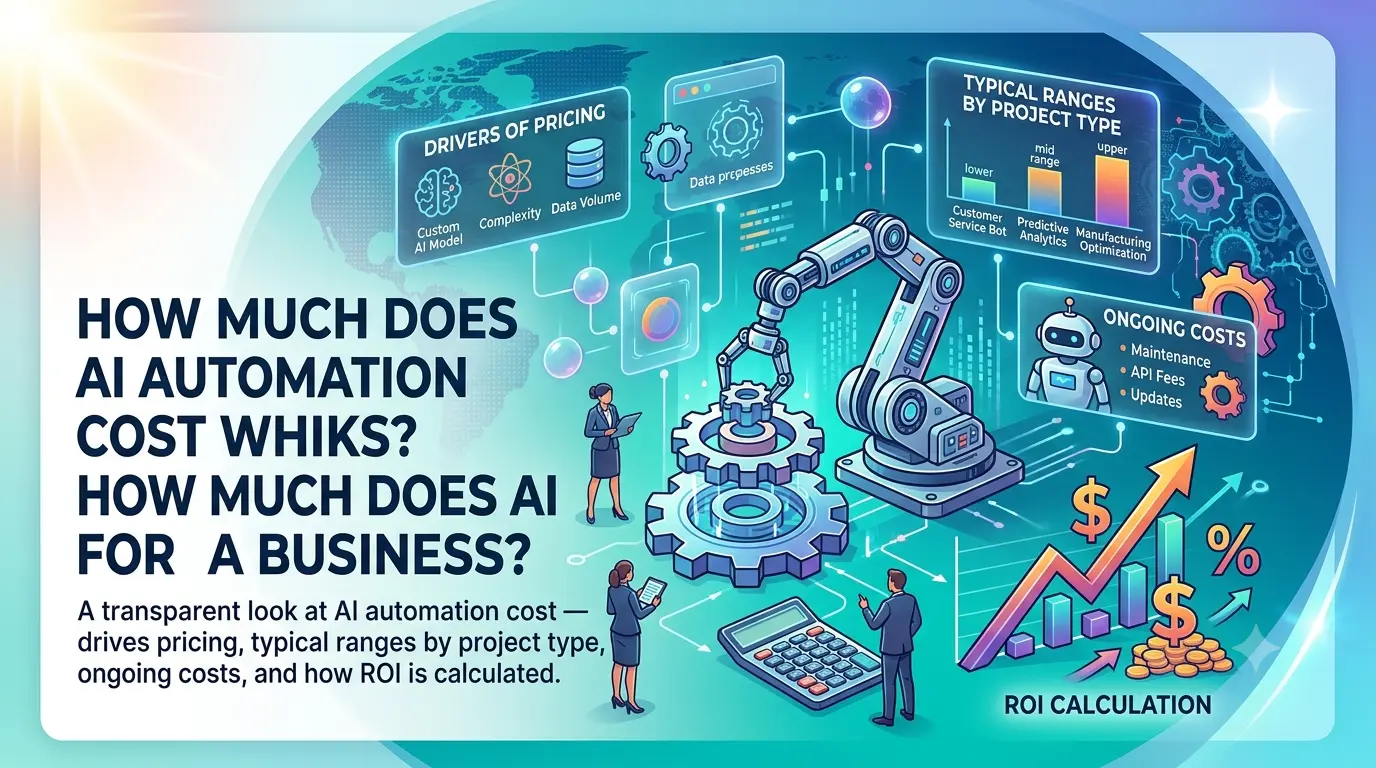
Search anywhere in Lebanon’s digital marketing content for a straight answer on what AI automation actually costs, and the search comes up empty. Agencies talk about chatbots, AI agents, and workflow automation as strategic priorities for 2026, but almost none of them publish anything resembling real pricing, leaving business owners to request a call just to find out whether automation is even in their budget range. AI automation cost is precisely the kind of question a business needs answered before it’s willing to book that call, and the absence of any transparent answer online is itself a sign of how new and unstandardized this pricing landscape still is.
This guide breaks down what actually drives AI automation cost for a small or mid-sized business, typical price ranges by project type described qualitatively, the ongoing costs that continue after initial implementation, and how to actually calculate the return on that investment before committing to it.
What Drives AI Automation Cost?
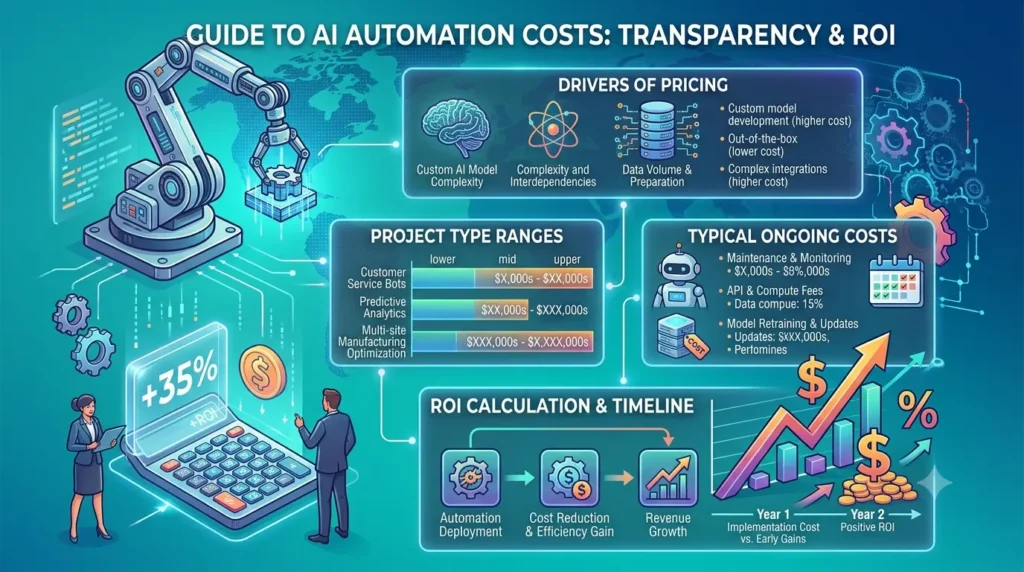
Scope of the Automation
The single biggest factor in AI automation cost is how much of a business process the automation actually needs to cover. A simple chatbot answering a fixed set of common customer questions is a fundamentally smaller project than an AI agent coordinating a multi-step process across several internal systems, even though both get described loosely as “AI automation.” Defining scope precisely before requesting a quote — which specific tasks, which specific decisions, which specific systems are involved — is what turns a vague price range into an accurate one.
Integration Complexity
Automation rarely exists in isolation; it usually needs to connect to a business’s existing tools — a CRM, an inventory system, a booking platform, WhatsApp Business, email, or accounting software. Each additional system an automation needs to integrate with adds real development and testing time, since every integration point is a place where something can break and needs to be handled correctly. A business requesting a quote should expect the number of integrations involved to meaningfully affect the price, and should be direct about every system the automation actually needs to touch rather than discovering additional integration needs partway through the project.
Custom Development vs. Off-the-Shelf Tools
Off-the-shelf automation platforms and chatbot builders offer significantly lower upfront cost and faster deployment, since the underlying technology is already built and simply needs configuration for a specific business. Custom-built automation, developed specifically around a business’s exact workflow, costs considerably more upfront but can handle requirements that no off-the-shelf tool accommodates natively — unusual business logic, specific integrations with internal systems, or automation across a process that doesn’t map cleanly onto any pre-built template. Most small businesses in Lebanon are well-served by off-the-shelf or lightly customized solutions; the jump to fully custom development is generally reserved for businesses with genuinely unusual requirements or those planning to scale the automation significantly over time.
Typical Price Ranges by Project Type
Rather than quoting fixed numbers that quickly become inaccurate or misleading for a specific business’s actual needs, it’s more useful to describe how AI automation investment tends to scale by project complexity. A straightforward chatbot handling FAQ-style questions and basic lead capture, built on an off-the-shelf platform with minimal customization, sits at the lower end of the investment spectrum, with modest ongoing costs. A more capable automation — one integrating with a CRM or booking system, handling several distinct conversation flows, or automating a specific internal process like appointment scheduling — occupies a mid-range investment level, reflecting the additional development, testing, and integration work involved.
A fully custom AI agent, capable of autonomous decision-making across multiple systems and handling genuinely complex, judgment-based tasks, represents the highest investment tier, both in initial development and in the testing and refinement needed before it operates reliably without excessive oversight. None of these tiers are fixed prices — the actual number for any specific business depends on the exact scope, integrations, and complexity involved, which is why a real quote requires a genuine conversation about the specific process being automated rather than a generic package price.
Ongoing Costs After Implementation
Initial development is only part of the total cost picture. Most AI automation tools, whether off-the-shelf or custom-built, carry ongoing costs for the underlying AI model usage, hosting, or platform subscription fees, which scale with how much the automation is actually used rather than remaining fixed regardless of volume. Maintenance is a separate ongoing cost: automations need periodic review and adjustment as a business’s processes evolve, as connected systems change, or as the underlying AI models and platforms themselves are updated by their providers.
Businesses that budget only for initial build cost and don’t account for these ongoing expenses are often surprised months later by a monthly bill they hadn’t planned for, or by an automation that quietly stops working correctly after a connected system changes without anyone updating the automation to match. A realistic AI automation cost estimate always includes both the upfront build and a reasonable ongoing budget for usage and maintenance, not just the initial number.
How ROI Is Actually Calculated?
Calculating return on AI automation investment starts with quantifying what the automation is actually replacing or improving — hours of staff time previously spent on the automated task, the cost of hiring additional staff to handle growing volume without automation, or the value of leads and inquiries that were previously lost due to slow response times that automation eliminates. This requires an honest baseline measurement before implementation, not just an assumption about how much time or money the automation will save.
A useful ROI calculation compares the total cost of automation — initial build plus ongoing usage and maintenance costs over a defined period, typically twelve months — against the quantified value of the time saved, errors reduced, or additional revenue captured over that same period. Automation that looks expensive on a monthly basis can still deliver strong ROI if it’s replacing costs that were significantly higher, such as the fully loaded cost of an additional employee; automation that looks cheap can still deliver poor ROI if it’s solving a problem that wasn’t actually costing the business much in the first place. This is precisely why scoping the actual business problem before requesting a quote matters as much for evaluating ROI as it does for getting an accurate price.
AI Automation Cost vs. Hiring Additional Staff
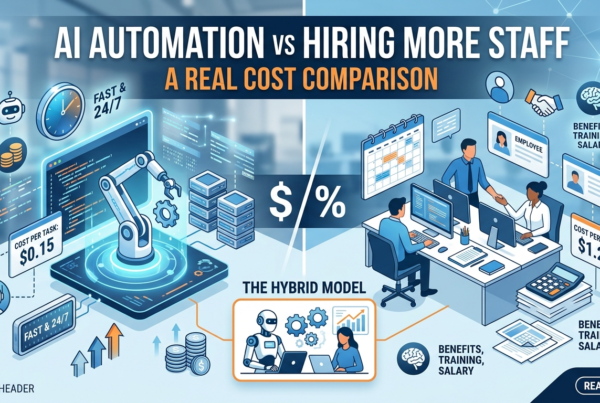
One of the most useful ways to contextualize AI automation cost is comparing it directly against the alternative most businesses default to when a process becomes too much to handle manually: hiring another person. The fully loaded cost of an additional employee — salary, benefits, training time, management overhead — is often meaningfully higher than the ongoing cost of an automation handling the same repetitive task, particularly once that automation is built and running reliably. This doesn’t mean automation always wins that comparison; a role requiring genuine judgment, relationship management, or flexibility that current automation can’t replicate is still better filled by a person. But for genuinely repetitive, rules-based tasks, comparing automation cost against the realistic cost of hiring gives a far more grounded sense of whether the investment makes financial sense than looking at automation cost in isolation.
Red Flags of Underpriced or Overpromised Automation
Because AI automation is a newer service category without standardized pricing, it’s worth being direct about warning signs. A vendor quoting an unusually low price for what sounds like complex, autonomous functionality is often either underscoping the actual work involved or planning to deliver a much simpler rules-based system dressed up in AI terminology. A vendor unwilling to explain, in specific terms, which systems the automation integrates with, how it handles edge cases outside its expected scope, or what ongoing costs to expect, is a signal worth treating with real caution regardless of how attractive the initial price looks. Getting a clear, itemized breakdown of build cost, integration cost, and ongoing usage cost before committing protects against the common pattern of a low initial quote followed by unexpected costs once the project is already underway.
Frequently Asked Questions
It depends entirely on scope — a simple chatbot requires a much smaller investment than a custom AI agent integrated across multiple systems. A scoped conversation about the specific process being automated gives a far more accurate answer than any general figure.
Most small businesses are well-served by off-the-shelf or lightly customized tools, which cost considerably less and deploy faster. Custom development becomes worthwhile specifically when a business has requirements — unusual workflows, complex integrations, or plans for significant scale — that off-the-shelf tools can’t accommodate.
Usage-based fees for the underlying AI model or platform, hosting costs where applicable, and periodic maintenance as connected systems or business processes change are the standard ongoing costs, separate from the initial build.
This varies by project, but most businesses can begin measuring meaningful ROI within a few months of implementation, once enough usage data accumulates to compare actual time and cost savings against the total investment.
Yes, and this is often the recommended approach. Starting with a well-scoped, smaller automation — handling one specific task well — lets a business validate real ROI before expanding into more complex, higher-investment automation across additional processes.
Ready to Find Out What Automation Would Actually Cost Your Business?
Getting an accurate answer to what AI automation cost would look like for your business requires a real conversation about your specific processes, systems, and goals, not a generic package price. Book a free AI automation assessment with Creative 4 All and get a clear, scoped estimate based on what your business actually needs.