
Launching an online store in Lebanon comes with an extra layer of complexity that most global platform comparisons never address: payment gateway availability, shipping logistics across a smaller domestic market alongside international shipments, and a customer base that includes both local buyers and a significant Lebanese diaspora across the GCC, Europe, and North America. A generic ecommerce platform comparison written for a US or European audience can point a Lebanese seller in the wrong direction entirely, since the constraints that matter most here — which payment processors actually work, how shipping integrations handle regional carriers, how currency and pricing display to different audiences — barely register in that global content.
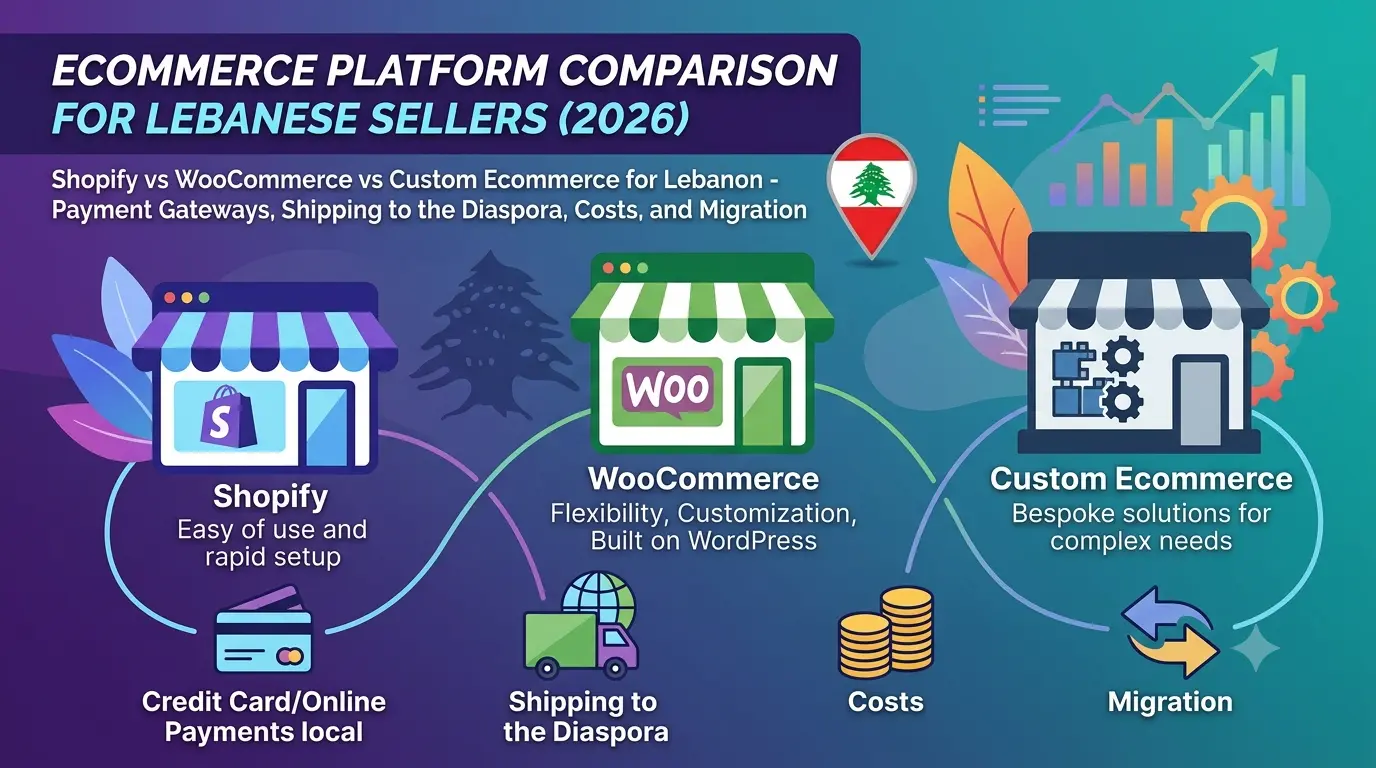
This guide runs through an ecommerce platform comparison of Shopify, WooCommerce, and custom ecommerce development specifically through the lens of cost, flexibility, and local payment and shipping compatibility, then covers what matters specifically for Lebanese and MENA-diaspora sellers, and what to consider before migrating between platforms.
Comparing Shopify, WooCommerce, and Custom Ecommerce
Shopify
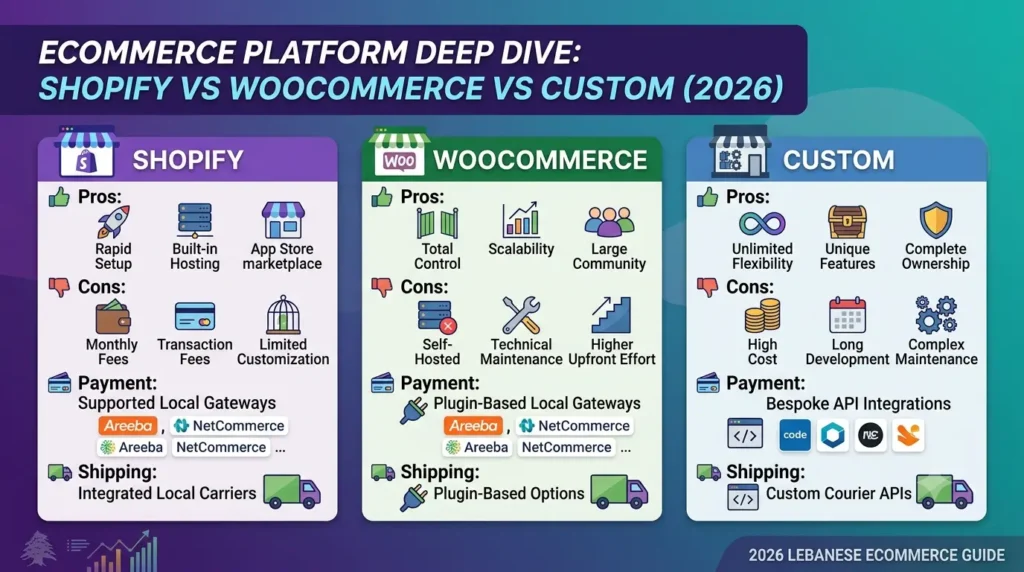
Shopify remains the fastest path to a functional, professional-looking online store, with checkout, inventory management, and basic shipping calculation largely pre-built and requiring minimal technical setup. Its monthly subscription plus transaction fees represent a predictable, if recurring, cost structure that scales with the business rather than requiring a large upfront investment. The tradeoff for Lebanese sellers specifically is that Shopify’s payment gateway ecosystem is built primarily around processors with strong Western market presence, which means confirming gateway compatibility with Lebanese merchant accounts needs to happen before committing to the platform, not after building the store.
WooCommerce
WooCommerce, built on top of WordPress, offers substantially more flexibility than Shopify at a lower direct platform cost, since it’s open-source software rather than a subscription service — though hosting, a properly configured server, and any premium plugins still carry real costs. This flexibility extends directly to payment gateway integration: WooCommerce’s plugin ecosystem makes it considerably easier to integrate with regional and local payment processors that aren’t natively supported by more rigid platforms, which matters directly for Lebanese merchants working with banks or processors that international platforms don’t prioritize. The tradeoff is that WooCommerce requires more hands-on management — updates, security, and configuration — than a fully hosted platform like Shopify.
Custom Ecommerce Development
A fully custom ecommerce build removes platform constraints entirely, allowing integration with any payment gateway, shipping carrier, or business system a seller actually needs, regardless of whether a pre-built platform supports it natively. This makes custom development the strongest option for sellers with complex, non-standard requirements — multi-currency pricing tailored to specific markets, integration with in-house inventory or accounting systems, or unusual shipping logic spanning both local Lebanese delivery and international shipments to diaspora customers. The tradeoff is cost and timeline: custom development requires a meaningfully larger upfront investment and longer build time than either Shopify or WooCommerce, making it the right fit primarily for sellers who’ve already validated their model and know precisely what they need.
What Matters Specifically for Lebanese and MENA-Diaspora Sellers?
Payment Gateway Compatibility
This is the single most consequential factor in any ecommerce platform comparison for a Lebanese business, and it deserves attention before any other platform decision. Not every payment processor supports Lebanese merchant accounts cleanly, and the gateways that do work reliably here don’t always integrate natively with every ecommerce platform. Confirming which specific payment gateway a business will use, and then checking that gateway’s actual compatibility with each platform under consideration, should happen at the very start of the platform selection process rather than as an afterthought once development is already underway. This single step alone eliminates entire platform options before any other comparison factor even needs to be weighed, which is why it deserves to come first rather than last in the decision process.
Shipping and Logistics Integration
Shipping logic for a Lebanese ecommerce business typically needs to handle two genuinely different scenarios: local delivery within Lebanon, often coordinated with local courier services, and international shipping to diaspora customers across the GCC, Europe, and North America, which involves different carriers, customs considerations, and cost structures entirely. A platform’s shipping integration capabilities should be evaluated against both scenarios specifically, since a platform that handles one well doesn’t automatically handle the other — WooCommerce’s plugin flexibility often makes it easier to integrate multiple, specifically chosen shipping solutions for each scenario, while Shopify’s shipping ecosystem tends to favor carriers with stronger presence in Western markets.
Currency and Diaspora Pricing
Selling to both a local Lebanese audience and a diaspora audience often means displaying pricing differently depending on the visitor — USD pricing for an international audience, potentially different currency handling for the local market, and clear communication about which currency a given price actually reflects. This is a meaningfully more complex requirement than most global ecommerce guides address, since businesses in more currency-stable markets rarely need to think carefully about this kind of dual-audience pricing display.
Cost Comparison Beyond the Sticker Price
Any honest ecommerce platform comparison needs to look past the initial subscription or development cost to how fees accumulate as a store actually grows. Shopify’s transaction fees, layered on top of its monthly subscription, compound with sales volume in a way that can make a high-revenue store’s total platform cost climb well beyond what the monthly fee alone suggests, particularly once payment processing fees are added on top. WooCommerce avoids Shopify’s per-transaction platform fee structure, though payment processor fees still apply regardless of platform, and premium plugins needed to replicate certain built-in Shopify features add their own costs over time.
Custom ecommerce development inverts this pattern entirely: higher upfront cost, but no recurring platform fee or transaction cut beyond whatever the chosen payment processor charges. For a Lebanese seller doing meaningful transaction volume, particularly one serving diaspora customers at higher average order values, this difference in fee structure can matter more over a two-to-three-year horizon than the platform’s initial price tag suggests. Running the numbers on projected transaction volume against each platform’s actual fee structure, rather than comparing only the advertised monthly cost, gives a far more accurate picture of which option is genuinely most affordable at the seller’s actual scale.
A Simple Decision Framework for Lebanese Sellers
Rather than treating this as an abstract debate, it helps to work through a short sequence of questions specific to how the business actually sells. If the priority is launching quickly with minimal technical overhead and the confirmed payment gateway works reliably with Shopify, it’s usually the fastest path to a functioning store. If payment gateway flexibility or specific regional integrations matter more than speed of launch, and the business has access to even modest development support, WooCommerce typically offers the better fit. If the business has already validated its model, sells at meaningful volume to both local and diaspora customers, and needs shipping or currency logic that neither platform handles well out of the box, custom development becomes worth its higher upfront cost.
This ecommerce platform comparison ultimately comes down to matching the platform to the seller’s actual payment, shipping, and audience complexity rather than defaulting to whichever platform is most talked about in generic global content that was never written with a Lebanese seller’s constraints in mind.
Migration Considerations
Whichever platform a business starts on, it’s worth understanding upfront how difficult a future migration would be, since ecommerce businesses in particular tend to outgrow an initial platform choice as they scale. Moving from Shopify to WooCommerce, or vice versa, generally involves exporting product data, customer records, and order history, which is reasonably well-documented for standard stores but becomes more involved for stores with significant custom functionality layered on top of the base platform.
Migrating either platform to a custom-built solution is more involved still, since a custom system doesn’t have a standardized import process the way migrating between two established platforms does — this makes thorough documentation of the original store’s configuration, integrations, and customizations essential groundwork before any migration begins, regardless of which direction it’s headed. Businesses anticipating significant growth or a shift toward more complex, non-standard requirements are often better served planning for that eventual migration from the start, rather than building deeply into a platform’s specific ecosystem only to discover its limitations once outgrowing it becomes urgent rather than planned.
Frequently Asked Questions
WooCommerce typically has the lowest direct platform cost since it’s open-source, though hosting and development costs still apply. Shopify’s predictable monthly cost can be worth the tradeoff for sellers prioritizing speed and simplicity over the lowest possible cost.
Support varies and needs to be confirmed for the specific payment processor a business intends to use, since Shopify’s payment ecosystem is built primarily around gateways with strong presence in Western markets. Checking this compatibility before committing to Shopify is essential rather than optional for Lebanese sellers.
Generally yes, since WooCommerce requires managing hosting, updates, security, and plugin compatibility directly, while Shopify handles much of this as a fully hosted platform. The tradeoff is that WooCommerce’s flexibility, particularly around payment gateway integration, often benefits Lebanese sellers enough to justify the added management overhead.
When a business has requirements neither platform handles well natively — complex multi-currency logic, integration with existing internal systems, or highly specific shipping workflows spanning local and international markets — custom development becomes the more reliable long-term option despite the higher upfront cost.
This requires deliberate planning around currency display, payment gateway options that work for both audiences, and shipping logic that handles local delivery and international shipping as genuinely separate workflows rather than a single generic shipping setting.
Ready to Choose the Right Ecommerce Platform for Your Business?
Choosing between Shopify, WooCommerce, and custom ecommerce development — the core of any ecommerce platform comparison for a Lebanese business — should be based on your specific payment, shipping, and audience needs, not a generic global recommendation. Request an ecommerce consultation with Creative 4 All and get a platform recommendation built around how you actually sell to Lebanese and diaspora customers.