

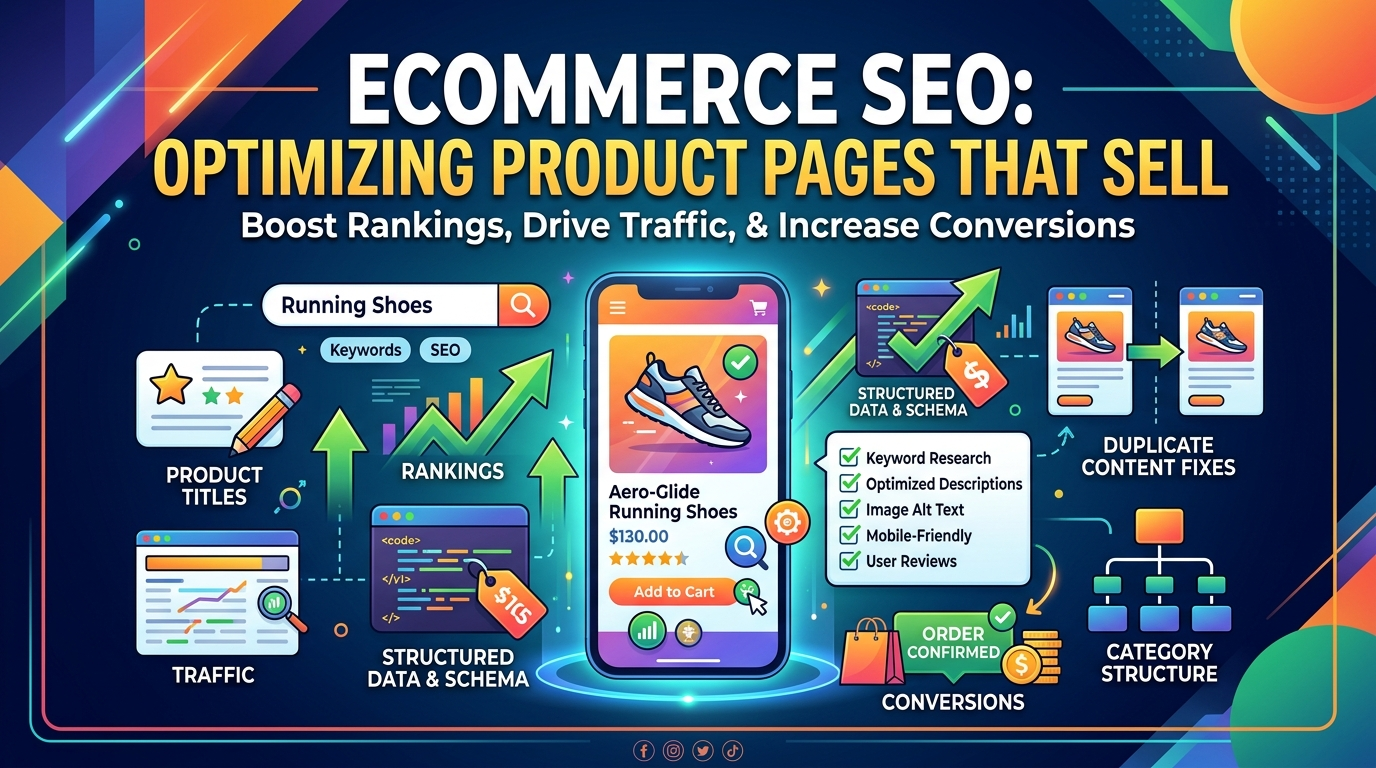
Most ecommerce stores treat product pages as an afterthought. The homepage gets a redesign, the blog gets a content calendar, and the product pages — the pages actually responsible for revenue — are left running on whatever the platform generated by default. That is a costly mistake, because product pages are where search intent, commercial intent, and conversion intent all meet at once. A shopper searching for a specific product is closer to a purchase decision than almost anyone else on your site, and if that page cannot rank or cannot convert once it does, the rest of the SEO strategy is working against a leak that never gets patched.
Ecommerce SEO is not the same discipline as SEO for a service business or a blog. It has to deal with thousands of near-identical pages, product variants that create duplicate content by design, category structures that can either help or actively sabotage crawl efficiency, and a constant tension between what search engines want to see and what shoppers respond to visually. This article walks through how to approach product page optimization properly: the on-page fundamentals, how to handle duplicate and thin content at scale, how category architecture supports (or undermines) everything below it, and how to keep the page focused on selling while still satisfying the technical requirements of online store SEO.
Why Product Pages Are the Most Overlooked Asset in Ecommerce SEO Strategy?
The Gap Between Traffic Strategy and Revenue Pages
Many ecommerce teams invest heavily in blog content, backlinks, and paid campaigns while leaving product pages untouched since launch. This creates a strange imbalance: informational content ranks and drives traffic, but the pages that actually generate revenue are thin, duplicated across variants, or missing the structured data that would help them appear as rich results. Traffic without conversion-ready landing pages is a wasted investment. Product pages deserve the same strategic attention as any pillar content piece, because in commercial and transactional search, they are the pillar content.
What Makes a Product Page “SEO-Ready”?
From an ecommerce SEO standpoint, a product page is SEO-ready when it satisfies three separate audiences at once: the search engine crawler trying to understand what the page is about, the search engine’s ranking systems trying to judge whether the page deserves to rank for a commercial query, and the human shopper trying to decide whether to buy. Getting all three right requires more than filling in a title field — it requires deliberate content, structured data, and page architecture decisions made with search intent in mind from the start.
Product Page SEO Fundamentals: Titles, Descriptions, and Schema
Writing Product Titles That Rank and Convert
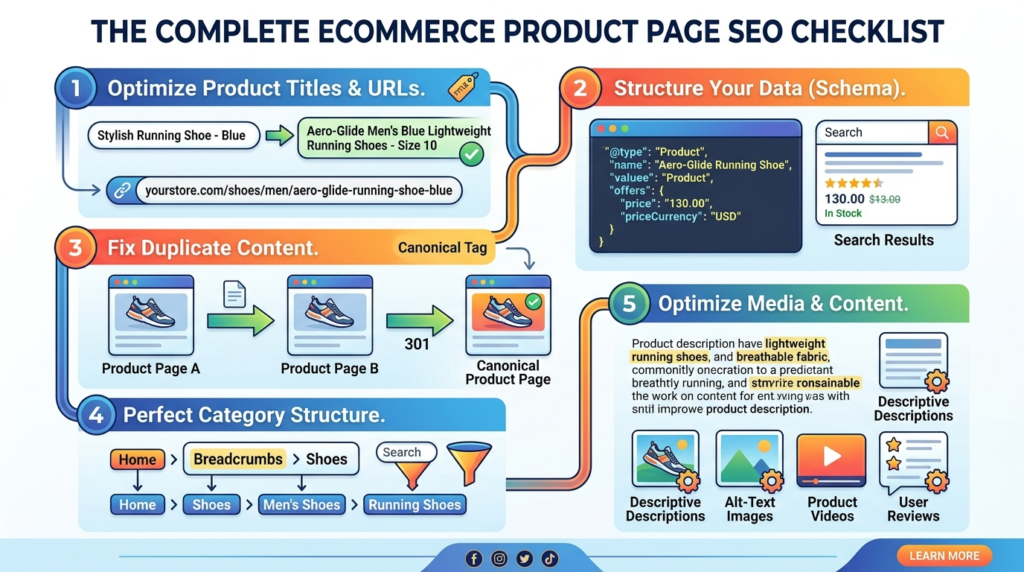
The product title (both the on-page H1 and the HTML title tag, which should usually differ slightly) is the single highest-leverage element on the page. It needs to contain the primary product keyword in a natural position, ideally near the beginning, while still reading like something a person would actually search for or click on in a results page. A title like “Item 4521-B” tells search engines and shoppers nothing. A title built around brand, product type, key attribute, and use case — for example, a specific material, size range, or intended audience — gives both the algorithm and the shopper enough context to make a decision. Avoid keyword stuffing in titles; one well-placed instance of the primary keyword outperforms three repetitions that make the title unreadable.
Crafting Meta Descriptions That Earn the Click
Meta descriptions do not directly influence rankings, but they directly influence click-through rate, which is one of the strongest behavioral signals available to search engines over time. For product pages, the meta description should answer the implicit question a shopper has when they see the result: why this product, and why this store. Mentioning price range, a key differentiator, and a subtle trust signal (fast delivery, warranty, local stock availability) within the roughly 155–160 character limit tends to outperform a generic restatement of the product name.
Implementing Product Schema Markup Correctly
Structured data is where most ecommerce sites lose easy wins. Product schema, correctly implemented, allows a product page to display price, availability, and review ratings directly in the search results — real estate that a competitor without schema simply cannot claim, regardless of how well their page is written. The schema should include the Offer sub-type with accurate, dynamically updated price and availability values, and the AggregateRating sub-type only when genuine reviews exist; fabricated or static ratings on out-of-date schema are a policy violation that can trigger manual actions. Schema should be validated after every platform update, since ecommerce platforms frequently push theme or plugin changes that silently break structured data without any visible symptom on the front end.
Solving Duplicate and Thin Content at Scale
Why Ecommerce Sites Struggle With Duplicate Content?
Duplicate content is one of the most persistent ecommerce SEO problems, and it is close to unavoidable in ecommerce by default. Product variants (different colors, sizes, or bundle configurations) frequently generate separate URLs with nearly identical content. Manufacturer-supplied descriptions get pasted directly onto product pages, meaning the exact same paragraph might appear on hundreds of competing stores. Filter and sort parameters can generate an almost unlimited number of URL combinations for what is functionally the same page. None of this is a sign of a poorly run store — it is simply what happens when a catalog scales — but left unmanaged, it dilutes ranking signals across near-duplicate URLs and wastes crawl budget that should be spent on pages that matter.
Practical Fixes for Product Variants and Syndicated Descriptions
The fix depends on the type of duplication. For product variants, canonical tags should point secondary variant URLs to a primary version, or the variants should be consolidated into a single URL with in-page selectors, depending on how the platform and the audience behave. For manufacturer-supplied descriptions, the practical solution at scale is not to hand-rewrite every single product page — that is rarely feasible for a catalog of any real size — but to prioritize rewriting for the highest-traffic and highest-margin products first, and to build unique supporting content (buying guides, comparison sections, FAQ blocks) around lower-priority products so the page has genuinely unique text even if the core description is shared. Parameter-driven duplicate URLs from filters and sorting should generally be excluded from indexing through robots directives or parameter handling rather than left to accumulate silently.
Category Page Architecture That Supports Product Pages
Building a Logical Category Hierarchy
Product pages do not rank in isolation; they rank as part of a category structure that either reinforces their relevance or dilutes it. A shallow, logical hierarchy — homepage to top-level category to subcategory to product — gives search engines a clear signal of how products relate to one another and passes authority efficiently down to individual product pages through internal linking. Overly deep hierarchies bury products several clicks from the homepage, which both weakens the authority they receive and makes them harder for shoppers to discover through browsing rather than search.
Faceted Navigation Without Crawl Budget Waste
Faceted navigation — filtering by size, color, price range, brand, and similar attributes — is essential for usability on any catalog beyond a small handful of products, but it is also the single most common cause of crawl budget waste on ecommerce sites. Every combination of filters can generate a technically unique URL, and without careful handling, a store with a few hundred real products can generate hundreds of thousands of crawlable filter combinations. The solution is selective indexation: allow indexing for filter combinations that represent genuine search demand (a specific brand plus category, for instance), and block indexing for combinations that are unlikely to ever be searched for directly, using a combination of canonical tags, robots directives, and internal link discipline so crawlers are not routed toward low-value URLs in the first place.
Balancing SEO With Conversion-Focused Design
Above-the-Fold Priorities for Search and Sales
The content that appears above the fold on a product page has to do double duty: it needs to contain the signals search engines look for (a clear H1, the primary keyword in context, structured pricing and availability) while also answering the shopper’s immediate questions (what is this, how much does it cost, is it in stock, can I trust this store). These goals are not actually in tension when the page is planned correctly — a well-written H1 and opening paragraph can satisfy both audiences simultaneously, and the mistake most stores make is treating SEO copy and conversion copy as two separate things to be layered on top of each other rather than one unified piece of writing.
Trust Signals That Support Both Rankings and Revenue
Trust signals — genuine customer reviews, clear return and shipping policies, security badges, and specific rather than vague guarantees — do more than reassure a hesitant shopper. Reviews in particular feed directly into schema markup and give search engines fresh, unique, user-generated content on a page type that otherwise struggles with thin or duplicated text. A product page with a healthy volume of genuine reviews is, in effect, generating its own unique content over time without any additional writing effort, which is one of the most sustainable long-term advantages an ecommerce SEO strategy can build.
Measuring Whether Your Ecommerce SEO Strategy Is Actually Working
The Metrics That Matter on Product and Category Pages
Traffic alone is a misleading measure of ecommerce SEO success. A product page can receive steady organic sessions and still underperform if the visitors arriving are not converting, or if they are landing on the wrong variant of a page and bouncing before they find the option they wanted. The metrics worth tracking at the page level are organic sessions segmented by product and category template, add-to-cart rate from organic traffic specifically, indexation status for the URLs that matter most, and click-through rate from search results — which, as covered above, is heavily influenced by whether schema markup is displaying correctly. Reviewing these together, rather than in isolation, is what separates a real ecommerce keyword strategy from simply chasing rankings for their own sake.
Building a Recurring Audit Cadence
Because ecommerce catalogs change constantly — new products launch, old ones go out of stock, prices shift, and platforms push updates — a one-time optimization pass on product pages does not hold up for long. A recurring audit cadence, ideally monthly for high-priority categories and quarterly for the full catalog, catches schema errors, broken canonical tags, newly created duplicate content, and category pages that have drifted out of their intended hierarchy before those issues have time to erode rankings. Treating ecommerce SEO as an ongoing discipline rather than a launch-day checklist is ultimately what determines whether product pages keep performing as the catalog scales.
Frequently Asked Questions
Ideally yes, but for large catalogs this is rarely realistic in the short term. Prioritize hand-written, keyword-optimized descriptions for high-traffic and high-margin products first, then work through the remaining catalog over time while using canonical tags and supporting content to manage duplication in the meantime.
Product schema does not directly boost ranking position on its own, but it strongly influences click-through rate by enabling rich results with price, availability, and star ratings. Higher click-through rate is itself a signal search engines factor into long-term performance, so the effect on visibility is real even though it is indirect.
Keep the page live rather than deleting it if the product may return to stock, update the schema availability field accurately, and offer alternatives or a restock notification option on the page. Deleting product pages that have accumulated backlinks and ranking history wastes SEO equity that took time to build.
Allowing faceted navigation to generate unlimited indexable URL combinations. This spreads crawl budget across low-value pages and can dilute the ranking strength of the category pages that actually matter.
After every theme update, plugin update, or platform migration, and on a routine quarterly basis otherwise. Structured data errors frequently occur silently, with no visible change on the front end of the page, so periodic validation using structured data testing tools is necessary rather than optional.
Ready to Turn Your Product Pages Into Revenue Drivers?
Product pages that rank without converting, or convert without ranking, are both leaving money on the table. Creative 4 All’s ecommerce SEO team audits online stores across Lebanon and the GCC to identify exactly where product and category pages are losing search visibility, crawl budget, or conversion rate — and builds a prioritized product page optimization plan to fix it. Get a Free SEO Audit and see where your product pages stand today.