

Three weeks into a new SEO engagement, a business owner checks their rankings, sees little movement, and starts wondering whether the investment was a mistake. This moment happens constantly, and it happens because almost nothing online actually answers how long does SEO take in a way that sets realistic expectations before the work even begins. SEO isn’t instant, and that isn’t a flaw in the process or a sign that something’s wrong — it’s simply how search engines evaluate and rank content, and understanding why removes the anxiety that leads businesses to abandon a strategy right before it starts compounding.
This guide explains why SEO isn’t instant and why that’s actually normal, the specific factors that speed up or slow down results, realistic month-by-month milestones for a typical engagement, and what can be measured early versus what only shows up later, so progress can be judged against something real rather than impatience.
Why SEO Isn’t Instant — and Why That’s Normal?
Search engines like Google evaluate a site through crawling and indexing before any content can rank at all, and that process itself takes time — new or updated pages don’t appear in search results the moment they’re published, they need to be discovered, crawled, and processed by Google’s systems first. Beyond indexing, ranking well requires Google’s algorithm to build confidence in a page’s relevance and authority relative to everything else already ranking for the same search, and that confidence builds through sustained signals over time rather than being assigned instantly based on a single optimization pass.
This is fundamentally different from paid advertising, where visibility appears the moment a campaign launches and disappears the moment spending stops. SEO builds a compounding asset — rankings, authority, and traffic that continue generating value long after specific work is completed — but that compounding effect requires time to establish in the first place, which is exactly why how long does SEO take doesn’t have a single universal answer measured in days or even a few weeks.
Factors That Speed Up or Slow Down Results
Competitive Density
How many other businesses are competing for the same searches directly affects timeline. A niche category with few established competitors can see meaningful ranking movement within a couple of months, while a highly competitive category like legal services or real estate in a major city requires substantially more sustained work before achieving the same visibility, simply because more established sites are already occupying the positions being targeted.
Domain Age and History
A domain with an established history of publishing relevant content and earning legitimate backlinks generally sees faster results than a brand-new domain starting from zero trust and authority, since Google’s confidence in a site builds cumulatively over its history rather than resetting with each new optimization effort. This doesn’t mean a new domain can’t rank well — it means the early months of an SEO engagement on a new domain often focus on establishing that foundational trust before more competitive rankings become realistic.
Content Volume and Consistency
Sites publishing genuinely useful content on a consistent schedule tend to see faster, more compounding results than sites publishing sporadically or in occasional large bursts followed by long gaps. This isn’t purely about volume — a smaller amount of genuinely excellent, well-targeted content published consistently tends to outperform a larger volume of thin content published inconsistently, but consistency itself is a meaningful factor independent of any single piece’s quality.
Technical Foundation
A site with unresolved technical issues — poor crawlability, slow load times, structural problems — has a lower ceiling on how quickly content and link-building work can actually translate into rankings, since those technical issues limit how effectively Google can access and evaluate the site’s content in the first place. This is precisely why a technical audit typically comes first in any serious SEO engagement, addressing the foundation before layering content and authority-building work on top of it.
Realistic Month-by-Month Milestones
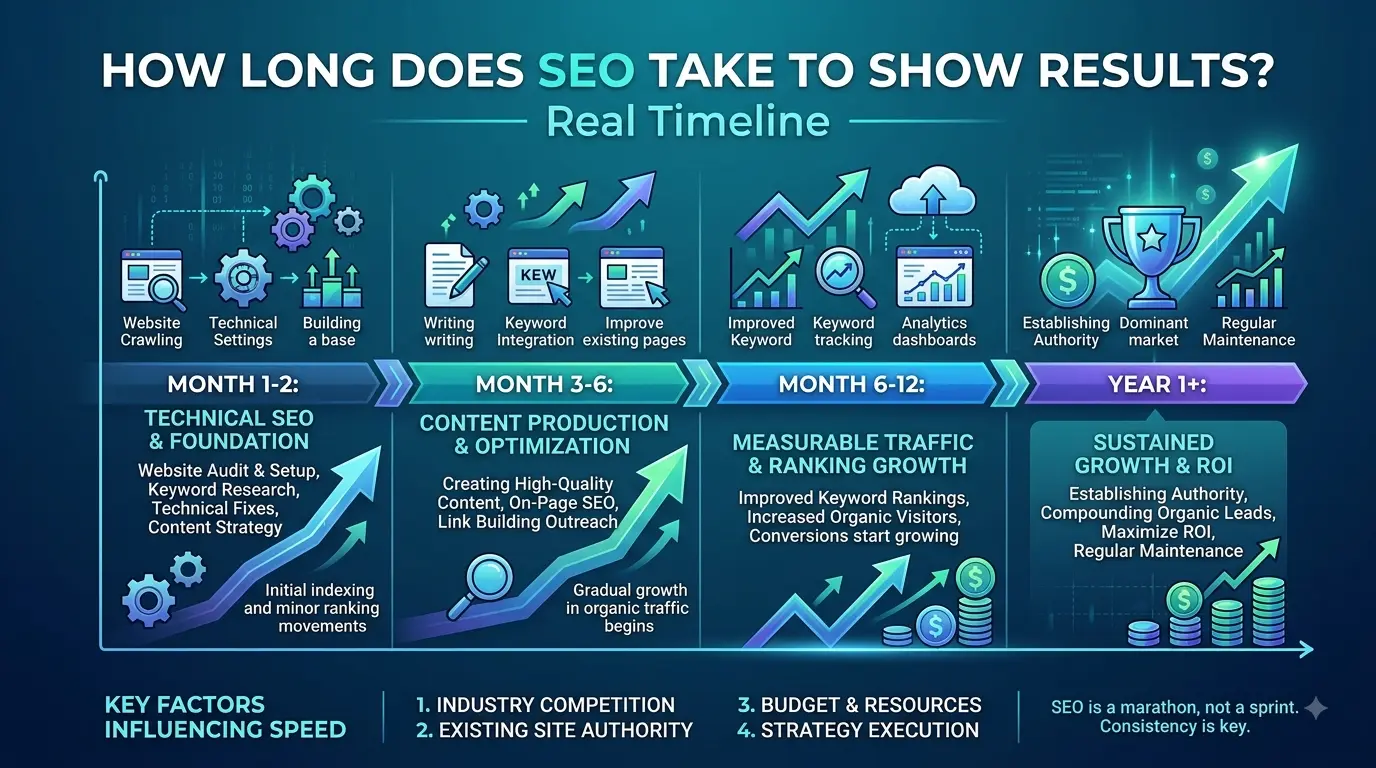
The first one to two months of a typical engagement focus primarily on foundational work — technical fixes, initial content, and setting up proper tracking — with visible ranking movement still limited during this period, since Google needs time to crawl and evaluate the changes being made. Months three through four typically show the first genuinely meaningful movement: initial ranking improvements for lower-competition keywords, growing impressions in Search Console even before those impressions translate into significant traffic, and early indicators that the foundational work is taking hold.
Months five through six usually bring more substantial ranking movement across a broader set of target keywords, along with traffic growth that starts becoming visible in analytics rather than requiring careful, granular tracking to notice. From month six onward, results typically compound more visibly as accumulated content, technical improvements, and authority-building work reinforce each other, with the most substantial gains in traffic, leads, and revenue usually appearing between months six and twelve rather than in the earliest months of an engagement. These timelines shift based on the competitive density, domain history, and technical starting point described above — a low-competition category with a well-established domain can see meaningful results faster than this general timeline suggests, while a highly competitive category may need longer.
What Can Be Measured Early vs. Late?
Early in an engagement, the metrics worth tracking are leading indicators rather than final outcomes: search impressions in Google Search Console, even before they translate into significant clicks, indicate that content is being indexed and considered relevant for target searches. Initial ranking movement for lower-competition, longer-tail keywords often shows up before movement on the most competitive, highest-value target terms, since those less contested rankings are naturally easier to achieve first. Technical health improvements — resolved crawl errors, improved Core Web Vitals scores — are measurable immediately after implementation, even though their downstream effect on rankings takes longer to materialize.
Later in an engagement, the metrics shift toward business outcomes: meaningful organic traffic growth, qualified lead volume from organic search specifically, and ultimately revenue or bookings attributable to organic channels. Judging an SEO engagement’s success by revenue in month two is measuring the wrong thing at the wrong time — revenue is a lagging indicator that depends on the compounding effect of rankings and traffic that simply haven’t had time to build yet, while the early leading indicators are exactly what should be reviewed to confirm the engagement is on track before those later outcomes materialize.
Setting Expectations With Clients or Stakeholders
Understanding how long does SEO take matters just as much for internal stakeholder alignment as it does for the business owner making the initial investment decision. A marketing manager who understands the realistic month-by-month timeline can set accurate expectations with leadership before the engagement begins, preventing the kind of premature pressure to show results that leads to abandoning a strategy right as it’s starting to compound. Sharing this timeline explicitly at the start of an engagement — not as a disclaimer buried in a contract, but as a genuine part of the strategy conversation — turns a potential source of later frustration into a shared, agreed-upon framework for evaluating progress.
This matters even more for businesses that have previously tried SEO and abandoned it after a few disappointing months, since that history often means walking back an existing skepticism about whether how long does SEO take claims from an agency can be trusted at all. Being specific and honest about which milestones to expect when, rather than offering vague reassurance, is what actually rebuilds that trust.
Frequently Asked Questions
In low-competition categories or for very specific long-tail keywords, some ranking movement can appear within a few weeks. Meaningful, sustained results across a competitive keyword set almost always require several months at minimum, regardless of category.
Ranking fluctuation, especially in the early months of an engagement, is normal as Google continues evaluating a page’s relevance and authority relative to competitors. Isolated fluctuation matters far less than the overall trend measured over several months.
A larger budget can support more content production and technical work happening in parallel, which can compress the timeline somewhat, but the underlying process of Google building confidence in a site’s authority still takes time regardless of budget size.
Yes. The first month typically focuses on technical fixes, foundational content, and tracking setup, with Google still in the process of crawling and evaluating those changes rather than having fully processed them yet.
Reviewing leading indicators — Search Console impressions, technical health improvements, lower-competition keyword movement — gives a much clearer early signal of whether the engagement is progressing correctly than waiting for the most competitive rankings or revenue figures to move first.
Ready for an SEO Strategy Built Around Realistic Expectations?
Understanding your specific timeline starts with understanding your specific competitive landscape and starting point. Get a free SEO audit from Creative 4 All and get a realistic, honest answer to how long does SEO take for your specific business.