
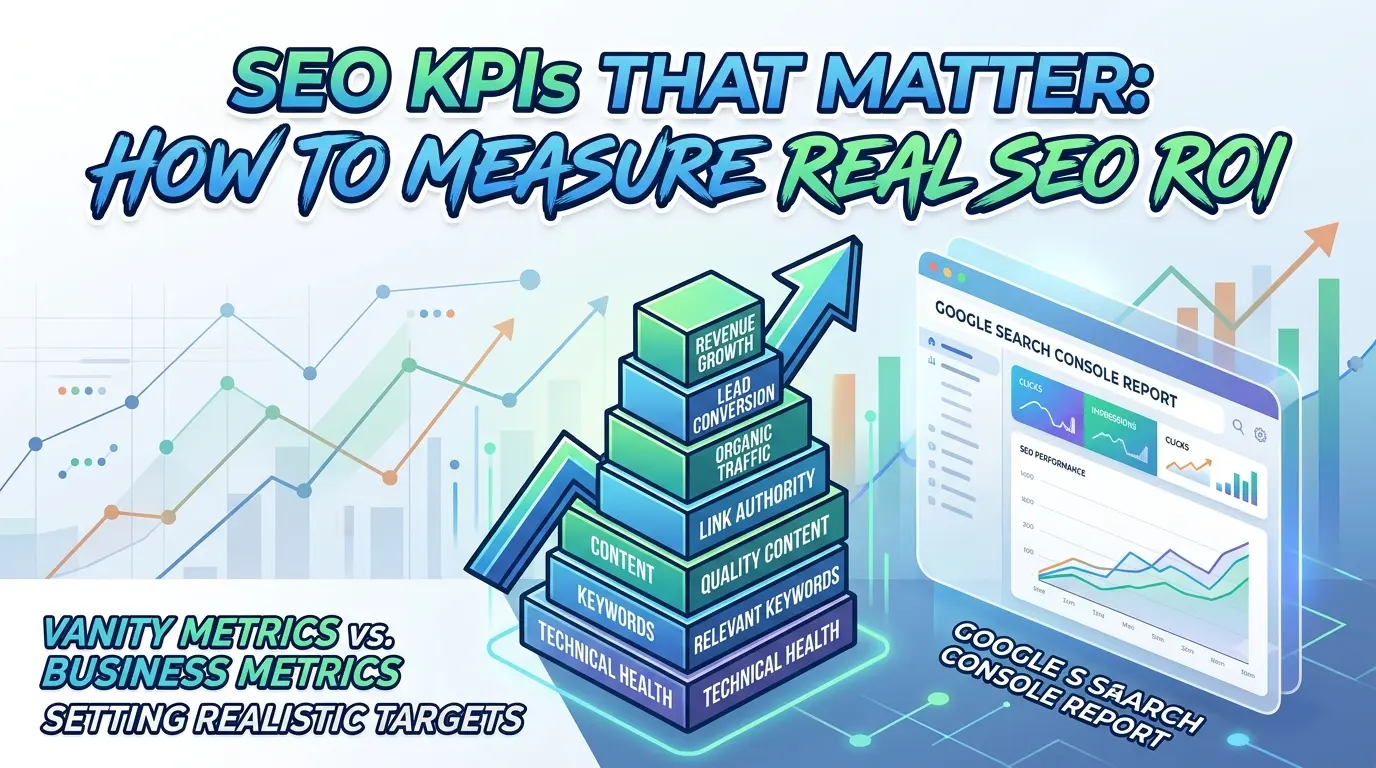
A monthly SEO report full of green upward arrows can still leave a business owner with the same nagging question: is any of this actually translating into revenue? The problem usually isn’t a lack of data — it’s that most reports lead with the easiest metrics to make look impressive rather than the SEO KPIs that actually connect to business outcomes. Traffic can climb for months while leads and revenue stay flat, and a business that only tracks the metrics an agency chooses to highlight has no real way to tell the difference between genuine progress and a report engineered to look good.
This guide separates vanity metrics from business metrics, walks through the specific SEO KPIs that actually matter — traffic, rankings, click-through rate, conversions, and revenue — explains how to actually read a Google Search Console report, and covers how to set realistic monthly targets so progress can be judged against something concrete rather than a vague sense of whether things “seem to be improving.”
Vanity Metrics vs. Business Metrics
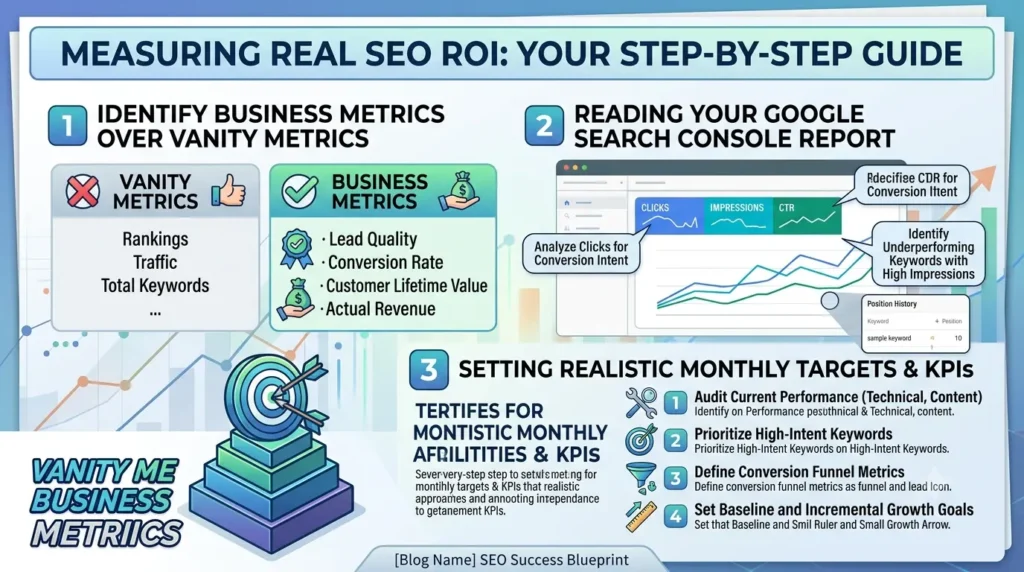
Vanity metrics are numbers that are easy to report and generally trend upward over time regardless of whether SEO work is actually driving business results — total keywords ranked, total backlinks acquired, or raw pageviews with no context about who’s visiting or why. These numbers aren’t meaningless, but they’re incomplete on their own, and a report that leads with them without connecting them to business outcomes is either not measuring the right things or is deliberately avoiding the harder conversation about whether SEO is producing real return.
Business metrics, by contrast, connect directly to what a business actually cares about: qualified leads generated, conversion rate from organic traffic specifically, and ultimately revenue attributable to organic search. The right SEO KPIs for any given business sit somewhere between these two categories — traffic and rankings matter as leading indicators of progress, but they should always be evaluated in light of whether they’re translating into the business outcomes that justify the investment in the first place.
The KPI Stack That Actually Matters
Organic Traffic
Organic traffic — visits arriving through unpaid search results — is the most basic SEO metric, and it matters as a leading indicator, but only when segmented meaningfully. Total organic traffic climbing while traffic to commercially relevant pages stays flat suggests growth in low-value informational content rather than genuine business progress. Reviewing traffic by landing page, not just as a single site-wide number, reveals whether growth is happening where it actually matters.
Keyword Rankings
Keyword rankings track a site’s position in search results for specific target terms, and they matter most when tracked for a defined, prioritized list of commercially relevant keywords rather than every keyword a site happens to rank for. Ranking improvements on keywords with genuine search volume and commercial intent are meaningful; ranking well for obscure, low-volume terms with no real business relevance is not, even though both would show up as “improved rankings” in an unfiltered report.
Click-Through Rate (CTR)
CTR measures what percentage of people who see a listing in search results actually click through to the site, and it’s one of the more underused SEO KPIs in typical reporting. A page ranking in a strong position but with a low CTR relative to what’s typical for that position often has a weak or unclear meta title and description, signaling an opportunity to improve results without needing to move up in rankings at all. Google Search Console reports CTR directly, making it one of the easiest KPIs to check and act on.
Conversion Rate
Conversion rate — the percentage of organic visitors who complete a meaningful action, whether that’s submitting a contact form, making a purchase, or booking a call — connects traffic directly to business value. A page driving substantial traffic with a poor conversion rate points to a content or landing page problem rather than an SEO problem specifically, since the visibility work is succeeding even if the page itself isn’t converting that visibility into action.
Organic Revenue
Organic revenue, where trackable, is the clearest possible measure of SEO ROI: actual sales or booked value attributable to organic search traffic, ideally tracked through proper attribution in analytics rather than assumed. For businesses where direct revenue attribution isn’t feasible — many service businesses, for instance — a reasonable proxy is qualified lead volume from organic traffic multiplied by an estimated close rate and average deal value, giving a defensible approximation of ROI even without perfect tracking infrastructure.
Average Position and Why It’s Often Misread
Average position, also reported directly in Google Search Console, shows the typical ranking spot a page or query holds across all the searches it appeared for, and it’s one of the more frequently misread SEO KPIs in client reporting. An average position of 8 doesn’t mean a page consistently ranks eighth — it’s an average across a wide range of queries and search contexts, some of which might rank much higher and others much lower, and reading it as a single consistent ranking spot misrepresents what’s actually happening. Average position is most useful when tracked as a trend over time for a defined set of priority keywords, rather than treated as a single definitive number describing a site’s overall search presence.
Why These KPIs Matter for the Agency-Client Relationship?
Beyond measuring genuine progress, agreeing on a clear set of SEO KPIs upfront protects both a business and its agency from the kind of vague disagreement that erodes trust over time. A business that understands what “good” looks like in a monthly report can evaluate progress on its own terms rather than relying entirely on an agency’s framing, and an agency that reports honestly against agreed-upon KPIs builds credibility that a report full of unexplained vanity metrics never can. This shared understanding is precisely what separates a genuine long-term SEO partnership from a relationship that quietly erodes the first time growth naturally slows for a normal, explainable reason.
How to Read a Google Search Console Report?
Google Search Console’s Performance report is the single most useful free tool for tracking these SEO KPIs directly, and understanding how to read it turns raw data into an actual signal. The Queries tab shows which specific search terms are driving impressions and clicks, letting a business see exactly which keywords are working and which have high impressions but low clicks — a strong signal for the CTR issue described above. The Pages tab breaks this same data down by landing page, revealing which pages are actually earning visibility and which aren’t, informing exactly where content investment should go next.
Comparing date ranges — the last three months against the previous three, or year-over-year for businesses with seasonal patterns — separates genuine trend from normal fluctuation, since a single month’s dip or spike rarely means much on its own. Cross-referencing Search Console data with Google Analytics conversion data closes the loop between visibility and actual business outcomes, connecting which queries and pages are driving impressions and clicks to which of those visits are actually converting once they land on the site.
Setting Realistic Monthly Targets
SEO is a compounding investment, and targets need to reflect that reality rather than expecting linear, immediate growth from month one. A realistic target-setting approach starts with the current baseline across each KPI, then sets incremental month-over-month goals reflecting the fact that early months typically show smaller movement in traffic and rankings while technical fixes and initial content take time to be indexed and ranked, with growth typically compounding more visibly from month four onward as that early work matures.
Targets should be specific to the business’s actual competitive category and starting point rather than borrowed from a generic industry benchmark that may not reflect the reality of a specific market or competitive landscape. A business in a highly competitive category should expect a longer runway before meaningful ranking movement than a business in a lower-competition niche, and setting targets that account for that difference prevents the discouragement of judging progress against an unrealistic benchmark that was never actually achievable on the original timeline.
Frequently Asked Questions
Most SEO engagements show early movement in traffic and rankings within three to six months, with more substantial gains in conversions and revenue compounding over six to twelve months as technical work, content, and authority-building reinforce each other.
If only one metric is trackable, organic revenue or a close proxy like qualified lead volume is the most meaningful, since it connects directly to business value rather than serving only as a leading indicator like traffic or rankings.
Yes. Normal fluctuation from seasonality, algorithm updates, and simple variance is expected, which is why comparing broader trends over several months matters more than reacting to any single month’s number in isolation.
A good report connects every metric back to business outcomes rather than leading with vanity numbers in isolation, and should be willing to explain clearly how each reported KPI relates to actual leads, conversions, or revenue.
Google Search Console and Google Analytics are both free and provide the core data needed to track traffic, rankings, CTR, and conversions directly, though connecting that data to a coherent strategy and interpreting it accurately typically benefits from SEO expertise.
Ready to Understand What Your SEO Investment Is Actually Producing?
Real SEO reporting connects every metric to business outcomes, not just numbers that trend upward. Get a free SEO audit from Creative 4 All and get a clear picture of where your site’s SEO KPIs actually stand today.