

Committing to a monthly SEO retainer without first understanding what’s actually wrong with a site is a bit like agreeing to a renovation budget before anyone’s inspected the house. A proper SEO audit is the inspection — the diagnostic step that identifies exactly what’s holding a site back before any content, link-building, or technical work begins, so that investment goes toward fixing real problems rather than guessing at general best practices. Skipping this step is one of the most common reasons an SEO engagement fails to show results in the first few months: work gets built on top of unresolved technical issues or thin content that no amount of new blog posts can fully compensate for.
This guide walks through why an audit needs to come first, the four pillars every legitimate SEO audit should cover — technical, content, backlink, and competitor — what a good audit report actually looks like, the red flags that signal a rushed or superficial audit, and how a proper audit process should work from start to finish.
Why an Audit Comes First?
Starting SEO work without an audit is starting without a diagnosis, and every subsequent decision inherits that uncertainty. A content strategy built without first checking search intent and existing rankings might target keywords the site has no realistic chance of competing for. A link-building campaign launched without first checking for existing toxic backlinks might be building authority on top of a foundation that’s actively working against the site. An SEO audit removes that guesswork by establishing exactly where a site stands before any new investment is made, which is why it should be the first deliverable in any serious SEO engagement rather than an optional add-on.
This sequencing also protects the business commissioning the work, not just the quality of the strategy. A business that skips the audit and jumps straight into a retainer has no real baseline to measure progress against a few months later — improvements get attributed to the new work, but there’s no way to confirm the starting point actually needed those specific fixes, or whether a completely different set of priorities would have moved the needle faster.
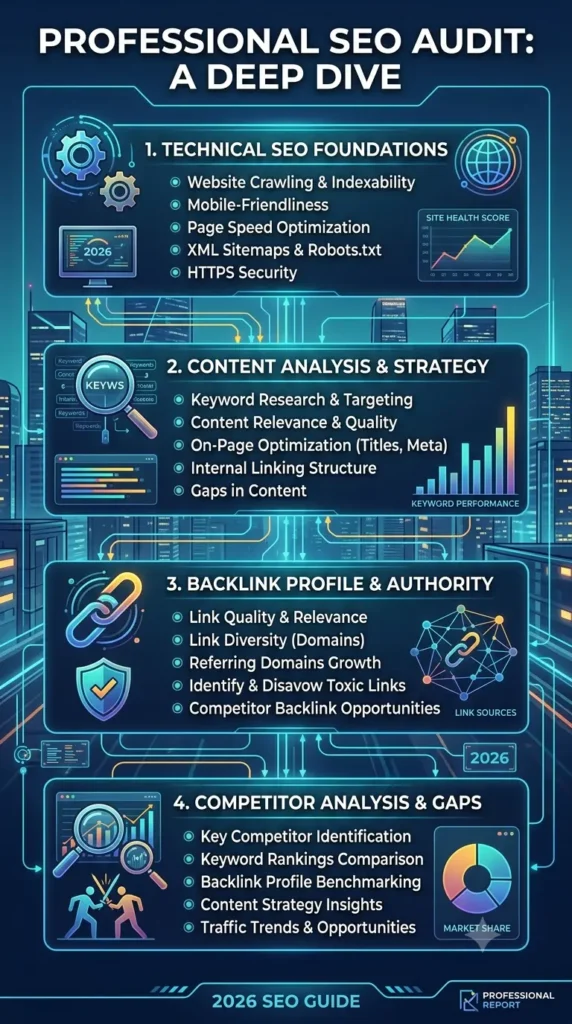
The Four Audit Pillars
Technical Audit
The technical audit examines whether Google can actually crawl, index, and properly render a site — checking for crawl errors, broken redirects, duplicate content, missing or incorrect canonical tags, XML sitemap issues, mobile usability problems, and Core Web Vitals performance. This pillar matters first because content and link-building work built on top of unresolved technical issues has a limited ceiling; a page that’s crawled inconsistently or blocked from indexing can’t rank well regardless of how strong its content or backlink profile becomes.
Content Audit
The content audit reviews existing pages against search intent, content depth, and organic performance, identifying pages that are thin, outdated, duplicative, or simply never built around real keyword research in the first place. This pillar typically surfaces a mix of opportunities: pages worth expanding and updating rather than replacing, pages worth consolidating because they’re competing against each other for the same searches, and genuine content gaps where no existing page addresses a topic the business should be visible for at all.
Backlink Audit
The backlink audit reviews the quality and relevance of links pointing to a site, identifying toxic or spammy links that could be suppressing rankings alongside genuine link-building opportunities the site hasn’t yet captured. A site that’s accumulated low-quality backlinks, whether through a previous agency’s poor practices or old, forgotten directory submissions, may need active link disavowal work before new link-building can be expected to move the needle, which is exactly the kind of finding an audit surfaces before it becomes an expensive surprise later.
Competitor Audit
The competitor audit examines what’s actually working for the sites currently outranking a business for its target searches — their content depth, their backlink profiles, their technical setup, and their overall topical coverage. This pillar turns an audit from a purely internal diagnostic into a genuinely competitive one, since ranking well isn’t just about a site’s own quality in isolation, but about how that quality compares to whoever currently holds the positions a business wants to compete for.
What a Good Audit Report Actually Looks Like?
A genuinely useful SEO audit report does more than list findings — it prioritizes them by actual impact and connects each one to a specific, actionable recommendation rather than a vague technical description a business owner can’t act on. Findings should be grouped by severity, distinguishing issues that are actively suppressing rankings right now from lower-priority items worth addressing eventually but not urgently. The report should reference specific pages, specific technical errors, and specific competitor examples rather than speaking only in generalities that could apply to any website.
A quality audit also includes the data behind its findings — screenshots or exports from tools like Google Search Console, Screaming Frog, Ahrefs, or SEMrush — rather than asking a business to simply trust an unsupported claim. This transparency matters because it lets a business (or a second opinion, if one is sought) verify the findings independently rather than relying purely on the auditor’s word.
Red Flags That Signal a Bad Audit
Certain patterns reliably indicate a rushed, templated, or superficial audit rather than a genuine diagnostic. A report that reads identically to what a generic automated tool would output, with no evidence of manual review or business-specific context, suggests the “audit” was barely more than running a free tool and forwarding the results. A report with no prioritization — treating a critical indexability issue with the same urgency as a minor image alt-text gap — signals the auditor didn’t actually assess real-world impact. An audit that arrives without any competitor analysis at all misses half the picture, since a site’s technical and content quality only matters relative to what it’s actually competing against in search results.
Perhaps the clearest red flag is an audit that conveniently identifies exactly the amount of work the agency happens to sell, regardless of the site’s actual condition — a legitimate audit should sometimes conclude that a site’s technical foundation is solid and the real opportunity lies elsewhere, rather than always finding a reason to justify the maximum possible retainer.
How Creative 4 All’s Audit Process Works?
A proper audit process starts with the technical crawl, using tools like Screaming Frog alongside Google Search Console data to establish the site’s actual indexability and technical health baseline. Content and keyword performance are reviewed next, cross-referencing existing rankings and traffic data against genuine keyword research to identify both underperforming pages and real content gaps. Backlink analysis using tools like Ahrefs or SEMrush identifies both toxic link risk and untapped link-building opportunity, and a competitor review benchmarks the site against whoever’s actually winning the searches that matter most to the business.
The result is a prioritized report, not a generic checklist — specific findings tied to specific pages and specific fixes, ranked by actual impact, giving a business a clear, defensible starting point for exactly where SEO investment should go first.
How an Audit Shapes What You Should Actually Pay for SEO?
A completed SEO audit does more than identify problems — it directly shapes what a fair, accurate SEO quote should look like going forward. A site with a clean technical foundation and a handful of content gaps needs a very different scope of ongoing work than a site with significant technical debt, toxic backlinks requiring disavowal, and thin content across dozens of pages. Without an audit establishing this baseline, any monthly retainer quote is essentially a guess dressed up as a number, since the agency proposing it has no real basis for estimating how much work the site actually requires.
This is also why comparing SEO quotes across agencies rarely works well without a shared audit to compare them against — one agency’s quote might assume a relatively healthy site needing mostly content and link work, while another assumes significant technical remediation is required first, and without a common diagnostic, a business has no way to tell which assumption is actually correct. Starting with an audit, then requesting quotes based on its specific findings, turns a comparison of vague packages into a comparison of specific, scoped proposals addressing the same known set of problems.
Frequently Asked Questions
A thorough audit for a small to mid-sized business site typically takes one to two weeks, depending on site size and how much manual review each pillar requires beyond automated tool output.
It depends entirely on depth. A free audit that includes genuine manual review across all four pillars can be just as valuable as a paid one; a free audit that’s just an automated tool export with no analysis or prioritization isn’t a substitute for genuine diagnostic work.
An initial comprehensive audit before starting or restarting SEO work, followed by lighter technical check-ins every few months and a fuller audit annually or whenever performance unexpectedly drops, covers most businesses’ needs without requiring constant re-auditing.
Basic technical checks are accessible using free tools like Google Search Console and PageSpeed Insights. A full audit across all four pillars, particularly the competitor and backlink analysis, typically benefits from tools and expertise most business owners don’t have readily available in-house.
A good audit ends with a prioritized action plan, which then informs whether the business proceeds with a project-based fix of the highest-priority issues, an ongoing retainer, or some combination of both based on what the findings actually showed.
Ready to Find Out What’s Actually Holding Your Site Back?
Understanding exactly what’s limiting your search visibility is the first step before any SEO investment makes sense. Get a free SEO audit from Creative 4 All and see precisely where your site stands across technical health, content, backlinks, and your competition.