
Almost every marketing conversation eventually reaches a point where someone says “top of funnel” or “bottom of funnel” as if the meaning is obvious, and for anyone who hasn’t encountered the concept before, it genuinely isn’t. A marketing funnel is simply a way of describing the path a potential customer travels from first hearing about a business to actually becoming a customer, broken into stages that each require a different kind of content, message, and channel. Understanding this framework matters because it’s the shared vocabulary behind nearly every marketing decision — which content to create, which channel to prioritize, and how to measure whether any of it is actually working.
This guide explains what a marketing funnel is and why it matters, how to map content and channels to each stage, the common leaks that quietly drain a funnel’s effectiveness, and a simple framework for auditing your own.
What a Marketing Funnel Is and Why It Matters?
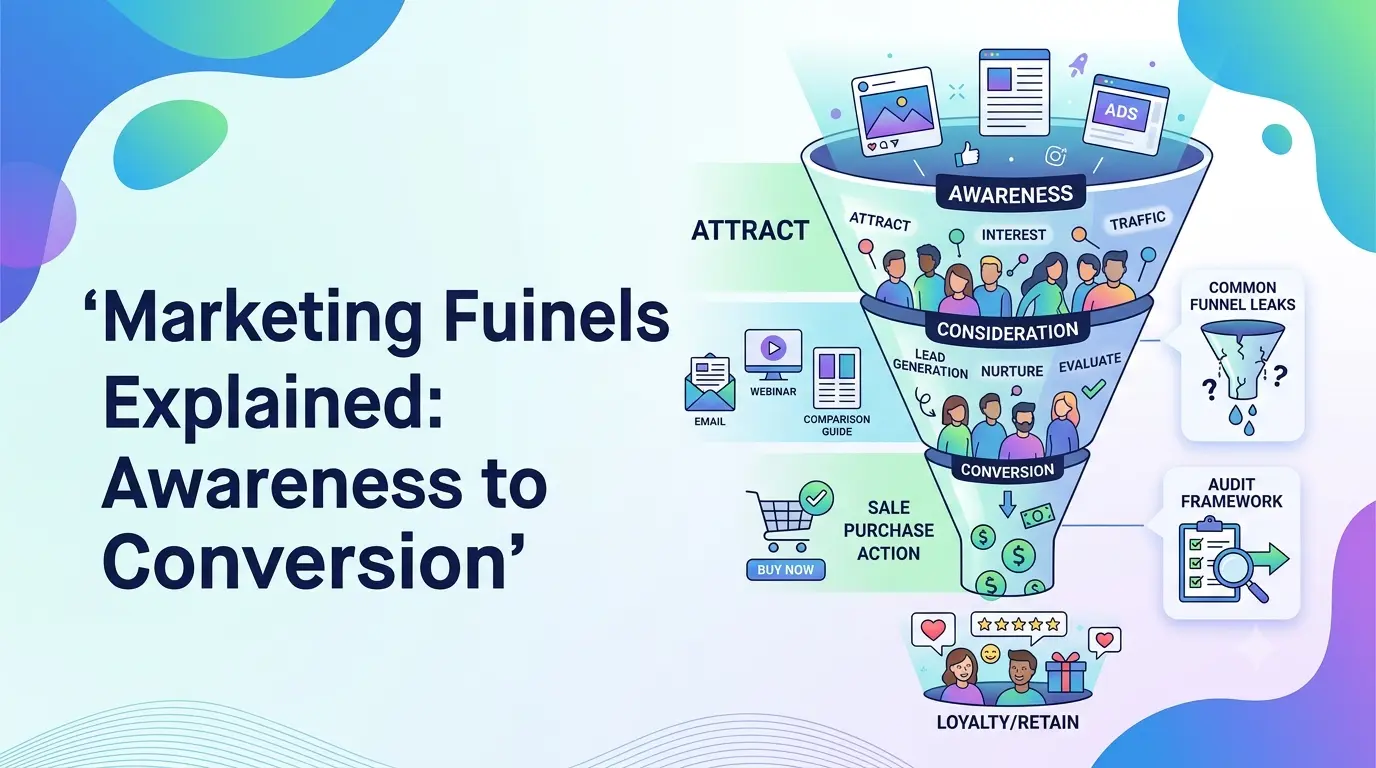
A marketing funnel describes the journey from a person who’s never heard of a business to a paying customer, typically broken into three broad stages: awareness, consideration, and decision — often abbreviated as TOFU (top of funnel), MOFU (middle of funnel), and BOFU (bottom of funnel). The funnel shape reflects a simple reality: far more people encounter a business at the awareness stage than ever become customers, and each stage naturally narrows as people who aren’t a genuine fit drop out along the way.
This matters practically because a single piece of content or a single channel rarely serves every stage well. A detailed pricing comparison page serves someone already deciding between specific options; that same page means nothing to someone who’s never heard of the business or the problem it solves. Recognizing which stage a piece of content, a channel, or a campaign is actually built for prevents the common mistake of judging every marketing effort by the same metric — a TOFU blog post judged purely on immediate lead generation will always look like it’s failing, even when it’s doing exactly what it’s supposed to do at that stage.
Mapping Content and Channels to Each Stage
Awareness (TOFU)
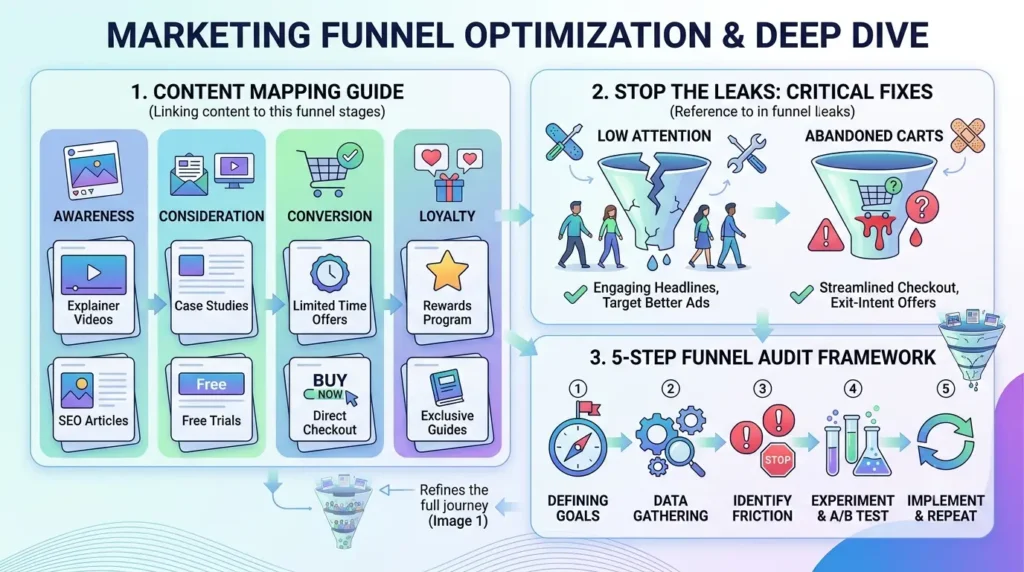
At the awareness stage, a potential customer doesn’t yet know they have a problem this specific business solves, or doesn’t yet know this business exists as an option. Content here focuses on genuinely useful, educational material — blog posts answering broad questions, social media content building visibility, and search-optimized content capturing people researching a general topic rather than a specific solution. Channels that reach a wide audience efficiently, like organic search, social media, and broader-reach paid advertising, tend to do the heaviest lifting at this stage.
Consideration (MOFU)
At the consideration stage, a potential customer has identified their problem and is actively researching solutions and providers, comparing options rather than just learning that a category of solution exists. Content here shifts toward more specific material — comparison guides, case studies, detailed service explanations, and email sequences that build on an initial point of contact rather than introducing a topic from scratch. This is where lead capture becomes central: content valuable enough that a visitor is willing to exchange contact information for it, moving them from an anonymous visitor into a tracked, nurturable lead.
Decision (BOFU)
At the decision stage, a potential customer has narrowed their options and is evaluating specific providers against each other, looking for the details that will tip a close decision one way or another. Content here includes pricing information, direct comparisons against named competitors, testimonials and case studies from similar customers, and clear calls-to-action that make taking the next step as frictionless as possible. This is where sales conversations, consultations, and direct offers do their heaviest work, since the remaining hesitation at this stage is usually about confidence and trust rather than basic awareness or understanding.
Funnel Metrics That Actually Matter at Each Stage
Measuring a marketing funnel well means tracking different metrics at each stage rather than applying one universal number, like overall conversion rate, across the entire journey. At the awareness stage, reach, impressions, and organic search visibility indicate whether content is actually being seen by a relevant audience, though these numbers alone say nothing about quality of fit — a large audience of people who will never become customers isn’t a meaningful win. At the consideration stage, engagement metrics like time on page, email open and click rates, and lead capture conversion rate indicate whether content is successfully building enough trust and interest to move someone toward an actual decision.
At the decision stage, the metrics that matter most are the ones tied directly to revenue: sales conversation booking rate, proposal-to-close rate, and ultimately customer acquisition cost measured against the lifetime value of the customers actually acquired. Tracking these stage-specific metrics separately, rather than reporting only a single blended conversion rate, makes it possible to see exactly where a funnel is performing well and where it needs attention, rather than treating the whole system as one indistinguishable block of performance.
Common Funnel Leaks and How to Fix Them
A funnel leak is any point where potential customers drop out for reasons that have nothing to do with genuine lack of fit — they’re lost not because the business was wrong for them, but because something in the funnel itself failed to move them forward. A common leak at the top of the funnel is content that attracts the wrong audience entirely: ranking well for a broad keyword that draws visitors with no realistic path toward becoming a customer wastes traffic that looks impressive in a report but never contributes to actual growth.
A common middle-funnel leak is asking for too much too soon — a lead capture form demanding extensive information before a visitor has built enough trust to share it, which drives away people who would have converted with a lighter initial ask. A common bottom-funnel leak is unclear or delayed follow-up: a lead who’s ready to decide and reaches out, only to wait days for a response, often moves on to a competitor who responded faster, regardless of how strong the original content or offer was. Each of these leaks requires a different fix — better audience targeting at the top, a lighter-touch lead capture process in the middle, and faster, more consistent follow-up at the bottom — which is exactly why understanding which stage a problem occurs at matters more than treating “conversions are low” as a single, undifferentiated problem.
How the Funnel Relates to the Buyer Journey?
The marketing funnel and the buyer journey describe the same underlying reality from two different angles. The buyer journey focuses on the customer’s experience and mindset at each point — what they’re thinking, feeling, and trying to figure out — while the funnel focuses on the business’s structure for reaching and converting that same person at each of those points. Keeping both perspectives in mind prevents a funnel from becoming a purely internal, business-centric structure disconnected from what a real person is actually experiencing as they move through it.
This is also why a well-built funnel isn’t a rigid, one-way pipeline in practice. Real buyers often move back and forth between stages — researching, stepping back, returning later with new questions — rather than progressing in a perfectly linear line from first contact to purchase. A funnel framework works best as an organizing structure for content and measurement, not as a literal, forced sequence every individual customer is expected to follow exactly.
A Simple Funnel-Audit Framework
Auditing a marketing funnel starts with mapping existing content and channels against the three stages, identifying any stage that’s genuinely thin — a business with plenty of BOFU sales content but almost no TOFU educational material will struggle to fill the top of the funnel with enough volume for the bottom stages to convert meaningfully. Next, review the actual data available at each stage transition: how many people move from awareness-stage content to consideration-stage engagement, and from there into an actual sales conversation, since a sharp drop-off at any specific transition point identifies exactly where a leak is occurring rather than leaving it as a vague sense that “marketing isn’t working.”
Finally, match the business’s actual sales cycle length and complexity to the funnel structure being used — a high-consideration purchase with a long research phase needs a more developed middle-funnel content library than a low-consideration, quick-decision purchase does, and applying the same funnel depth to both mismatches effort against what customers actually need at each stage.
Frequently Asked Questions
Every business has some version of a customer journey whether or not it’s formally mapped out. Explicitly structuring content and channels around funnel stages becomes valuable once a business has enough marketing activity that coordinating it without a shared framework starts causing real inefficiency.
The terms are often used interchangeably, though “marketing funnel” typically emphasizes the earlier awareness and consideration stages handled primarily through content and advertising, while “sales funnel” often emphasizes the later stages once a sales team is directly involved in moving a lead toward a decision.
This varies enormously by industry and purchase complexity — a low-cost, low-consideration product might move someone through in minutes, while a significant B2B service purchase can take months. There’s no universal timeline; the useful benchmark is your own business’s typical sales cycle, tracked over time.
This depends on where a business’s actual leaks are occurring. A business with strong awareness but poor conversion needs more middle- and bottom-funnel investment; a business with few qualified leads at all needs more top-of-funnel investment first, since there’s nothing downstream to optimize without enough people entering at the top.
Occasionally, but content usually performs best when it’s built with one primary stage in mind. Content trying to simultaneously educate a complete newcomer and close a near-ready buyer often does neither job particularly well, since the two audiences need fundamentally different information and tone.
Ready to Build a Funnel That Actually Converts?
Understanding funnel stages is the foundation for every other marketing decision — which content to create, which channels to prioritize, and where to actually invest. Book a free digital marketing consultation with Creative 4 All and get a funnel audit built around your specific business and sales process.