
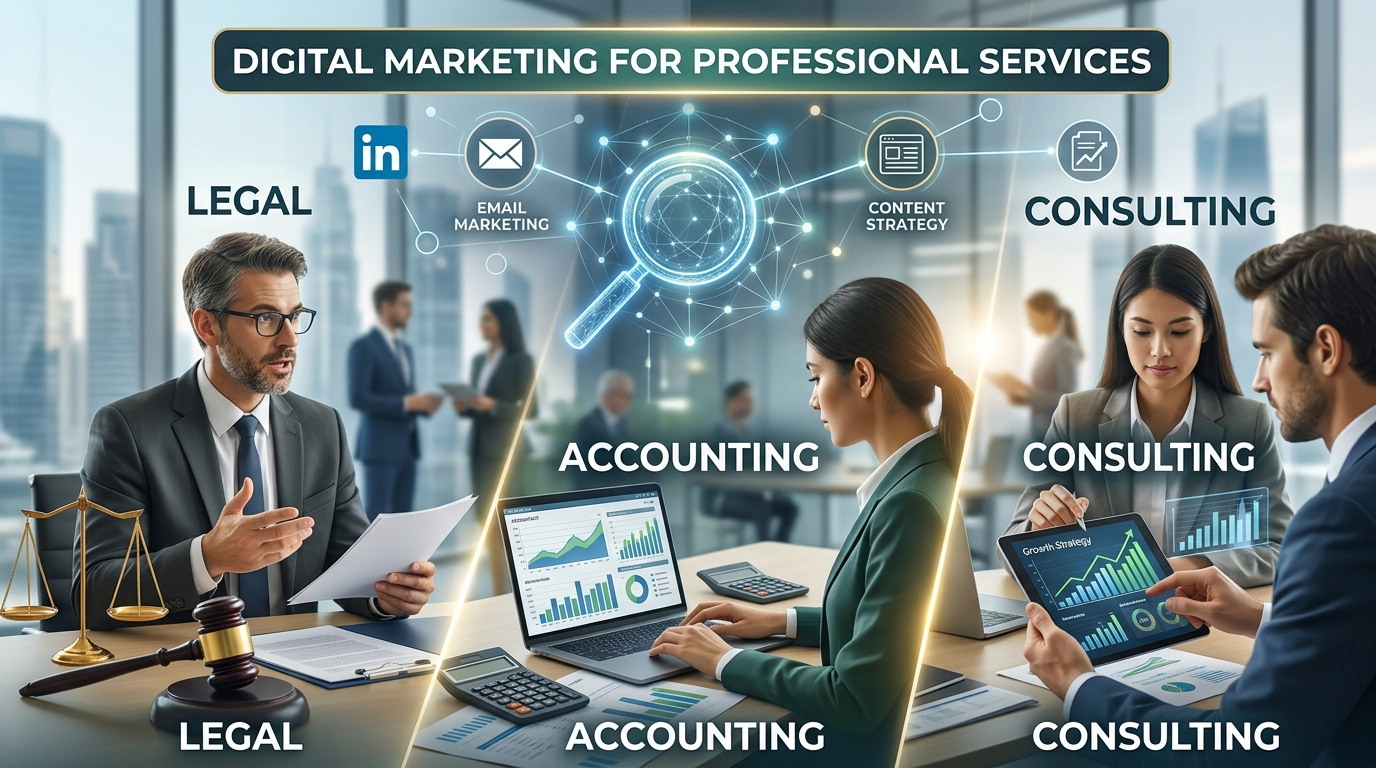
A law firm, an accounting practice, and a management consultancy sell almost nothing that can be demonstrated with a product photo or a discount code. What they sell is judgment, and judgment is difficult to evaluate from the outside. This is precisely why professional services buyers behave so differently from buyers in almost any other category: before a single phone call is made, they have already read the firm’s website, scanned partner LinkedIn profiles, searched for case outcomes or published commentary, and formed a fairly firm opinion about whether this firm actually knows what it is doing. Digital marketing for professional services firms is not about generating volume the way an ecommerce campaign might. It is about making sure that extensive, quiet research phase ends with the buyer convinced enough to pick up the phone.
This distinction matters enormously for how a legal, accounting, or consulting firm should approach its marketing. Tactics built for transactional purchases — aggressive discounting, high-frequency paid ads, urgency-driven calls to action — tend to actively undermine credibility in this category rather than build it. What works instead is a slower, evidence-based approach built on demonstrated expertise, visible reputation, and a website that reads like the work of people who are genuinely good at what they do.
Why Professional Services Buyers Research Extensively Before Reaching Out?
The High-Stakes Nature of Legal, Accounting, and Consulting Decisions
Choosing the wrong law firm, accountant, or consultant carries real financial and reputational consequences, and buyers know this instinctively even when they cannot fully articulate it. A business owner selecting corporate counsel or an outsourced CFO is not comparing prices the way they might for office supplies — they are trying to answer a much harder question: can I trust this person or firm with something that genuinely matters. That question cannot be answered by a single ad impression or a discount offer. It gets answered gradually, through accumulated signals of competence and reliability gathered across multiple touchpoints over days or weeks.
What Buyers Actually Look For During the Research Phase
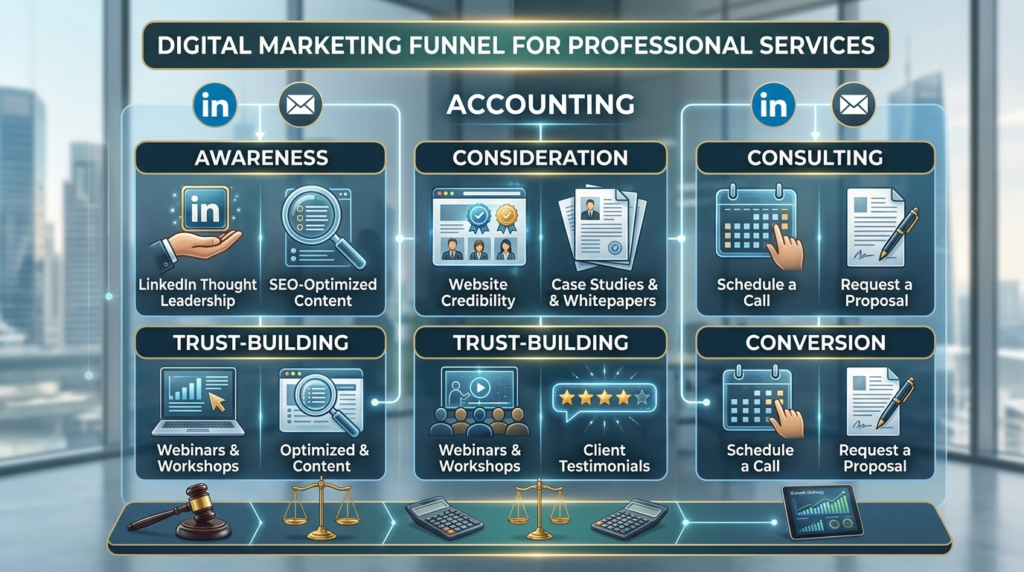
During this research phase, buyers are typically looking for evidence of relevant experience (has this firm handled situations like mine before), evidence of clear thinking (does the content this firm publishes demonstrate genuine expertise or just generic advice anyone could write), and social proof that does not feel manufactured (client testimonials, visible recognition from peers, a track record that can be independently verified). A firm’s digital presence needs to supply all three, consistently, across every channel a prospective client is likely to check.
Thought Leadership Content as the Primary Lead Driver
Turning Expertise Into Content That Builds Trust
For professional services firms, thought leadership content is not an optional nicety — it is usually the single highest-leverage marketing activity available, because it directly answers the buyer’s core question of whether this firm actually knows what it is talking about. An article that walks through how a specific legal, tax, or operational problem was actually solved, written with genuine specificity rather than generic platitudes, does more to build trust than almost any other content format. This requires firm partners and senior consultants to be directly involved in content creation, since the expertise being demonstrated has to be real and specific enough that a knowledgeable reader recognizes it as such.
Content Formats That Work Best for Legal, Accounting, and Consulting Firms
Different professional services categories tend to favor slightly different content formats. Law firm marketing often performs best with detailed explainers of legal changes and their practical implications for specific industries, since this demonstrates both legal knowledge and business awareness simultaneously. Accounting firm marketing tends to work well with seasonal, deadline-driven content (tax changes, regulatory filing updates) that positions the firm as the resource clients check before a deadline rather than after a problem occurs. Consulting firm marketing benefits most from case-study-style content that walks through a framework or methodology applied to a real (even if anonymized) business situation, since consulting buyers are essentially evaluating a way of thinking as much as a specific outcome.
LinkedIn’s Outsized Role for Professional Services Marketing
Why LinkedIn Outperforms Other Channels for This Audience?
For nearly every other industry vertical, a diversified channel strategy makes sense. For professional services, LinkedIn plays an outsized role that other channels rarely match, because it is the one platform where business decision-makers are actively present in a professional mindset, actively researching people and firms they may work with, and actively willing to engage with substantive content rather than purely entertainment-driven material. A well-written post from a named partner discussing a real client situation (in appropriately anonymized or generalized form) will typically outperform the same content published only on the firm’s blog, simply because LinkedIn puts it directly in front of an audience already primed to evaluate professional credibility.
Building a Firm-Wide LinkedIn Presence, Not Just a Company Page
The most common mistake professional services firms make on LinkedIn is treating the company page as the primary vehicle, when in reality individual partner and consultant profiles tend to generate far more engagement and trust than a corporate account ever will. Buyers want to evaluate the specific person they might work with, not an anonymous brand voice. Building genuine LinkedIn positioning across the firm’s senior team — with consistent posting, real commentary rather than reposted articles, and visible engagement in relevant industry conversations — compounds over time into a reputation that a paid campaign simply cannot replicate.
Website and SEO Foundations That Support Trust
Service Pages That Demonstrate Expertise, Not Just List Offerings
A service page that simply lists “corporate law,” “tax advisory,” or “operations consulting” as bullet points does nothing to differentiate a firm from any competitor offering the same categories. Effective service pages for this vertical describe the firm’s specific approach, reference the kinds of situations the firm has handled, and name the senior people responsible for that practice area with enough detail that a prospective client can start forming an impression of competence before ever picking up the phone.
Referral-Driven Trust Signals on the Website
Professional services has always run heavily on referrals, and a website should reinforce rather than compete with that dynamic. Prominently displaying genuine client testimonials, notable matters or engagements (where confidentiality allows), and any third-party recognition or accreditation gives a referred prospect the confirmation they are looking for once they arrive at the site to do their own quiet verification before calling. This referral-reinforcing function is often more important for a professional services website than ranking for competitive keywords, since much of the traffic will already be word-of-mouth driven and simply needs the site to validate the recommendation they already received.
Measuring What Actually Matters in Professional Services Marketing
Why Traffic and Rankings Are the Wrong Primary Metrics?
Because search volume for professional services keywords tends to be low, chasing traffic or keyword rankings as the primary success metric often leads a firm to abandon a strategy that is actually working. A single well-placed thought leadership article that generates three qualified consultation requests from senior decision-makers has delivered far more value than a high-traffic blog post that generates hundreds of visits and zero inquiries. The right metrics for this vertical are consultation requests, the seniority and relevance of the people engaging with content on LinkedIn, and whether new client conversations reference specific pieces of published content — not raw visit counts.
Tracking the Long Sales Cycle Accurately
Professional services buying decisions frequently take weeks or months from first contact with a firm’s content to an actual signed engagement, which makes simple last-click attribution misleading. A prospective client might read a thought leadership article in January, follow a partner on LinkedIn in February, and only reach out for a consultation in April after a specific need arises. Firms that track only the immediate action around the point of contact will consistently undercount the value of the content and LinkedIn activity that built the trust behind that eventual inquiry. A longer-view approach — noting how new clients first became aware of the firm, even informally during the intake conversation — gives a far more accurate picture of what digital marketing for professional services is actually contributing.
Common Pitfalls That Undermine Credibility
Overproduced Content That Reads as Generic
A frequent mistake is outsourcing thought leadership content entirely to a marketing team or freelance writer without meaningful input from the partners or consultants whose expertise it is meant to represent. The result often reads as competent but generic — accurate in a broad sense but lacking the specific detail, war stories, and nuanced judgment that actually signal deep expertise to a knowledgeable reader. The most effective process usually involves the marketing team conducting a structured interview with the relevant expert and then shaping that raw expertise into polished content, rather than asking a writer to produce the content from a topic brief alone.
Inconsistent Presence Across Channels
A firm with an impressive LinkedIn presence but an outdated, thin website (or the reverse) sends a confusing signal to a prospective client who is cross-referencing both. Consistency matters as much as quality here: the tone, credentials, and areas of expertise presented on LinkedIn should match what a visitor finds on the website, and both should be current enough that a prospect does not encounter a three-year-old bio photo or an outdated list of practice areas that no longer reflects the firm’s actual focus. Periodically auditing both channels side by side — comparing what a prospect would see on the website against what they would see checking the same partner’s LinkedIn profile — catches these mismatches before a prospective client does.
Frequently Asked Questions
Paid advertising can work for highly specific, high-intent searches (a particular legal service or urgent tax situation), but it rarely performs as the primary channel for this vertical. Trust-building content and LinkedIn presence typically generate a stronger return over time, since the buying decision depends heavily on demonstrated credibility that a paid ad alone cannot convey.
Consistency matters more than frequency. A firm publishing one genuinely substantive article per month, written with real specificity, will outperform a firm publishing weekly generic content that reads like it could have come from any competitor. Quality and demonstrated expertise are what drive trust in this category.
Ideally yes, though a firm can start with two or three senior people willing to post consistently and build outward from there. A handful of genuinely active, credible profiles will outperform a large number of dormant ones.
Search volume for professional services keywords is often lower than in consumer categories, but the intent behind each search tends to be much higher and more specific. This makes long-tail, specific-situation content (a particular legal question, a specific tax scenario) more valuable than broad, high-volume keyword targeting.
Treating marketing as a volume game rather than a trust-building exercise. Aggressive advertising, generic content, and impersonal branding tend to undermine the credibility this category depends on, while consistent, specific, expertise-driven content tends to build it steadily over time.
Ready to Build Trust Before the First Consultation?
Digital marketing for professional services firms succeeds when it demonstrates real expertise rather than chasing volume. Creative 4 All works with legal, accounting, and consulting firms across Lebanon and the GCC to build the thought leadership content, LinkedIn presence, and website credibility that turns quiet research into booked consultations. Book a Free Digital Marketing Consultation to see where your firm’s digital presence stands today.