
A manufacturer deciding on a new equipment supplier or a law firm choosing a new IT provider doesn’t make that decision the way a consumer decides on a restaurant for dinner — it involves multiple people, weeks or months of evaluation, and a level of scrutiny that a single ad or a single landing page was never designed to satisfy. B2B digital marketing Lebanon companies need looks fundamentally different from consumer marketing because the buying process itself is fundamentally different, and treating a B2B audience with B2C tactics wastes budget on a mismatch between how the marketing works and how the actual decision gets made.
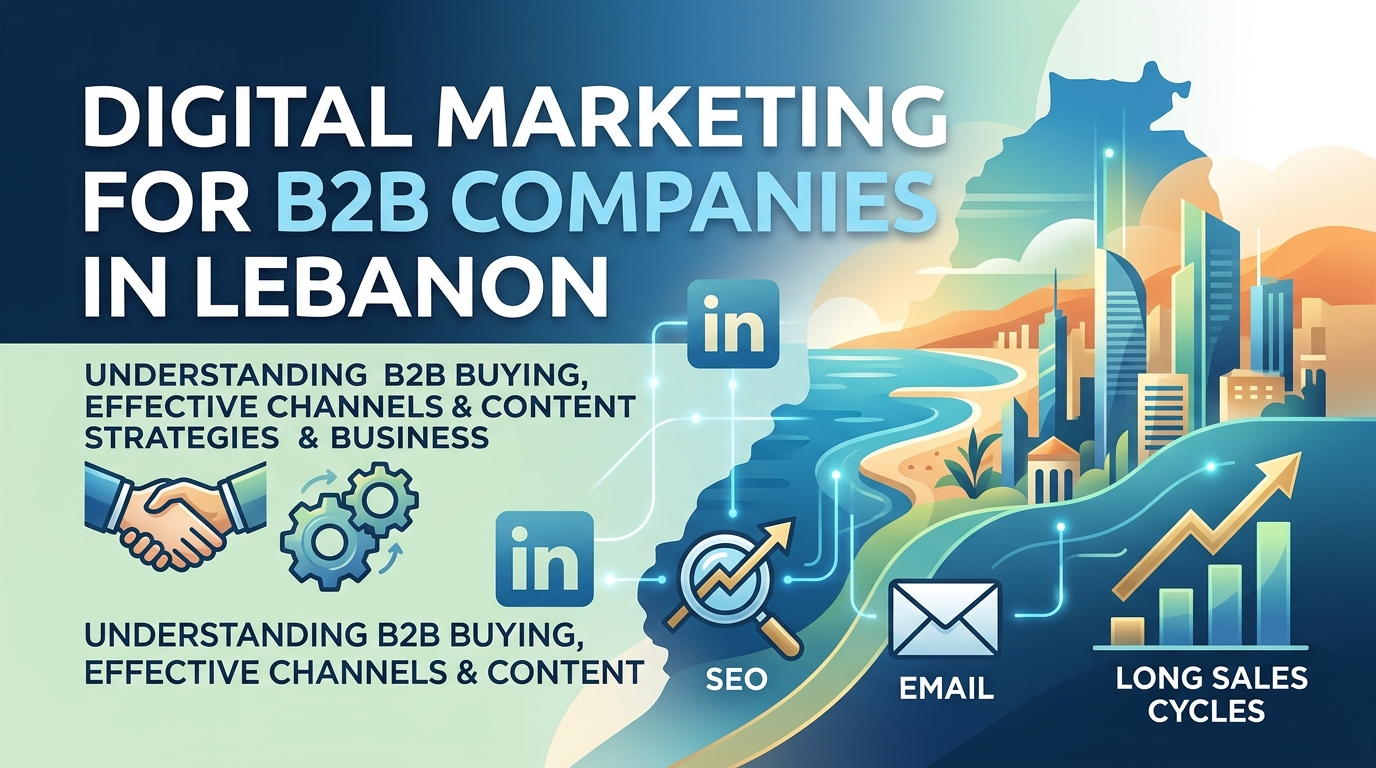
This guide covers how B2B buying differs from B2C in ways that directly shape marketing strategy, the channel priorities that actually work for B2B digital marketing Lebanon companies — LinkedIn, SEO, and email — the kind of content that supports a long sales cycle rather than trying to force a fast conversion, how account-based marketing fits into a Lebanese B2B context, and how to measure success across a genuinely long buying process.
How B2B Buying Differs From B2C?
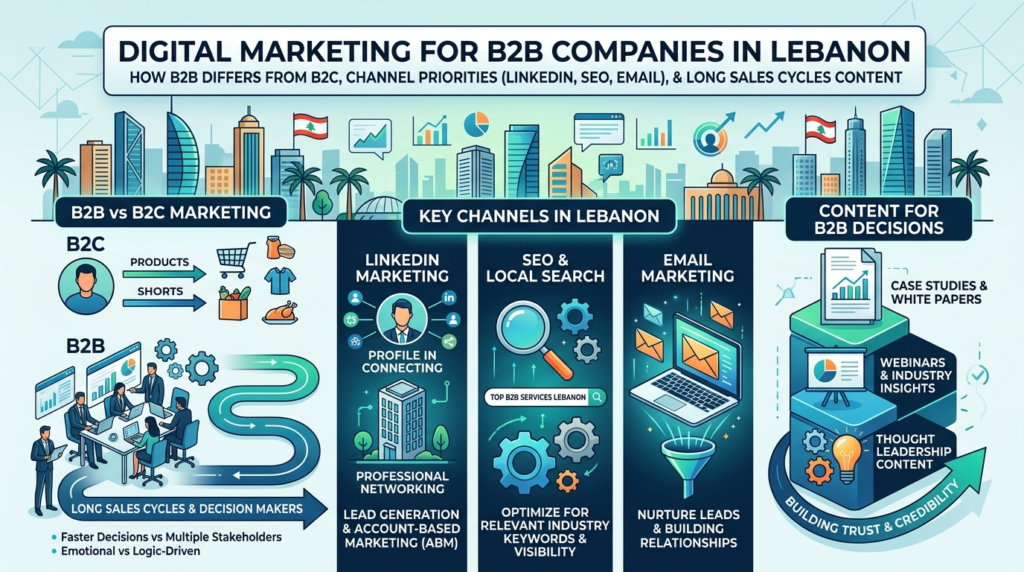
B2B purchasing decisions typically involve multiple stakeholders rather than a single decision-maker — a technical evaluator assessing whether a solution actually works, a financial approver weighing cost against budget, and an executive sponsor concerned with strategic fit, each with different priorities and different content needs throughout the same buying process. This means B2B digital marketing Lebanon companies invest in needs to address several distinct audiences within the same target account, rather than assuming a single message or a single piece of content can satisfy everyone involved in the decision.
Sales cycles in B2B routinely stretch across weeks or months rather than the minutes or days typical of most consumer purchases, which means marketing’s job shifts from driving an immediate transaction toward nurturing a relationship and building trust incrementally over that entire extended timeline. A B2B marketing strategy measuring success purely by immediate conversions misses most of what actually matters, since the real value often lies in staying relevant and top-of-mind through a sales cycle that a single ad campaign was never going to close on its own.
Channel Priorities for B2B in Lebanon
LinkedIn functions as the primary professional network for B2B decision-makers in Lebanon, making it one of the highest-value channels for reaching the specific job titles and industries a B2B company actually sells to, rather than the broad consumer audience most other social platforms are built around. Organic LinkedIn content — genuine industry insight, case studies, and thought leadership from company leadership — builds the kind of professional credibility that directly supports a long B2B sales cycle, while LinkedIn’s targeting capabilities allow paid campaigns to reach specific job titles, industries, and company sizes with a precision most other advertising platforms can’t match.
SEO
SEO matters significantly for B2B specifically because a meaningful share of the research phase in a long B2B buying process happens through search — a technical evaluator researching a specific solution category, a procurement team comparing vendors, someone on the buying committee simply trying to understand an unfamiliar topic before a meeting. Content built around the specific questions and comparisons a B2B buyer actually searches for during this research phase captures demand that paid advertising alone would miss entirely, and does so without ongoing per-click cost once that content is ranking.
Email remains one of the most effective channels for nurturing a B2B lead through a long sales cycle, since it allows a company to stay consistently present in a prospect’s inbox with relevant, valuable content over weeks or months without requiring that prospect to actively seek the company out each time. A well-structured email nurture sequence — sharing genuinely useful content, relevant case studies, and appropriately timed check-ins — keeps a company top-of-mind through a lengthy evaluation process far more effectively than a single initial outreach followed by silence until the prospect happens to reach back out.
Content That Supports Long Sales Cycles
Content addressing each stage of a long B2B buying process serves a genuinely different function at each point: early-stage content should focus on educating a prospect about a problem or opportunity they may not have fully framed yet, middle-stage content should help a prospect evaluate specific solutions and compare approaches, and late-stage content should address the specific objections and validation a final decision-maker needs before committing. A single generic piece of content trying to serve all three stages at once typically serves none of them particularly well.
Case studies and detailed client success stories carry outsized weight in B2B content specifically, since a prospective buyer evaluating a significant, considered purchase wants concrete evidence that a company has successfully solved a genuinely comparable problem for a genuinely comparable client, not just general claims about capability. Content addressing the technical or operational details a specialist stakeholder needs to evaluate a solution — not simplified marketing language, but genuinely substantive detail — signals the kind of expertise that builds credibility with the technical evaluators who often hold real influence over a B2B purchasing decision even when they aren’t the final approver.
Account-Based Marketing in a Lebanese Context
Account-based marketing — focusing marketing effort on a specific, defined list of target accounts rather than casting a broad net across an entire market — works particularly well for B2B companies in Lebanon given the market’s relatively concentrated set of large enterprises, manufacturers, and institutions in many B2B categories. Rather than running broad campaigns hoping to capture whichever unknown companies happen to be in-market, an account-based approach identifies the specific companies most likely to need a given solution and builds coordinated, multi-channel outreach — LinkedIn engagement, targeted content, direct email, even personalized landing pages — specifically for that defined list.
This concentrated approach tends to produce a stronger return than broad-market campaigns specifically in smaller, more concentrated markets like Lebanon, where the total addressable market for many B2B categories is genuinely limited enough that a company can realistically identify and directly target most of its realistic prospect universe rather than needing to reach an anonymous mass audience.
Measuring B2B Marketing Success Across a Long Cycle
Judging B2B digital marketing Lebanon efforts by immediate conversion volume alone misrepresents what’s actually happening, since most of the value in a long B2B sales cycle accrues incrementally through engagement, relationship-building, and pipeline progression rather than a single conversion event. Meaningful B2B metrics include marketing-qualified leads entering the pipeline, engagement from specific target accounts over time, and ultimately pipeline velocity — how efficiently accounts move through each stage of a long sales process rather than how many convert on a first touch.
Attribution across a multi-month, multi-touch B2B buying process is genuinely more complex than in consumer marketing, where a single ad click often leads directly to a purchase. A realistic B2B digital marketing Lebanon measurement approach tracks the cumulative influence of multiple touchpoints — a LinkedIn post, a piece of gated content, an email sequence, a direct sales conversation — across the full length of the buying process, rather than crediting only the final touchpoint immediately before a deal closes.
Frequently Asked Questions
Yes, particularly for organic content and targeted outreach, which can be pursued effectively even on a modest budget. Paid LinkedIn advertising is more expensive per click than most other platforms, making it worth reserving for the highest-value target accounts rather than broad campaigns.
This depends on the typical sales cycle for the specific product or service, but nurture sequences generally need to run for the full duration of that cycle — often several months — rather than a short initial burst followed by silence.
Both matter for different reasons and work well together — SEO captures active research demand over the long term, while LinkedIn builds relationships and credibility with specific target accounts more directly, and most effective B2B strategies invest in both simultaneously.
Not necessarily — many B2B companies run account-based marketing for their highest-value target accounts alongside broader content and SEO efforts that capture demand from companies outside that specific target list.
B2B content generally needs more substantive depth and technical credibility to satisfy specialist evaluators, and needs to address multiple stakeholders with different concerns throughout a longer decision process, rather than a single persuasive message aimed at one immediate buyer.
Ready to Build a B2B Strategy That Matches How Your Buyers Actually Decide?
B2B marketing succeeds by matching the long, multi-stakeholder reality of how B2B purchasing decisions actually happen. Book a free digital marketing consultation with Creative 4 All and build a strategy across LinkedIn, SEO, and email built around your specific sales cycle.