


A commercial construction project rarely gets decided by a single search and a single click — it gets decided over weeks or months, with a procurement manager or business owner researching several contractors, checking their past work, and often asking around before ever submitting a formal inquiry. SEO for construction companies in this environment looks nothing like SEO for a business selling a quick, low-consideration product, because the actual buying process it needs to support is long, deliberate, and heavily influenced by trust signals that take real work to build convincingly online.
This guide covers how construction buyers actually search differently from consumer audiences, how to build a portfolio-driven service page structure that reflects genuine project experience, local SEO considerations for contractors working across multiple sites, how to capture and qualify B2B leads from search traffic, and the kind of content SEO for construction companies needs to build trust with commercial buyers evaluating a contractor for a significant project.
How Construction Buyers Search Differently?
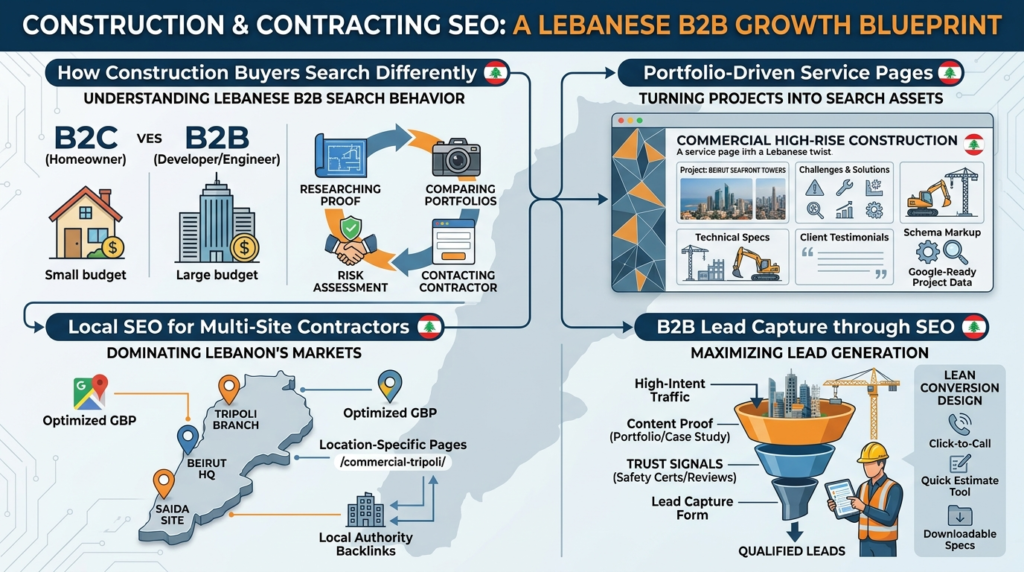
Construction and contracting searches skew heavily commercial and project-based rather than casual or exploratory — someone searching “commercial fit-out contractor Beirut” or “industrial construction company Lebanon” is typically already in an active procurement process, not casually browsing. This means SEO for construction companies can afford to be more directly commercial in its targeting than categories serving impulse or low-consideration purchases, since the search itself already signals meaningful buying intent.
Referral influence plays an outsized role in construction specifically, more than in most B2B categories — a procurement manager researching contractors online is very often verifying or supplementing a recommendation they already received through a professional network rather than discovering options from a cold search alone. This means a contractor’s online presence needs to hold up under scrutiny from a buyer who already has some context and expectations, rather than needing to win the entire decision through search visibility alone; the website’s job shifts from pure lead generation toward validating and reinforcing the trust a referral has already begun building.
Building a Portfolio-Driven Service Page Structure
For a construction company, past project work is the single most persuasive piece of content available, and service pages built around a real portfolio — actual completed projects with photos, project scope, and outcomes — perform fundamentally better than generic service descriptions listing capabilities without evidence. Each major service category (commercial construction, industrial fit-outs, residential renovation, whatever specific services the company offers) benefits from its own dedicated page structured around the specific project types and scale relevant to that service, rather than a single generic “our services” page trying to cover everything at once.
Project case studies deserve particular attention within this structure: a detailed case study covering a specific project’s scope, challenges, and outcome does more to build buyer confidence than a simple photo gallery, since it demonstrates not just visual results but the company’s actual process and problem-solving capability on a project genuinely comparable to what a prospective client is considering. Organizing the portfolio by project type and scale — rather than a single undifferentiated gallery — also directly supports the SEO goal of matching specific service pages to the specific searches procurement managers actually run.
Local SEO for Multi-Site Contractors
Contractors operating across multiple sites, service areas, or regional offices face a specific local SEO challenge that a single-location business doesn’t: each service area or office location genuinely benefits from its own dedicated local presence — a location-specific page, a properly configured Google Business Profile for that specific site, and consistent NAP information matching exactly across every location and directory listing — rather than a single generic company page trying to represent every service area simultaneously.
This matters directly because commercial buyers searching for a contractor often include a location qualifier in their search — “commercial contractor Tripoli,” “industrial construction Zahle” — and a company without location-specific content genuinely relevant to that search loses visibility to a competitor with a properly built local presence in that specific area, even if the multi-site company is equally or more capable of handling the project. Building this out systematically, one properly optimized location page per genuine service area, addresses a gap that’s particularly common among established construction companies that built their reputation through referrals long before local SEO became a meaningful factor in how buyers research contractors.
Capturing and Qualifying B2B Leads From Search Traffic
A contractor’s website needs a clear path for a genuinely interested procurement contact to actually initiate a conversation, and that path looks different from a typical consumer lead form. SEO for construction companies should account for the reality that a serious commercial inquiry usually involves project details a simple “contact us” form doesn’t capture well — project type, approximate scope or budget range, timeline, and location — and a more structured inquiry form collecting this information upfront helps a business development team prioritize and respond to leads more efficiently than a bare-bones contact form that requires a follow-up call just to understand what’s actually being requested.
Response time matters significantly in B2B construction lead handling, since a procurement manager evaluating several contractors in parallel often moves forward with whichever company responds first with a substantive answer, rather than waiting indefinitely for a slower competitor. Ensuring inquiries generated through organic search reach the right person quickly, with enough context to respond meaningfully on first contact, converts search traffic into an active conversation far more reliably than a lead that sits unanswered for days before anyone follows up.
Content That Builds Trust With Commercial Buyers
Beyond the portfolio itself, content addressing the specific concerns a commercial buyer actually has before committing to a contractor — safety certifications and track record, project timeline reliability, how change orders and scope adjustments are handled, insurance and bonding — directly addresses the due diligence questions a procurement process genuinely involves, rather than assuming the portfolio alone answers every question a buyer needs resolved. This kind of content signals a level of professionalism and process maturity that matters significantly in commercial procurement, where buyers are evaluating not just capability but reliability and risk.
Client testimonials specifically from the commercial or industrial clients a contractor is trying to attract carry more weight than generic praise, since a prospective buyer evaluating a contractor for a significant commercial project wants to see evidence of the company successfully handling comparable work for comparable clients, not just residential testimonials from an unrelated market segment. Content addressing common questions about the construction process itself — permitting, typical timelines for specific project types, how the company handles common challenges — further reinforces the sense that this is a company that genuinely understands the buyer’s actual situation rather than offering generic marketing language.
Frequently Asked Questions
Given the lower search volume and longer B2B sales cycles typical in construction, meaningful lead generation from SEO typically takes several months to build, though the leads that do come through tend to be well-qualified given how deliberately construction buyers search.
Yes — referral-based buyers frequently verify a contractor online before committing, which means a weak or outdated online presence can undermine an otherwise strong referral, making SEO valuable even for a referral-heavy business model.
Each genuine service area benefits from its own dedicated, location-specific page, since commercial buyers often search with a location qualifier and a single generic company page can’t compete effectively against location-specific content for that specific search.
Detailed case studies covering project scope, challenges, and outcomes for work genuinely comparable to what a prospective buyer is considering matter more than a simple photo gallery, since they demonstrate process and problem-solving capability, not just visual results.
The fundamentals are similar, but construction specifically benefits from portfolio-driven content and case studies given how visually verifiable the work is, and from strong local SEO given how often location qualifiers appear in genuine commercial construction searches.
Ready to Turn Your Project Portfolio Into a Lead Generation Asset?
Construction SEO succeeds by building the trust signals commercial buyers actually look for during a long, deliberate procurement process. Get a free SEO audit from Creative 4 All and find out exactly how SEO for construction companies like yours should be structured to capture qualified leads.