
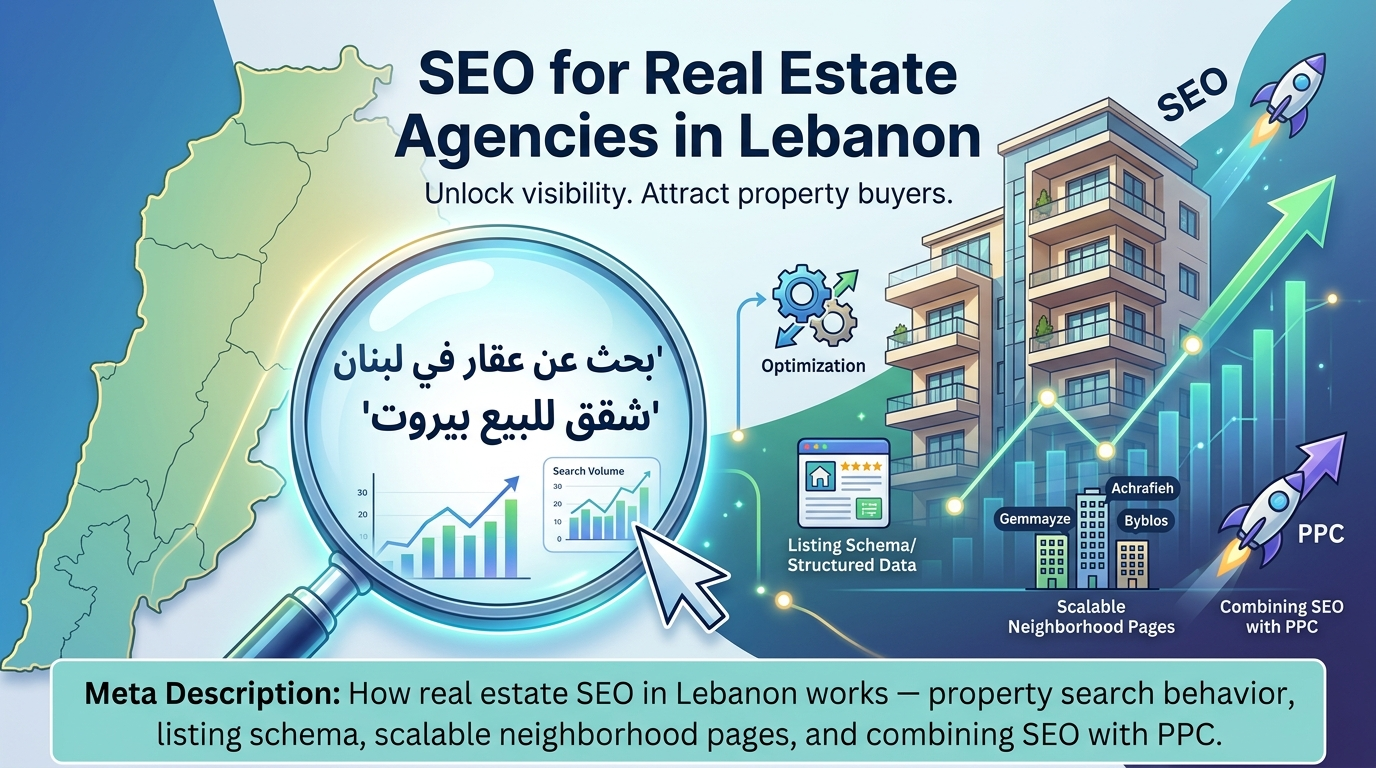
A property search rarely starts with a single generic term — it starts with a specific combination: “apartment for sale Achrafieh,” “villa for rent Beit Mery,” “office space Hamra.” Real estate SEO Lebanon agencies invest in needs to be built around this reality rather than treating property marketing like any other local business, since the actual search behavior driving real estate traffic is fundamentally combinatorial — neighborhood plus property type plus transaction intent, repeated across dozens of relevant combinations rather than a handful of broad keywords.
This guide covers how property buyers and renters actually search, what listing schema and photo optimization do for a property’s search visibility, how to build scalable neighborhood landing pages that capture this combinatorial search behavior, and how combining SEO with PPC produces faster lead flow while organic visibility compounds in the background for real estate SEO Lebanon agencies invest in.
How Property Buyers Actually Search?
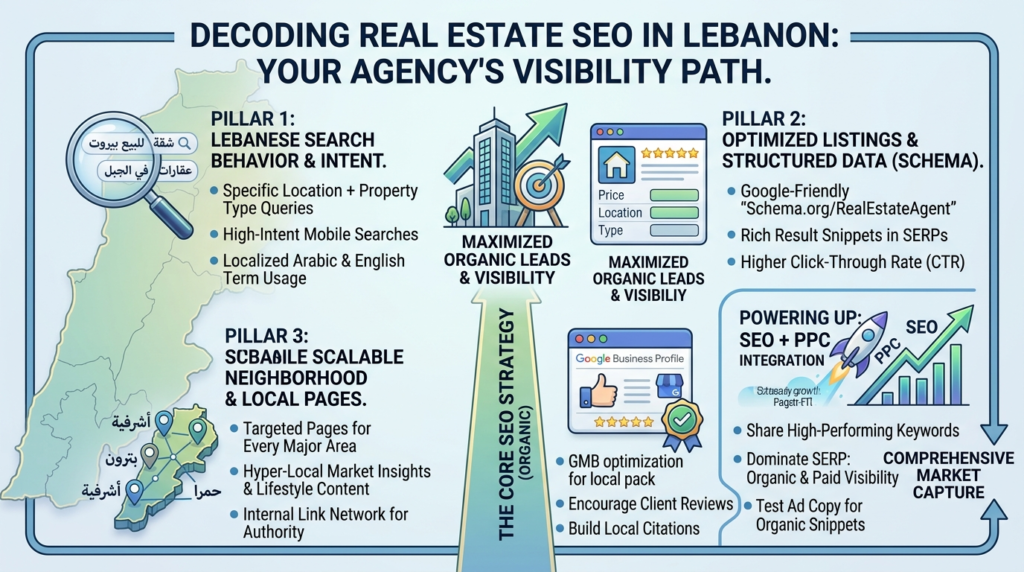
Real estate search behavior is defined by specificity in a way that distinguishes it from most other local business categories. A prospective buyer or renter rarely searches “real estate agency Lebanon” — they search for the specific neighborhood and property type combination that matches what they’re actually looking for: “3 bedroom apartment Jounieh,” “commercial space for rent Downtown Beirut,” “land for sale Metn.” This means a real estate agency’s SEO opportunity isn’t concentrated in one or two high-volume keywords, but spread thin across a genuinely large number of specific, lower-volume combinations that collectively represent significant total search demand.
This combinatorial pattern directly shapes what a strong real estate SEO Lebanon strategy actually requires: rather than optimizing a single generic “properties for sale” page and hoping it captures all of this varied search intent, an agency needs content structured around the specific neighborhood-and-property-type combinations that match how people actually search, since a generic page competing for a specific, high-intent combination search will consistently underperform a page built directly around that combination. Transaction intent adds a further layer of specificity worth accounting for directly — a search for a property “for sale” reflects a meaningfully different buyer mindset and timeline than one “for rent,” and content that conflates the two, or fails to clearly separate them, dilutes relevance for both search types rather than serving either one well.
Listing Schema and Photo Optimization
Structured data using Schema.org’s RealEstateListing markup gives Google explicit, machine-readable information about a property — price, location, property type, number of bedrooms, square footage — rather than requiring Google to infer these details from unstructured page text. Properly implemented listing schema can unlock rich results in search listings, displaying key property details directly in the search result itself, which meaningfully improves click-through rate for a listing competing against plainer, unstructured competitor pages.
Photo optimization matters directly for both user experience and technical SEO: descriptive, keyword-relevant file names and alt text help Google understand what each image actually shows, while properly compressed images keep page load speed fast despite the naturally image-heavy nature of property listing pages. A listing page with a dozen large, unoptimized images can suffer meaningfully on Core Web Vitals, which works directly against the same ranking goals the content itself is trying to achieve. Consistent, high-quality photography also directly affects conversion once a visitor lands on a listing, since real estate is a category where visual quality substantially influences whether a prospective buyer takes the inquiry seriously.
Building Scalable Neighborhood Landing Pages
Given the combinatorial nature of real estate search, a real estate agency’s SEO strategy needs a scalable system for producing neighborhood-and-property-type landing pages rather than manually building each one from scratch as a fully custom project. This connects directly to programmatic SEO principles: a well-structured template capturing the genuinely unique aspects of each neighborhood and property type — local amenities, price trends, transportation access, school proximity — populated systematically across each relevant combination, produces a large set of genuinely useful, differentiated pages far more efficiently than fully manual content production.
The key distinction between effective programmatic neighborhood pages and the kind of low-quality, templated content Google’s systems are increasingly good at identifying and suppressing is genuine differentiation: each page needs actual unique value specific to that neighborhood and property type, not the same generic paragraph with only the neighborhood name swapped out. A neighborhood page for Achrafieh apartments should read meaningfully differently from one for Jounieh villas — different amenities highlighted, different price context, different practical considerations relevant to that specific combination — rather than following an identical template that happens to auto-populate different location names.
Avoiding Duplicate Content Risk From MLS-Style Feeds
Agencies syndicating property data from a shared MLS-style feed or working with the same listings a competing agency also markets face a genuine duplicate content risk, since Google’s systems can flag near-identical listing descriptions appearing across multiple domains as low-value or duplicative. This matters directly for real estate SEO Lebanon agencies pursuing, since a syndicated listing description copied verbatim from a shared feed competes for ranking against every other site publishing that same description, with none of them gaining a meaningful advantage from content that isn’t genuinely unique to their site.
The practical fix is adding genuine, agency-specific value around any syndicated core listing data — original commentary on the property, neighborhood context written specifically for that agency’s audience, and a distinct presentation and page structure rather than reproducing the syndicated description as the entire page content. This transforms a page from a duplicate of the raw feed data into a genuinely differentiated asset that has its own legitimate reason to rank, even when the underlying property details are shared across multiple sites by necessity.
Combining SEO with PPC for Faster Lead Flow
Organic SEO for real estate is a genuinely valuable long-term investment, but it takes months to build meaningful visibility across the full range of neighborhood-and-property-type combinations a comprehensive strategy targets. Paid search campaigns targeting the same combinatorial search patterns — Google Ads for specific “[property type] for sale/rent [neighborhood]” searches — can generate immediate lead flow while the organic strategy builds toward its own compounding visibility over time.
This combination works especially well in real estate because paid campaigns can be precisely scoped to the highest-intent, most commercially valuable search combinations first, generating immediate ROI data that also informs which neighborhood-and-property-type pages deserve the most SEO investment and content depth. Rather than treating SEO and PPC as competing budget lines, a coordinated real estate strategy uses paid search performance data to prioritize organic content investment, and uses organic content to gradually reduce dependence on paid spend for the specific combinations that build strong enough organic rankings to compete without ongoing ad spend.
Frequently Asked Questions
Timelines vary by neighborhood competitiveness, but meaningful ranking movement for lower-competition neighborhood-and-property-type combinations typically appears within a few months, while more competitive, high-demand areas take longer to build sufficient authority and content depth.
Both matter, but individual listings typically have a shorter useful search lifespan since properties sell or rent and come off the market, which is why neighborhood-and-property-type landing pages — built to remain relevant regardless of any single listing’s status — usually deserve more sustained SEO investment than individual listing pages alone.
It’s risky only when pages lack genuine differentiation and read as templated, thin content. Real estate is actually well suited to programmatic approaches when each page reflects genuinely unique, neighborhood-specific information rather than a generic template with location names swapped.
Most agencies benefit from running both simultaneously rather than sequentially, since PPC generates immediate leads and performance data while SEO investment compounds toward reduced long-term dependence on paid spend for the same search combinations.
Both matter significantly — photos directly affect both technical SEO factors like page speed and the conversion rate once a visitor lands on a listing, while written content captures the specific search intent that brings that visitor to the page in the first place.
Ready to Turn Property Search Behavior Into Qualified Leads?
Real estate SEO succeeds by matching how buyers and renters actually search, not by treating property marketing like generic local business SEO. Get a free SEO audit from Creative 4 All and find out exactly how your real estate SEO Lebanon strategy should be structured to capture real search demand.