
A restaurant host answering the same three questions on repeat all evening — “are you open,” “do you have a table for four,” “what’s on the menu tonight” — represents exactly the kind of repetitive, predictable workload that pulls attention away from the guests who are actually in front of them. AI chatbots for restaurants address this directly, handling the volume of routine questions and requests that would otherwise consume staff time better spent on service, without losing the responsiveness guests expect from a hospitality business specifically.
This guide covers the common hospitality pain points chatbots actually solve, how WhatsApp-based ordering and reservation flows work in practice, how menu and availability automation keeps information accurate without manual updates, multilingual considerations specific to Lebanon’s market, and how to measure the impact on covers and revenue rather than treating chatbot adoption as an assumption of value.
Multilingual Considerations for Hospitality Chatbots
A chatbot serving Lebanese guests needs to genuinely handle Arabic, English, and French rather than assuming one language covers the actual guest base, since a hospitality business turning away or mishandling requests in any of these languages loses guests who’d otherwise have booked or ordered without friction. This means the chatbot’s underlying language handling needs to detect and respond naturally in whichever language a guest initiates contact with, rather than forcing a single default language and hoping guests adapt to it.
Menu items, descriptions, and any promotional content within the chatbot flow should be genuinely localized rather than mechanically translated, particularly for dish names or descriptions where a literal translation loses meaning or appeal that the original language conveys naturally. A guest ordering in Arabic should have the same clear, appetizing menu experience as a guest ordering in English, not a flattened or awkward version that feels like an afterthought to the primary language the business built its chatbot around.
Common Hospitality Pain Points Chatbots Solve
Reservation requests arriving across multiple channels — a phone call, a WhatsApp message, a walk-in, an Instagram DM — create a coordination problem where staff have to manually consolidate availability across all of them, risking double-booking or simply missing a request during a busy service. Repetitive questions about hours, location, menu items, dietary accommodations, and parking consume staff time answering the same handful of things dozens of times a day, time that’s particularly costly during peak hours when every minute of staff attention matters most.
Order-taking for delivery or takeout adds another layer of repetitive, error-prone manual work — writing down orders, confirming them back to the customer, and manually entering them into a POS system introduces exactly the kind of friction and error risk that AI chatbots for restaurants are well suited to eliminate, since automated order collection reduces both the staff time required and the chance of a miscommunicated order reaching the kitchen. During peak service hours, when phones ring constantly and staff are already stretched across dine-in, delivery, and walk-in demands simultaneously, this repetitive coordination work is often where service quality quietly starts to slip, even when the kitchen itself is operating smoothly.
WhatsApp-Based Ordering and Reservation Flows
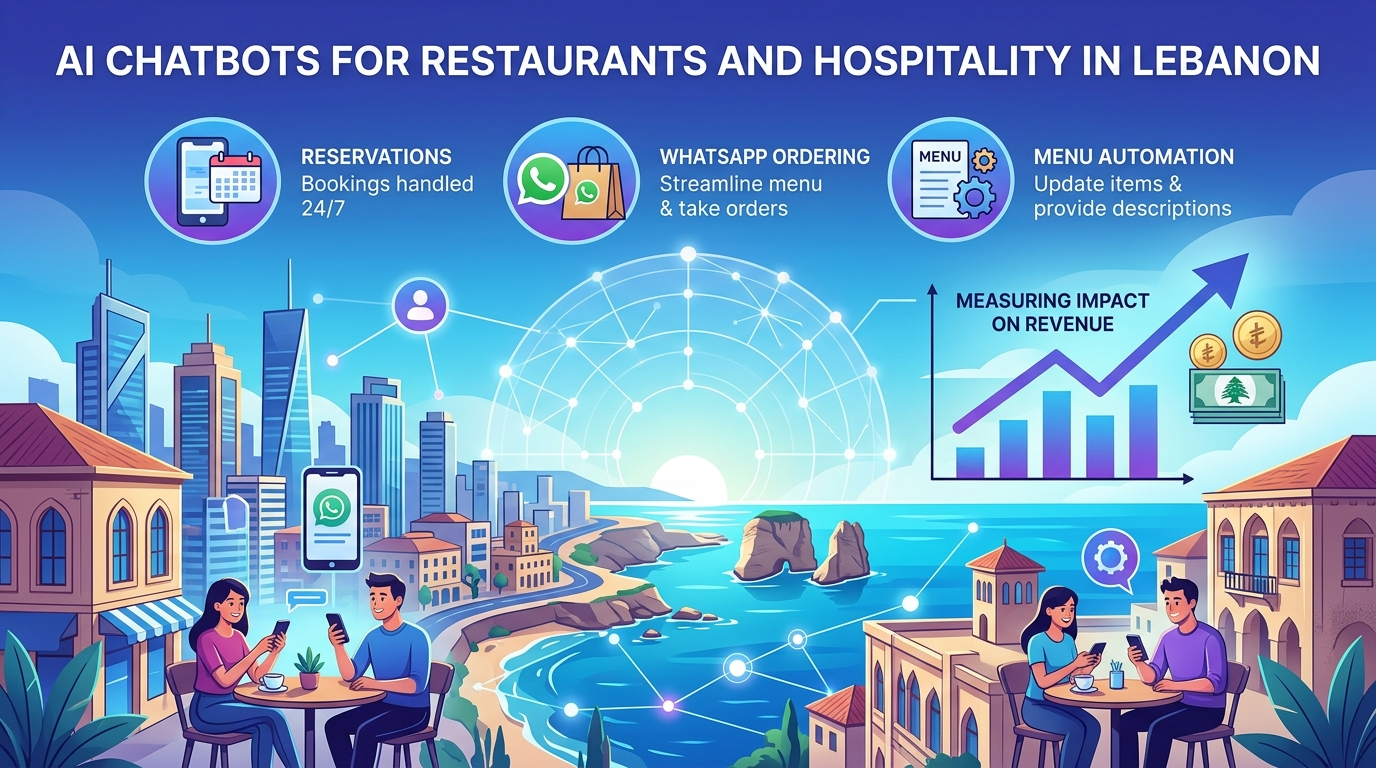
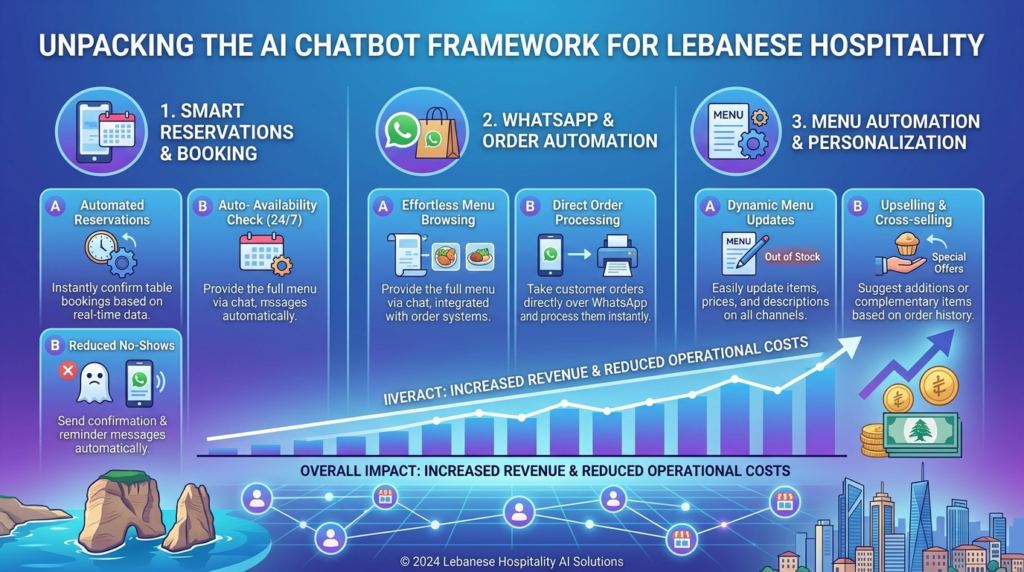
WhatsApp is the default channel for how Lebanese consumers already contact restaurants and hospitality businesses, which makes it the natural platform for automation rather than trying to redirect that established behavior toward a separate app or website form. A well-built reservation flow lets a guest specify party size, preferred date and time, and any special requests directly within WhatsApp, checking availability and confirming the booking without requiring a phone call or staff intervention for the straightforward majority of requests.
Ordering flows work similarly: a guest browses a structured menu presented conversationally, selects items, and completes an order — for delivery, pickup, or even in some cases dine-in ordering from the table — with the chatbot handling item availability, basic customization options, and order confirmation before that order routes to kitchen and staff systems. This kind of conversational commerce keeps the interaction feeling natural and low-friction for the guest while still capturing structured, accurate order data on the business side.
Menu and Availability Automation
Keeping menu information, pricing, and availability accurate across a chatbot, a website, and any delivery platform integrations is one of the more overlooked but consequential parts of hospitality automation, since a chatbot confidently quoting an outdated menu item or price creates a worse guest experience than having no automation at all. Automation that pulls menu and availability data from a single, centrally managed source — rather than requiring separate manual updates across every channel — keeps information consistent and reduces the ongoing maintenance burden on staff who would otherwise need to update multiple systems every time a dish changes or runs out.
Real-time availability updates matter specifically for items prone to running out during service — a limited daily special, a seasonal dish, a popular item that regularly sells out — since a chatbot that can reflect that unavailability immediately prevents the frustration of a guest ordering something no longer available and needing a follow-up correction.
Measuring Impact on Covers and Revenue
Adopting AI chatbots for restaurants should be evaluated against concrete business metrics rather than assumed to be valuable simply because it’s automation. Reservation completion rate — how many chatbot-initiated reservation conversations actually result in a confirmed booking — indicates whether the flow itself is working smoothly or losing guests partway through. Average response time to inquiries, compared against pre-automation staff response times during busy periods, shows whether automation is genuinely closing the gap where guests previously waited or gave up.
Order volume and average order value through the automated channel, tracked over time, reveal whether the chatbot is actually driving incremental business or simply shifting existing order volume from one channel to another. No-show rates for chatbot-booked reservations, compared against phone or walk-in bookings, indicate whether the automated booking experience produces guests as reliably committed as those who book through a more traditional channel. Reviewing these metrics regularly, rather than adopting automation once and assuming it continues working well indefinitely, keeps the investment genuinely accountable to actual business outcomes rather than treated as a set-and-forget technology purchase.
Frequently Asked Questions
Yes, when designed well — a chatbot can clearly communicate unavailability, offer alternative time slots, and even manage a waitlist, which is generally a better guest experience than an unanswered call or message during a busy service.
Preference varies, but many guests — particularly younger ones — prefer messaging over calling for straightforward requests like reservations, which is exactly why WhatsApp-based automation meets guests where they already default to communicating.
Well-designed chatbots handle common customization options — removing an ingredient, choosing a size, selecting from defined variations — reliably, though highly unusual or complex custom requests typically still route to staff for direct handling.
No. Automation handles the repetitive, predictable volume of requests, freeing staff to focus on service quality, complex requests, and the in-person hospitality experience that genuinely requires a human.
A focused implementation covering reservations, common questions, and basic ordering can typically be built and tested within a few weeks, with more complex integrations to POS or delivery platforms extending that timeline somewhat.
Ready to Let Automation Handle the Repetitive Work?
AI chatbots for restaurants free your staff to focus on the guests actually in front of them while handling the volume of routine requests automatically, without asking guests to trade the personal, responsive service hospitality depends on for a colder, more transactional experience. Book a free AI automation assessment with Creative 4 All and find out exactly what a chatbot could handle for your restaurant or hospitality business.