
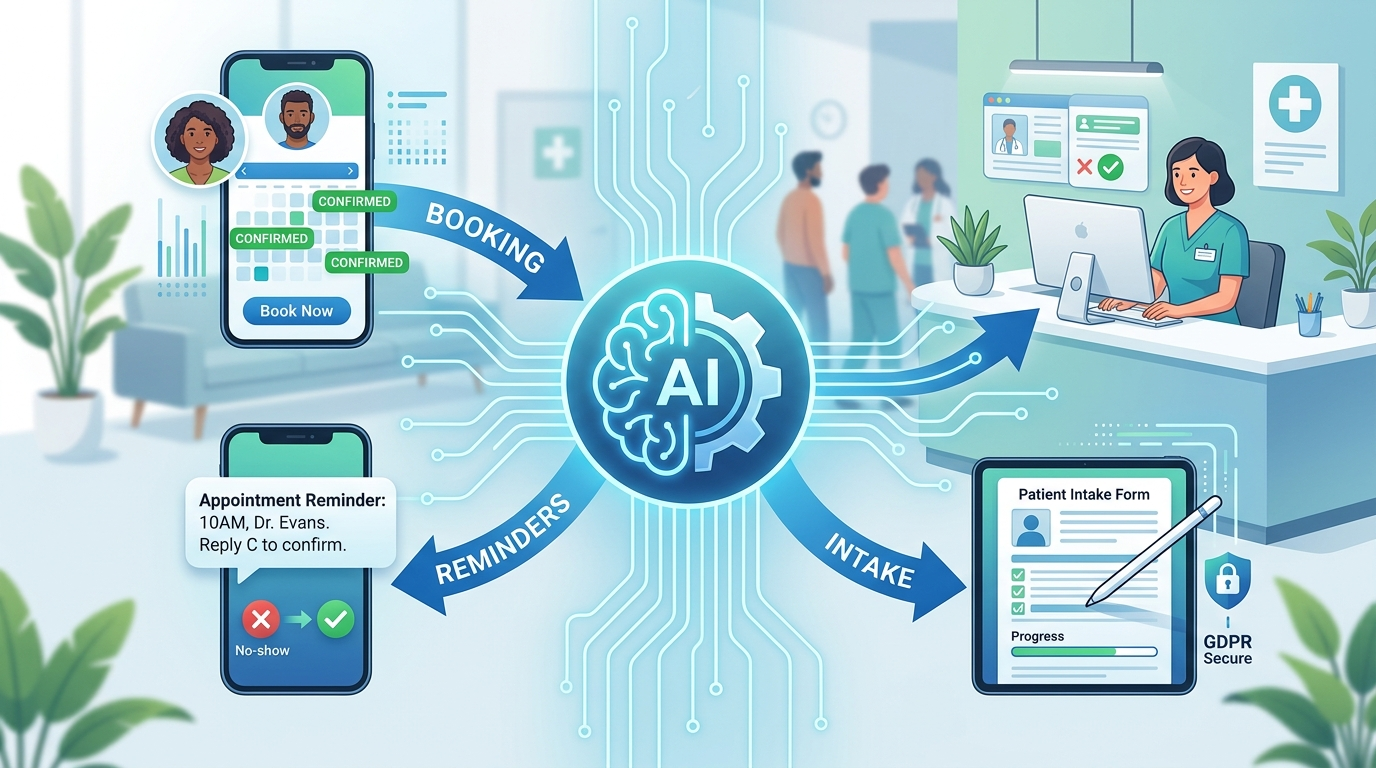
A missed appointment costs a clinic more than the lost visit itself — it costs the staff time spent scheduling it, the slot that could have gone to another patient, and the compounding effect of a schedule that never quite runs at full capacity because a predictable percentage of bookings simply don’t show up. AI automation for clinics addresses this directly, not as a futuristic add-on but as a practical fix for one of the most persistent and measurable operational problems a medical practice deals with day to day.
This guide covers the real cost of no-shows to a Lebanese clinic, how automated reminders and confirmations reduce that cost, how intake form automation saves staff time before a patient even arrives, the data privacy considerations that apply specifically to healthcare automation, and how AI automation for clinics integrates with existing systems rather than replacing them.
The No-Show Problem and Its Real Cost
No-shows are one of the most quietly expensive problems in clinic operations, precisely because the cost is distributed and easy to underestimate rather than showing up as a single obvious line item. Every missed appointment represents lost revenue for that slot, staff time already spent on scheduling and any pre-visit preparation, and an opportunity cost — another patient who could have filled that slot but wasn’t offered it because the clinic didn’t know in advance the original booking wouldn’t show. Over a full month, even a modest no-show rate compounds into a meaningful gap between a clinic’s scheduled capacity and its actual patient throughput.
Most no-shows aren’t a sign of patient disregard — they’re usually simple forgetfulness, a scheduling conflict that arose after booking, or uncertainty about whether the appointment was actually confirmed in the first place. This matters because it means the problem is genuinely solvable through better communication rather than requiring a fundamentally different scheduling approach, which is exactly where AI automation for clinics delivers a clear, measurable return.
Automated Reminders and Confirmations
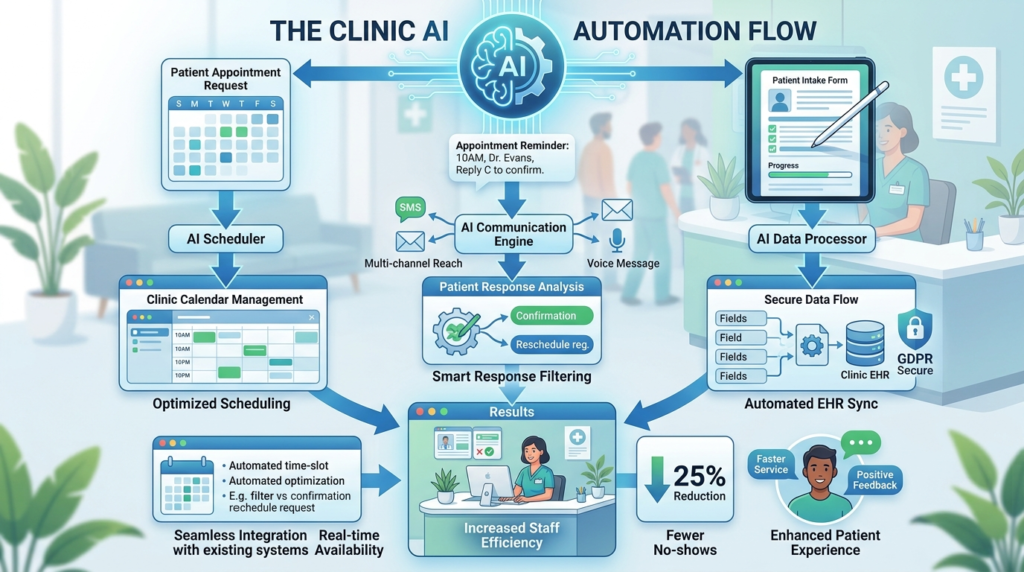
Automated appointment reminders sent via SMS or WhatsApp at strategically timed intervals — typically a few days before and again the day before or morning of — directly address the forgetfulness that accounts for a large share of no-shows, without requiring staff to manually track and send individual reminders for every booking on the schedule. A well-designed reminder system also makes confirming or rescheduling easy through a simple reply rather than requiring a phone call, which meaningfully increases the percentage of patients who actually engage with the reminder rather than ignoring it.
Confirmation requests built into the reminder flow serve a second function beyond reducing no-shows: a patient who explicitly confirms is more likely to actually show up than one who received a reminder but never engaged with it, and a patient who responds to reschedule opens that slot back up for another patient with enough advance notice to actually fill it. This turns a passive reminder into an active scheduling tool that gives clinic staff real, timely visibility into which appointments are genuinely confirmed versus uncertain.
Intake Form Automation
Collecting patient intake information — medical history, current symptoms, insurance details, consent forms — before a patient arrives rather than in the waiting room saves meaningful staff time and reduces the front-desk bottleneck that slows down the start of every appointment. Automated intake sent alongside appointment confirmation, completed by the patient on their own time before the visit, means clinical staff can review relevant information before the patient even walks in, rather than discovering it during the appointment itself.
This automation works best when the intake form itself is genuinely well-designed — appropriately scoped to what’s actually needed for that specific appointment type rather than a generic, overly long form that discourages completion, and accessible on mobile since most patients will complete it on their phone rather than a desktop computer. A shorter, well-targeted automated intake form completed by most patients beats a comprehensive one that gets abandoned halfway through.
Data Privacy Considerations for Healthcare Automation
Healthcare automation carries data privacy obligations that don’t apply to most other business categories, and these need to be addressed directly rather than treated as an afterthought layered onto a generic automation platform. Any system handling patient health information — appointment details, intake responses, medical history — needs genuine data protection measures: secure storage, restricted access limited to relevant staff, and clear policies around how long that data is retained and how it can be deleted if a patient requests it.
Automated communication itself needs to respect the same medical-ethics constraints that apply to any other patient-facing communication: reminders and confirmations should reference appointment details without disclosing sensitive diagnosis or treatment information in a message that could be seen by someone other than the intended patient, particularly over SMS or WhatsApp where message previews can display on a locked screen. Choosing an automation platform or vendor with genuine experience handling healthcare data, rather than a generic marketing automation tool repurposed for a clinic, meaningfully reduces the risk of a privacy misstep that a clinic can’t easily recover from once it happens.
How This Integrates With a Clinic’s Existing Systems?
Automation delivers the most value when it connects directly to a clinic’s existing appointment scheduling software rather than operating as a separate, disconnected system that requires staff to manually keep both in sync. A properly integrated system pulls appointment data directly from the scheduling platform to trigger reminders and confirmations automatically, and pushes confirmed intake responses back into the patient’s record without requiring manual data entry on either end.
For clinics without a sophisticated existing scheduling system, automation can sometimes justify upgrading to one as part of the same project, since the reminder and intake automation described here depends on having structured, accessible appointment data to work from in the first place. This is worth scoping honestly during any automation project: a clinic running scheduling purely through a paper calendar or an unstructured spreadsheet has a genuinely different starting point than one already using dedicated scheduling software, and the right automation approach reflects that difference rather than assuming a one-size-fits-all implementation.
Calculating the Real ROI of Clinic Automation
Evaluating AI automation for clinics starts with quantifying what a clinic is actually losing to no-shows and manual intake work today — the average number of no-shows per week multiplied by the average revenue per appointment slot, plus the staff hours spent weekly on manual reminder calls and in-person intake collection that automation would otherwise handle. This baseline number, calculated honestly before any automation investment, gives a clinic a real figure to compare against the ongoing cost of running an automated system, rather than adopting automation on faith that it will help.
Most clinics find that even a modest reduction in no-show rate, combined with the staff time reclaimed from manual reminder and intake work, produces a return that clearly outweighs the ongoing cost of AI automation for clinics within the first few months of implementation. This calculation also helps set realistic expectations: automation that reduces no-shows by a meaningful but not dramatic percentage is still a strong investment when weighed against the compounding cost of doing nothing, even if it doesn’t eliminate the problem entirely.
Frequently Asked Questions
The specific reduction varies by clinic and patient population, but automated reminders and confirmations reliably reduce no-show rates in most practices, since a meaningful share of no-shows stem from simple forgetfulness that a well-timed reminder directly addresses.
WhatsApp is generally preferred given how widely and consistently it’s used across the Lebanese market, though SMS remains a reliable fallback for patients without WhatsApp access or for messages requiring guaranteed delivery regardless of app status.
No. Intake automation collects information before a visit so clinical staff can review it in advance, but it doesn’t replace the actual clinical consultation, examination, or judgment that happens during the appointment itself.
Through secure storage, restricted staff access, and clear data retention and deletion policies, ideally implemented by an automation provider with specific healthcare data handling experience rather than a generic platform repurposed for medical use.
Yes. Even a small practice benefits from reduced no-shows and less front-desk time spent on manual reminders and intake collection, and the automation can be scoped modestly to match a smaller clinic’s actual volume and budget.
Ready to Reduce No-Shows and Streamline Patient Intake?
The cost of no-shows and manual intake processes adds up quietly every week a clinic operates without addressing them. Book a free AI automation assessment with Creative 4 All and find out exactly how much AI automation for clinics like yours could save in reduced no-shows and reclaimed staff time.