
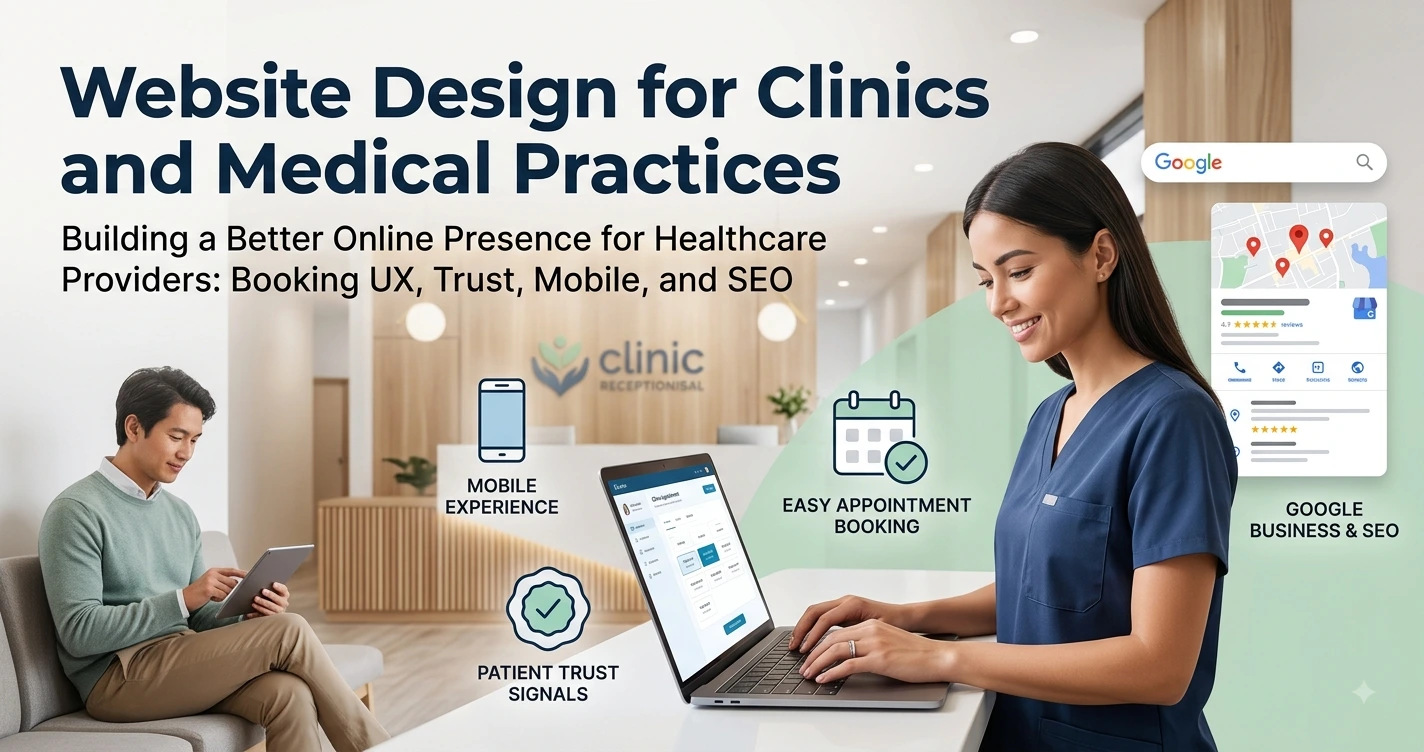
A patient searching for a new dentist or pediatrician in Lebanon typically has three or four clinic websites open in browser tabs at once, comparing them within seconds before deciding which one to actually call or book with. Medical website design carries a specific kind of pressure that a typical business website doesn’t face — a patient isn’t just evaluating whether a business looks professional, they’re evaluating whether they trust this specific provider with something as personal as their health, often while feeling some degree of anxiety or urgency that shapes how they experience the site itself.
This guide covers what patients actually look for in a clinic website, how appointment-booking UX affects whether a visitor becomes a patient, the trust and privacy signals that matter specifically for healthcare, mobile experience considerations given how patients search, and how medical website design should integrate with a clinic’s broader SEO and Google Business Profile presence rather than functioning as an isolated asset.
What Patients Actually Look for in a Clinic Website?
Patients researching a new provider are typically looking to confirm a small set of specific things quickly: does this clinic treat my specific concern or specialty, what are the credentials of the doctors or specialists on staff, where exactly is the clinic located and how accessible is it, and what will the actual visit and payment process look like. A clinic website that buries this information behind generic marketing language, or requires several clicks to find basic answers, loses patients to a competitor’s site that answers the same questions immediately and clearly.
This means medical website design should prioritize clarity and quick access to practical information over purely aesthetic considerations, even though visual polish still matters for building initial trust. A homepage that immediately communicates the clinic’s specialties, makes physician credentials easy to find, and provides a clear next step — book an appointment, call, get directions — serves a patient’s actual decision-making process far better than a beautifully designed page that requires scrolling and searching to answer the same basic questions.
Multilingual Considerations for Clinic Websites
Medical website design in Lebanon needs to account for a patient base that searches and communicates across Arabic, English, and French, and this affects more than just translating page text. Right-to-left Arabic layout requires specific design attention — form fields, navigation, and booking widgets all need to render correctly and remain equally easy to use in Arabic as in English, rather than treating the Arabic version as a secondary afterthought bolted onto an English-first design. A patient navigating an Arabic version of a clinic site that feels visually broken or awkward compared to the English version receives a subtly negative trust signal at exactly the moment trust matters most.
Booking forms and confirmation messages should also be available in the patient’s preferred language throughout the entire process, not just on the initial landing page, since switching languages mid-flow or receiving a confirmation in the wrong language creates confusion precisely when clarity matters most for someone about to share personal health information.
Appointment-Booking UX
The appointment-booking flow is often the single most consequential piece of UX on a clinic website, since it’s the exact point where a visitor either becomes a scheduled patient or abandons the process and looks elsewhere. A booking flow that asks for excessive information upfront, uses an unclear or multi-step process without indicating how many steps remain, or fails to clearly confirm that a request actually went through, loses patients who had already decided to book but got frustrated by friction in the process itself.
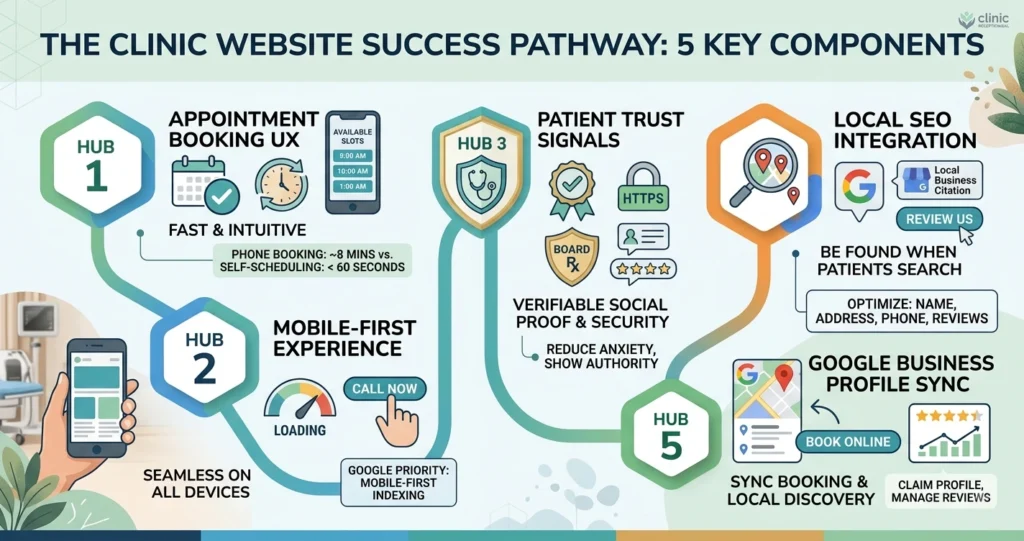
A well-designed booking experience minimizes required fields to genuinely necessary information, works cleanly on mobile devices given how much clinic-related searching happens on phones, offers clear next steps immediately after submission (a confirmation message, an expected response time, or direct integration with a real-time booking calendar where available), and provides an easy fallback — a visible phone number or WhatsApp contact — for patients who prefer speaking with someone directly rather than completing an online form, which remains a meaningful portion of the patient population in Lebanon regardless of how well the online flow is designed.
Trust and Privacy Signals for Healthcare Websites
Trust signals matter more in medical website design than in almost any other business category, since a patient is evaluating not just service quality but whether to share sensitive personal health information with this specific provider. Physician credentials, displayed clearly and specifically rather than vaguely, are one of the strongest trust signals available — a named doctor with their specific qualifications, rather than a generic “our team” description, gives a patient something concrete to evaluate. Patient testimonials, handled carefully to avoid referencing specific treatment details that could compromise privacy, reinforce that trust through social proof from people who’ve already made the same decision the visitor is currently considering.
Healthcare privacy notices — how patient information submitted through a contact form or booking system is handled, stored, and protected — matter both for genuine legal compliance and for the trust signal they send to a privacy-conscious patient. A clinic website that’s vague or silent about how personal health information is handled misses an opportunity to reassure exactly the kind of cautious, health-conscious visitor most likely to become a long-term patient once that initial trust is established.
Mobile Experience for Patients
Mobile traffic dominates clinic website visits even more than it does for many other business categories, since a patient often searches for a provider in the moment they need one — after noticing a symptom, during a work break, or while comparing options on the way to an already-scheduled but unsatisfactory appointment elsewhere. A clinic website that renders poorly on mobile, loads slowly, or requires pinching and zooming to read basic information loses exactly the patients most motivated to act quickly, since that frustration pushes them toward whichever competitor’s site actually works well on their phone.
Beyond basic mobile responsiveness, a genuinely mobile-optimized clinic site makes the phone number tappable to call directly, positions the booking call-to-action prominently without requiring extensive scrolling, and ensures any booking form or calendar widget actually functions cleanly on a small touchscreen rather than being a desktop-designed element that simply shrinks poorly onto mobile.
Integrating Website Design With SEO and Google Business Profile
A clinic website doesn’t function in isolation — it needs to work together with the clinic’s SEO strategy and Google Business Profile presence rather than existing as a disconnected asset. This means the website’s content should be built around the actual keywords and patient questions a clinic’s SEO strategy targets, rather than the site and content strategy being planned separately by different people with no coordination. Consistent NAP (name, address, phone) information across the website, Google Business Profile, and every medical directory listing directly supports local search visibility, and any inconsistency between these sources creates confusion for both patients and Google’s ranking systems.
The website should also make it easy for a patient who found the clinic through a Google Business Profile search to complete the same actions available there — booking, calling, getting directions — without friction, since a disconnected experience between the initial discovery point and the website itself loses patients at exactly the moment they were ready to take action. Treating website design and local SEO as a single, coordinated strategy rather than two separate projects handled independently produces meaningfully better results than either effort pursued in isolation.
Frequently Asked Questions
A clear, low-friction path to booking an appointment or making contact, since even the best content and design ultimately need to convert a visitor into a scheduled patient to actually matter for the practice.
Yes, when handled carefully to avoid referencing specific treatment details or diagnoses that could compromise patient privacy. General experience-focused testimonials build meaningful trust without those risks.
Site speed, mobile usability, and clear content structure all factor into how Google evaluates page quality, while consistent business information across the website and other listings directly supports local search visibility.
Both matter, but for a new patient with no prior relationship to the clinic, the website is often the first real signal of professionalism and trustworthiness they encounter, making it a genuine factor in whether they choose to book.
A simple, fast, clear website with an easy booking process outperforms a feature-heavy site that’s slow or confusing. Advanced features like real-time calendar integration add value only when they genuinely simplify the patient’s experience rather than adding complexity.
Ready for a Website That Actually Converts Patients?
A clinic’s website should work as hard as its SEO strategy to bring in new patients — clear, trustworthy, and genuinely easy to book through. Request a website quote from Creative 4 All and get medical website design built around how patients actually search, decide, and book.