
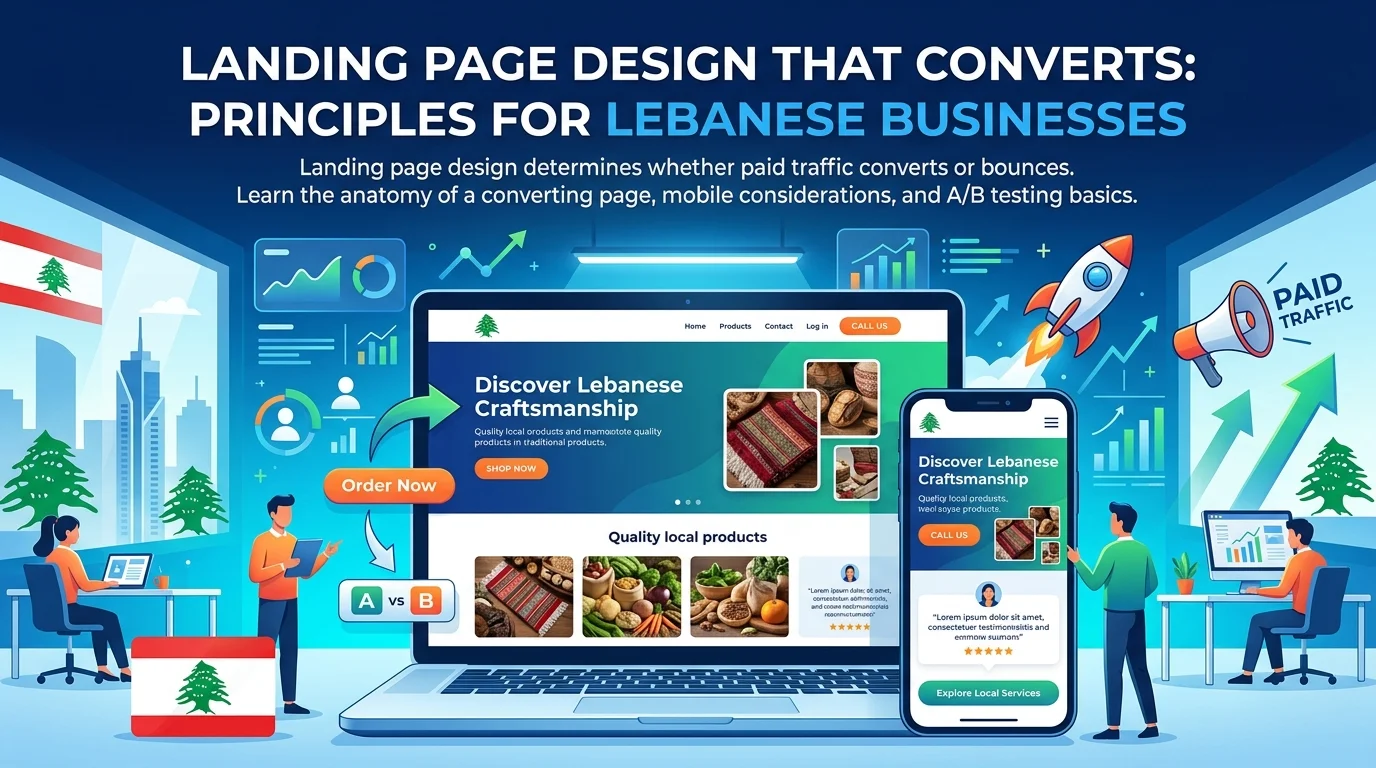
A common and costly mistake in paid campaigns is sending ad traffic straight to a homepage, then wondering why the click-through rate looked promising but conversions never materialized. A homepage is built to serve every visitor arriving for every possible reason; a landing page is built to serve one specific visitor arriving with one specific expectation set by the ad, email, or campaign that brought them there. Understanding landing page design as its own discipline, distinct from general website design, is what separates campaigns that convert from campaigns that simply generate traffic.
Why Campaign Traffic Needs a Dedicated Landing Page, Not the Homepage?
The Homepage Problem
A homepage typically presents multiple messages, multiple navigation paths, and multiple calls to action simultaneously, because it needs to serve visitors with entirely different intents — a first-time visitor exploring the business, an existing customer looking for support, a job seeker checking careers. A visitor who just clicked a specific ad promising a specific offer arrives at this homepage and has to work to find the thing they were actually promised, and that friction alone causes a significant share of visitors to simply leave.
What a Dedicated Landing Page Does Differently?
A dedicated landing page removes every distraction not directly relevant to the specific campaign that drove the visit — no general navigation menu, no unrelated content, no competing calls to action — presenting only the message and offer the visitor was promised and a single, clear path to convert. This focus is precisely why dedicated landing pages consistently outperform homepages for paid traffic: the visitor’s expectation and the page’s content match exactly, removing the cognitive work of figuring out where to go next.
Anatomy of a Converting Landing Page
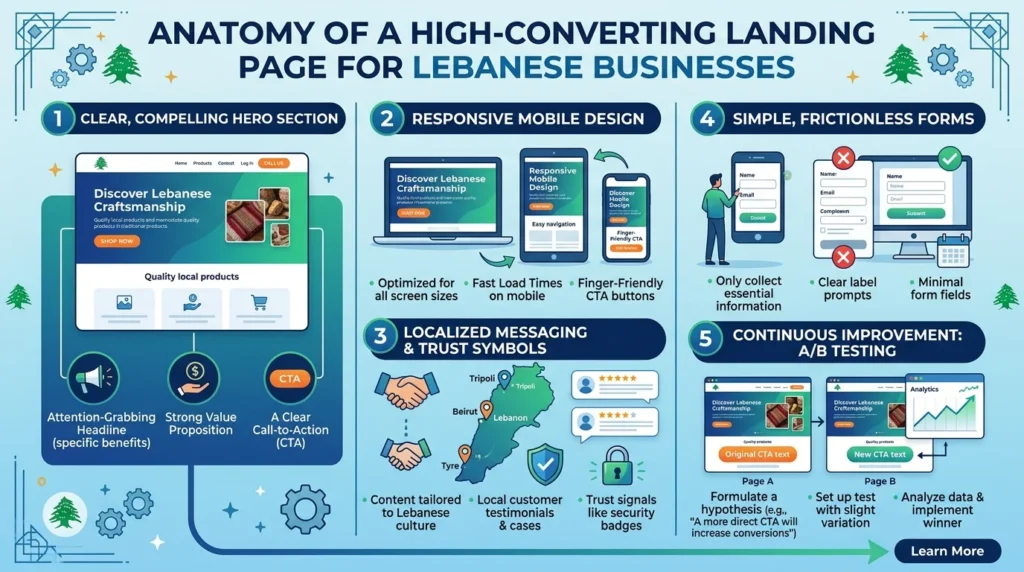
The Headline and Above-the-Fold Content
The headline and everything visible without scrolling — the above-the-fold content — needs to immediately confirm the visitor arrived at the right place and communicate the core value proposition within seconds. This section should directly echo the language and promise from whatever ad or link brought the visitor there, since a mismatch between what was promised and what the landing page actually says immediately raises doubt and increases bounce rate.
Social Proof
Testimonials, client logos, review scores, or specific results achieved for similar customers build the credibility a visitor needs before taking action, particularly for higher-consideration offers where trust matters more than for an impulse purchase. Placing social proof near the point where a visitor is deciding whether to convert — close to the form or call-to-action button — is generally more effective than burying it lower on the page where fewer visitors actually see it.
CTA Placement and Form Friction
The call-to-action button should be visually prominent, use action-oriented language specific to what happens next (“Get My Free Quote” rather than a generic “Submit”), and appear both above the fold and repeated further down the page for visitors who scroll before deciding. Form friction — asking for more information than genuinely necessary at this stage — is one of the most common conversion killers; a form requesting only a name and email typically converts meaningfully better than one requesting extensive details a business doesn’t actually need until a later stage of the relationship.
Mobile Landing Page Considerations
Simplifying for Small Screens
A landing page that works well on desktop often needs genuine simplification for mobile, not just automatic responsive scaling — shorter headlines, a more compact above-the-fold section, and a form with fewer fields to reduce the friction of typing on a small touchscreen keyboard. Given that a substantial share of paid campaign traffic arrives via mobile devices, treating mobile as an equal design priority rather than an afterthought directly affects overall campaign conversion rates.
Speed on Mobile Networks
Mobile landing pages need to load quickly even on slower mobile network connections, since paid traffic is expensive per click and a slow-loading page causes a meaningful share of that paid traffic to abandon before the page even finishes loading. Compressing images, minimizing unnecessary scripts, and testing actual load time on a real mobile connection rather than assuming desktop broadband speeds apply prevents this specific, costly failure mode.
A/B Testing Basics
What to Test First?
Testing headline variations and call-to-action button copy typically produces the largest, fastest-to-detect improvements, since these elements directly affect whether a visitor engages at all. Once these foundational elements are reasonably optimized, testing form length, social proof placement, and overall page layout can continue to produce incremental gains, though these later tests generally require more traffic to reach statistically meaningful results.
Avoiding Common Testing Mistakes
Testing too many elements simultaneously makes it impossible to attribute a result to any specific change, while ending a test too early based on an initial promising trend often produces a false positive that reverses once more data accumulates. Running one clear test at a time, with a large enough sample size to reach genuine statistical confidence before drawing conclusions, produces considerably more reliable optimization than frequent, hasty changes based on incomplete data.
What Separates High-Converting Landing Pages From the Rest?
A Single, Focused Conversion Goal
High-converting landing pages share one structural trait regardless of industry: a single, unambiguous conversion goal that every element on the page supports, rather than presenting a visitor with multiple competing actions to choose between. A page asking a visitor to simultaneously request a quote, download a guide, and follow the business on social media dilutes attention across three weaker asks rather than concentrating it on one strong one, and conversion rates typically suffer as a direct result.
Matching Message to Traffic Source
High-converting landing pages also match their tone, imagery, and specific language to the traffic source driving visitors there, rather than using one generic version for every channel. A landing page receiving traffic from a professional LinkedIn ad campaign often benefits from a more formal, business-focused presentation than the same offer promoted through a casual social media post, even when the underlying offer itself is identical.
Campaign Landing Page Best Practices Worth Following Consistently
Keeping Campaign and Page Messaging in Sync
One of the most consistently effective campaign landing page best practices is treating the ad copy and landing page copy as a single continuous message rather than two separate creative projects handled independently. When the specific phrase or promise used in an ad appears again on the landing page, visitors experience a sense of continuity that reduces doubt about whether they clicked the right link, which measurably improves conversion compared to a landing page that technically relates to the ad but doesn’t echo its specific language.
Building a Reusable Template Rather Than Starting From Scratch Each Time
Businesses running frequent campaigns benefit from developing a reusable, well-tested landing page template — with the core structure (headline placement, social proof section, CTA design) already proven to work — that can be adapted for each new offer rather than rebuilding the entire page from scratch every time. This approach preserves what has already been learned about what converts for that specific audience while still allowing the actual offer and messaging to change as needed.
Frequently Asked Questions
Generally yes, or at minimum for every distinct offer or audience segment, since the core value of a dedicated landing page comes from matching its message precisely to what a specific campaign promised. Reusing one generic landing page across multiple different campaigns undermines much of this matching benefit.
This depends on the offer’s complexity and price point — a simple, low-commitment offer (a free guide, a newsletter signup) typically converts well with a short page, while a higher-consideration offer (an expensive product, a significant service commitment) often benefits from more content addressing objections before asking for conversion. There is no universal ideal length independent of what is actually being offered.
This varies enormously by industry, offer type, and traffic quality, making a universal benchmark unreliable. Tracking a specific landing page’s conversion rate over time and testing against its own baseline is generally more useful than comparing against a generic industry average that may not reflect a comparable situation.
Generally no, or at minimum a significantly stripped-down version — full navigation gives visitors an easy path to leave the specific conversion flow the landing page was designed to drive, undermining the focused, distraction-free structure that makes dedicated landing pages effective in the first place.
This depends on the current conversion rate and the size of the difference being tested, but generally a test needs enough conversions on each variant (often several hundred) to reach statistical confidence rather than a result that could simply be random variation. Low-traffic landing pages often need to run tests longer to reach a reliable conclusion.
Ready to Build Landing Pages That Actually Convert?
Landing page design determines whether the traffic a campaign generates actually turns into leads or customers, or simply bounces away. Creative 4 All builds dedicated, conversion-focused landing pages for businesses across Lebanon and the GCC, built specifically to support PPC and digital marketing campaigns rather than repurposing a generic homepage. Request a Website Quote to discuss a landing page built for your next campaign.