
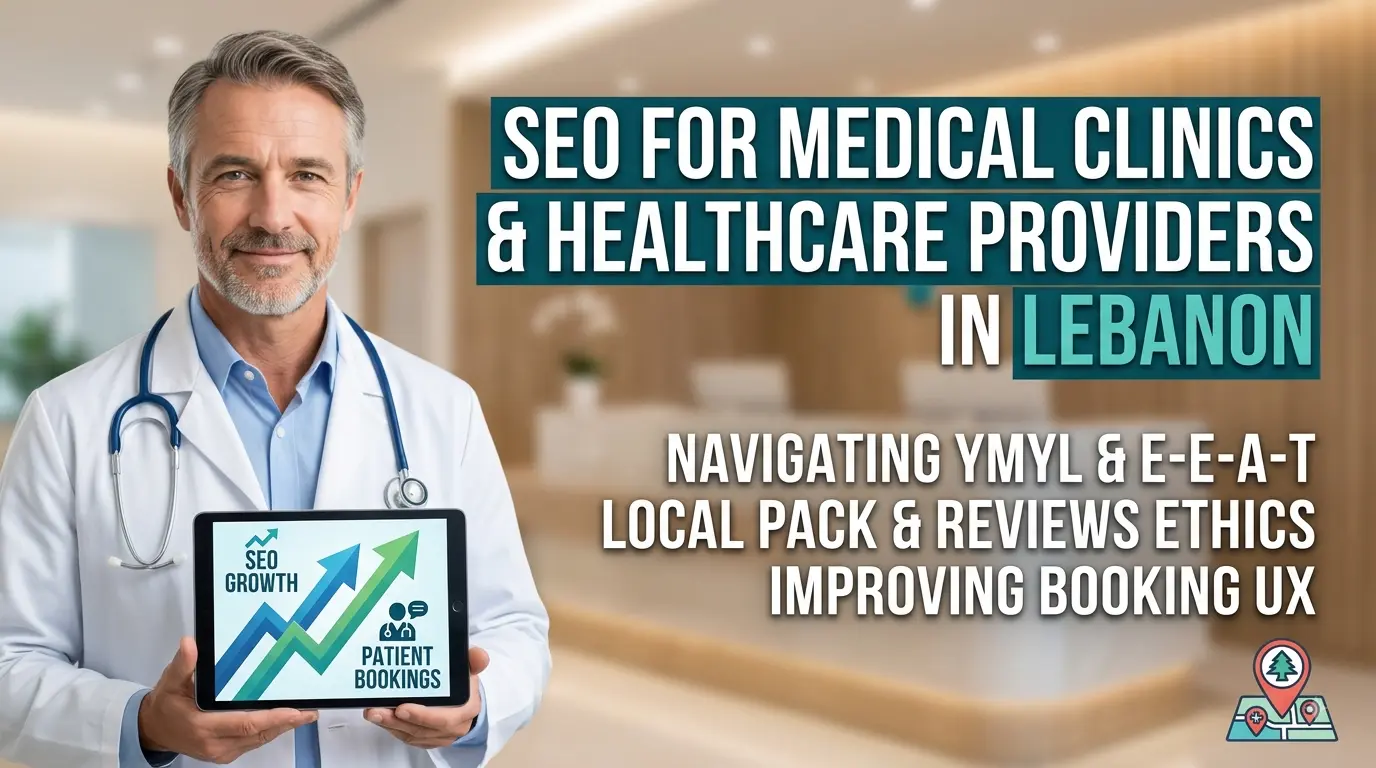
Search “dentist near me” or “pediatrician Beirut” and the results that appear reflect one of the most heavily scrutinized categories in all of Google’s ranking systems. SEO for clinics Lebanon requires a fundamentally different approach than SEO for a retail business or a marketing agency, because healthcare content falls under what Google explicitly classifies as Your Money or Your Life content — pages where inaccurate information carries genuine potential to harm a reader, and where Google’s quality standards are correspondingly stricter than almost any other category.
This guide covers why healthcare SEO plays by different rules, how to win the local pack for a clinic specifically, how to build content that satisfies both patients and Google’s E-E-A-T standards simultaneously, how to generate patient reviews within medical-ethics constraints, and how appointment-booking UX connects directly to SEO for clinics Lebanon performance.
Why Healthcare SEO Is Different?
YMYL and Its Ranking Implications
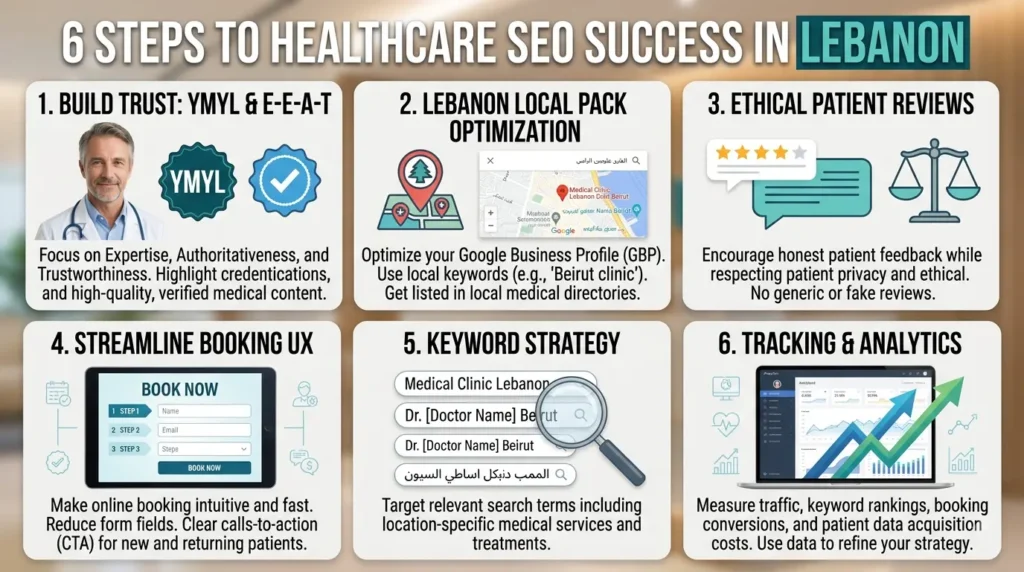
Google’s Search Quality Rater Guidelines classify medical and health content as Your Money or Your Life (YMYL) — a category where content quality standards are held to a meaningfully higher bar than general topics, since inaccurate medical information can genuinely harm a reader’s health or wellbeing. This isn’t a separate ranking algorithm applied only to healthcare sites, but it does mean the same E-E-A-T signals that matter for any site — expertise, experience, authoritativeness, trustworthiness — carry disproportionate weight for SEO for clinics Lebanon specifically, and weak signals that a lower-stakes category might tolerate can meaningfully suppress a healthcare site’s visibility.
Medical E-E-A-T Specifically
Medical E-E-A-T requires demonstrable clinical expertise behind published content — genuine physician or specialist authorship, verifiable credentials, and content that reflects real clinical knowledge rather than generic health information assembled from other websites. A clinic publishing content under an anonymous “admin” byline, or content that reads as generically sourced rather than written or reviewed by an actual clinician, faces a real disadvantage against competitors publishing content with clear, verifiable medical authorship, regardless of how well-written the content itself might be.
Multilingual Considerations for Healthcare Content
SEO for clinics Lebanon providers need to plan for often serves patients across Arabic, English, and French simultaneously, and E-E-A-T standards apply independently to each language version of a page rather than assuming strong English content automatically carries the same trust signals into its Arabic translation. An Arabic version of a clinical content page that loses the author attribution, credentials, or level of clinical specificity present in the English original effectively resets the trust signal for that version, even when the underlying medical information is accurate.
This means genuine localization — not mechanical translation — matters specifically for medical content, since patients searching in Arabic deserve the same clinically authored, credential-backed content as patients searching in English, and Google’s systems evaluate each language version on its own merits. Clinics serving a genuinely multilingual patient base, which describes most practices in Lebanon, should budget for this as a real content requirement rather than an afterthought handled through basic translation once the English version is complete.
Winning the Local Pack for Clinics
Google Business Profile optimization matters more for a clinic than almost any other business category, since the local pack — the three map-based results Google shows above organic listings for location-based searches — is often where a patient searching for a nearby provider makes their first real decision. A complete, accurate profile includes correct clinic categories (matching medical specialty precisely rather than a generic “doctor” label), accurate hours including any variation for specific services, a clinic address that matches exactly across the website and every directory listing, and photos showing the actual practice, team, and facility rather than generic stock imagery.
Category precision matters more for medical practices than most other business types, since a patient searching for a pediatric dentist is genuinely served by a search result matching that specific specialty rather than a general “dentist” category that could apply to any practice. Reviewing and correcting category selection, along with ensuring NAP (name, address, phone) consistency across the website, Google Business Profile, and every medical directory the clinic appears in, addresses one of the most common and most fixable local SEO gaps among Lebanese healthcare providers.
Content That Satisfies Both Patients and Google’s E-E-A-T Standards
Content built around actual patient questions — what to expect during a specific procedure, how to prepare for an appointment, what symptoms warrant a visit — serves genuine search intent while also demonstrating the clinical expertise E-E-A-T rewards, provided that content is written or reviewed by a qualified clinician rather than assembled purely from other websites. Author bylines matter directly here: content attributed to a named physician or specialist, with their credentials clearly stated, gives both patients and Google’s systems something concrete to evaluate that an anonymous or generic byline cannot provide.
Content should avoid making specific medical claims that overstate certainty — outcomes vary by patient, and content that reads as overly promotional or that promises specific results risks both an E-E-A-T penalty and genuine ethical concerns around medical advertising. The strongest healthcare content strikes a balance: genuinely informative, written with real clinical authority, but appropriately measured in how it discusses outcomes, since that measured tone itself functions as a trust signal rather than a limitation.
Generating Patient Reviews Within Medical-Ethics Constraints
Patient reviews are one of the strongest trust signals available to a clinic, both for Google’s local ranking systems and for a patient comparing providers, but generating them requires navigating real medical-ethics and privacy constraints that don’t apply to most other business categories. Requesting a review must never reference specific treatment details or diagnoses, since doing so risks a patient privacy violation regardless of whether the patient themselves brought it up in their review — a simple, generic request to share their experience is both compliant and generally more effective than a request referencing specific clinical details.
Timing matters directly: requesting a review immediately after a positive interaction — following a successful appointment, at natural high-satisfaction moments — produces better response rates than a generic, delayed request sent through an unrelated email campaign. Clinics should never offer any form of incentive for reviews, since this violates both Google’s review policies and generally accepted medical marketing ethics, and should have a clear, respectful process for responding to negative reviews that addresses the concern professionally without revealing any patient-specific information in the public response.
Appointment-Booking UX and Its Connection to SEO
A clinic’s appointment-booking flow directly affects SEO performance in ways that aren’t always obvious: a slow or confusing booking process increases bounce rate and reduces the on-page engagement signals that factor into how Google evaluates page quality, while a smooth, fast booking flow keeps visitors engaged and improves the conversion metrics that validate a page’s relevance for the searches driving that traffic in the first place. Beyond the direct SEO connection, a difficult booking experience simply loses patients who found the clinic through search but abandoned the process before actually scheduling, wasting the visibility work that brought them there in the first place.
A properly optimized booking flow minimizes required fields to what’s genuinely necessary, works cleanly on mobile devices given how much clinic-related search happens on phones, and clearly communicates what happens after a request is submitted rather than leaving a patient uncertain whether their appointment request actually went through. Clinics running online booking systems should also ensure those systems don’t create duplicate or thin pages that dilute the site’s overall content quality signals, since some booking platforms generate low-value pages that can quietly work against the broader SEO effort if left unmanaged.
Frequently Asked Questions
Not literally every piece, but content addressing genuine clinical topics benefits significantly from clear physician or specialist authorship or review, since anonymous or generic authorship is one of the clearest gaps Google’s systems can identify in YMYL content specifically.
The fundamentals are similar — Google Business Profile optimization, NAP consistency, local citations — but category precision matters more for clinics given how specifically patients search for particular specialties, and review generation requires navigating medical-ethics and privacy considerations that don’t apply to most other business categories.
Yes, if the request references specific treatment details, offers any incentive, or otherwise violates Google’s review policies or medical advertising ethics. A simple, generic request sent at the right moment, with no incentive attached, is both compliant and effective.
Timelines follow the same general pattern as other SEO work — meaningful movement typically over three to six months — though YMYL categories can sometimes take slightly longer to build the trust signals Google weighs particularly heavily for healthcare content.
Regular, genuinely useful content addressing real patient questions supports both search visibility and E-E-A-T signals over time, provided it’s written or reviewed by qualified clinical staff rather than published purely to hit a content quota.
Ready to Build an SEO Strategy That Meets Healthcare’s Higher Bar?
Medical SEO requires meeting a stricter standard than most categories, and getting SEO for clinics Lebanon right pays off directly in both rankings and patient trust. Get a free SEO audit from Creative 4 All and find out exactly where your clinic’s search visibility and E-E-A-T signals stand today.