Many Arabic websites in Lebanon and the Gulf share the same story. The English site came first, a translator converted the pages into Arabic a few months later, and the Arabic version has quietly underperformed ever since. The words are correct, but the pages target phrases nobody searches for, use spellings that miss common variants and read like translations rather than content written for an Arabic speaker.
Arabic SEO is not English SEO with the text swapped. Arabic has spelling variants that change how words are matched, a gap between formal written Arabic and the dialects people actually type, loanwords that compete with Arabic terms, and right-to-left layouts that affect both usability and technical setup. This guide covers what makes Arabic SEO different, how to research Arabic keywords, how to optimise pages and URLs, and how to measure results in Lebanon and the GCC.
Why Arabic SEO Is Different?
Three features of the language shape almost every Arabic SEO decision.
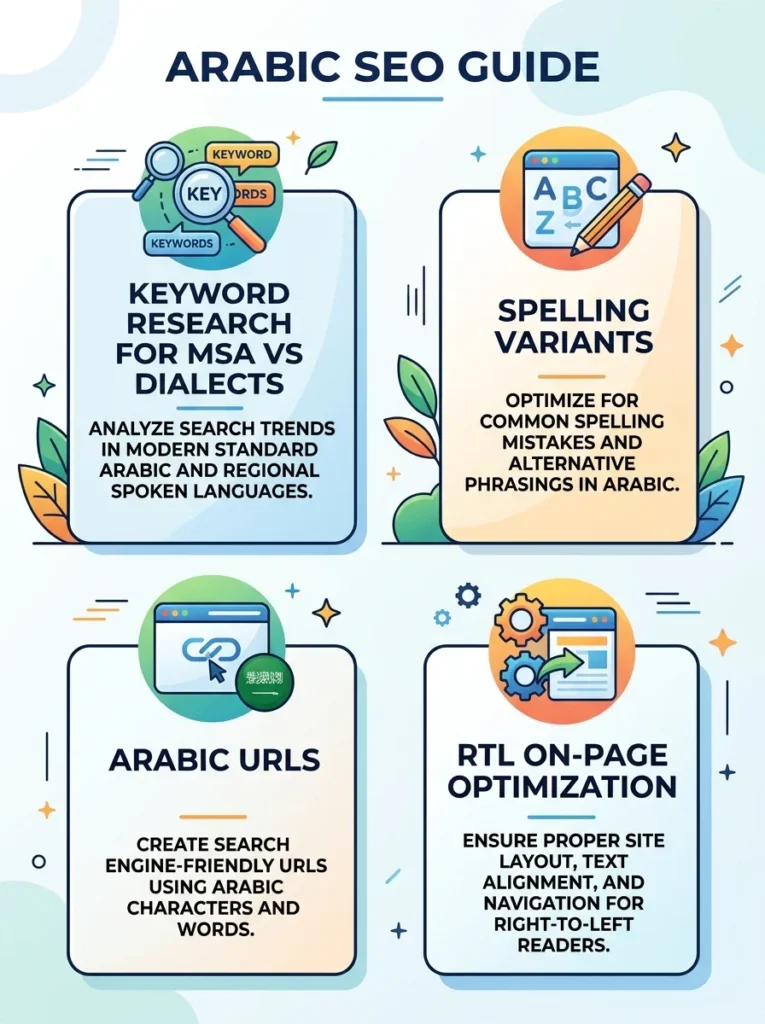
The first is diglossia: the coexistence of Modern Standard Arabic (MSA), used in formal writing, and many spoken dialects. People increasingly type in dialect, especially in Lebanon and the Gulf, yet most websites write only in MSA. A Lebanese user might search “قديش سعر تصميم موقع” (dialect for “how much does a website design cost”), while a page is optimised only for “كم تكلفة تصميم موقع إلكتروني.”
The second is spelling variation. The same word can be written in several valid or common ways, particularly with hamza forms (أ، إ، آ، ا), the final taa marbuta (ة or ه) and the final alef maqsura (ى or ي). Users often type the simplest form on a phone keyboard.
The third is mixed vocabulary. Many marketing and technology terms have both an Arabic form and a widely used loanword: “تحسين محركات البحث” and “سيو,” “التسوق عبر الإنترنت” and “أونلاين.” Some users even search in Arabizi, Arabic written in Latin letters. Together these features mean that Arabic keyword targeting requires more research, not less.
Arabic Keyword Research: Finding How People Really Search
Good Arabic keyword research starts from real search behaviour rather than translated English keyword lists. Literal translation is the single biggest cause of weak Arabic pages, because the translated phrase is often not the one people type.
Start With Intent, Then Find the Phrasing
Write down what the customer wants, then find every way they might express it. For a web design agency, one intent (“I want to know the price of a website”) might appear as MSA, Lebanese dialect, Gulf phrasing and a loanword-heavy version. Search each phrasing in Google with your target country selected, note the autocomplete suggestions and look at which pages rank. That shows which phrasing Google associates with the intent and which competitors serve it.
Use Tools, but Treat Arabic Data Carefully
Keyword tools and Google’s Keyword Planner provide Arabic data, but coverage for smaller markets such as Lebanon can be thin, and volume figures for dialect or spelling variants may be missing or merged. Combine tools with Google autocomplete, “People also ask” boxes, related searches and, above all, your own Search Console data. Our guide to keyword research for Lebanese businesses covers the broader process.
Check Spelling Variants in the Results
Google often understands that variants refer to the same word, but results are not always identical. Search the main variants of your key phrases, such as forms with and without hamza or with ة versus ه, and compare the results. If they differ significantly, mention the important variants naturally in your content, for example once in the body text and once in an FAQ, rather than forcing every form into the title.
Map Dialect Keywords to the Right Pages
Dialect phrasing tends to dominate conversational and price-related searches, while MSA dominates formal and informational ones. Use MSA as the backbone of your pages, which keeps content readable across all Arabic markets, and include common dialect phrasings where they fit naturally: in FAQs, headings that echo real questions, and local service pages. If you target both Lebanon and Saudi Arabia, remember that everyday words differ: a mobile phone is commonly “خلوي” or “تلفون” in Lebanon but “جوال” in Saudi Arabia.
On-Page Arabic SEO Best Practices
Once you know the target phrases, apply these Arabic SEO best practices on every page.
Titles and Meta Descriptions
Put the primary phrase near the start of the title tag, just as in English. Arabic letters vary in width, and Google truncates titles by display width, so keep Arabic titles concise, generally in the same range of characters you would use for English, and check the preview. Avoid diacritics (tashkeel) in titles and descriptions; they rarely help matching and can clutter snippets. Write meta descriptions in natural, persuasive Arabic with a clear benefit and call to action.
Headings and Body Content
Use one H1 with the primary phrase, and H2 and H3 headings that reflect real questions people ask. Write the content natively for Arabic readers rather than translating sentence by sentence: Arabic paragraph structure, examples, currencies and references should feel local. A page for Lebanese readers should mention Lebanese cities, payment habits and examples; a page for Saudi readers should feel Saudi. Thin translated pages are a common reason Arabic content fails to index or rank, as we explain in our guide to multilingual SEO.
Language and Direction Markup for Arabic SEO
Set the page language and direction correctly in the HTML:
lang="ar"
and
dir="rtl"
on Arabic pages. Use hreflang to connect Arabic pages with their English and French equivalents; use
ar
for Arabic aimed at all markets, or regional codes such as
ar-LB
or
ar-SA
only when you genuinely create different versions for different countries. Add
inLanguage
to Article or WebPage structured data.
Arabic URLs: Arabic Script, Transliteration or English?
URL slugs are one of the most debated SEO for Arabic websites questions. There are three options, each valid if applied consistently.
Arabic-script slugs (for example /ar/blog/تصميم-مواقع/) match the language of the page and look natural in Arabic search results and when shared, but they appear as long percent-encoded strings in some places, and some content management systems cut long Arabic slugs off mid-word because each Arabic letter takes several bytes when encoded. Keep Arabic slugs short, around four or five words, and check that your platform does not truncate them.
English slugs on Arabic pages (for example /ar/blog/web-design/) are short, stable and easy to manage, and they work perfectly well for SEO. Transliterated slugs (for example /ar/blog/tasmim-mawaqe/) are the weakest choice: they are neither readable Arabic nor meaningful English.
Whichever you choose, avoid changing existing URLs without a clear reason, and redirect old URLs properly when you do.
Technical Arabic SEO: RTL, Fonts and Speed
Right-to-left design affects SEO indirectly through usability and performance. Layouts, navigation, breadcrumbs and icons should mirror correctly, and mixed-direction content such as phone numbers, prices and English brand names should display properly within Arabic text. Our upcoming guide to Arabic RTL website design covers the design side in detail.
Fonts deserve special attention. Some Arabic web fonts are large, and loading several weights can slow pages noticeably, hurting Core Web Vitals on mobile networks. Limit font weights, use modern font formats and test Arabic pages separately from English ones, since they often load different assets.
Local Signals in Arabic SEO
For local businesses, Arabic visibility extends beyond the website. Add Arabic details to your Google Business Profile where appropriate, keep the business name consistent with your signage, encourage reviews in whatever language customers prefer and reply in the same language. Arabic-language citations in local directories and coverage in Arabic media also strengthen local relevance. For Gulf expansion, our guides to SEO for the UAE market and digital marketing in Saudi Arabia explain market-specific signals.
Building Authority: Off-Page Arabic SEO
Links and mentions from Arabic-language websites relevant to your industry signal that your Arabic content serves Arabic readers. Useful sources include Arabic industry publications, chambers of commerce and professional associations, local news sites, university and event pages, and partners who publish in Arabic. Writing genuinely useful Arabic content, such as guides, data and local insights, is the most sustainable way to earn them. Avoid buying links from low-quality Arabic link networks; they carry the same risks as anywhere else.
Measuring Arabic SEO Performance
Track Arabic SEO results separately from English. In Search Console, filter the Performance report by the /ar/ folder (or your Arabic subdomain), then review queries to see which phrasings and spelling variants bring impressions. Use regular-expression filters to group variants of the same phrase and to separate Arabic-script, Arabizi and English queries landing on Arabic pages. Compare clicks and positions by country, since the same Arabic page may perform very differently in Lebanon, the UAE and Saudi Arabia. Our Google Search Console guide explains these filters.
Common Arabic SEO Mistakes
A few Arabic SEO mistakes appear again and again:
- Literal translation of English pages and keyword lists.
- MSA only, ignoring the dialect phrasing customers use for price and service questions.
- One market assumption, using Lebanese terms for Saudi audiences or vice versa.
- Long Arabic slugs that get truncated, or URLs changed without redirects.
- Missing language markup, such as no
dir="rtl", wronglangor broken hreflang.
Fixing these usually produces faster gains than creating new content, because it unlocks the value of pages you already have.
Frequently Asked Questions
Arabic SEO is the practice of optimising Arabic-language web pages to rank in Google for the phrases Arabic speakers actually search. It covers keyword research across MSA, dialects and spelling variants, native Arabic content, correct right-to-left and language markup, URL choices and local signals.
Use Modern Standard Arabic as the foundation, because it reads well across all Arabic markets, and include common dialect phrasings where they fit naturally, especially in FAQs and price or service questions. Pages targeting a single market can use more local language.
Arabic-script URLs can look natural in Arabic results, but they are not required. Short English URLs work equally well for ranking. If you use Arabic slugs, keep them to four or five words and make sure your platform does not truncate them.
Learning how to rank Arabic pages on Google starts with research: find how your audience phrases each intent, including dialect and spelling variants, write native Arabic content that fully answers the query, set correct lang, dir and hreflang markup, keep pages fast on mobile and build relevant Arabic links and local signals. Then track Arabic queries separately in Search Console.
Often, but not always. Google frequently recognises variants such as different hamza forms or ة and ه, yet results can still differ. Check the main variants of important phrases and mention significant ones naturally in your content.
Make Your Arabic Pages Work as Hard as Your English Ones
Arabic content can be a genuine competitive advantage in Lebanon and the GCC, precisely because so many competitors still treat it as a translation exercise. Strong Arabic SEO combines real keyword research, native writing, careful technical setup and local authority, and it often reaches audiences that English pages never do.
If you would like an expert review of your Arabic pages, keywords and technical setup, the Creative 4 All team works natively in Arabic, English and French. Explore our SEO services in Lebanon and request a free SEO audit through the form.