
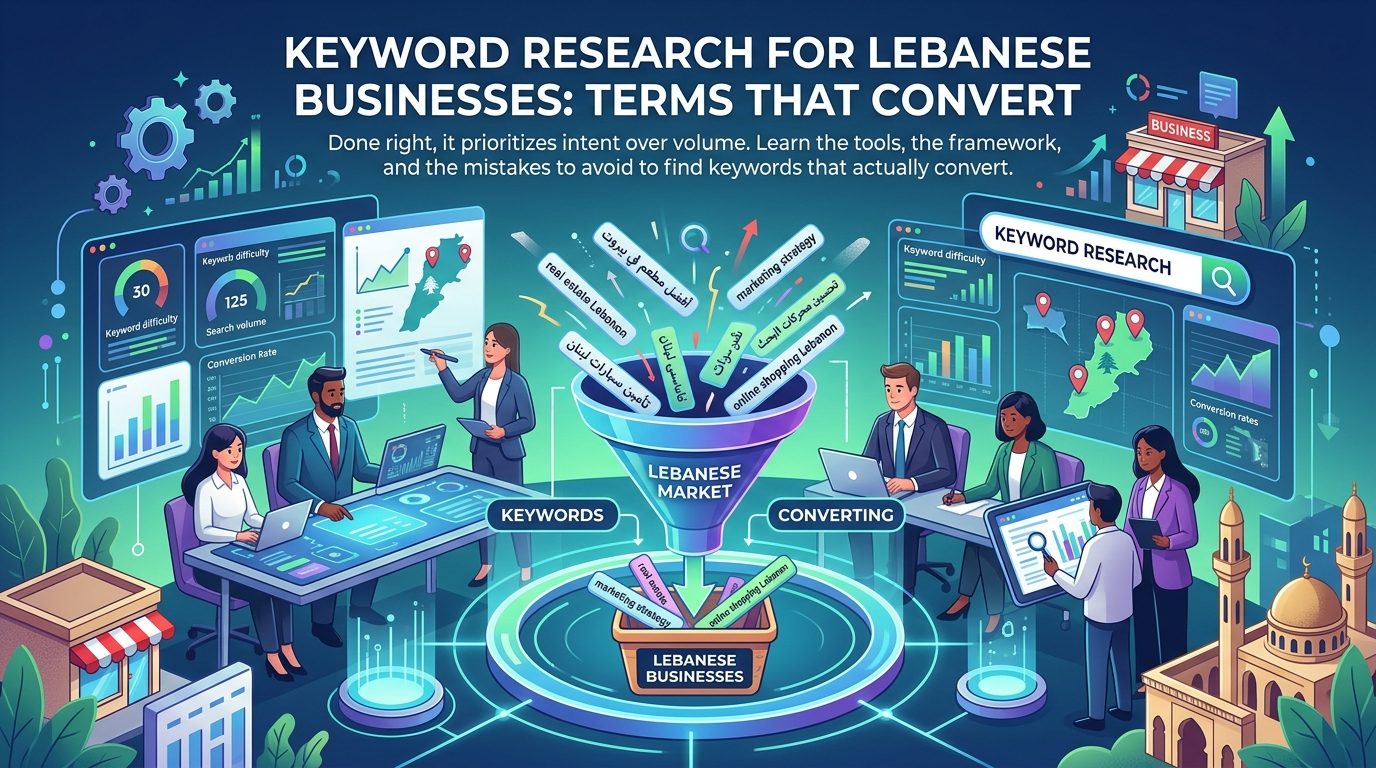
Most businesses that struggle to get results from SEO are not failing because of weak content or poor technical setup. They are failing because the keyword research that shaped their content strategy prioritized search volume over search intent, producing pages that attract visitors who were never going to become customers in the first place. A high monthly search volume number looks impressive in a spreadsheet, but it means nothing if the people searching that term are looking for something the business does not actually offer.
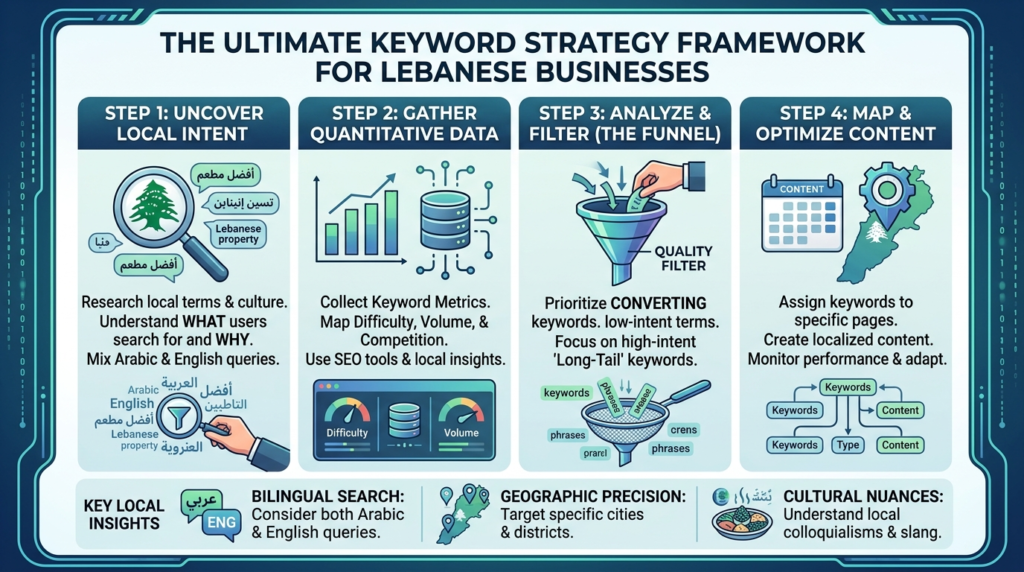
Real keyword research starts by understanding what a searcher actually wants, then works backward to which keywords represent that intent, rather than starting from a volume number and hoping the intent works out. This article walks through that intent-first approach: the four types of search intent, how to choose between free and paid keyword tools, how to prioritize commercial value over vanity metrics, and how to organize keywords into a map that actually guides content production.
Understanding Search Intent Before You Start
The Four Types of Search Intent
Every search query falls roughly into one of four intent categories: informational (someone looking to learn something, like “what is local SEO”), navigational (someone looking for a specific website or brand, like “Creative 4 All Beirut”), commercial investigation (someone comparing options before a decision, like “best SEO agency Lebanon”), and transactional (someone ready to act, like “hire SEO agency Beirut”). Misreading which category a keyword falls into is one of the most common and costly keyword research mistakes, since content built for the wrong intent will not satisfy the searcher regardless of how well-written or well-optimized it is.
Why Intent Matters More Than Volume?
A keyword with 50 monthly searches and strong transactional intent is frequently worth far more to a business than a keyword with 5,000 monthly searches and purely informational intent, since the smaller, intent-matched keyword attracts visitors who are actually close to making a purchase decision. This is the core principle behind effective SEO keyword strategy: search volume tells you how many people are searching, but intent tells you how many of those searches could realistically become customers, and the second number matters far more to a business’s bottom line than the first.
Free vs. Paid Keyword Tools
What Google Keyword Planner Actually Tells You?
Google Keyword Planner remains a genuinely useful free starting point, particularly for understanding rough search volume ranges and discovering related keyword variations a business might not have considered. Its limitations are real, though: volume data is often presented in broad ranges rather than precise numbers, and it lacks the detailed competitive analysis and keyword difficulty scoring that paid tools provide. For a small business just beginning keyword research, Google Keyword Planner is usually sufficient to identify an initial list of candidate terms worth investigating further.
When Ahrefs or SEMrush Become Worth the Cost?
As a business’s content operation matures, paid keyword tools like Ahrefs and SEMrush earn their cost through more precise data, competitive gap analysis (seeing which keywords competitors rank for that you do not), and keyword difficulty scoring that helps prioritize which terms are realistically achievable given the site’s current authority. These tools become genuinely worth the investment once a business is producing content regularly enough that guessing which keywords to target starts costing more in wasted content production than the tool’s subscription fee.
Prioritizing Commercial and Transactional Keywords Over Vanity Volume
Reading SERP Analysis to Confirm Real Intent
Before committing content resources to any keyword, a quick SERP analysis — actually looking at what currently ranks for that term — confirms or corrects assumptions about intent far more reliably than the keyword phrase alone. If a keyword that looks commercial actually returns a results page dominated by informational blog posts and “beginner’s guide” content, that is a strong signal the keyword’s real intent is informational despite how it reads, and content built as a hard sales pitch for that term will likely underperform.
Why a Smaller, High-Intent Keyword List Wins?
A focused list of twenty genuinely high-intent buyer intent keywords, each carefully matched to content that satisfies the specific intent behind it, consistently outperforms a sprawling list of two hundred keywords chosen primarily for volume. The smaller list is also considerably more manageable to actually execute against, since each keyword gets dedicated, well-researched content rather than the broader list forcing thin, rushed pages to cover ground the business does not have the resources to properly address.
Building a Keyword Map by Funnel Stage
TOFU, MOFU, and BOFU Keywords Explained
Organizing keyword research by funnel stage — top, middle, and bottom of funnel — helps ensure a business’s content addresses searchers at every point in their decision journey rather than only at the very end. Top-of-funnel keywords tend to be broader and informational (“what is digital marketing”), middle-of-funnel keywords reflect active comparison and consideration (“digital marketing agency vs freelancer”), and bottom-of-funnel keywords carry clear transactional intent (“digital marketing agency Beirut pricing”). A healthy keyword map includes terms across all three stages, since a business relying entirely on bottom-of-funnel keywords misses the much larger pool of prospects still earlier in their research.
Mapping Keywords to Content You’ll Actually Produce
A keyword map only creates value once it connects to a realistic content production plan. Rather than listing keywords in isolation, an effective map assigns each keyword (or cluster of related keywords) to a specific piece of content, a target publish date, and the internal links that should connect it to related pages on the site. This turns keyword research from an abstract exercise into a concrete production roadmap the business can actually follow.
Mistakes That Waste Ad and Content Budget
Chasing High Volume Without Checking Difficulty
One of the most expensive keyword research mistakes is targeting high-volume keywords without checking how difficult they realistically are to rank for given the site’s current authority. A new or smaller website investing months of content effort into a highly competitive keyword dominated by established, high-authority competitors is unlikely to see meaningful results, while that same effort applied to a slightly lower-volume but far more achievable keyword often produces real rankings within a reasonable timeframe.
Ignoring Long-Tail Keywords
Long-tail keywords — longer, more specific phrases with lower individual search volume — are frequently dismissed too quickly in favor of shorter, higher-volume terms, despite often converting at a meaningfully higher rate precisely because they reflect more specific, further-along intent. A business ignoring long-tail keywords in favor of only chasing broad, highly competitive terms often misses a substantial, more easily achievable, and often more profitable segment of its total addressable search traffic.
Adapting Keyword Research for Arabic and French Audiences
Keyword Behavior Doesn’t Translate Directly
A common mistake for Lebanese businesses is translating a proven English keyword list directly into Arabic or French rather than researching each language independently. Search behavior genuinely differs across languages — the same underlying need might be phrased very differently, and search volume for a translated term often bears little resemblance to the volume of the equivalent phrase native speakers actually type. Effective keyword research for a trilingual audience treats each language as its own research project, using local-language keyword tool data rather than assuming a direct translation carries the same intent or volume.
Colloquial Arabic vs. Modern Standard Arabic in Search
Search behavior in Arabic often includes a mix of Modern Standard Arabic and colloquial Lebanese phrasing, and the two can produce meaningfully different volume and competition data for what is conceptually the same query. A keyword strategy that only accounts for formal Arabic risks missing a significant share of how people in Lebanon actually search, particularly for commercial and local intent queries where colloquial phrasing is especially common.
Keeping the Keyword List a Living Document
Reviewing Performance Against the Original Intent Assumptions
Once content built around a keyword map has been live for a few months, it is worth checking whether the actual visitors arriving match the intent the keyword was chosen for. A page built for commercial intent that is instead attracting purely informational traffic, evidenced by high bounce rates and low conversion, signals that the original SERP analysis may have misjudged the keyword’s true intent, and the content or targeting may need adjustment.
Retiring Underperforming Keywords Without Guilt
Not every keyword chosen during initial research will perform as expected, and that is a normal part of the process rather than a failure. Retiring or deprioritizing keywords that consistently attract the wrong audience or show no realistic path to ranking, in favor of reallocating that content effort toward keywords with demonstrated intent match, keeps the overall keyword strategy productive rather than carrying dead weight indefinitely.
Frequently Asked Questions
A focused starting list of fifteen to twenty-five high-intent keywords, spread across TOFU, MOFU, and BOFU stages, is generally more productive than a much larger list chosen primarily for search volume. Quality of intent match matters more than the quantity of keywords tracked.
Google Keyword Planner is sufficient for a small business just beginning keyword research and producing content occasionally. Paid tools become worth the investment once content production is frequent enough that keyword difficulty scoring and competitive gap analysis meaningfully improve which topics get prioritized.
Search the term yourself and look at what currently ranks. If the results page is dominated by product or service pages and comparison content, the intent is commercial or transactional. If it is dominated by educational blog posts and guides, the intent is informational, regardless of how the keyword phrase itself reads.
Buyer intent, in most cases. A smaller-volume keyword with clear commercial or transactional intent typically produces more actual customers than a much higher-volume keyword with purely informational intent, since the searcher’s readiness to act matters more than the raw number of people searching.
A full review every six to twelve months is reasonable for most businesses, with more frequent spot-checks whenever a new product, service, or market expansion changes what customers are actually searching for. Search behavior and competitive landscapes shift enough over a year that a keyword map built once and never revisited gradually loses accuracy.
Ready to Find Keywords That Actually Convert?
Keyword research done properly prioritizes intent over volume, connecting your content to the searches that actually lead to customers. Creative 4 All builds intent-based keyword strategies for businesses across Lebanon and the GCC, mapped to a realistic content plan rather than a spreadsheet of vanity numbers. Get a Free SEO Audit to see which keywords your business should actually be targeting.