
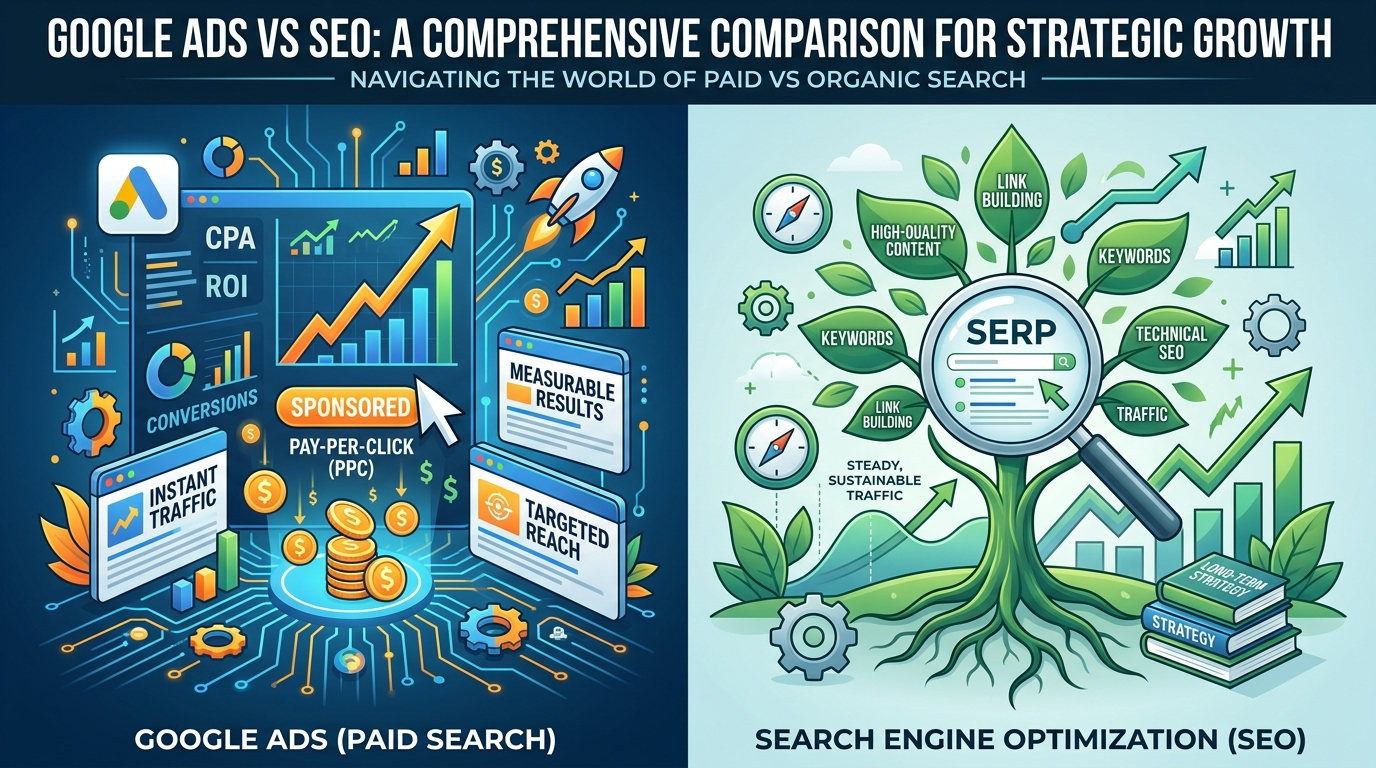
Google Ads vs SEO is one of the most common questions a business asks when it has a limited marketing budget and needs to decide where the first dollar goes. It is also a question that usually gets answered with an oversimplified verdict — “SEO is free, so start there” or “ads work faster, so skip SEO” — when the honest answer depends on factors specific to the business asking the question: how urgently revenue is needed, how competitive the industry is, and how much runway the business has before results need to show up.
This article is not going to declare a universal winner, because there isn’t one. What follows is the real tradeoff between the two channels, why most businesses that do this well end up using both rather than choosing one permanently, and a practical framework for deciding where to start based on your specific situation.
The Fundamental Tradeoff: Speed vs. Sustainability
What Google Ads Delivers Immediately?
Google Ads can generate qualified traffic within hours of a campaign going live, since paid placement does not depend on any accumulated ranking history or content authority. For a business that needs revenue this month, not in six months, this speed is not a minor convenience — it can be the difference between making payroll and not. The tradeoff is that this traffic stops the moment the budget stops. There is no residual value carried forward once a campaign is paused; the visibility purchased exists only for as long as it is paid for.
What SEO Builds Over Time?
Organic search traffic vs paid search traffic follows a nearly opposite pattern. SEO typically takes three to six months, sometimes longer in competitive categories, before meaningful organic traffic starts to materialize, since it depends on search engines building trust in a domain and its content over time. Once that traffic does materialize, however, it continues arriving without an ongoing per-click cost, and it tends to compound as more content gets published and more backlinks and authority accumulate. A well-ranked page from a year ago can still be generating leads today at effectively zero marginal cost, something no paid campaign can replicate once its budget runs out.
Why the Answer Usually Isn’t Either/Or?
Where PPC and SEO Overlap and Reinforce Each Other?
Treating PPC or SEO first as a permanent, exclusive choice misses how naturally the two channels reinforce each other in practice. A business running Google Ads while building out SEO content benefits from paid visibility covering the gap during the months SEO needs to mature, rather than having no search presence at all during that ramp-up period. Once organic rankings do start delivering meaningful traffic for a given keyword, ad spend on that specific term can often be reduced or reallocated elsewhere, since the business is no longer solely dependent on paid placement to appear for that search.
Data From Ads That Improves SEO Strategy
One of the most underused advantages of running both channels together is that Google Ads generates fast, concrete data about which keywords actually convert into leads or sales — data that would otherwise take months to gather through SEO alone. A business can test several keyword variations through paid campaigns, identify which ones drive genuine conversions rather than just clicks, and then prioritize SEO content development around the keywords already proven to convert, rather than guessing which topics are worth the months-long investment SEO requires.
A Decision Framework Based on Business Stage and Urgency
New Businesses and Urgent Revenue Needs
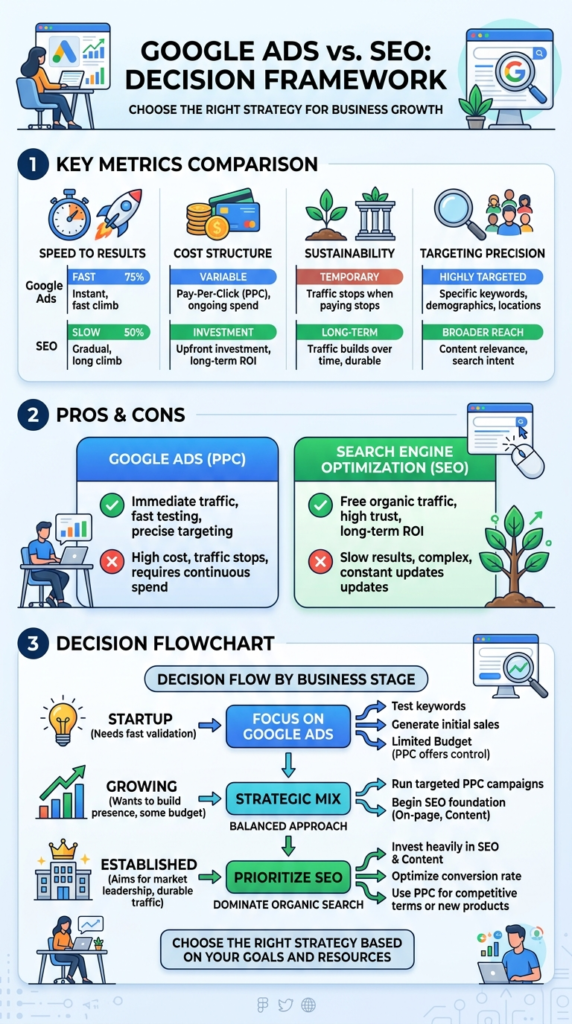
A brand-new business with no existing domain authority, no accumulated content, and an urgent need for revenue is generally better served starting with Google Ads. SEO’s multi-month ramp-up period is simply too slow to meet an immediate cash flow need, and a new domain has no existing trust signals to leverage even if content is published aggressively from day one. This does not mean SEO should be ignored entirely — content can and should begin in parallel — but the primary near-term revenue channel for a genuinely new business is almost always paid.
Established Businesses Playing the Long Game
A business with an existing website, some domain history, and a runway of six months or more before results are critically needed is often better served prioritizing SEO investment, since the compounding, no-marginal-cost nature of organic traffic delivers a stronger long-term return on the same budget. This is especially true for businesses in less aggressively competitive categories, where meaningful rankings are achievable without an enormous content and backlink investment.
Competitive, High-CPC Industries
In categories where cost-per-click is extremely high — legal services, certain financial products, some medical specialties — the economics shift again. High CPC makes sustained Google Ads spend expensive relative to the value of each lead, which strengthens the case for SEO investment even for newer businesses in these categories, since the long-term cost advantage of ranking organically becomes more pronounced the more expensive paid clicks are in that specific market. A business in one of these categories that runs the numbers honestly often finds that a handful of months of aggressive SEO content investment costs less than a single quarter of sustained top-position bidding on the same core keywords.
How a Combined Approach Compounds Results?
Using PPC to Validate Keywords Before Investing in SEO Content
Rather than committing months of content development to a keyword based on estimated search volume alone, running a short paid campaign against that keyword first reveals real conversion data before the larger SEO investment is made. This validation step meaningfully de-risks SEO content planning, since it replaces a guess about commercial intent with actual evidence of how searchers using that term behave once they land on a relevant page.
Owning Both Paid and Organic Real Estate on the SERP
For competitive, high-value search terms, appearing in both the paid ad position and the organic results for the same query captures a meaningfully larger share of the search results page than either channel alone. Research on search behavior consistently shows that appearing in multiple positions on the same results page increases overall click-through rate and builds stronger brand recall, since searchers who scroll past the ad still recognize the same business again in the organic listings below it. This dual-presence strategy is one of the strongest arguments for treating Google Ads vs SEO as a combined strategy rather than a single either/or decision once a business has the budget to support both simultaneously.
Budget Allocation: How Much to Put Toward Each Channel
A Starting Split for Limited Budgets
For businesses without the resources to fully fund both channels at once, a reasonable starting approach is allocating roughly 70 percent of the marketing budget to whichever channel matches the business’s primary need (Google Ads for urgency, SEO-focused content production for a longer-term view), with the remaining 30 percent supporting the other channel at a maintenance level. This prevents a business from abandoning one channel entirely while it builds up the other, keeping some momentum in both rather than a full stop-start pattern that wastes the setup effort already invested.
Adjusting the Split as Results Come In
The right allocation between paid search vs organic search is not a decision made once and left alone. As SEO content begins ranking and generating traffic for specific keywords, budget previously spent bidding on those same terms in Google Ads can often shift toward either new keyword territory or a heavier SEO content investment, since the organic presence is now doing work the paid budget previously had to cover alone. Reviewing this allocation quarterly, based on actual performance data from both channels, produces a far more efficient budget than a fixed split maintained indefinitely regardless of results.
Common Mistakes When Choosing Between the Two
Judging SEO by the Same Timeline as Paid Ads
A frequent and costly mistake is evaluating SEO performance after only four to six weeks, the kind of timeframe that would already show clear results from a Google Ads campaign, and concluding SEO “isn’t working” prematurely. SEO’s slower ramp-up is a structural feature of how search engines build trust in content over time, not a sign of a flawed strategy, and abandoning it before the typical three-to-six-month window has elapsed usually means writing off an investment just before it would have started paying off.
Running Ads Without a Plan to Eventually Reduce Dependency
The opposite mistake is treating Google Ads as a permanent, unchanging line item without ever building the organic presence that could eventually reduce reliance on paid spend. Businesses that never invest in SEO alongside their ads campaigns remain fully dependent on continuous ad spend indefinitely, missing the opportunity to gradually shift budget toward a channel that keeps generating traffic without an ongoing per-click cost.
Frequently Asked Questions
It depends primarily on urgency. A business needing revenue within the next one to two months should prioritize Google Ads, since SEO’s multi-month ramp-up period is too slow for immediate needs. A business with more runway and a genuine long-term view is often better served starting with SEO investment instead.
Google Ads can generate qualified traffic within days of launch, while SEO typically takes three to six months to produce meaningful organic traffic, sometimes longer in highly competitive categories. This timeline difference is the single biggest factor in most Google Ads vs SEO decisions.
No, and in most cases running both simultaneously produces a stronger combined return than either channel alone, particularly during the months while SEO is still building toward meaningful organic traffic. The two channels also generate useful data for each other when run together.
SEO generally offers stronger long-term value once rankings are established, since organic traffic continues arriving without an ongoing per-click cost. Google Ads offers no residual value once spend stops, though it remains essential for immediate visibility and specific high-value competitive terms.
Checking estimated cost-per-click for your core keywords through Google’s own keyword planning tools gives a rough sense of this. Industries like legal services and certain financial products often see CPC in the tens of dollars per click, which strengthens the case for prioritizing SEO investment even earlier than the general framework might suggest.
Ready to Build a Strategy That Uses Both Channels Effectively?
Google Ads vs SEO does not have to be a permanent either/or decision. Creative 4 All helps businesses across Lebanon and the GCC build a search strategy that uses paid and organic channels together, based on your specific stage, budget, and timeline. Get a Free PPC Account Review to see how your current paid search spend could work alongside a stronger SEO strategy.