

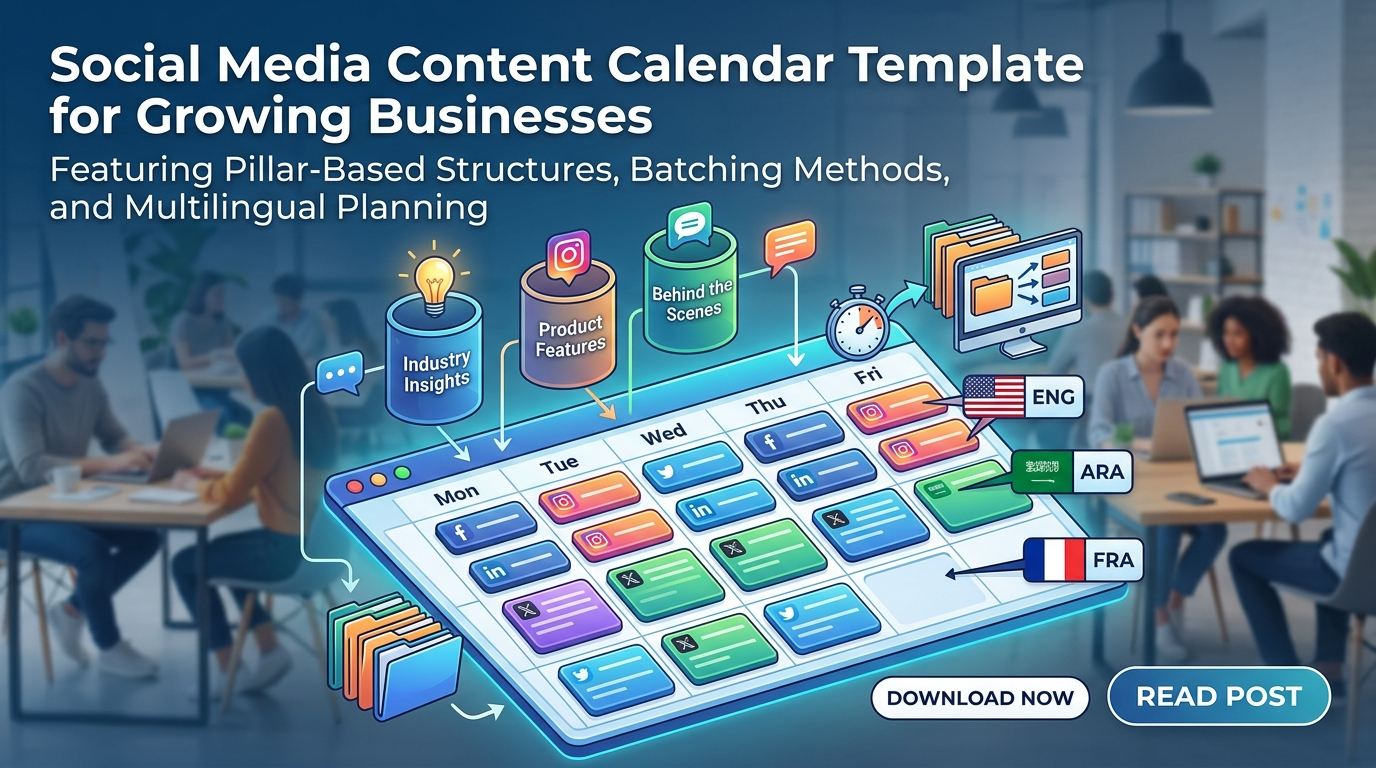
Most businesses that struggle with social media are not struggling because they lack ideas. They are struggling because every post gets created the same day it goes live, under time pressure, with no sense of how it connects to what was posted last week or what should come next. A social media content calendar exists to fix exactly this problem — not by making content more elaborate, but by moving the thinking work upstream, so posting day becomes an execution task rather than a scramble to figure out what to say.
This matters more as a business grows. A single founder posting occasionally can get away with reactive, in-the-moment content. Once a business is managing multiple platforms, multiple languages, or a small team contributing content, the absence of a shared calendar becomes a real operational problem — duplicated topics, inconsistent posting frequency, and gaps that only become obvious once a customer points out the account went quiet for two weeks.
Why Planning Ahead Beats Reactive Posting?
The Hidden Cost of Reactive, Last-Minute Content
Reactive posting has a cost that rarely shows up on a spreadsheet but shows up clearly in results: content created under time pressure tends to default to whatever is easiest to produce, not what best serves the audience or the business’s actual goals. A business scrambling to post something before the end of the day will almost always reach for a generic product photo or a repost rather than the more thoughtful piece of content that might have taken a genuine content calendar and thirty minutes of planning to conceive. Over months, this pattern quietly erodes the overall quality and variety of what gets published.
How Consistency Compounds Over Time?
Social platforms consistently reward accounts that post on a predictable, sustained rhythm over accounts that post in unpredictable bursts followed by long silences. A content planning template does not just make individual posts better — it makes the overall posting pattern more consistent, which compounds into stronger algorithmic distribution and a more reliable audience relationship over time. This compounding effect is one of the most underrated benefits of planning ahead, since its impact only becomes visible after several consistent months rather than immediately.
A Simple Content-Pillar-Based Calendar Structure
Choosing Three to Five Content Pillars
The foundation of any usable social media content calendar is a small set of content pillars — recurring themes the business consistently posts about, chosen specifically to serve both audience interest and business goals. A typical small business might use pillars like behind-the-scenes/process content, customer stories or testimonials, educational tips related to the product or service, and direct promotional content, rotating through these categories rather than posting whatever comes to mind that day. Three to five pillars is usually the right range — enough to keep content varied without so many categories that the rotation becomes difficult to plan or track.
Mapping Pillars to a Weekly Posting Rhythm
Once pillars are defined, mapping them onto a simple weekly rhythm removes nearly all the remaining guesswork from day-to-day posting. A basic structure might assign one pillar to each posting day of the week — Monday for educational content, Wednesday for behind-the-scenes, Friday for customer stories, with promotional content woven in roughly once a week rather than dominating the calendar. This structure gives the calendar predictability for the audience while giving the business a simple, repeatable framework to plan content weeks or months in advance rather than reinventing the wheel every single week.
Batching Content Creation to Save Time
What a Batching Session Actually Looks Like?
Content batching means producing multiple pieces of content in a single dedicated session rather than creating one post at a time as each posting day arrives. A practical batching session might involve blocking two to three hours to shoot photos or video for an entire month of behind-the-scenes content, then a separate session to write captions and organize everything into the calendar. This approach takes advantage of the setup and mental “warm-up” cost of content creation — once the camera is out and the mindset is in place, producing five pieces of similar content costs only marginally more time than producing one.
Tools That Make Batching Easier
A content planning template does not need to be complicated software — a well-organized spreadsheet with columns for date, platform, pillar, caption, and asset link is genuinely sufficient for most small to mid-sized businesses. The tool matters far less than the discipline of actually filling it in consistently, though dedicated social media scheduling tools become genuinely useful once a business is managing multiple platforms simultaneously, since they allow batched content to be scheduled for automatic publishing rather than requiring someone to manually post at the right time each day.
Adapting a Single Calendar for English, Arabic, and French Audiences
Translating vs. Localizing Each Post
For businesses in Lebanon publishing across English, Arabic, and French audiences, a genuine content calendar needs to account for more than simple translation. A post that performs well in English does not automatically translate into an equally effective Arabic or French version if it relies on wordplay, cultural references, or phrasing that does not carry over naturally. The calendar should note not just which languages a post needs, but whether the concept itself needs light localization — a different example, a regionally relevant reference — to land properly with each audience rather than reading as an obviously translated afterthought.
Staggering Publish Times Across Languages and Platforms
Rather than publishing the same content simultaneously across every language and platform, staggering publish times to match when each specific audience segment is most active tends to produce meaningfully better reach and engagement. A content calendar built with this in mind should track not just what gets posted, but when each version goes live, since the optimal posting time for an English-speaking audience segment does not always match the optimal time for an Arabic-speaking one, even on the same platform.
Building in Flexibility for Timely and Seasonal Content
Leaving Room for Real-Time Moments
A content calendar planned too rigidly can become a liability if it leaves no room to respond to genuinely timely moments — a trending topic relevant to the business, a local event, or breaking news the brand has a legitimate reason to comment on. Building in one or two flexible slots per week, deliberately left open rather than pre-filled with pillar content, gives a business room to post something timely without disrupting the overall structure or scrambling to bump already-planned content.
Planning Around Seasonal Moments in Advance
Seasonal content planning works best when holidays, regional observances, and predictable business cycles (back-to-school season, Ramadan, summer travel, end-of-year promotions) are mapped onto the calendar months ahead rather than noticed the week they arrive. A calendar that flags these moments in advance gives a business time to plan genuinely relevant content and any accompanying promotions, rather than producing something rushed at the last minute that misses the window when audience attention is actually highest.
Keeping the Calendar a Living Document
Reviewing and Adjusting Based on Performance
A content calendar should not be treated as a fixed plan set in stone once created. A brief monthly review of which pillars and posting times actually performed well, compared against the plan, allows the calendar to evolve based on real audience response rather than staying locked to assumptions made months earlier. Businesses that skip this review step often keep repeating content patterns that quietly underperform simply because nobody circled back to check.
Assigning Clear Ownership for Each Step
Even a well-designed content calendar breaks down if it is unclear who is responsible for each stage — drafting, reviewing, approving, and actually publishing. Assigning clear ownership for each of these steps, even in a business with just one or two people handling social media, prevents the common failure mode where a piece of content sits finished in the calendar for days because nobody was clearly responsible for hitting publish.
Adapting the Calendar as the Business Grows
From Solo Founder to Small Team
A calendar that works for a single founder posting three times a week looks very different from one that supports a small marketing team managing daily posts across multiple platforms. As responsibility for content shifts from one person to several, the calendar needs to evolve from a personal planning tool into a shared reference everyone can access, update, and understand without needing a verbal explanation of the system each time. Businesses that delay this transition often find that informal, single-person planning habits break down quietly once a second or third person starts contributing content.
Scaling Content Pillars as Offerings Expand
As a business adds new products, services, or locations, the original set of content pillars often needs revisiting rather than simply adding more categories indefinitely. A business that started with three pillars covering a single service line may need to consolidate or restructure those pillars once it offers several distinct services, ensuring the calendar still reflects a coherent, manageable rotation rather than sprawling into a dozen loosely related categories that make planning harder rather than easier.
Frequently Asked Questions
A four-to-six-week planning horizon works well for most small to mid-sized businesses, giving enough runway to batch content and adapt to upcoming events or seasonal moments without planning so far ahead that the calendar becomes stale or disconnected from current events.
Three to five pillars is a reasonable range for most businesses. Fewer than three tends to make content feel repetitive, while more than five often becomes difficult to track and rotate through consistently, especially for a small team managing the calendar alongside other responsibilities.
Not necessarily. A well-organized spreadsheet is genuinely sufficient for many small businesses, particularly when managing one or two platforms. Dedicated scheduling tools become more valuable once a business manages multiple platforms and languages simultaneously and wants to automate publishing.
Batching reduces the repeated setup cost — gathering equipment, getting into a creative mindset, reviewing brand guidelines — that occurs every time content creation starts from scratch. Producing several pieces of similar content in one dedicated session is almost always faster in total than producing the same number of pieces individually across separate days.
Adapted rather than translated word-for-word in most cases. Content that relies on cultural references, humor, or phrasing specific to one language often needs a locally relevant adjustment to resonate the same way with an Arabic or French-speaking audience, rather than reading as an obviously direct translation.
Ready to Build a Calendar That Actually Works for Your Business?
A social media content calendar only creates value when it gets used consistently, which depends on having a structure simple enough to maintain and a batching rhythm that fits how your team actually works. Creative 4 All helps growing businesses across Lebanon and the GCC build practical content calendars and posting systems across English, Arabic, and French audiences. Request a Social Media Strategy Session to build a content calendar tailored to your business.