
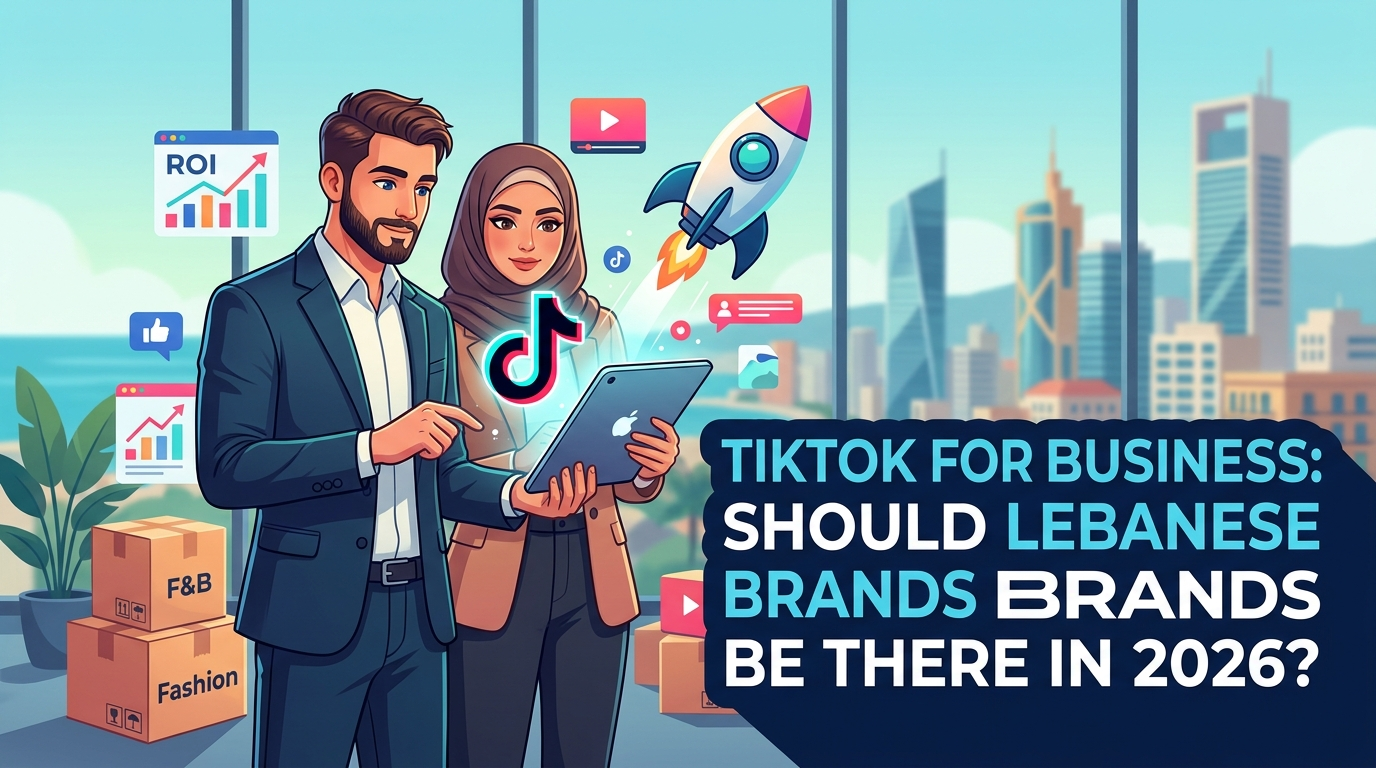
The question of whether TikTok for business actually makes sense keeps coming up in conversations with Lebanese business owners, and the honest answer is: it depends far more on what you sell and who you are trying to reach than most generic advice suggests. TikTok is not banned in Lebanon, and the platform’s global position has only stabilized further this year — a threatened nationwide ban in the United States was averted in January 2026 through a forced divestiture of its local operations, removing one of the biggest sources of uncertainty that made businesses hesitant to invest in the platform. That stability matters, but it does not automatically mean every Lebanese business should be building a TikTok presence. It means the platform is worth a genuine, honest evaluation rather than a reflexive dismissal or a reflexive rush to join.
This article is not going to tell you that every business needs TikTok, because that simply is not true. It is going to walk through who the platform actually works for, how its content style genuinely differs from Instagram, what a realistic time investment looks like, and a low-risk way to test whether it is worth pursuing before committing significant resources.
Who TikTok Actually Works For (and Who It Doesn’t)?
Consumer Brands With Visual or Emotional Appeal
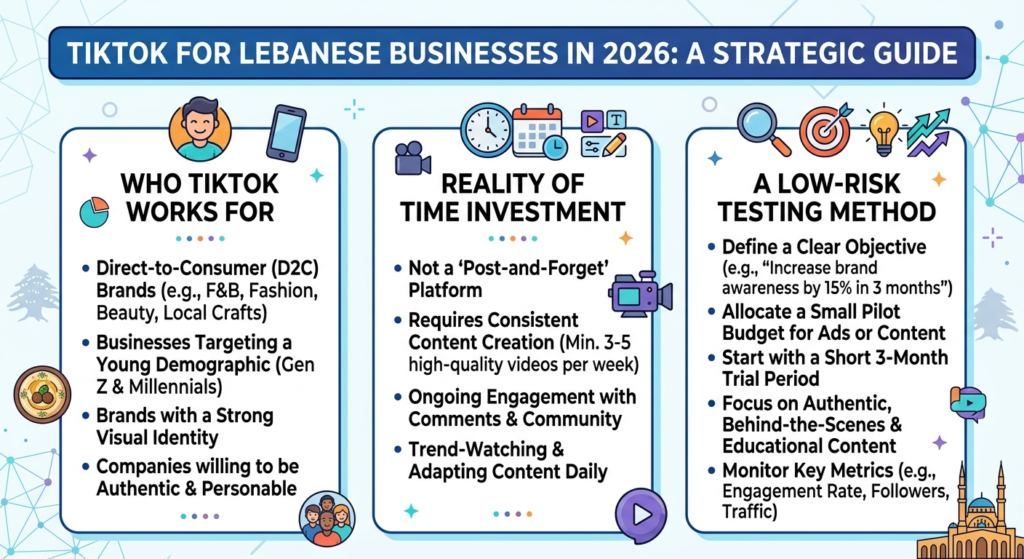
TikTok tends to work best for businesses selling something that photographs or films well, or that can tell an emotionally engaging story quickly: food and beverage, fashion and beauty, fitness, home decor, and consumer products generally. TikTok’s own trend forecasting for 2026 points toward audiences seeking genuine cultural connection and meaningful emotional payoff from the content they engage with, rather than passive, purely promotional viewing. Businesses in these categories in Lebanon — restaurants, boutiques, salons, home goods retailers — are generally well positioned to benefit from a TikTok presence, provided they can commit to the platform’s native content style rather than simply repurposing Instagram content.
Where TikTok Falls Short for Many Lebanese Businesses?
Professional services (legal, accounting, consulting), highly technical B2B products, and businesses with a narrow, older customer base tend to see a weaker return from TikTok specifically. This is not an absolute rule — B2B companies willing to lean into storytelling, education, and showing real people behind the brand can find genuine traction, but it takes deliberate effort rather than simply mimicking consumer-brand content. TikTok’s largest demographic segment skews toward users in their mid-twenties to mid-thirties, which is a meaningful factor for any business whose actual customer base sits well outside that range.
How TikTok Content Genuinely Differs From Instagram?
Native, Unpolished Style Over Produced Content
The single biggest mistake businesses make moving into TikTok marketing strategy is treating it like a smaller Instagram feed and simply reposting the same polished, produced content. TikTok audiences consistently respond better to content that feels native to the platform — unfiltered, personal, and shot in a style that does not scream “advertisement.” Some of the most effective recent brand campaigns have deliberately abandoned high-production advertising in favor of simple, authentic interviews and testimonials that feel more like a recommendation from a friend than a marketing message. Businesses that cannot let go of a heavily polished aesthetic, even for this one channel, typically struggle to gain traction regardless of budget.
Sound, Trends, and the Algorithm’s Discovery Engine
TikTok’s recommendation system functions less like a traditional social feed and more like a discovery engine that surfaces content to entirely new audiences based on engagement signals rather than existing follower relationships. This is precisely why small accounts with no existing following can still reach large audiences on TikTok in a way that is far harder to replicate on Instagram, where reach is more heavily tied to an account’s existing follower base. Sound and trending audio play a genuine role in this discovery mechanism, and TikTok has continued expanding its commercial sound library specifically to help businesses tap into trending audio without licensing complications.
The Realistic Time and Resource Investment
What Consistent Posting Actually Requires?
Effective TikTok marketing strategy generally requires more frequent posting than most other platforms — a reasonable minimum is three to five posts per week, with daily posting recommended during an active growth phase. This is a meaningfully higher time commitment than most Lebanese small businesses currently dedicate to Instagram, and it is worth being honest about that gap before committing to the platform. A business that can barely sustain one Instagram post per week is unlikely to suddenly find the capacity for daily TikTok content without either reallocating existing marketing resources or bringing in dedicated help.
Budget Considerations: Organic vs. Paid
TikTok’s organic reach potential remains genuinely strong compared to more saturated platforms, meaning a business can build initial traction without immediately spending on ads. That said, TikTok’s advertising ecosystem has matured considerably, offering commerce-focused ad formats and automation tools that reduce the setup friction that once made paid TikTok campaigns feel inaccessible to smaller advertisers. A sensible approach for most Lebanese businesses is to start with a modest organic content investment, and only introduce paid spend once early content has demonstrated genuine audience response worth amplifying.
A Simple Test-and-Measure Approach Before Committing
Running a Low-Risk Pilot
Rather than committing to a full TikTok marketing strategy immediately, a low-risk pilot of four to six weeks — posting three times per week with a genuine effort at native-style content — gives a business enough data to make an informed decision without a large upfront investment. This pilot period should focus on learning what resonates with a Lebanese or regional audience specifically, since content that performs well for a similar business internationally does not always translate directly without local context and language considerations.
Metrics That Indicate It’s Worth Scaling
During the pilot, the metrics that matter most are watch time and completion rate (how much of each video people actually watch, which is the algorithm’s strongest signal), follower growth relative to posting volume, and any direct engagement — comments, shares, and messages — that reflects genuine audience interest rather than passive viewing. A pilot that shows strong watch time and growing engagement, even with a small follower count, is a much stronger signal to scale investment than a pilot with high view counts but minimal engagement, since the latter often indicates content that reached an audience without actually connecting with it.
Adapting Short-Form Video Marketing to a Lebanese Audience
Language, Dialect, and Cultural Context
Content that performs well for a similar business in the US or Europe does not always translate directly to a Lebanese or wider regional audience. Short-form video marketing succeeds when it reflects how the actual target audience speaks and what they find genuinely funny, relatable, or useful — colloquial Lebanese Arabic, local humor, and references to shared cultural moments tend to outperform content that simply mimics international trends without adaptation. A business that films content exclusively in formal Arabic or English when its actual customers communicate casually in a local dialect is creating an unnecessary barrier to the native, relatable feel the platform rewards.
Balancing Regional Trends With Local Relevance
Global TikTok trends spread quickly, and jumping on a trending sound or format can genuinely help a new account get discovered. The businesses that do this most effectively adapt the trend with a locally relevant twist rather than copying it verbatim, since a trend applied with genuine local context tends to resonate more with the audience a Lebanese business actually needs to reach, even if the raw reach numbers on a purely generic version might look similar at first glance.
Integrating TikTok Into an Existing Social Media Presence
Not a Replacement, But an Addition
For most Lebanese businesses already active on Instagram and Facebook, TikTok should be evaluated as an addition to an existing social media presence rather than a replacement for it. Different audiences still use different platforms for different reasons, and abandoning an established Instagram following to chase TikTok’s growth potential is rarely the right trade-off. The businesses that manage this transition well typically treat TikTok as a distinct content stream with its own native style, while allowing genuinely strong-performing TikTok content to be reformatted for Instagram Reels afterward, rather than the reverse.
Repurposing Without Losing Platform-Native Feel
When repurposing content between platforms does make sense, the direction matters. Content built natively for TikTok’s unpolished, personal style can usually be reformatted for Instagram Reels without much loss, since Instagram audiences have grown more accepting of that same casual style over time. The reverse rarely works as well: content produced specifically for Instagram’s more polished aesthetic tends to underperform when dropped directly into TikTok’s feed unchanged, since it reads as an advertisement in a feed where audiences are primed to expect something more native and personal.
Frequently Asked Questions
It can be, particularly for consumer-facing businesses with visual appeal, since organic reach on TikTok remains stronger than on more saturated platforms. A four-to-six-week pilot with a modest time investment is a reasonable way to test this before committing meaningful budget.
Even though both are short-form video, TikTok audiences respond better to unpolished, native-feeling content and typically expect a higher posting frequency, while Instagram audiences are somewhat more tolerant of produced, aesthetically consistent content. Directly repurposing the same content for both often underperforms compared to tailoring content specifically to each platform’s audience expectations.
Not necessarily at first. TikTok’s organic reach remains genuinely strong, meaning a business can build initial traction and audience insight through organic posting alone before introducing paid spend to amplify content that has already proven to resonate.
Businesses whose customer base sits well outside TikTok’s core demographic, or that offer highly technical, low-visual products with no genuine story to tell, tend to see weaker returns. This is not an absolute rule, but it is worth an honest assessment before committing significant time to the platform.
A reasonable minimum is three to five times per week, with daily posting during an active growth phase producing stronger results. Consistency generally matters more than achieving occasional viral hits, since the algorithm favors accounts with a steady, predictable posting pattern.
Ready to Find Out if TikTok Makes Sense for Your Business?
Deciding whether TikTok for business is worth pursuing depends on your specific customers, products, and capacity for consistent content, not a generic yes-or-no answer. Creative 4 All helps Lebanese businesses evaluate and, where it makes sense, build a genuine TikTok marketing strategy alongside their existing social media presence. Request a Social Media Strategy Session to find out whether TikTok is the right next channel for your brand.