
Search “social media marketing” and most of what comes back reads the same way it did in 2019: listicles promising “38 reasons your business needs a social media expert,” generic posting-frequency advice, and vague encouragement to “engage with your audience.” None of it answers the actual question a business owner in Lebanon needs answered — which platforms are actually worth the time, what to post on them, and how to know whether any of it is working. A real social media marketing strategy Lebanon businesses can act on requires something more structured than a list of tips: a framework for choosing platforms deliberately, building content around clear pillars, and measuring results against business outcomes rather than vanity metrics.
This guide replaces the scattered-tactics approach with a real social media marketing strategy Lebanon businesses can execute directly — how to choose the right platforms for a specific audience rather than defaulting to all of them, how to build content pillars that make planning sustainable rather than a constant scramble for ideas, how to set KPIs that actually reflect business value, and a simple monthly process that turns strategy into something a small team can realistically execute.
Choosing the Right Platforms for Your Audience
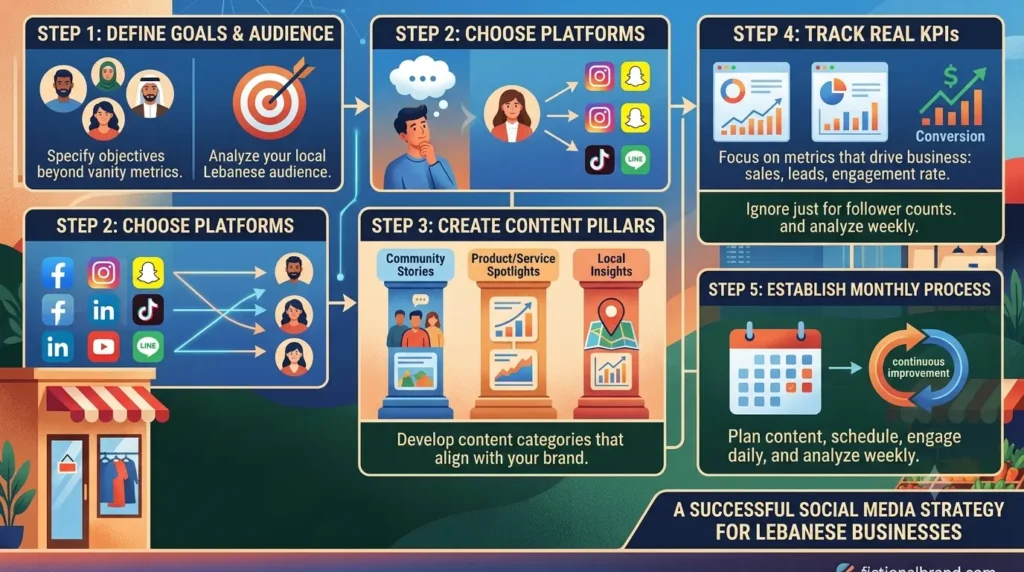
The most common mistake in social media strategy isn’t picking the wrong platform — it’s trying to maintain a meaningful presence on all of them at once. A business with limited marketing capacity spread across Instagram, Facebook, TikTok, and LinkedIn simultaneously usually ends up posting inconsistently and mediocrely everywhere, rather than posting well and consistently on the one or two platforms that actually reach its audience. A genuine social media strategy businesses can sustain starts with an honest platform selection, not an attempt to be everywhere at once.
Instagram remains the strongest general-purpose platform for consumer-facing Lebanese businesses, particularly those with a visual product or service — restaurants, retail, beauty and wellness, home and design. Its mix of feed posts, Stories, and Reels supports both polished brand content and more casual, behind-the-scenes material, making it flexible enough to carry most of a business’s social presence on its own if resources are limited to a single platform.
Facebook’s organic reach has declined significantly over the years, but it remains genuinely useful for specific purposes in the Lebanese market: community groups, local business discovery, and an audience skewing somewhat older than Instagram’s core user base. Businesses targeting a broader demographic, or relying on Facebook Marketplace and local community groups for word-of-mouth referral, often find it worth maintaining even when Instagram carries the bulk of the visual content strategy.
TikTok
TikTok has grown quickly among younger audiences in Lebanon and works best for businesses that can produce genuinely native short-form video content rather than repurposed Instagram Reels. Its algorithm rewards entertainment and authenticity over production polish, which makes it a strong fit for brands willing to experiment with a more casual, personality-driven content style, and a poor fit for businesses only able to produce corporate-style video content.
LinkedIn is the clear choice for B2B businesses, professional services, and any business built around thought leadership or recruiting — a marketing agency, a law firm, a consultancy, or a business targeting other companies rather than individual consumers. Content here should lean toward genuine expertise and industry insight rather than the more casual tone that performs well on Instagram or TikTok, since the audience and their expectations are fundamentally different.
Choosing among these platforms comes down to an honest answer to two questions: where does the target audience actually spend time, and what content format can the business realistically produce well and consistently. A business without in-house video capability will struggle on TikTok regardless of how well-suited the platform seems for its audience; a B2B service business posting casual Instagram-style content on LinkedIn will struggle to be taken seriously by the professional audience it needs to reach there.
Building Content Pillars
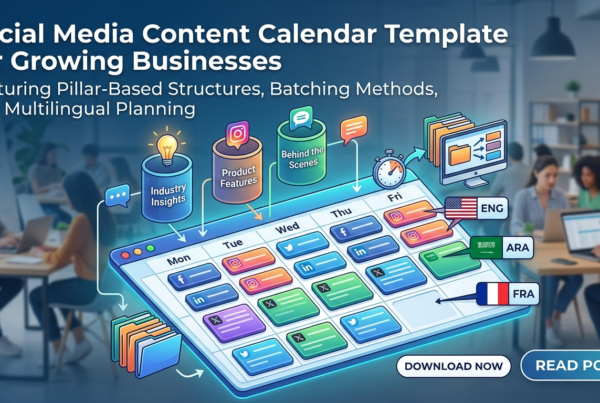
Once platforms are chosen, the next failure point is content planning that relies on inspiration rather than structure — which is exactly why so many businesses post inconsistently or run out of ideas within a few weeks. Content pillars solve this by defining three to five recurring categories of content that a business consistently returns to, rather than starting from a blank page for every single post.
A typical set of pillars for a service business might include educational content that answers common customer questions, behind-the-scenes content showing the team and process, social proof content featuring testimonials and results, and promotional content covering offers and announcements — each pillar rotating through a monthly content calendar rather than any single type dominating the feed. This structure does double duty: it makes planning faster since ideas map to an existing category, and it keeps the overall feed varied enough that an audience doesn’t tune out from repetitive, purely promotional content.
The specific pillars should reflect what the audience actually finds valuable rather than a generic template — a restaurant’s pillars look nothing like a law firm’s, even though both benefit from the same underlying structure of defined, recurring content categories rather than ad hoc posting.
Setting Realistic, Business-Relevant KPIs
Follower count is the easiest metric to track and the least useful one to optimize for, since it says nothing about whether social media is actually contributing to business goals. A social media marketing strategy Lebanon businesses should measure success by leads generated, website clicks, direct messages converted into inquiries, and — where ecommerce is involved — actual sales attributed to social channels, rather than reach or follower growth in isolation.
This doesn’t mean engagement metrics are irrelevant; they’re a useful early signal of whether content is resonating before it has time to translate into business outcomes. But engagement should be treated as a leading indicator to monitor, not the goal itself. A post with strong engagement that never drives a single inquiry or click is a signal worth investigating rather than a result worth celebrating on its own. Setting KPIs before a content calendar is even built — deciding upfront what “working” looks like in terms of leads or sales rather than deciding after the fact based on whatever numbers happen to look good — keeps the entire strategy anchored to actual business value.
A Simple Monthly Planning Process
Turning platform selection, content pillars, and KPIs into something a small team can actually execute means building a lightweight monthly process rather than an elaborate system that becomes its own burden to maintain. A practical starting point: block time once a month to plan the coming month’s content around the established pillars, batch-producing as much content as realistically possible in that session rather than creating everything the day it’s due to post. Review the previous month’s KPI data before planning the next month, adjusting which content types get emphasized based on what actually drove results rather than what felt good to create.
This monthly rhythm also creates a natural point to revisit platform choices and content pillars themselves every few months, since audience behavior and platform algorithms both shift over time, and a strategy that worked six months ago may need adjustment rather than blind continuation. Businesses that skip this review cycle tend to keep repeating whatever they started with, regardless of whether it’s still the right approach.
Language and Local Considerations
A social media marketing strategy Lebanese businesses build also needs to account for the country’s multilingual reality in a way that generic global advice never addresses. Captions and content often need to work across Arabic, English, and French audiences simultaneously, and the right mix depends on the specific business and audience rather than a single default — a business targeting an international, English-speaking clientele in Beirut may lean primarily English, while one serving a broader local audience often benefits from Arabic-first captions with English or French as a secondary layer.
WhatsApp also plays a larger role in the customer journey in Lebanon than it does in many Western markets, often serving as the actual conversion point after a customer discovers a business on Instagram or Facebook. A strategy that drives strong engagement on the platform but doesn’t have a clear, easy path from a social media inquiry to a WhatsApp conversation is missing a step that matters more here than it might in markets where that handoff happens differently.
Why This Replaces Generic Social Media Advice?
Most social media content online, including a lot of what’s been published under this exact topic for years, treats the subject as a list of disconnected tips rather than a coherent system. A real social media marketing strategy Lebanon businesses can rely on ties platform selection, content planning, and measurement together into one process, where each decision informs the next rather than existing as an isolated tactic. This is the difference between a business that posts because it feels like it should, and one that posts with a clear sense of why, to whom, and what success actually looks like.
Frequently Asked Questions
One or two platforms maintained consistently and well almost always outperform four or five maintained sporadically. Choosing based on where the target audience spends time and what content format the business can realistically produce is more important than trying to cover every platform.
Consistency matters more than raw frequency. A sustainable schedule that can be maintained indefinitely — even if that means three posts a week rather than daily — tends to perform better over time than an ambitious schedule that collapses after a month.
Engagement rates vary significantly by platform, industry, and audience size, which makes a single benchmark unreliable. A more useful approach is tracking whether engagement is trending up or down over time relative to the business’s own historical performance, rather than comparing against a generic industry average.
Organic content and paid advertising work best together rather than as separate efforts — organic content builds the pillars and voice that paid campaigns can then amplify to a wider audience, particularly for boosting content that’s already proven to perform well organically.
Meaningful audience growth and engagement trends typically take three to six months of consistent execution to become clear, though direct response metrics like inquiries or clicks can show up faster once content and targeting are properly aligned with the audience.
Ready to Build a Strategy That Actually Drives Results?
A social media presence built on scattered tactics rarely outperforms one built on a clear, structured strategy. Request a social media strategy session with Creative 4 All and get a platform, content, and measurement plan built specifically around your business and audience.