
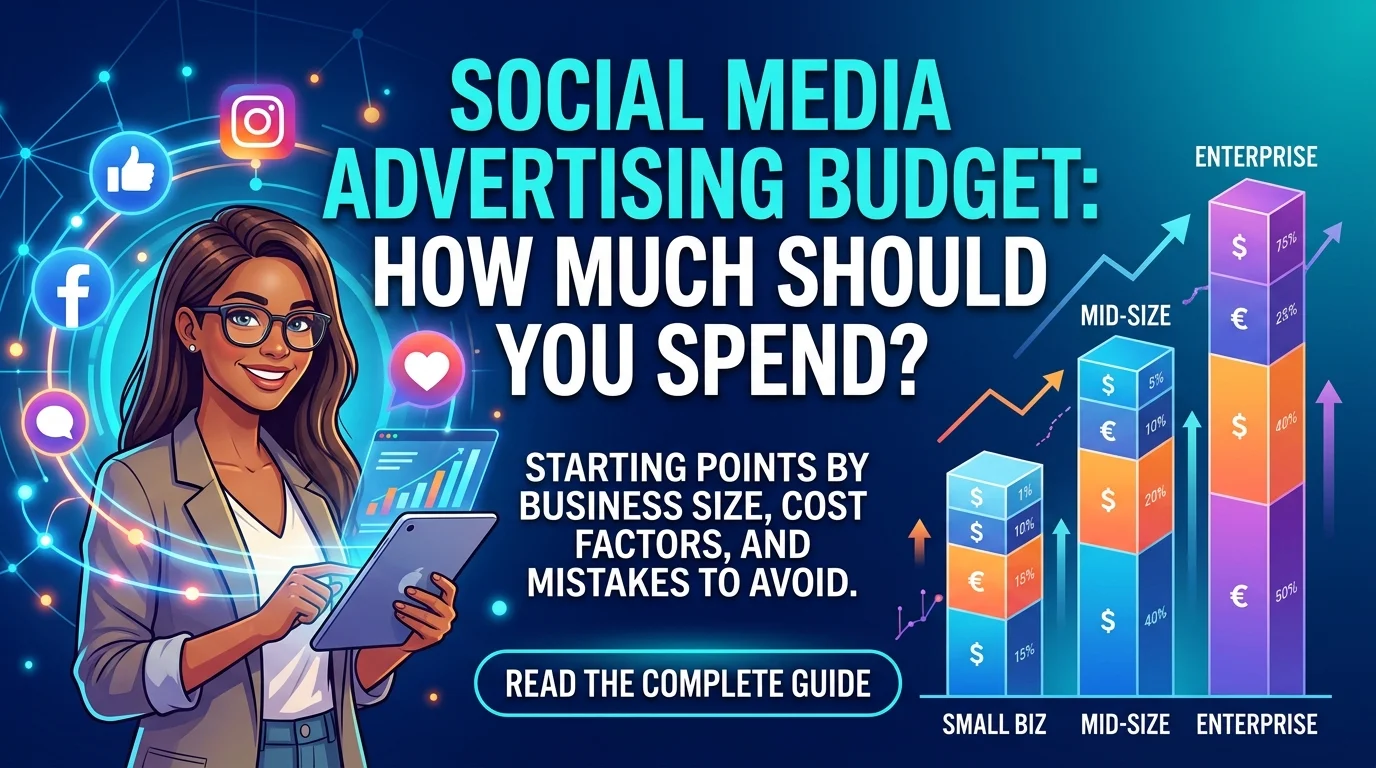
“How much should I spend on social media ads?” is one of the most common questions a business asks before launching its first paid campaign, and it rarely has a single clean answer, since the right social media advertising budget depends heavily on business size, campaign objective, and what a business is actually trying to achieve. This article works through realistic starting points, explains why campaign objective changes what a reasonable budget actually looks like, and flags the budget mistakes that waste spend regardless of how much is allocated in the first place.
Budget Starting Points by Business Size and Objective
Small Business Starting Budgets
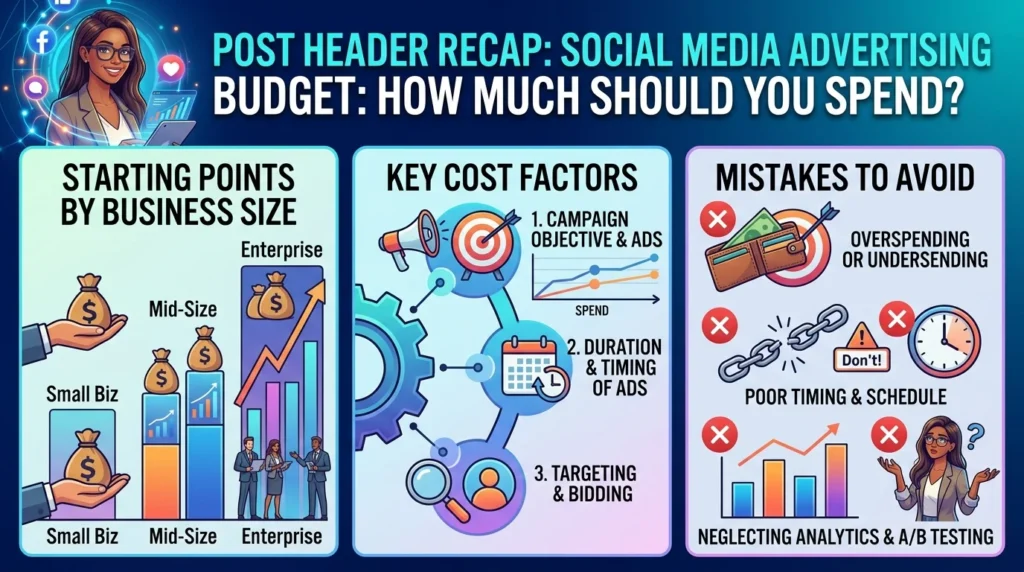
A small business testing paid social for the first time generally does well starting with a modest daily ad budget — enough to generate meaningful data within a few weeks without risking significant money on an unproven approach. This starting phase is about learning what works (which audience, which creative, which offer) rather than maximizing volume immediately, and a business that starts too small to generate any meaningful data wastes the testing period just as much as one that overspends before validating the approach.
Mid-Size and Established Business Budgets
A mid-size or established business with validated messaging and a proven offer can reasonably scale budget considerably beyond initial testing levels, since the learning phase is largely complete and the remaining question becomes how much volume the business can profitably absorb rather than whether the approach works at all. Budget at this stage should scale in proportion to the business’s actual capacity to fulfill increased demand and the genuine profitability of each conversion, rather than simply spending as much as cash flow allows.
How Campaign Objective Affects Cost?
Awareness vs. Conversion Objectives
An awareness campaign (optimizing for reach or impressions) typically costs considerably less per person reached than a conversion campaign (optimizing for purchases, leads, or sign-ups), since the platform’s algorithm works harder and competes against more advertisers to find people genuinely likely to complete a specific conversion action. Comparing cost per result across campaigns with different objectives without accounting for this difference produces a misleading sense that one campaign is performing better than another when they are actually measuring fundamentally different things.
Why Cost Per Result Varies by Objective?
Cost per result for a conversion-focused campaign reflects not just the platform’s advertising costs but the actual difficulty of the conversion action itself — a newsletter signup costs considerably less per conversion than a high-value purchase, since fewer people are willing to complete the more demanding action regardless of how well-targeted the campaign is. Setting budget expectations based on the specific objective and conversion difficulty, rather than a single universal “good” cost per result benchmark, produces considerably more realistic planning.
Avoiding Common Paid Social Budget Mistakes
Underfunding Campaigns Before They Can Learn
Setting a daily budget too low for the platform’s algorithm to exit its learning phase and reliably identify who converts means a campaign never gets the chance to actually perform well, regardless of how long it runs. This is one of the most common reasons a business concludes “social ads don’t work for us” when the actual problem was budget too constrained to let the algorithm learn effectively in the first place.
Spreading Budget Too Thin Across Objectives
Splitting a modest overall budget across many simultaneous campaign objectives, audiences, or ad sets dilutes each individual effort below the threshold needed to generate meaningful data or exit the learning phase, producing an account full of underperforming campaigns rather than one or two genuinely well-tested approaches. Consolidating budget behind fewer, more focused efforts until each has enough data to evaluate properly generally outperforms spreading the same total spend thin across many simultaneous tests.
Setting a Facebook Instagram Ad Budget Specifically
Shared Budget Across Both Platforms
Since Meta Ads Manager runs both Facebook and Instagram campaigns through the same platform, this combined budget is typically managed as a single pool rather than split into entirely separate budgets for each platform, with the algorithm automatically distributing spend toward whichever placement performs better for the specific audience and objective. Manually forcing an even split between the two platforms often performs worse than letting the algorithm allocate based on actual results, since audience behavior frequently favors one platform meaningfully over the other for a specific business.
Platform-Specific Considerations Worth Knowing
Instagram placements, particularly Stories and Reels, sometimes carry different cost dynamics than standard Facebook feed placements, and a budget that performs well on one placement type may underperform on another even within the same overall campaign. Reviewing placement-level performance data periodically, rather than assuming spend is distributing optimally without checking, catches cases where manually excluding an underperforming placement could improve overall efficiency. A business selling visually driven products often finds Instagram placements outperform Facebook ones, while a business targeting an older demographic with a more text-heavy offer may see the reverse, which is exactly why checking actual data matters more than assuming either platform is inherently better.
Paid Social Spend Planning as an Ongoing Process
Building a Quarterly Planning Rhythm
Effective ongoing budget management treats spend as something to revisit regularly based on performance data and changing business priorities, rather than a figure set once at the start of the year and left unchanged regardless of what the data shows. A quarterly planning rhythm, reviewing which campaigns and objectives delivered genuine return over the previous period, allows budget to shift toward what is actually working rather than remaining anchored to initial assumptions that may no longer hold.
Planning Around Seasonal Demand Shifts
This ongoing planning should also account for predictable seasonal shifts in both audience behavior and advertising competition — certain periods see increased competition and higher costs per result industry-wide, while others offer comparatively efficient opportunities to scale spend. Building this seasonal awareness into the annual budget plan, rather than treating every month identically, produces more efficient spend allocation across the full year. A business that anticipates a high-competition period in advance can choose to either scale spend aggressively to maintain share of voice or deliberately pull back and wait for a less expensive window, rather than being caught off guard by a sudden, unexplained jump in cost per result.
Frequently Asked Questions
This varies by industry and typical conversion value, but a starting point sufficient to generate at least a modest number of results daily within the platform’s recommended range for exiting the learning phase gives a campaign a genuine chance to perform, rather than a token amount too small to produce usable data.
Campaign budget optimization, which lets the platform automatically shift budget toward better-performing ad sets within a campaign, generally works well once there’s enough historical data for the algorithm to make informed decisions. For brand-new accounts or campaigns with very limited initial data, manual budget allocation per ad set sometimes provides more predictable control during the earliest testing phase.
Comparing cost per result against the actual value of that result to your business (not just the platform’s reported cost) determines genuine profitability, rather than looking at cost per result in isolation without connecting it to what a conversion is actually worth.
Not automatically — a larger budget applied to an unproven offer, poor targeting, or weak creative simply wastes more money faster, while a well-validated approach with a modest budget can perform efficiently before ever needing to scale. Budget should scale proportionally with validated performance, not in place of it.
Reviewing performance at least weekly during active campaigns, and adjusting budget based on actual cost per result and conversion data rather than a fixed schedule, keeps spend aligned with what is genuinely working rather than running on autopilot indefinitely.
Ready to Build a Social Media Ad Budget That Actually Performs?
A social media advertising budget only works when it’s sized correctly for the business’s stage, matched to the right campaign objective, and concentrated enough to actually let campaigns learn and perform. Creative 4 All helps businesses across Lebanon and the GCC plan and manage paid social budgets that deliver genuine, measurable results. Request a Social Media Strategy Session to figure out exactly what your business should be spending.