

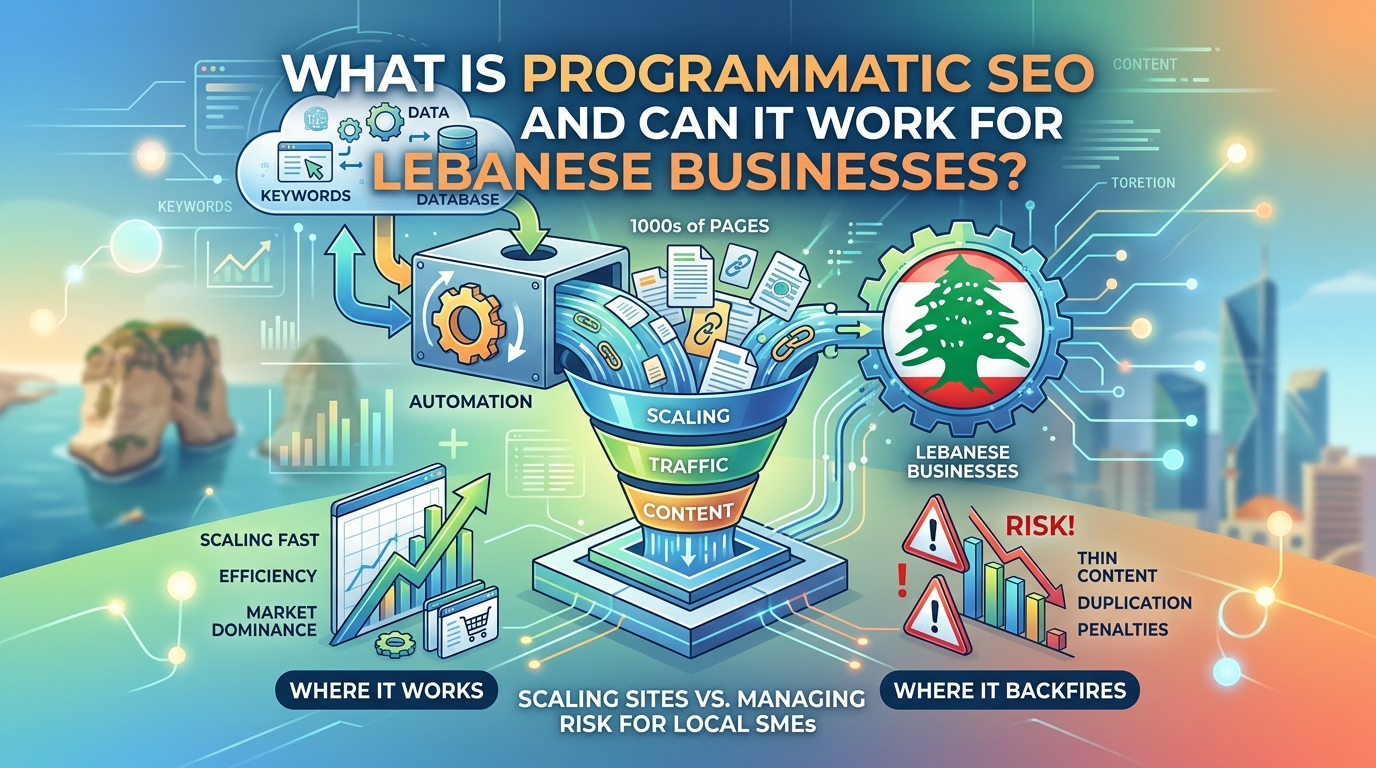
Programmatic SEO gets talked about as either a growth hack that can multiply a site’s organic traffic overnight, or a spam tactic that invites a Google penalty. Both framings miss the more useful truth: programmatic SEO is a legitimate technique with real, well-documented use cases, and its success or failure has almost nothing to do with the tactic itself and almost everything to do with whether the underlying data and execution quality actually justify the scale. For Lebanese SMEs evaluating whether this approach fits their business, understanding where it genuinely works and where it backfires matters far more than a simple yes-or-no verdict.
What Programmatic SEO Actually Is?
The Template-Plus-Data Model
Programmatic SEO combines a content template with a structured dataset to generate a large number of individual pages automatically, rather than writing each page by hand. A real estate site might combine a single page template with a database of property listings, neighborhoods, and price ranges to generate thousands of pages like “apartments for rent in Achrafieh under $800” without a human writing each one individually. The template defines the structure and the recurring elements; the data fills in what makes each page specific and, ideally, genuinely useful to the searcher who lands on it.
How It Differs From Traditional Content Production?
Traditional content production involves a writer researching and drafting each piece individually, which produces depth and nuance but scales slowly — a small team might produce a few dozen quality articles a month. Data-driven SEO built on templates can produce hundreds or thousands of pages in the same timeframe, but that speed comes with an inherent tradeoff: each individual page typically contains less unique, hand-crafted content than a traditionally written article, which is precisely why execution quality determines whether the approach succeeds or actively damages a site.
Where Programmatic SEO Works Well?
Real Estate, Ecommerce, and Directory Sites
The clearest, most consistently successful use cases share a common shape: a business already possesses a large, structured dataset that naturally maps to genuine search demand. Real estate platforms have property listings, ecommerce sites have product catalogs, and directory sites have business or professional listings — in each case, the underlying data already exists, and the templated page structure simply exposes that data in a form organized around how people actually search. A furniture retailer with a catalog of two thousand products already has the ingredients for thousands of legitimately useful product pages; the programmatic approach here is not manufacturing thin content, it is efficiently surfacing real inventory.
The Common Thread: Structured, Repeatable Data
What separates a good programmatic SEO candidate from a poor one is whether the underlying data is genuinely structured, accurate, and specific enough to make each generated page meaningfully different and useful. A business with rich, accurate data on locations, categories, prices, or specifications has the raw material for templated landing pages that actually serve a distinct search intent. A business trying to force this model onto vague or sparse data usually produces pages that all say roughly the same thing with a few words swapped, which is exactly the pattern search engines are built to detect and penalize.
Where It Backfires?
Thin and Duplicate Content Risk
The most common failure mode in this approach is generating pages where the template contributes ninety percent of the content and the data contributes only a swapped city name or category label, producing pages that are functionally near-duplicates of each other. Google’s algorithms are specifically designed to detect this pattern, and sites that generate large volumes of low-value, near-identical pages risk having those pages deindexed en masse, or in more serious cases, facing a sitewide quality assessment that affects pages far beyond the templated ones.
When Google Treats Scale as a Spam Signal?
Scale itself is not the problem — legitimate large sites with millions of pages exist and rank well. The problem is scale combined with low uniqueness and low genuine value per page. A sudden jump from a fifty-page website to a five-thousand-page website, especially if the new pages share a template with minimal unique content and see no real user engagement, reads to Google’s systems as a strong signal of manufactured content rather than organic growth, and this pattern has been a specific target of quality-focused algorithm updates in recent years.
A Realistic Framework for Lebanese SMEs
Starting Small: Location + Category Combinations
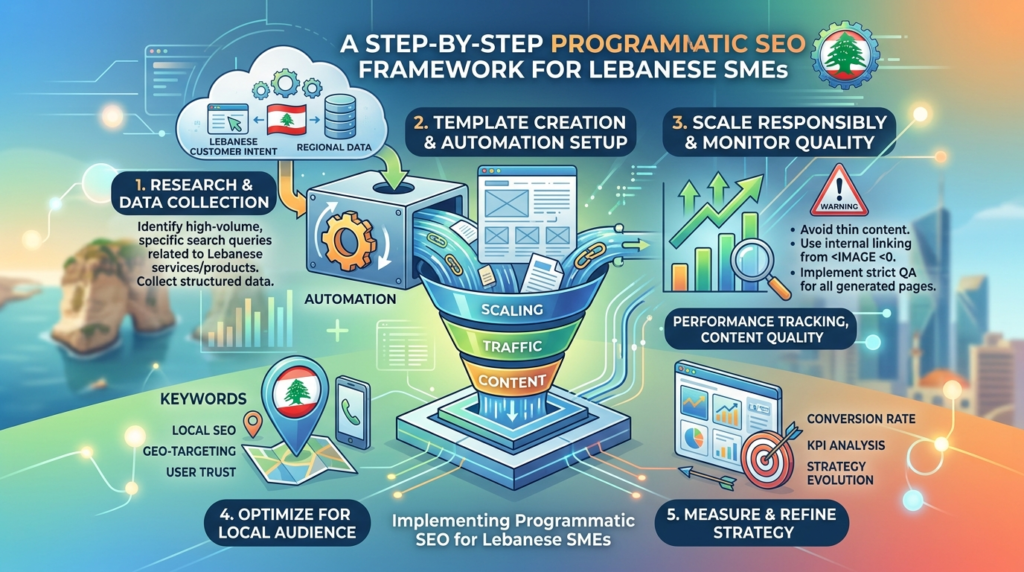
A realistic starting point for a Lebanese SME considering scaled content SEO is a modest, well-scoped combination of location and service or product category — for example, a home services business creating pages for each combination of service type and neighborhood it genuinely serves, rather than generating pages for every town in the country regardless of whether the business operates there. Starting with twenty or thirty genuinely accurate, useful combinations and expanding gradually based on performance produces a far safer foundation than launching several hundred pages at once based on a spreadsheet of theoretical service areas.
Quality-Control Guardrails That Keep Pages Out of Trouble
Any scaled content effort needs explicit guardrails: a minimum threshold of genuinely unique content per page beyond the template (specific local details, actual pricing, real customer examples relevant to that specific combination), a review process before pages go live rather than fully automated publishing with no human check, and ongoing monitoring to identify and either improve or remove pages that show no search visibility or engagement after a reasonable period. These guardrails cost more time upfront than pure automation, but they are precisely what separates a program that compounds in value from one that quietly accumulates risk.
Case Examples Worth Learning From
Real Estate Portals as the Textbook Case
Large real estate platforms are often cited as the clearest example of this approach done well, since a property listing naturally generates a page, a neighborhood naturally generates a landing page aggregating those listings, and a price range or bedroom count naturally generates a filtered view — all genuinely useful to someone searching for exactly that combination. The underlying data (real listings, updated regularly) is what makes the scale legitimate rather than manufactured, since each page reflects real, current inventory rather than a hollow template with nothing behind it.
Where Ambitious Attempts Have Gone Wrong?
A common failure pattern involves a business observing a competitor’s success with this approach and attempting to replicate the page structure without possessing equivalent underlying data. A local service business that copies a national competitor’s location-page template but has no genuine presence, pricing, or track record in most of the listed locations produces pages that look structurally similar but lack the real substance that made the original approach work, and search engines tend to notice this gap fairly quickly through weak engagement signals and eventual quality assessments.
Balancing Automation With Genuine Value
Where Human Review Still Belongs in the Process?
Even a well-designed system benefits from human review at key checkpoints — confirming that generated pages read naturally rather than awkwardly, that data feeding the template is accurate and current, and that each page genuinely answers the query it targets rather than merely containing the right keywords. Removing human oversight entirely to maximize output speed is usually where a reasonable approach tips into the kind of manufactured content search engines are designed to catch.
Treating This as an Ongoing Program, Not a One-Time Launch
The businesses that sustain success with this approach over time treat it as an ongoing program requiring regular maintenance — updating data as it changes, retiring pages that no longer reflect real inventory or service areas, and continuing to monitor which pages perform and which do not. A one-time launch followed by years of neglect tends to accumulate outdated, low-value pages that drag down the overall quality signal of the domain, undoing much of the initial benefit.
Frequently Asked Questions
Not necessarily. Programmatic SEO refers to the template-plus-data structure used to generate pages at scale; the content within that structure can be written by AI, written by humans, or some combination of both. The structural approach and the content generation method are separate decisions, and quality control matters regardless of which method produces the actual text.
There is no official minimum word count, but each page needs enough genuinely unique, specific information beyond the shared template that it would provide real value to a searcher even without the surrounding boilerplate. A page that could be produced by swapping one word in a template without losing any meaningful information is a strong warning sign.
Businesses with a genuinely large, structured dataset that maps to real search demand — extensive product catalogs, multi-location service areas, or large listing inventories — are the strongest candidates. Businesses without this kind of underlying data are usually better served by traditional, individually written content.
Starting with a small, carefully scoped batch — often twenty to fifty pages covering genuinely served combinations of location, category, or product type — and expanding based on actual performance is considerably safer than launching hundreds or thousands of pages immediately based on theoretical coverage.
Yes, in more serious cases. If a large share of a site’s pages are identified as thin or manufactured, Google’s site-wide quality assessments can affect the ranking potential of the entire domain, not just the templated pages themselves, which is why quality guardrails matter as much as the underlying data structure.
Ready to Find Out if Programmatic SEO Fits Your Business?
Programmatic SEO can genuinely multiply a site’s search visibility when the underlying data justifies the scale, or quietly damage it when it does not. Creative 4 All helps Lebanese businesses evaluate whether their data and business model support a scaled content approach, and builds the quality guardrails that keep it safe when it does. Get a Free SEO Audit to see whether programmatic SEO makes sense for your business.