
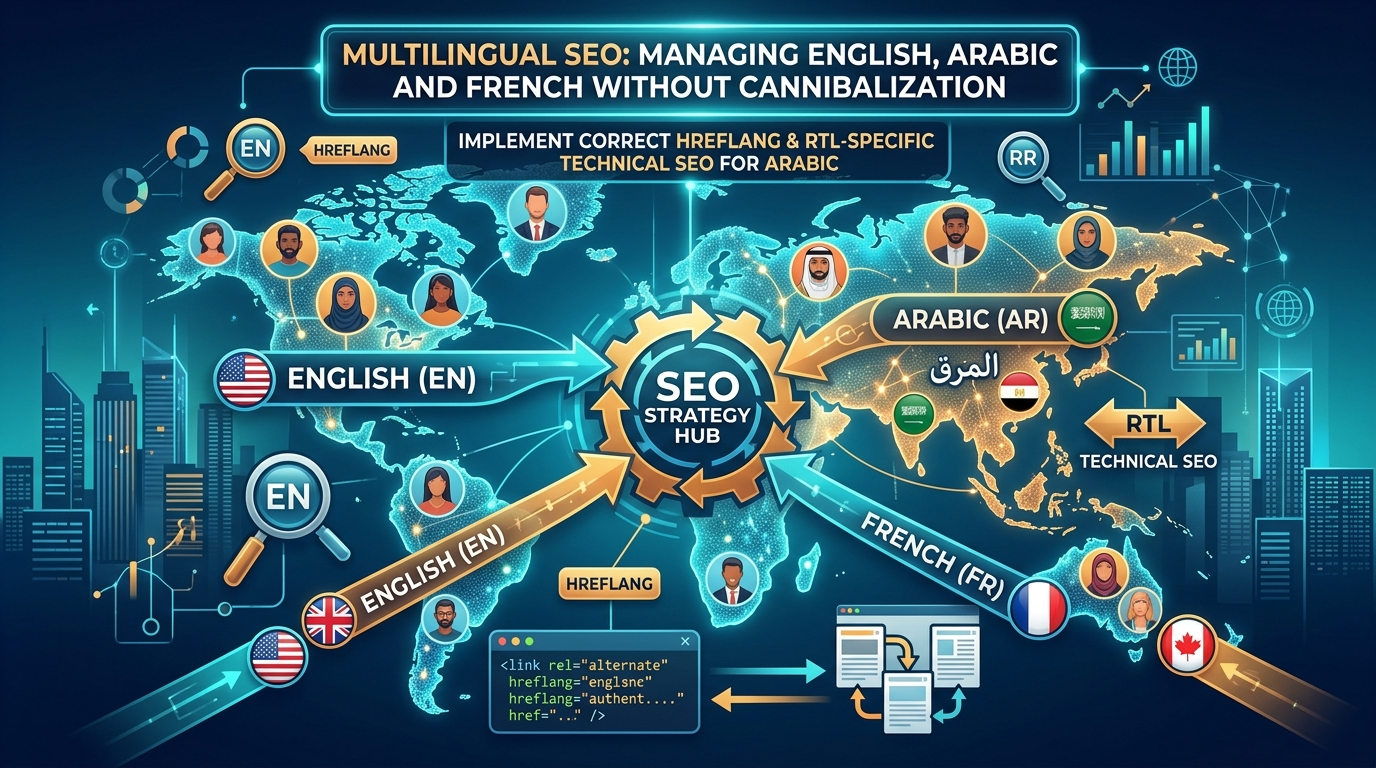
Running a website in three languages sounds like it should simply triple a business’s search visibility — three times the content, three times the audience, three times the ranking opportunity. In practice, a poorly structured multilingual site often achieves the opposite: its own language versions compete against each other for the same rankings, search engines struggle to determine which version to show which searcher, and the business ends up with weaker visibility than a well-structured single-language site would have achieved. Multilingual SEO is not simply translation plus publishing; it is a distinct technical discipline with its own rules, and getting those rules wrong actively works against a business rather than merely failing to help.
Why Multilingual Sites Risk Cannibalizing Their Own Rankings?
When Two Language Versions Compete for the Same Query?
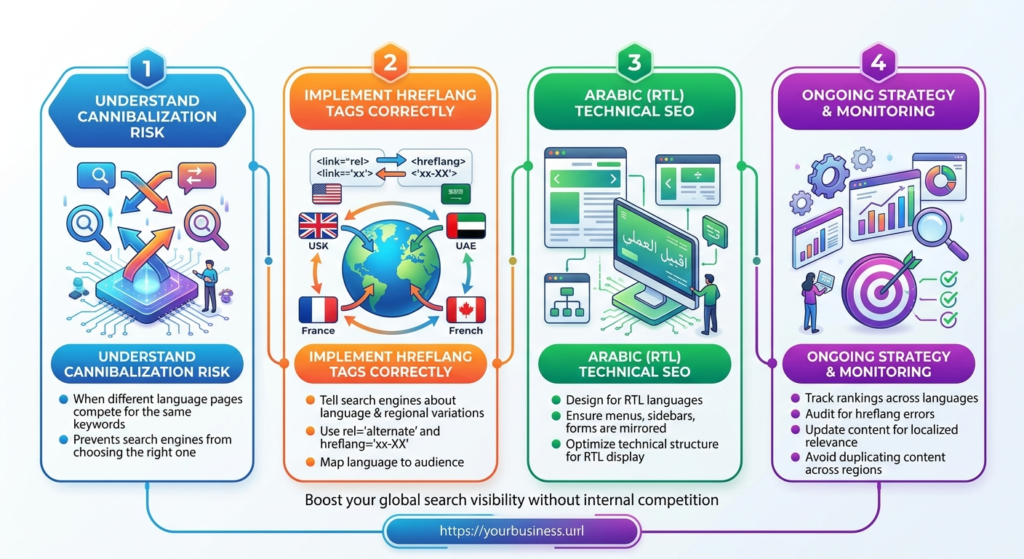
Cannibalization happens when a search engine cannot clearly determine which of two or more pages on the same site should rank for a given query, splitting ranking signals across both rather than concentrating them on the correct one. This is a genuine risk for multilingual sites when, for example, an Arabic-speaking user in Lebanon searches using an English-language term (a common pattern for technical or business vocabulary), and both the English and Arabic versions of a relevant page have some claim to answering that query. Without clear technical signals telling search engines which version serves which audience, the two pages can end up competing rather than each capturing its own intended segment.
Duplicate Content Across Language Versions
A separate but related risk arises when translations are close enough to the original that search engines struggle to treat them as genuinely distinct content, particularly for closely related languages or when a translation is minimal and mechanical rather than substantively localized. This is less of a concern between languages as different as English and Arabic, but it becomes more relevant when comparing structurally similar romance-language content, or when a French version reads as a near word-for-word translation of English with minimal adaptation to how French-speaking users actually search and phrase queries.
Correct hreflang Implementation
How hreflang Tags Actually Work?
The hreflang attribute tells search engines which language and regional version of a page to show a given searcher, explicitly linking each language version to its counterparts rather than leaving search engines to guess based on content similarity alone. A properly implemented hreflang setup requires every language version of a page to reference all other versions, including itself — a page in English needs hreflang tags pointing to its Arabic and French equivalents, and each of those versions needs the same complete set pointing back to the English version and to each other. This mutual, complete referencing is what makes the setup function correctly; a partial or one-directional configuration frequently fails to produce the intended effect.
Common hreflang Mistakes That Cause Problems
The most frequent hreflang errors include missing return tags (Page A links to Page B, but Page B does not link back to Page A), incorrect language or region codes (using “ar” when “ar-LB” would more precisely target Lebanese Arabic, for instance), and hreflang tags pointing to URLs that redirect or no longer exist. Each of these errors can cause search engines to ignore the hreflang signals entirely, effectively leaving the site without the language-targeting benefit the tags were meant to provide, even though the tags are technically present in the code.
RTL-Specific Technical SEO for Arabic
URL Structure and Directionality
Arabic content requires right-to-left (RTL) rendering, and this has implications beyond the purely visual layout. URL structure should still typically use a clear language subdirectory (/ar/ rather than embedding Arabic characters awkwardly into URL paths), and the HTML lang and dir attributes need to correctly declare both the language (ar) and the text direction (rtl) so browsers and search engines render and interpret the page correctly. A page missing the correct dir attribute can display Arabic text with subtly broken layout — misaligned punctuation, incorrectly ordered numbers within Arabic sentences, or UI elements that visually make more sense in an LTR context bleeding into the RTL layout. Getting this right from the initial build is considerably easier than retrofitting it after a site has already launched with LTR assumptions baked into the templates.
Technical Rendering Issues Unique to RTL
Beyond text direction itself, RTL pages need specific attention to how navigation menus, breadcrumbs, and directional icons (arrows, especially) are mirrored appropriately, since a “next” arrow pointing left rather than right in an RTL context can genuinely confuse users even when the underlying content is perfectly translated. From an SEO standpoint, poor RTL implementation contributes to weaker user engagement signals — higher bounce rates, shorter session durations — which can indirectly affect how search engines evaluate the Arabic version’s quality relative to a well-executed English or French counterpart on the same site.
A Working Example: Auditing a Trilingual Site Structure
URL Architecture Across EN/AR/French
A clean, scalable approach to structuring a trilingual site organizes content under clear language subdirectories — /en/, /ar/, and /fr/ — with each language maintaining a parallel content structure so that the same underlying page exists at a predictable, mirrored URL across all three versions. This structure makes hreflang implementation considerably more straightforward, since the relationship between corresponding pages is immediately visible from the URL pattern itself rather than requiring a separate mapping document to track which pages correspond to which across languages.
What to Check When Auditing Your Own Multilingual Setup?
Auditing a trilingual site’s own multilingual SEO health involves several concrete checks: confirming hreflang tags exist and correctly reference all language versions bidirectionally, verifying that each language version’s content is genuinely adapted rather than a raw mechanical translation, checking that Arabic pages correctly declare RTL direction and render without layout issues, and confirming that internal linking connects each language version to its own equivalent pages rather than accidentally linking across languages in ways that confuse the site’s structure. Running this kind of audit periodically, rather than assuming a multilingual setup configured correctly once will remain correct indefinitely, catches configuration drift that often occurs as new pages get added without the same rigor applied to the original launch.
Arabic SEO Beyond Technical Implementation
Keyword Research That Reflects Real Arabic Search Behavior
Effective Arabic SEO requires keyword research conducted natively in Arabic, not derived by translating an English keyword list. Search behavior in Arabic often blends Modern Standard Arabic with colloquial regional phrasing, and a keyword list built purely from formal, dictionary-correct Arabic can miss a substantial share of how people in Lebanon and the broader region actually type their queries. Genuine Arabic SEO treats this as its own research project, using Arabic-language keyword tools and reviewing actual search console data for the Arabic site separately from the English or French versions.
Content Depth Parity Across Languages
A common but easily overlooked mistake is publishing a genuinely thorough, well-researched English article while the corresponding Arabic and French versions receive a much lighter, abbreviated treatment. Search engines evaluate each language version largely on its own merits, and a thin Arabic page will not rank as well as its more thorough English counterpart regardless of how strong the English version performs. Maintaining comparable depth and quality across all three languages, rather than treating Arabic and French as secondary afterthoughts to the English original, is essential for genuinely effective Arabic SEO and French SEO alike.
French SEO Lebanon: A Distinct Market Consideration
Why French Content Needs Local Adaptation, Not Just Translation?
French SEO Lebanon carries its own nuance distinct from French SEO for a France-based audience. Lebanese French includes vocabulary, phrasing, and cultural references that differ from Metropolitan French, and content translated for a French national audience without adjustment can read as slightly foreign to Lebanese French speakers, weakening both engagement and the natural language matching that helps content rank for locally phrased queries. Reviewing actual search terms driving traffic to the French version, rather than assuming French-from-France keyword research applies directly, produces a more accurate picture of how the local audience actually searches.
Balancing Global French Terms With Local Phrasing
Some French SEO Lebanon content genuinely benefits from broader, internationally recognized French terminology, particularly for business or technical topics where local and international phrasing converge. The judgment call is recognizing which terms to keep aligned with broader French-language search behavior and which specific, high-intent local phrases deserve dedicated attention because they reflect exactly how a Lebanese French-speaking audience searches.
Frequently Asked Questions
Hreflang is specifically for signaling equivalent versions of the same content in different languages. If the content genuinely differs by language rather than being translations or close equivalents, hreflang tags are not the right tool, and each page should simply be treated as distinct content targeting its own audience.
Automatic translation widgets do not provide the same SEO benefit as genuinely separate, properly structured language versions with their own URLs and hreflang implementation, since search engines generally cannot index content that only appears after a browser-side translation is triggered. For real multilingual SEO value, dedicated language versions remain necessary.
This depends on whether content genuinely differs by region. A general “ar” code works when Arabic content serves all Arabic-speaking regions equally, while more specific codes like “ar-LB” for Lebanon become useful when content, pricing, or messaging genuinely differs by country within the Arabic-speaking market.
Incomplete or incorrect hreflang implementation is the most frequent cause, often because new language versions were added without updating the hreflang tags on existing pages to reference them, leaving the tag sets incomplete and search engines uncertain about how the versions relate to each other.
Comparing engagement metrics (bounce rate, average session duration, pages per session) between the Arabic version and the English or French versions of equivalent pages can reveal a meaningful gap worth investigating. A significantly higher bounce rate on Arabic pages, when the content itself is comparably strong, often points to a technical rendering issue rather than a content quality problem.
Ready to Make Sure Your Multilingual SEO Actually Works Together?
Multilingual SEO succeeds when English, Arabic, and French versions reinforce each other rather than competing for the same rankings. Creative 4 All builds and audits trilingual SEO architecture for businesses across Lebanon and the GCC, with correct hreflang implementation and RTL-specific technical work built in from the start. Get a Free SEO Audit to see how well your current multilingual setup is actually structured.