
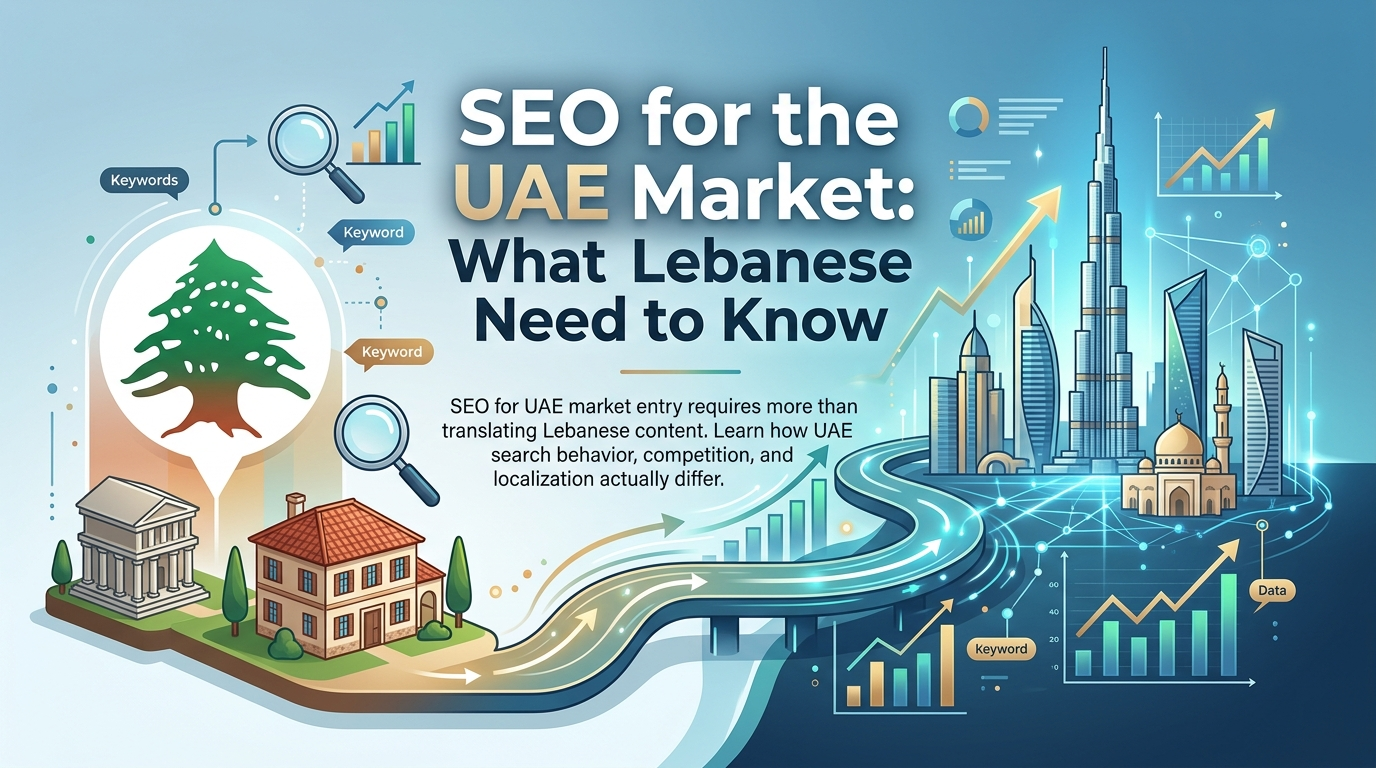
A Lebanese business that has built solid search visibility at home often assumes the same SEO approach will translate directly to the UAE market, treating expansion as a matter of adding a new location page or two. The reality is considerably more demanding. The UAE represents a fundamentally different competitive environment — higher search volume, denser competition, and a business audience shaped by different expectations — and businesses that underestimate this gap typically spend budget without seeing the visibility they expected. This article walks through how UAE search behavior genuinely differs, how to think about targeting Dubai, Abu Dhabi, or the wider Emirates, and the practical first steps worth taking before committing significant budget.
How UAE Search Behavior Differs From Lebanon?
Higher Competition, Higher Stakes
The UAE’s economy, and Dubai’s in particular, attracts an enormous concentration of both local and international businesses competing for the same search terms, many of them well-resourced enterprises with mature SEO programs already in place. A keyword that might see modest competition in Lebanon can be considerably more contested in the UAE, simply because more businesses with more resources are targeting the same audience. This does not mean UAE search is unwinnable for a Lebanese business, but it does mean the bar for content quality, technical execution, and authority-building is meaningfully higher than what worked for ranking at home.
Mobile-First, English-Heavy Search Habits
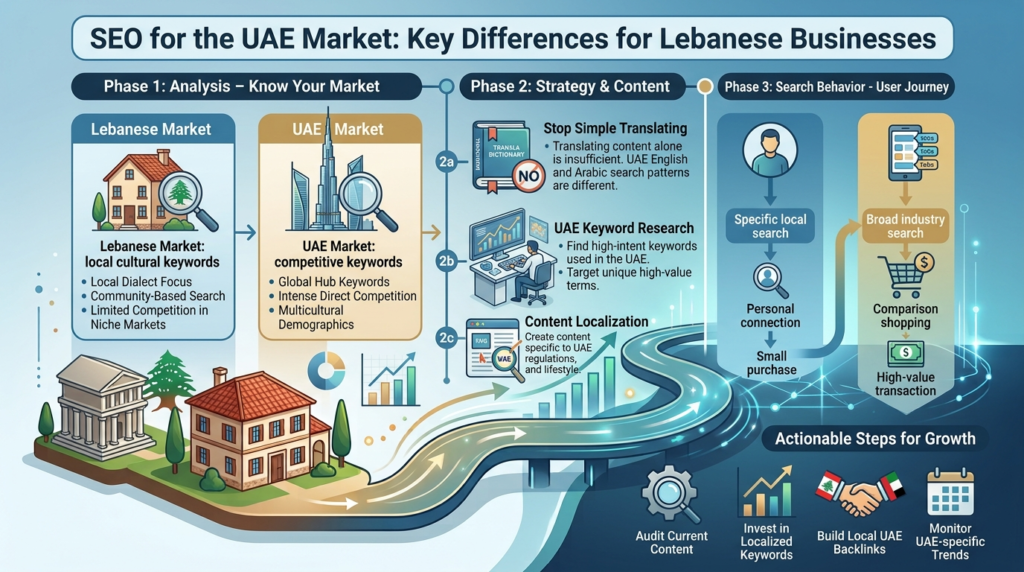
UAE search behavior skews heavily toward mobile devices, even more pronounced than trends in many other markets, and a substantial share of commercial searches — particularly in Dubai — happen in English rather than Arabic, reflecting the UAE’s large expatriate population and English’s role as a common business language. A Lebanese business assuming its Arabic-language SEO strategy will carry over directly to the UAE without adjustment often misses this reality, since the optimal language mix for UAE search frequently differs from what works best domestically.
Targeting Dubai vs. Abu Dhabi vs. Broader UAE
When City-Level Targeting Makes Sense?
Dubai and Abu Dhabi each have distinct search behavior, competitive landscapes, and audience characteristics, and treating them as interchangeable often produces weaker results than targeting each deliberately. A business offering city-specific services — anything requiring a physical presence or local delivery — benefits from explicit Dubai SEO or Abu Dhabi-specific content and local signals, since a searcher looking for a service in one city generally wants a provider that genuinely serves that city, not a generic UAE-wide claim.
Building a UAE-Wide Strategy Instead
For businesses offering services that genuinely apply across the entire UAE — many B2B services, ecommerce, or digital products — a broader UAE-wide strategy without artificial city-level segmentation often makes more sense than manufacturing separate Dubai and Abu Dhabi content that does not reflect genuine local differentiation. The decision between city-specific and UAE-wide targeting should be driven by whether the underlying business model actually varies by city, not by an assumption that more granular targeting is automatically better.
Content Localization Considerations for the UAE Market
Currency, Measurement, and Business Norms
Content built for a Lebanese audience needs genuine adjustment before it works for UAE visitors, starting with practical details: pricing displayed in AED rather than USD or Lebanese pounds, measurements and business hour conventions that match local expectations, and contact information reflecting UAE phone formats and business registration norms. These details seem minor individually, but their cumulative absence signals to a UAE visitor that a site was not genuinely built with their market in mind, which quietly undermines trust even when the core offering is strong.
Tone and Positioning for a Different Buyer
The UAE business buyer, particularly in Dubai’s competitive commercial environment, often expects a more polished, premium-positioned presentation than what works well in the Lebanese market, reflecting the UAE’s status as a hub for international business and a correspondingly higher baseline expectation for professional presentation. Content and design that reads as perfectly appropriate for a Lebanese audience can read as slightly underdeveloped by comparison to UAE market norms, which is worth genuinely assessing rather than assuming a direct port of existing content and design will land the same way.
Practical First Steps for Lebanese Businesses Entering UAE Search
Google Business Profile and Local Signals
For any business with a genuine UAE presence, establishing and thoroughly optimizing a Google Business Profile specific to that UAE location is one of the highest-leverage early steps, since local search results weight this signal heavily for location-relevant queries. This includes accurate UAE contact information, business hours reflecting local norms (including adjustments around Ramadan and UAE public holidays), and genuine UAE-based reviews rather than relying solely on reputation built in the Lebanese market.
Competitive Research Before Committing Budget
Before investing significant budget in UAE keyword research and content production, conducting a realistic competitive assessment — actually searching target keywords from a UAE-based perspective and evaluating who currently ranks — reveals whether the specific niche is genuinely accessible or dominated by large, well-resourced competitors that would make near-term ranking success unlikely. This research prevents the common mistake of assuming success in Lebanon will translate proportionally to the UAE market without accounting for the meaningfully different competitive density.
Conducting UAE Keyword Research the Right Way
Why Lebanese Keyword Data Doesn’t Transfer Directly?
UAE keyword research needs to be conducted natively rather than assuming search volume and phrasing patterns from Lebanese keyword data carry over. The same underlying service or product often gets searched using different terminology in the UAE, shaped by the market’s international business culture, its large expatriate population’s varied first languages, and commercial conventions that differ from Lebanon’s. Running keyword research tools specifically against the UAE market, rather than reusing a Lebanese keyword list with the location filter changed, produces meaningfully more accurate targeting.
Prioritizing Achievable Terms Over Aspirational Ones
Given the UAE’s competitive density, a keyword research process should explicitly separate genuinely achievable terms from aspirational ones dominated by large, established competitors. A Lebanese business new to the UAE market is generally better served starting with more specific, lower-competition long-tail terms that reflect real buyer intent, building authority gradually, rather than immediately targeting the broadest, most contested keywords where near-term ranking success is unlikely regardless of content quality.
Ranking in Dubai Search Results Specifically
What Makes Dubai’s Search Landscape Distinct?
Ranking in Dubai search results specifically requires accounting for the sheer density of international businesses, franchises, and well-funded startups all competing in the same commercial categories, often with far larger content and link-building budgets than a business new to the market can immediately match. Dubai’s search results for competitive commercial terms frequently feature a mix of large international brands and long-established local players, meaning a new entrant needs a genuinely differentiated angle rather than attempting to out-produce competitors purely on volume.
Building Credibility Signals Specific to Dubai
Beyond on-page content, ranking well in Dubai benefits from credibility signals that resonate specifically with that market — mentions or citations from UAE-based publications, partnerships or client relationships with recognizable Dubai-based businesses, and genuine local reviews and engagement. These signals take time to build and cannot be manufactured quickly, which is part of why realistic timeline expectations matter so much when planning a UAE market entry.
Measuring Progress Realistically
Setting UAE-Specific Benchmarks
Because the UAE’s competitive density differs so much from Lebanon’s, applying the same ranking and traffic benchmarks used domestically to a UAE campaign often produces a misleading picture of progress. A UAE campaign that has not yet reached page-one rankings for its most competitive target terms after a few months may still be performing well relative to realistic expectations for that specific competitive category, and setting benchmarks based on UAE-specific competitive research rather than Lebanese historical performance gives a far more accurate read on whether the strategy is actually working.
When to Reassess the Approach?
A UAE SEO effort genuinely struggling to gain traction after a reasonable, well-resourced period is worth reassessing rather than simply continuing to add more content in the hope that volume alone will eventually break through. This reassessment should look specifically at whether the keyword targets chosen were realistic given the competitive landscape uncovered during initial research, and whether the content and technical execution genuinely meet the higher bar the UAE market tends to require.
Frequently Asked Questions
Generally yes, primarily because competitive keywords require more content investment, stronger technical execution, and more link-building effort to achieve comparable rankings. Businesses should budget realistically for this higher competitive bar rather than assuming Lebanese market costs will transfer directly.
This depends on whether the business model genuinely varies by city. Businesses requiring physical presence or local delivery benefit from city-specific targeting, particularly for Dubai given its search volume and competition, while businesses offering UAE-wide digital services often perform better with a broader, unified strategy rather than artificial city segmentation.
Both matter, but the right mix depends on the specific audience and industry. English carries substantial weight for commercial and business searches in the UAE given the market’s international business character, while Arabic remains important for reaching Emirati nationals and Arabic-speaking residents specifically.
Generally longer than comparable efforts in Lebanon, given the higher competition density in most commercial categories. A realistic timeline often extends beyond the three-to-six-month range typical for less competitive Lebanese searches, particularly for high-value commercial keywords in Dubai specifically.
Assuming a direct port of Lebanese content, without genuine localization or competitive research, will produce comparable results. The UAE’s search competition, buyer expectations, and content norms differ meaningfully enough that a copy-paste approach typically underperforms a strategy built specifically for the UAE market’s actual conditions.
Ready to Build an SEO Strategy That Actually Works for UAE Expansion?
SEO for UAE market entry requires genuine localization and realistic competitive assessment, not a direct copy of what worked in Lebanon. Creative 4 All helps Lebanese businesses build UAE-specific SEO strategies grounded in actual search behavior and competitive density in Dubai, Abu Dhabi, and beyond. Get a Free SEO Audit to see what a realistic UAE expansion strategy would require for your business.