
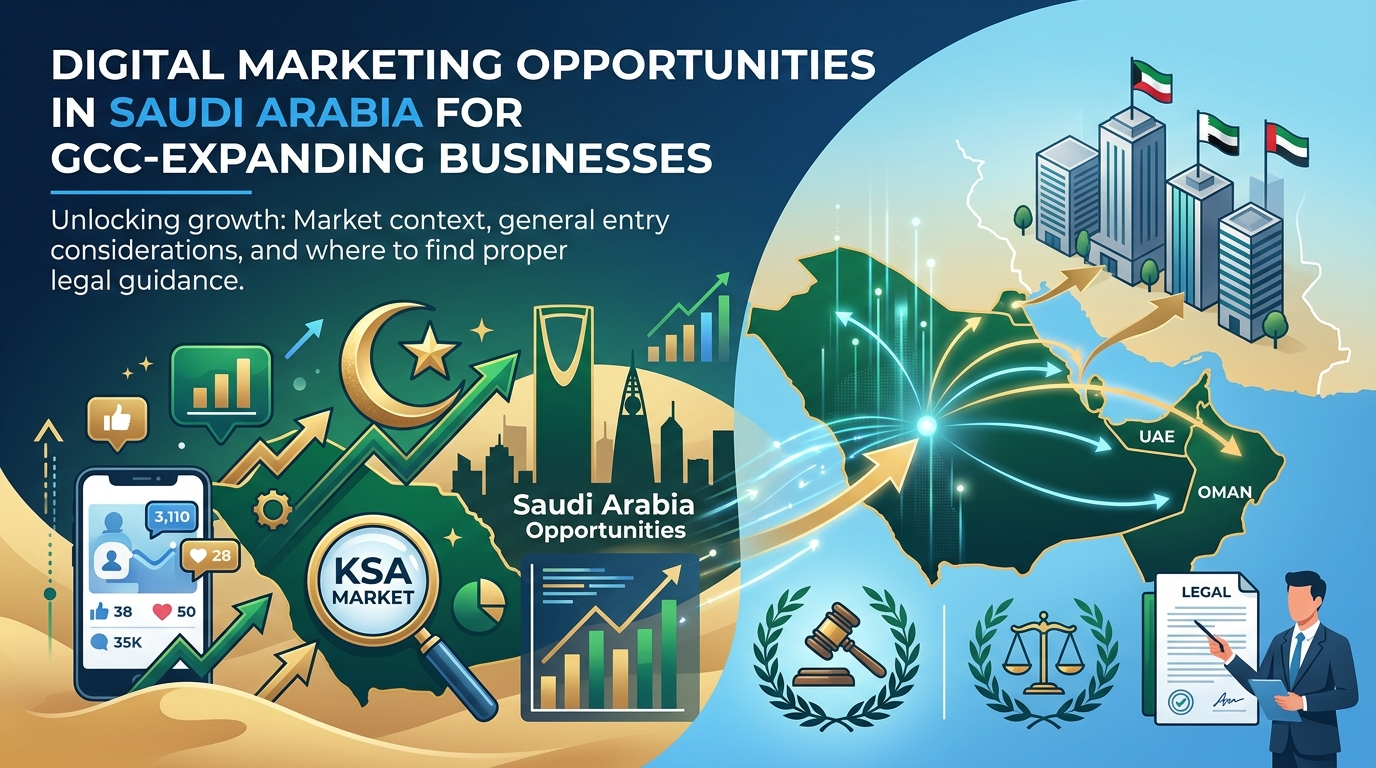
Saudi Arabia has become the single largest and fastest-growing market in the GCC for businesses considering regional expansion, and the scale of its digital transformation over the past few years makes it difficult to ignore for any company thinking beyond its home market. For Lebanese businesses that have already found success domestically, digital marketing Saudi Arabia represents a genuinely different order of opportunity compared to smaller neighboring markets, though capturing it requires understanding a market with different digital habits, different regulatory considerations, and a scale of competition that rewards careful preparation over rushed entry. This article covers the market context worth understanding, general considerations for a digital entry, and where formal professional guidance becomes essential rather than optional.
Why Saudi Arabia Represents a Major Regional Opportunity?
Market Size and Vision 2030’s Digital Push
Saudi Arabia’s digital economy has grown into a substantial and rapidly expanding share of national GDP, driven directly by Vision 2030’s deliberate push to diversify the economy away from oil dependence and build a modern, technology-driven commercial base. This is not a slow, incremental shift — government-backed infrastructure investment has brought internet penetration to near-universal levels and pushed 5G coverage across the vast majority of urban areas, creating the underlying conditions for digital commerce and digital marketing to scale quickly across a population that is both large and increasingly digital-first in its habits.
Ecommerce and Digital Ad Spend Growth
Saudi Arabia’s ecommerce sector has been growing at a pace that consistently outperforms global averages, with steady double-digit annual growth reflected across multiple independent market analyses covering the past several years. This growth is supported by a rapid shift from cash to digital payments, strong social commerce engagement particularly among younger consumers, and continued government initiatives supporting small and medium enterprise digitization. For a Lebanese business considering GCC expansion, this combination of scale and growth rate makes Saudi Arabia genuinely difficult to overlook as a long-term market priority, even where Lebanon or smaller Gulf markets remain the immediate operational focus.
General Considerations for Entering the Saudi Market Digitally
Language, Culture, and Content Localization
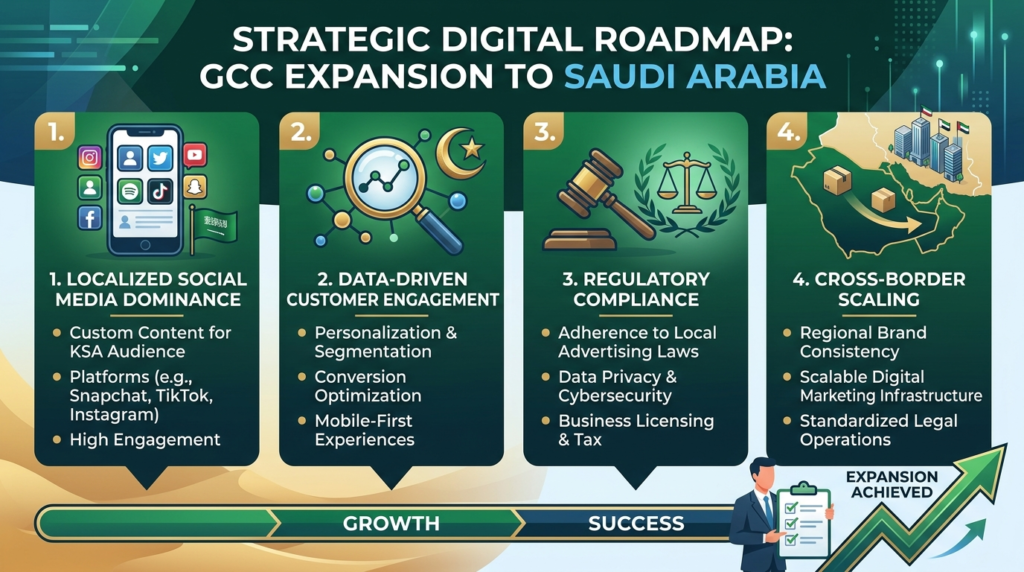
Content built for a Lebanese or broader Levantine Arabic-speaking audience needs genuine adaptation before it resonates with a Saudi audience, since dialect, cultural references, and even preferred content formats differ meaningfully between the two markets. A Saudi Arabia market entry strategy built purely on repurposing existing Lebanese content without local review typically underperforms content built with genuine Saudi cultural and linguistic context in mind, particularly for messaging that touches on values, family, or social norms where regional sensitivity matters considerably.
Platform and Channel Differences From Lebanon
Digital channel usage in Saudi Arabia reflects the country’s own distinct patterns rather than mirroring Lebanese habits directly — certain social platforms carry outsized influence in Saudi Arabia relative to their relevance elsewhere in the region, and paid advertising costs and competition levels on major platforms tend to run higher given the market’s overall commercial scale. Before committing meaningful budget, reviewing how a business’s specific industry actually performs across Saudi digital channels, rather than assuming Lebanese platform priorities transfer directly, produces a far more accurate initial strategy.
Understanding the Regulatory Landscape (At a High Level)
Why Formal Legal Guidance Matters Before Committing?
Saudi Arabia maintains its own distinct regulatory framework covering business registration, data protection, advertising standards, and ecommerce operations, and this framework has continued to evolve as part of the Kingdom’s broader digital economy development. This article does not attempt to provide legal or regulatory guidance, since requirements can be specific, subject to change, and dependent on the particular business model and sector involved. Any business seriously considering a Saudi Arabia market entry should engage qualified local counsel or a licensed advisor familiar with current Saudi commercial and digital regulations before making binding commitments.
Areas Where Local Counsel Should Be Consulted
Areas worth raising directly with qualified local counsel typically include business registration and foreign ownership requirements, data protection and privacy compliance for any Saudi user data collected, advertising and content standards specific to the Saudi market, and any sector-specific licensing that may apply depending on the business’s industry. Treating these as open questions to resolve with proper legal guidance, rather than assumptions carried over from Lebanese or general GCC experience, protects a business from costly missteps during market entry.
A Measured First-Step Approach for GCC-Expanding Businesses
Testing Demand Before Full Market Entry
Rather than committing to a full-scale Saudi market entry immediately, a measured first step — running a modest, well-targeted digital campaign to gauge actual audience response and demand — provides real data about whether a specific product or service resonates with Saudi buyers before larger investment follows. This approach also surfaces practical questions (logistics, payment preferences, customer service expectations) that are far cheaper to discover early than after a larger commitment has already been made.
Building Credibility Signals Specific to Saudi Arabia
Saudi consumers and business buyers, like those in the UAE, tend to respond well to visible, locally relevant credibility signals — genuine engagement from Saudi-based customers or partners, content that demonstrates real familiarity with the local market rather than an obviously imported approach, and a digital presence that treats the Saudi audience as a primary focus rather than an afterthought appended to a Lebanese or regional strategy. Building this credibility takes time and cannot be manufactured through advertising volume alone, which is part of why an early, deliberate presence often outperforms a rushed, resource-heavy launch attempted later once competitive pressure has already increased.
How Saudi Arabia Fits Into a Broader GCC Strategy?
Sequencing Saudi Arabia Relative to Other Gulf Markets
Many Lebanese businesses approaching GCC expansion default to targeting the UAE first, given its historical role as a regional business hub, but Saudi Arabia’s sheer market size and growth trajectory make a strong case for treating it as an equally serious priority rather than a secondary market to consider only after UAE success. The right sequencing genuinely depends on the specific industry — some categories see faster traction in the UAE’s more internationally oriented commercial environment, while others align more naturally with Saudi Arabia’s rapidly digitizing domestic consumer base.
Shared Infrastructure Across Regional Expansion
Businesses expanding into both the UAE and Saudi Arabia often find meaningful overlap in the foundational work required — Arabic content localization processes, regional payment and logistics considerations, and general GCC market research — even though the two markets ultimately require distinct execution. Building this shared infrastructure with an eye toward eventual multi-market expansion, rather than treating each country as an entirely separate project built from scratch, tends to produce a more efficient regional strategy over time.
Common Missteps Worth Avoiding Early
Treating Saudi Arabia as a Single Undifferentiated Market
Saudi Arabia’s own internal diversity — across regions, age groups, and urban versus more traditional communities — means a single, one-size-fits-all campaign often underperforms compared to messaging tailored to more specific audience segments within the country. Businesses that assume “Saudi Arabia” represents one homogeneous audience frequently discover that a more segmented approach, similar to how a mature market would be treated, produces meaningfully better engagement.
Moving Faster Than Proper Guidance Allows
The scale of opportunity in Saudi Arabia can create pressure to move quickly, but rushing past proper legal and regulatory guidance to accelerate a launch is a common and costly misstep. A business that takes the additional time to confirm registration, data handling, and advertising compliance requirements with qualified counsel before launching avoids the far more expensive scenario of having to unwind or restructure an improperly established market presence after the fact.
Frequently Asked Questions
It can be, particularly for businesses offering digital products, services, or ecommerce that do not require extensive physical infrastructure. The market’s scale means competition can be significant in popular categories, so a focused, well-researched approach tends to work better than an unfocused broad launch.
This depends entirely on the specific business activity and should be confirmed with qualified local legal counsel, since requirements vary by business model and have continued to evolve as part of ongoing regulatory development. This article cannot substitute for that formal guidance.
The KSA digital advertising landscape generally involves higher costs and denser competition on major platforms, reflecting the market’s larger scale and stronger purchasing power in many categories, though this varies significantly by industry and specific target audience.
Generally yes. Saudi Arabic dialect, cultural references, and content preferences differ meaningfully from Levantine Arabic markets, and content genuinely adapted for a Saudi audience typically performs better than content translated or repurposed without local review.
Underestimating the importance of proper regulatory and legal guidance before committing resources is a significant risk, alongside assuming Lebanese digital strategy and content will transfer directly without adaptation. Both risks are manageable with proper preparation and qualified local advice.
Ready to Explore Saudi Arabia as Part of Your GCC Expansion?
Digital marketing Saudi Arabia represents one of the strongest growth opportunities in the region, but capturing it requires genuine market understanding and proper professional guidance, not assumptions carried over from other markets. Creative 4 All helps Lebanese businesses think through GCC expansion strategy, including how Saudi Arabia fits into a broader regional plan. Book a Free Digital Marketing Consultation to discuss whether Saudi Arabia should be part of your expansion roadmap.