
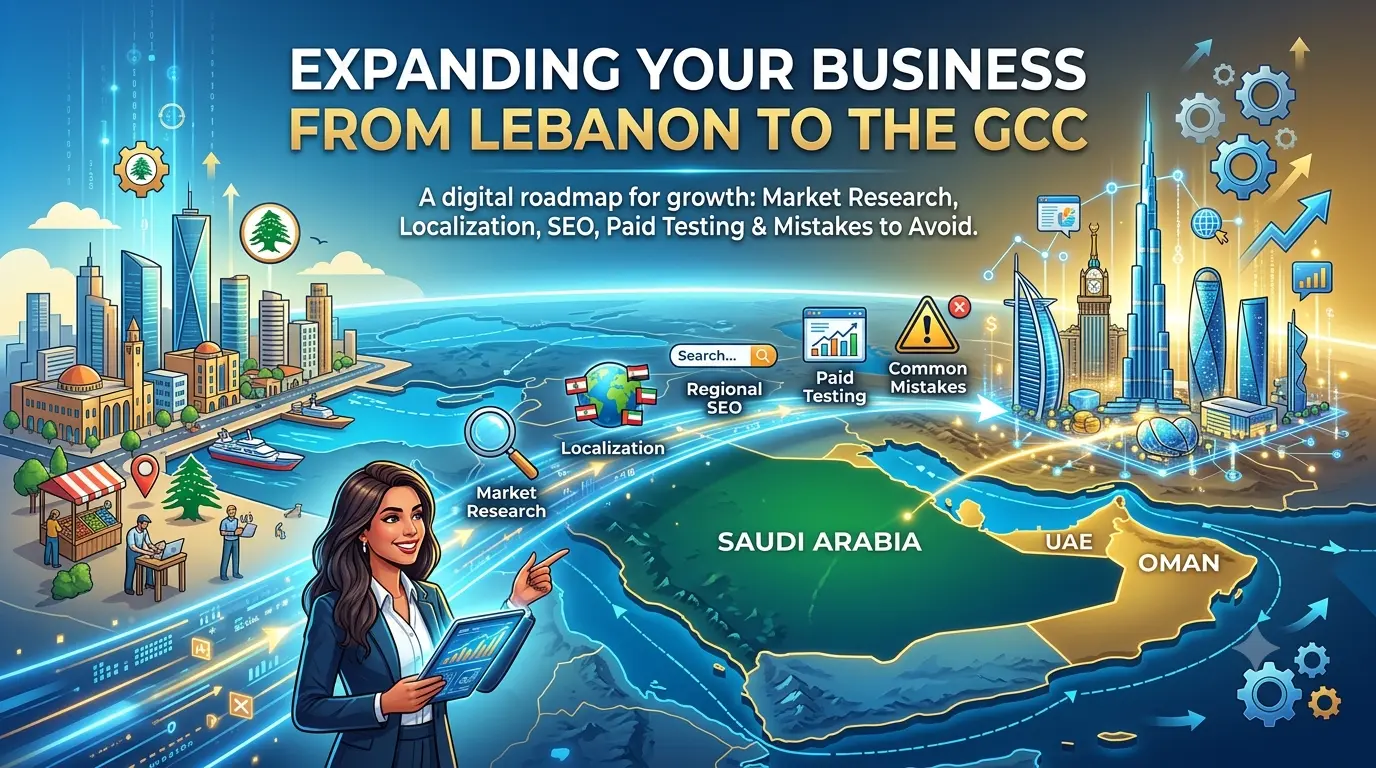
A significant number of Lebanese businesses eventually reach the same point: the local market has been served well, growth has plateaued at what Lebanon’s economy can realistically support, and the next stage of growth clearly lies across the Gulf. Digital expansion Lebanon to GCC is a real, well-worn path — the Lebanese diaspora across the UAE, Saudi Arabia, and the broader Gulf is large, established, and economically active, and Lebanese business culture already shares deep linguistic, cultural, and commercial ties with the region. What’s usually missing isn’t opportunity; it’s a clear, sequenced plan for actually executing that expansion digitally rather than treating it as a vague, someday ambition.
This guide lays out why Lebanon-based businesses are genuinely well-positioned for GCC expansion, a digital-first sequence for executing it — market research, localized content, regional SEO, and paid testing — the common mistakes that derail expansion attempts, and a practical starting framework for a business ready to take the first step.
Why Lebanon-Based Businesses Are Well-Positioned for GCC Expansion?
Language and Cultural Fluency
Lebanese businesses operate natively in Arabic, English, and often French, which maps directly onto the linguistic reality of the GCC market — Arabic as the primary regional language, English as the dominant business and commercial language across the Gulf’s international hubs, and French carrying real weight in specific professional and luxury sectors. This trilingual fluency isn’t a translation exercise a Lebanese business has to build from scratch; it’s an existing operational capability that businesses entering the Gulf from Western markets often have to develop at real cost and with real risk of getting cultural nuance wrong.
Diaspora Networks
The Lebanese diaspora across the UAE, Saudi Arabia, Qatar, and Kuwait represents both a warm initial audience and a genuine business network — established Lebanese business owners, professionals, and community connections that can meaningfully shorten the trust-building period a new market entrant typically has to work through from zero. A Lebanese business expanding into Dubai or Riyadh isn’t necessarily starting as a complete unknown; existing diaspora relationships often provide early customers, local market intelligence, and introductions that accelerate the early stages of market entry.
Cultural and Commercial Proximity
Beyond language and diaspora, Lebanese business culture already shares meaningful commercial and cultural common ground with the GCC — shared regional business customs, comparable expectations around service and relationship-building, and a level of cultural fluency that’s genuinely difficult for a business entering from a culturally distant market to replicate quickly. This proximity doesn’t eliminate the real differences between the Lebanese and Gulf markets, but it does mean a Lebanese business starts the expansion process with less cultural translation work than many international entrants face.
The Digital-First Expansion Sequence
Market Research
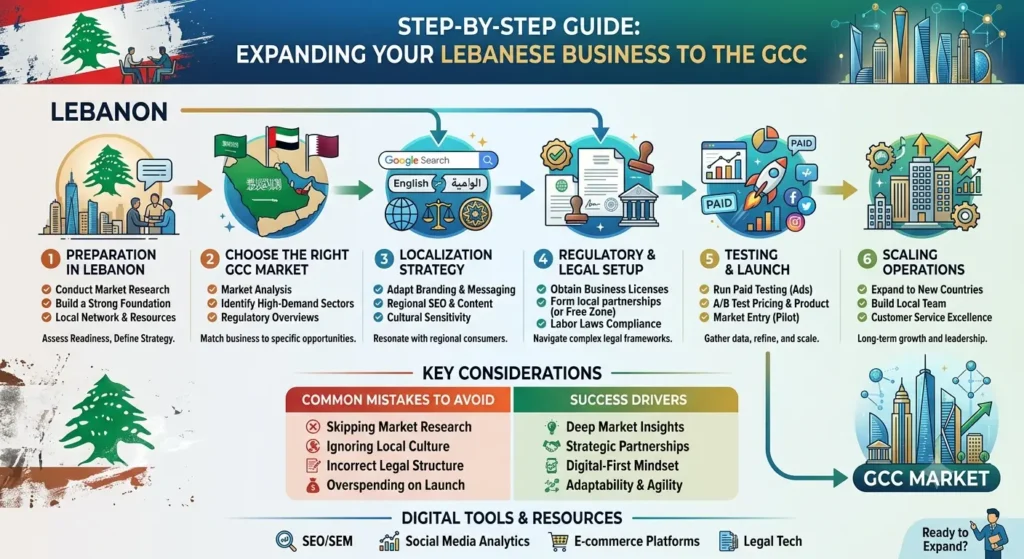
Before any content, advertising, or localization work begins, genuine market research needs to establish whether real demand exists for the specific product or service in the specific GCC market being considered, since demand, competition, and customer behavior can vary significantly even between neighboring Gulf countries. This means researching actual search volume and competition for relevant keywords in each target market, understanding local competitors already serving that demand, and identifying any regulatory or business registration requirements specific to operating commercially in that country, since these vary meaningfully across UAE, Saudi Arabia, Qatar, and Kuwait.
Localized Content
Genuine localization — not simple translation — comes next: content, messaging, and positioning adapted to how the target GCC audience actually searches, communicates, and makes purchasing decisions, rather than Lebanese content with only the language swapped. This includes adjusting currency, addressing region-specific customer concerns, and in many cases producing content that speaks to the specific competitive landscape and cultural context of that market rather than assuming Lebanese market positioning translates directly.
Regional SEO
Building search visibility in a new GCC market requires its own dedicated SEO work — market-specific keyword research, potentially dedicated country-specific pages or subdomains depending on how significant the expansion is, and building relevant local citations, backlinks, and business listings within that market rather than assuming Lebanese search authority carries over automatically. Google increasingly serves genuinely localized results, which means a business with strong Lebanese SEO performance can still be entirely invisible in Emirati or Saudi search results without dedicated regional SEO work.
Paid Testing
Before committing significant budget to a new GCC market, controlled paid advertising testing validates real demand and conversion behavior with actual budget at stake, rather than relying purely on market research assumptions. A modest, well-structured test campaign reveals genuine cost per lead, conversion patterns, and audience response in the specific market being considered, providing real data to inform how aggressively to scale the broader expansion effort before larger organic content and SEO investments are made.
Common Expansion Mistakes
Treating the entire GCC as a single homogeneous market is one of the most consistent mistakes Lebanese businesses make when expanding regionally — the UAE, Saudi Arabia, Qatar, and Kuwait each have distinct regulatory environments, consumer behaviors, and competitive landscapes, and a strategy that works in Dubai doesn’t automatically transfer to Riyadh or Doha. Launching simultaneously across multiple GCC markets before validating demand in even one is a related mistake, spreading limited resources too thin to properly execute in any single market rather than establishing a genuine foothold in one before expanding further.
Assuming Lebanese content and positioning translate directly without genuine localization is another frequent error, often producing content that reads as foreign or out of touch with the target market’s actual expectations and search behavior. And underestimating the importance of regional SEO specifically — assuming that strong Lebanese search visibility will simply extend into GCC search results — leaves a business investing in content and advertising that never actually gets discovered by the audience it’s meant to reach.
A Practical Starting Framework
A Lebanese business ready to begin GCC expansion should start by choosing one target market — typically the one with the strongest existing diaspora connection, clearest demand signal from initial research, or most direct competitive opportunity — rather than attempting several markets simultaneously. From there, the sequence outlined above applies directly: validate demand through genuine market research, build properly localized content and positioning for that specific market, invest in dedicated regional SEO, and run controlled paid testing before scaling investment based on real performance data rather than assumptions carried over from the Lebanese market.
This sequential, single-market-first approach takes longer to reach a full GCC-wide presence than a simultaneous multi-market launch, but it produces a genuinely validated, properly localized foothold in each market rather than a thin, under-resourced presence spread across several markets at once.
Market-Specific Nuances Across the GCC
Treating the UAE, Saudi Arabia, Qatar, and Kuwait as interchangeable markets is one of the fastest ways to undermine an otherwise sound expansion plan, since each carries genuinely different digital and commercial characteristics worth understanding before committing resources. The UAE, particularly Dubai, offers the most internationally oriented digital environment in the region, with English performing strongly alongside Arabic and a business culture accustomed to a wide range of international brands and service providers, making it a common first entry point for Lebanese businesses testing GCC demand. Saudi Arabia represents by far the largest consumer market in the region, with Arabic content and a more locally rooted business culture playing a larger role than in the UAE, and its ongoing economic diversification has created substantial digital-first demand across multiple sectors that didn’t exist even a few years ago.
Qatar’s smaller but affluent market rewards a premium positioning strategy more than a volume-driven one, and its digital advertising landscape tends to be less saturated than the UAE’s, which can translate into more efficient paid testing costs for a business entering carefully. Kuwait, while smaller still, maintains strong regional trade and cultural ties to Lebanon specifically, often making it a comparatively low-friction market for a Lebanese business with existing Kuwaiti diaspora or business connections to test initial demand before committing to a larger, more competitive market like the UAE or Saudi Arabia.
Measuring Whether Expansion Is Actually Working
A digital expansion Lebanon to GCC effort needs its own set of success metrics distinct from what a business tracks in its home market, since comparing early-stage GCC performance against mature Lebanese metrics almost always looks discouraging by default. Early indicators worth tracking include search visibility for target keywords within the specific GCC market, paid testing cost per lead and conversion rate, and genuine engagement from the target audience — inquiries, direct messages, or early sales — rather than raw traffic volume alone, which can look promising without reflecting real market traction.
Reviewing these metrics on a defined schedule, comparable to how a business would evaluate any new market entry, keeps expansion decisions grounded in actual performance data rather than either premature optimism after a strong first month or premature abandonment after a slow one. A digital expansion Lebanon to GCC roadmap should build in these checkpoints from the start, rather than treating measurement as an afterthought once the expansion is already well underway.
Frequently Asked Questions
This depends on the specific business and product, but the UAE is often the most accessible starting point given its large Lebanese diaspora, English-friendly business environment, and established digital infrastructure, though Saudi Arabia’s larger market size makes it the right first choice for some categories.
Requirements vary significantly by country and by whether the business is selling digitally, physically operating, or both — this needs to be researched specifically for the target market and product category rather than assumed, since informal cross-border selling and formal local registration carry very different legal and tax implications.
A properly sequenced expansion — market research, localization, regional SEO, and paid testing — typically takes several months to a year before a business sees meaningful, validated traction in a new GCC market, though initial paid testing can produce useful signal much faster.
Both are usually necessary. English carries significant weight in Gulf business and commercial contexts, particularly in the UAE and Qatar, while Arabic remains essential for reaching the broader regional consumer audience, and the right balance depends on the specific market and audience being targeted.
Yes. A modest, well-structured paid testing campaign in a specific target market can validate demand and conversion behavior on a limited budget before any larger investment in localization, regional SEO, or broader advertising spend.
Ready to Build a Real Roadmap for GCC Expansion?
Expanding from Lebanon into the GCC works best as a sequenced, validated process, not a single leap into an unfamiliar market. Get a free SEO audit from Creative 4 All and start building a digital expansion Lebanon to GCC roadmap based on your specific business and target market.