
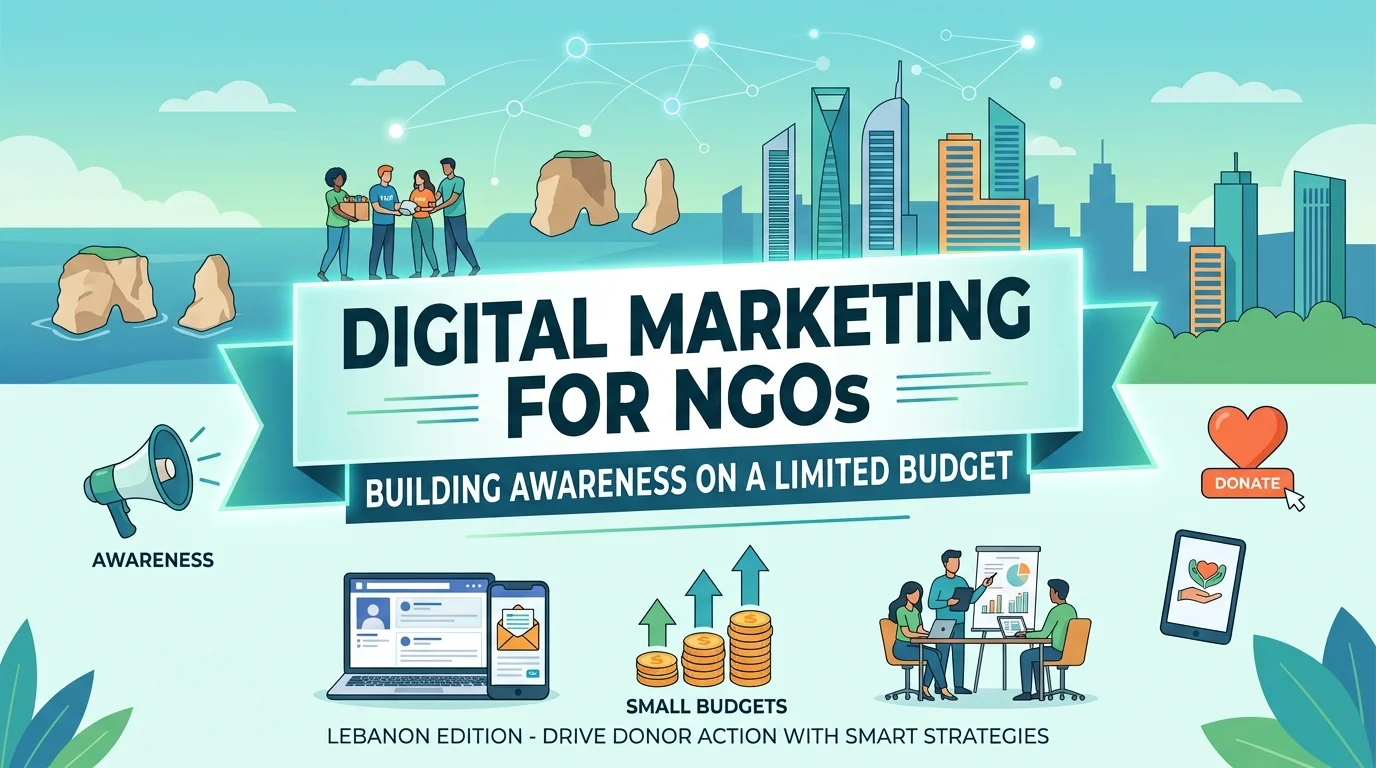
An NGO in Lebanon typically operates with a small team, a modest budget, and a mission that matters enormously to the people it serves, yet the same organization often struggles to get that mission in front of the donors, volunteers, and partners who could support it. Digital marketing for NGOs Lebanon organizations rely on faces constraints that a commercial business simply doesn’t: limited funds that must be justified to donors, a small staff already stretched across program delivery, and messaging that has to be both emotionally honest and carefully responsible. This article focuses on what actually works within those constraints, rather than assuming access to a commercial-sized marketing budget.
Why NGOs Face Distinct Marketing Constraints?
Limited Budget and Small Teams
Most NGOs cannot hire a dedicated marketing team or fund large paid campaigns, and every dollar spent on promotion is a dollar not spent on programs, which makes accountability to donors a genuine consideration in how marketing budget gets justified. This reality means nonprofit marketing strategy has to prioritize efficiency and sustainability over volume, favoring approaches a small team can realistically maintain consistently over ambitious plans that collapse after a few weeks of effort.
Mission-Driven Messaging Needs
NGO messaging carries a different weight than commercial advertising, since the content represents real people, real communities, and often sensitive situations, and the organization’s credibility depends on handling that representation honestly and respectfully. A commercial brand can lean on persuasive tactics that would feel inappropriate or exploitative in an NGO context, which means effective nonprofit communication relies on genuine transparency, dignity in how beneficiaries are portrayed, and a clear, honest account of how support translates into real impact.
Prioritizing Channels on a Limited Budget
Starting With Owned Channels
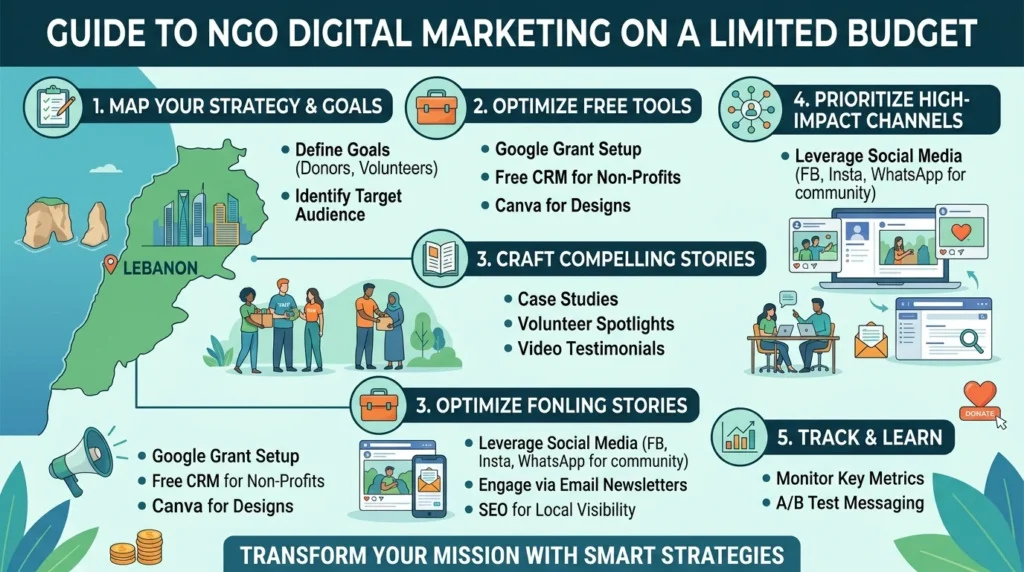
A sound nonprofit marketing strategy for an organization with limited resources generally gets the most durable return by investing first in channels it fully controls: a clear, mobile-friendly website explaining the mission and how to give or volunteer, an email list that can be communicated with directly over time, and social media profiles used consistently on the one or two platforms where the organization’s actual audience is active. These owned channels build lasting assets that don’t disappear when a paid campaign ends, and a well-maintained email list in particular becomes one of the most reliable and cost-effective ways to stay connected with supporters and encourage repeat giving.
Choosing Where to Invest Limited Paid Spend
When some paid budget is available, concentrating it on a small number of specific, measurable goals — promoting a particular fundraising campaign, driving sign-ups for a volunteer program, or boosting a high-performing piece of existing content — generally outperforms spreading a small budget thinly across many platforms and objectives. Starting with modest, tightly targeted spend and expanding only after seeing which specific approaches actually produce donations or sign-ups protects limited funds from being wasted on untested tactics.
Storytelling That Drives Donor Action
Why Stories Outperform Statistics Alone?
Statistics establish scale and credibility, but individual human stories are what typically move a reader from understanding a problem to feeling motivated to act on it, since people connect emotionally with a specific person’s experience far more readily than with an abstract number. The most effective approach combines both: a specific, honest story that makes the issue human, supported by clear data that shows the broader scale of the need and the organization’s genuine impact.
Building a Story That Leads to Action
A story intended to drive donor action needs more than emotional resonance; it needs a clear structure that moves a reader from the situation described, to what the organization did about it, to a specific, easy next step the reader can take. Ending a compelling story without any clear call to action wastes the emotional momentum it created, so every piece of storytelling content should point clearly toward one concrete action, whether donating, volunteering, subscribing, or sharing. Respecting the dignity and consent of anyone featured in a story is a non-negotiable foundation of this approach, protecting both the individuals involved and the organization’s long-term trust.
Free and Discounted Tools Available to Nonprofits
Ad Grant and Discount Programs
Several major technology companies run programs offering qualifying nonprofits free or discounted access to advertising credits and software, and ad grant programs in particular can provide eligible organizations with in-kind advertising allowances that significantly extend what a modest budget can achieve. Eligibility requirements, application processes, and the specific terms of these programs vary by provider and can change over time, and availability for organizations registered in a particular country should be confirmed directly with each provider before building a strategy around any specific program.
Free Tools for Content, Email, and Design
Beyond formal grant programs, many widely used tools for design, email marketing, project management, and collaboration offer free tiers or nonprofit-specific discounts that make professional-quality marketing achievable without a large software budget. A small NGO team can often cover the basics of email marketing, graphic design for social media, simple website analytics, and content scheduling using free or heavily discounted tools, reserving limited funds for the places where paid investment genuinely makes a difference.
Donor Communication That Builds Lasting Relationships
Thanking and Updating Donors Consistently
Donor communication shouldn’t begin and end with the donation request. Promptly thanking donors, then following up with honest updates showing how contributions were actually used, builds the trust that turns a one-time donor into a repeat supporter. A donor who receives a genuine thank-you and a clear account of impact is considerably more likely to give again than one who only ever hears from the organization when it needs money.
Segmenting Supporters by Their Relationship to the Cause
Different supporters relate to a cause differently: a first-time donor, a long-standing monthly giver, a volunteer, and a corporate partner each respond to different messages and need different types of communication. Even simple segmentation of an email list into a few groups, with messaging tailored to each, noticeably improves donor engagement compared to sending identical generic messages to every supporter regardless of how they actually connect with the organization.
Cause Marketing on a Budget
Partnering With Local Businesses
Cause marketing on a budget often starts with local business partnerships, which can extend an NGO’s reach and funding without requiring large marketing spend, since a business that genuinely cares about the cause can promote the organization to its own customer base while supporting the mission financially. The most successful partnerships are built on genuine alignment between the business’s values and the NGO’s mission, rather than a purely transactional exchange of logo placement for a donation.
Keeping Partnerships Authentic and Mutually Beneficial
An NGO considering a cause marketing partnership should evaluate whether the partner’s brand and practices align with the organization’s own values, since an unsuitable partnership can damage the NGO’s credibility with its supporters. Clear written agreements about how the partnership will be promoted, how funds will be handled, and how the NGO’s name and imagery may be used protect both sides and keep the relationship transparent.
Frequently Asked Questions
Start with the owned channels: a clear website, an email list, and one or two social platforms used consistently. These cost little beyond time, build lasting assets, and provide the foundation that any later paid effort will depend on.
It can be, but only for specific, measurable goals and after owned channels are working well. Small, tightly targeted spend tied to a particular fundraising campaign or volunteer drive generally delivers better value than broad, ongoing advertising without a clear objective.
By prioritizing dignity and informed consent, portraying people as active participants in their own stories rather than passive objects of pity, and being honest about both the challenge and the progress being made. Ethical storytelling builds more durable donor trust than manipulative emotional appeals.
A consistent, sustainable routine matters more than a large time commitment, so a realistic weekly rhythm that a small team can maintain over months, such as a regular email update and a few planned social posts, generally outperforms bursts of intense activity followed by long silences.
Tracking meaningful outcomes such as donations received, email list growth, volunteer sign-ups, and website visits from specific campaigns is more useful than focusing on follower counts or likes, since these outcomes directly connect to the organization’s actual goals.
Ready to Build Awareness for Your Cause Without a Large Budget?
Digital marketing for NGOs Lebanon organizations depend on works best when it is realistic about constraints, honest in its storytelling, and focused on a small number of channels done well. Creative 4 All supports mission-driven organizations across Lebanon and the GCC with practical, budget-conscious marketing approaches. Book a Free Digital Marketing Consultation to discuss what would work for your organization.