A marketing director in Dubai needs a bilingual website, Arabic and English content every week, SEO for the UAE and Saudi Arabia, and paid campaigns that speak naturally to Gulf audiences. Local agencies quote fees that would consume most of the budget. Offshore teams elsewhere are cheaper but struggle with Arabic and with Gulf culture. Somewhere between the two, a growing number of GCC companies have found the same answer: Lebanon.
Choosing to outsource digital marketing to a Lebanese agency is not a new idea; Lebanese marketers, designers and developers have worked with Gulf clients for decades, many of them from Beirut. But doing it well requires more than finding a lower quote. This guide, written for GCC founders, marketing heads and procurement teams, explains why companies in the UAE, Saudi Arabia, Qatar and Kuwait outsource digital marketing, web development and SEO to Lebanon, what the real trade-offs are, and how to structure the relationship so it works.
Why GCC Companies Outsource Digital Marketing to Lebanon?
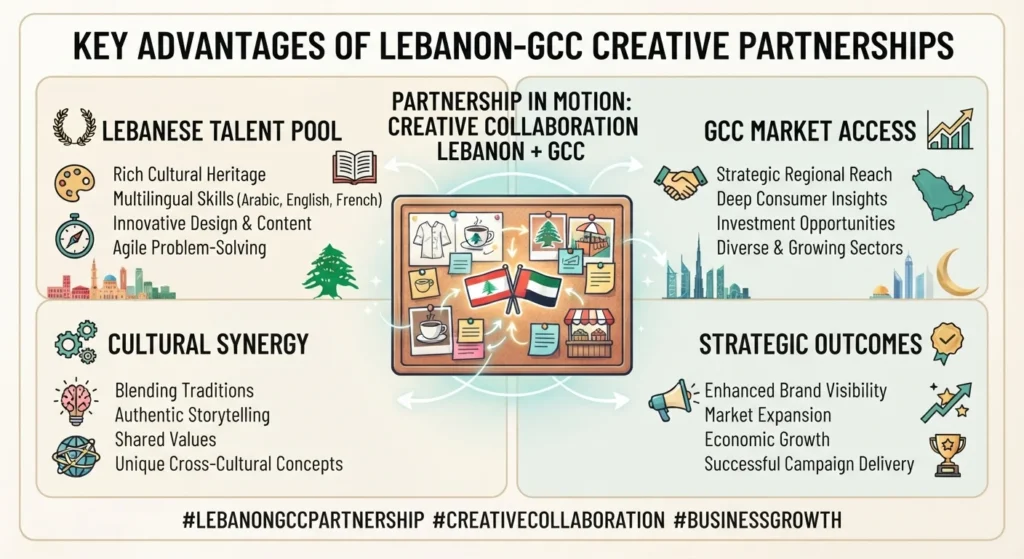
When businesses search for an “outsource digital marketing agency GCC” partner, they usually want three things at once: quality, cultural fit and sensible cost. Lebanon tends to offer all three.
Bilingual and Trilingual Talent
Lebanese creative and marketing professionals typically work fluently in Arabic and English, and often French. That matters in the Gulf, where most brands need both Arabic and English content of equal quality. Writing natural Arabic copy, designing proper right-to-left interfaces and running Arabic campaigns are everyday skills rather than specialist add-ons. Our guide to Arabic RTL website design shows how much depends on getting Arabic right.
Cultural Proximity Without Being Local
Lebanese teams understand Arab consumer culture, religious and seasonal calendars such as Ramadan and Eid, and the expectations of Gulf audiences, while bringing an outside perspective and experience across many markets. They are not Gulf natives, so Saudi or Emirati dialect content should still be reviewed by someone from the target market, but the cultural gap is far smaller than with teams outside the region.
Cost Structure
Agency fees in Dubai, Riyadh and Doha reflect high costs for office space, visas and living expenses. Lebanese agencies operate with a lower cost base, so for comparable senior talent their fees are often lower. Quotes vary widely by scope and seniority on both sides, so compare like with like rather than headline rates. The question of agency cost in Lebanon vs Dubai is best answered by requesting itemised proposals for the same scope from both.
What You Can Outsource?
Most GCC companies outsource some combination of the following, either as a project or on a retainer:
- Web design and development: bilingual websites, ecommerce stores and web applications.
- SEO and content: Arabic and English SEO, content production and technical audits.
- Paid media: Google, Meta, Snapchat and LinkedIn campaigns with creative.
- Branding and design: identity systems, campaign assets and Arabic typography.
- AI and automation: WhatsApp chatbots, workflows and integrations.
If you plan to outsource web development to Lebanon, a clear brief is essential; our guide on how to brief a web design agency explains what to include.
Choosing the Right Engagement Model
How you structure the work matters as much as who you hire.
Project-based work suits websites, rebrands and one-off audits, with a fixed scope, timeline and price. Retainers suit ongoing SEO, content, social media and paid campaigns, with a monthly scope and reporting cycle. A dedicated team model, where specific people work mainly on your account, suits companies that need consistent capacity and want the team to absorb their brand deeply. Finally, white-label partnerships suit GCC agencies that outsource production to a Lebanese partner while keeping the client relationship themselves. Many Gulf agencies already work this way, which is part of why the model is often described as a nearshore marketing agency for the Middle East.
Time Zones and Workweeks
Practical overlap is better than many expect. Lebanon follows Eastern European time with daylight saving, so it is one hour behind Saudi Arabia in winter and level with it in summer, and one to two hours behind the UAE depending on the season. That leaves most of the working day shared.
Workweeks differ slightly. The UAE moved its official workweek to Monday through Friday, Saudi Arabia works Sunday through Thursday, and Lebanese agencies generally work Monday through Friday. In practice, that gives four fully overlapping days with Saudi clients and five with UAE clients. Agree on response times, a weekly meeting slot and escalation contacts at the start, and the difference rarely causes problems.
Contracts, Ownership and Data
Strong contracts protect both sides. Make sure yours covers these points clearly.
Scope and Deliverables
A statement of work should define deliverables, quantities, revision rounds, timelines and reporting. Vague scopes cause most outsourcing disputes, whatever the country.
Ownership of Accounts and Assets
Your company should own its domains, hosting accounts, Google Analytics and Search Console properties, ad accounts, social media pages and design source files, with the agency added as a user or manager. This is the single most important protection when you outsource digital marketing, because it means you can change providers without losing history or access.
Data Protection and Confidentiality
If the agency will handle customer data, include data protection clauses that reflect the laws that apply to you, such as the UAE’s and Saudi Arabia’s personal data protection laws, along with confidentiality obligations and limits on where data may be stored. Lebanon has its own framework under Law No. 81 of 2018. Take legal advice for contracts involving sensitive data.
Payments, Invoicing and Tax
Most Lebanese agencies invoice international clients in US dollars and receive payment by international bank transfer, often to accounts set up for foreign currency payments. Agree on currency, payment schedule and method upfront.
Tax treatment depends on your jurisdiction. In both the UAE and Saudi Arabia, businesses that import services from abroad may need to account for VAT under the reverse-charge mechanism, and withholding tax rules can apply in some cases. Your finance team or tax adviser should confirm the treatment before you sign; this is general information, not tax advice.
Managing the Risks Honestly
Any GCC company considering Lebanon will ask about stability, and it is a fair question. Lebanon has faced serious economic and political difficulties in recent years, and power and connectivity can be less reliable than in the Gulf. Established Lebanese agencies have adapted: they run on generators and backup connectivity, store work in cloud systems, and many have staff or partners outside the country.
Ask any potential partner directly about their continuity plan: how they handle power or internet disruption, where files and systems live, who covers critical tasks if a team member is unavailable, and how quickly they can restore work. Combined with your ownership of all accounts and assets, a good continuity plan reduces the risk to a manageable level.
How to Vet a Lebanese Agency?
Treat the selection like any important supplier decision. Check that the agency has relevant work in Arabic and English, ideally for Gulf brands or similar sectors; speak to at least two client references, preferably in the GCC; ask who will actually work on your account and their seniority; review sample reports to see how results are measured; and confirm the agency’s process for approvals, revisions and escalation.
A short paid pilot, such as an audit, a landing page or a one-month campaign, is often the best test. It shows communication quality, deadlines and output before you commit to a long retainer. For broader context on entering Gulf markets, see our guides to SEO for the UAE market and digital marketing in Saudi Arabia, and for Lebanese brands heading the other way, digital expansion from Lebanon to the GCC.
When Outsourcing Is Not the Right Choice?
To outsource digital marketing is not always the answer. If your brand requires daily in-person collaboration, on-site event coverage or deep Saudi or Emirati dialect content at volume, a local team or a hybrid model may suit better. Many companies combine both: a small in-house marketing lead in the Gulf who owns strategy and approvals, supported by a Lebanese agency that handles production, development, SEO and campaign execution. That hybrid often delivers the best balance of control, quality and cost.
What the First 90 Days Should Look Like?
A well-run engagement follows a predictable rhythm, and knowing it helps you judge whether things are on track. In the first month, the agency should audit your current website, analytics, ad accounts and content, confirm access to every account, agree on KPIs and reporting dates, and present a written plan with priorities. Little visible output appears yet, but the foundations are set.
In the second month, production starts: website changes, the first content batch in Arabic and English, campaign launches or SEO fixes. Expect your team to spend time on approvals, especially for Arabic copy and brand tone. In the third month, the first meaningful data arrives. Review results against the agreed KPIs, adjust priorities and decide what to scale.
If, after 90 days, reporting is unclear, deadlines slip repeatedly or you still do not own your accounts, raise it directly. Companies that outsource digital marketing successfully treat these early months as a joint setup period rather than waiting passively for results.
Frequently Asked Questions
Mainly for bilingual Arabic-English talent, cultural understanding of Arab audiences and a lower cost base than Dubai, Riyadh or Doha agencies. Lebanese teams have long experience serving Gulf brands, and time zones overlap for most of the working day.
Often, because Lebanese agencies operate with lower office and living costs. However, quotes vary by scope and seniority, so ask both for itemised proposals covering the same deliverables before comparing.
Lebanon is one hour behind Saudi Arabia in winter and level with it in summer, and one to two hours behind the UAE depending on the season. Workweeks overlap on four days with Saudi Arabia and five with the UAE.
Use a clear statement of work, keep ownership of domains, hosting, analytics, ad accounts and design files, include data protection and confidentiality clauses, and ask about the agency’s continuity plan. A short paid pilot before a long retainer also reduces risk.
Prepare a detailed brief, request itemised proposals, check Arabic and English portfolio work and references, agree on milestones and ownership of code and accounts, and start with a defined project or pilot before moving to an ongoing relationship.
Find a Partner That Works Like Part of Your Team
For many Gulf companies, the decision to outsource digital marketing to Lebanon combines bilingual quality, cultural fit and efficient cost. The difference between a good and a frustrating experience comes down to structure: clear scope, owned accounts, agreed workflows across time zones, honest risk planning and a partner with real experience in Arabic and English markets.
Creative 4 All has worked from Beirut with clients across Lebanon and the Gulf on websites, SEO, paid media, branding and AI automation in Arabic, English and French. If you are considering whether to outsource digital marketing for your GCC business, explore our digital marketing services and book a digital marketing strategy call through the form.