
Few debates in marketing generate as much confident opinion as inbound vs outbound marketing. One camp insists that cold outreach and advertising are outdated interruptions; the other insists that waiting for customers to find you is a slow, passive strategy for businesses that can’t afford to wait. For a Lebanese business deciding where to spend limited time and money, both camps are partly right, and the more useful question is not which approach is better in the abstract but which combination fits a particular business’s situation, sales cycle, and capacity. This article defines both approaches plainly, weighs their strengths and weaknesses, and offers a practical way to decide where to start.
Defining Both Approaches Clearly
What Inbound Marketing Is?
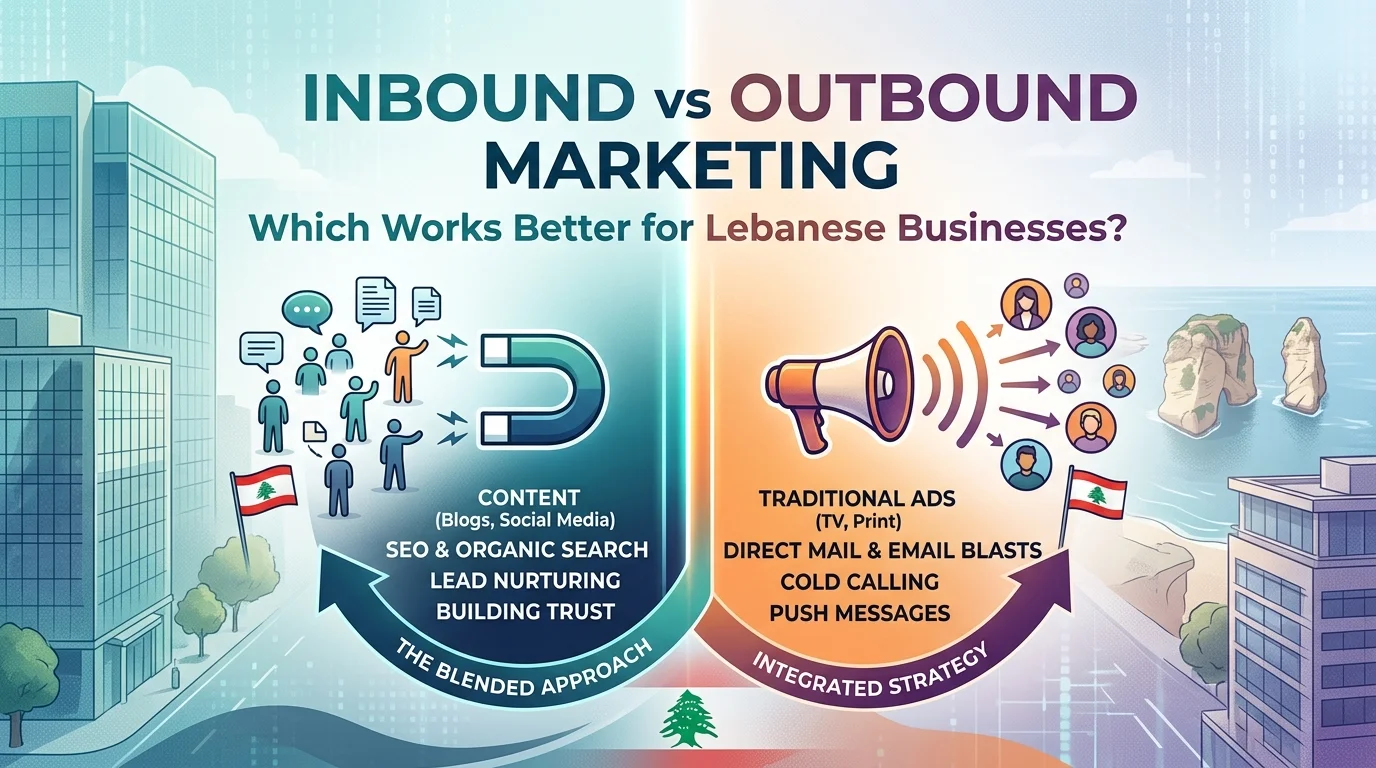
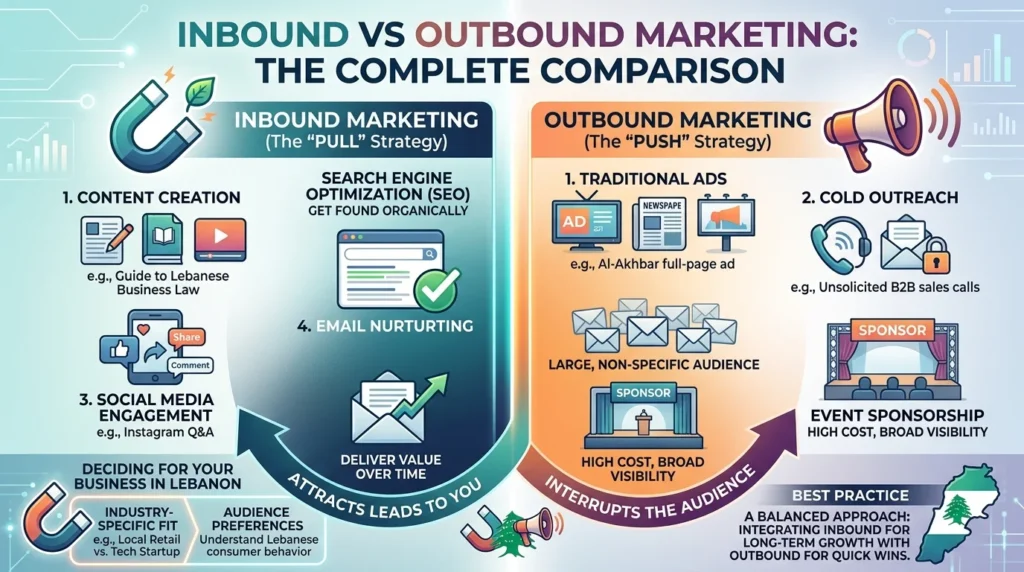
An inbound marketing strategy focuses on attracting people who are already looking for something, by creating content and experiences that are genuinely useful to them: blog articles that answer real questions, a website optimized to be found in search, helpful social media content, guides, webinars, and email content that people choose to receive. The business earns attention rather than interrupting for it, and the customer typically arrives already interested. Content-led growth of this kind compounds over time, since a well-built article or resource can keep attracting relevant visitors long after it was published.
What Outbound Marketing Is?
Outbound marketing tactics push a message out to an audience, whether or not that audience was actively looking: paid advertising, cold emails and calls, direct outreach, sponsored placements, trade show presence, and traditional media advertising. The business initiates the conversation. Done well, outbound can reach the right people quickly, since it does not depend on someone first discovering the business, which makes it useful when a company needs results sooner than content can deliver them.
Strengths and Weaknesses of Each in the Lebanese Market
Where Inbound Works Well?
Inbound works particularly well for businesses whose customers research before they buy: professional services, education, healthcare, B2B suppliers, and higher-consideration purchases generally. It builds credibility and trust, which matters a great deal in markets where reputation and recommendation carry weight, and it creates an asset (a library of useful content and a discoverable website) that keeps working without continuous spend. For businesses also targeting the Lebanese diaspora or GCC markets, searchable multilingual content can reach people who would be hard to reach through local outreach alone.
Where Outbound Works Well?
Outbound works well when a business has a clearly defined target customer who can be identified and approached directly, such as a B2B supplier targeting a list of specific companies, or when a business needs quick visibility for a launch, an event, or a time-limited offer. Paid advertising in particular allows a business to test messages and audiences quickly and switch spending on or off, which suits situations where speed and control matter more than long-term compounding. In relationship-driven markets, a direct, personal approach can also carry more weight than an anonymous digital touch, provided it is respectful and relevant.
Honest Limitations of Each
Inbound is slow: content takes time to be found and trusted, so a business that needs customers within weeks will likely be frustrated if it relies on inbound alone, and it requires consistent effort in creating and maintaining quality content. Outbound stops when the spend stops, can feel intrusive if poorly targeted, and tends to become more expensive as competition for the same audiences increases. Cold outreach also carries a reputational risk when it is generic or ignores whether the recipient has any reason to care.
Why Most Businesses Need a Blend, Not a Binary Choice?
How the Two Approaches Support Each Other?
In practice, inbound and outbound work best as parts of one system rather than competing options. Paid advertising can drive people toward the useful content that inbound builds, shortening the time it takes for new content to find an audience. Content created for inbound can give outbound outreach something genuinely valuable to offer, such as a guide or case study to share with a prospect, instead of a bare sales pitch. And retargeting visitors who found the business through search turns inbound attention into outbound follow-up at low cost. This blend helps generate demand and capture it, rather than relying on only one of the two.
Matching the Mix to the Business
The right proportion varies with the business. A company with a long, considered sales cycle often leans toward inbound for credibility and outbound for targeted follow-up. A business with a simple, fast purchase decision and a local customer base may lean more on outbound tactics like advertising and direct promotion, supported by a basic discoverable web presence. No single ratio suits everyone, which is why copying what a competitor or a global case study does without considering context rarely works well.
How to Decide Where to Start?
Three Questions That Guide the Starting Point
Three practical questions help a business decide where to start. First, how quickly are results needed? Urgent needs favor outbound for speed, with inbound begun in parallel for the longer term. Second, how do your customers actually find and choose a business like yours? If they search and research, inbound deserves early investment; if they are reached best through direct approach, outbound may come first. Third, what capacity does the team genuinely have? Inbound requires sustained content effort, and outbound requires ongoing spend or outreach time, so an honest assessment of resources prevents starting something that cannot be maintained.
Starting Small and Learning From Results
Whichever approach leads, beginning with a focused, measurable effort and learning from the results is more reliable than launching everything at once. A small number of well-chosen articles and one or two targeted campaigns, tracked against clear goals, reveal what resonates with the audience before larger commitments are made, and the findings can then guide where to expand.
Building an Inbound Marketing Strategy Step by Step
Start With the Questions Customers Actually Ask
A practical inbound marketing strategy starts not with what the business wants to say but with what its customers want to know. Listing the questions prospects ask before buying, the objections that come up in sales conversations, and the comparisons they make gives a ready-made list of content topics. Answering these questions honestly and clearly, in the languages the audience actually uses, builds the kind of trust that turns a visitor into an inquiry.
Make Content Easy to Find and Easy to Act On
Useful content only works if people can find it and know what to do next. That means a website that loads quickly and works well on mobile, pages that are structured so search engines can understand them, and a clear next step on every page, whether that is contacting the business, downloading a guide, or booking a consultation. Content that educates but offers no path forward leaves value on the table.
Choosing Outbound Marketing Tactics Wisely
Match the Tactic to Where Your Customers Actually Are
Outbound marketing tactics should be chosen based on where the target audience genuinely pays attention, not simply on what is familiar or fashionable. A business serving other businesses may find targeted outreach to a defined list far more effective than broad advertising, while a consumer business may get more from carefully targeted paid social campaigns. Starting with the one or two tactics best aligned to the audience, rather than spreading effort across many, keeps both budget and effort focused.
Make Outreach Relevant Rather Than Generic
Whether it is an advertisement or a direct message, outbound performs best when it speaks to something specific about the recipient’s situation and offers a clear reason to respond. Generic messages sent at volume are easy to ignore and can damage a business’s reputation, whereas a smaller number of carefully considered, relevant approaches tends to earn better responses and protect goodwill.
Two Illustrative Scenarios
A Professional Services Firm
Picture a professional services firm whose clients research carefully and choose based on trust. For this kind of business, a steady stream of genuinely useful articles and guides could build credibility over time, while selective outreach to a defined list of ideal clients and a small amount of targeted advertising could generate conversations in the meantime. The emphasis leans toward inbound, with outbound used to shorten the wait.
A Local Retail or Hospitality Business
Picture a local retail or hospitality business whose customers decide quickly and live nearby. Here, visible, well-targeted advertising and promotions may produce quicker results, supported by a well-maintained web presence and reviews that make the business easy to find and trust. The emphasis leans toward outbound, with a lighter inbound foundation. These scenarios are illustrations rather than rules, since each business should test what works for its own customers.
Common Mistakes When Choosing Between the Two
Treating Either Approach as a Magic Solution
Some businesses expect a handful of blog posts to produce a flood of customers within weeks, while others expect advertising spend alone to build lasting loyalty. Both expectations lead to disappointment, since each approach does a particular job and neither substitutes for a clear offer, a credible reputation, and a good customer experience.
Ignoring Measurement
A business that runs both approaches without tracking what each produces cannot tell which deserves more investment. Even simple tracking, such as asking new customers how they found the business and recording lead sources, makes the blend easier to adjust over time with evidence rather than opinion.
Frequently Asked Questions
Neither is universally better. Small businesses with limited budgets often benefit from starting with a modest inbound foundation (a clear website and a few genuinely useful pieces of content) alongside carefully targeted outbound efforts for faster results. The best mix depends on how customers find the business, how quickly results are needed, and what the team can sustain.
It typically takes months rather than weeks to build meaningful momentum, because content needs time to be found, indexed, and trusted. This is why inbound is better understood as a long-term investment that compounds, not a quick fix.
It can be, when it is well targeted, relevant, and respectful, and it tends to perform poorly when it is generic and mass-produced. Personalization and a genuine reason for contact make the difference between outreach that opens conversations and outreach that is simply ignored.
Yes, but it requires focus. A small team generally does better by doing a few things consistently, for example a regular content rhythm plus one targeted outbound channel, than by attempting many activities half-heartedly.
Track where leads and customers actually come from, how much each source costs, and how many convert into paying customers. If one approach produces noticeably more valuable customers per unit of effort or spend, that is a signal to shift emphasis toward it, while keeping enough of the other to support it.
Ready to Build the Right Marketing Mix for Your Business?
The real question in inbound vs outbound marketing is not which side wins but which combination fits your customers, your timeline, and your resources. Creative 4 All helps businesses across Lebanon and the GCC design a practical blend of content-led and direct marketing, measured against real business results. Book a Free Digital Marketing Consultation to work out where your business should start.