

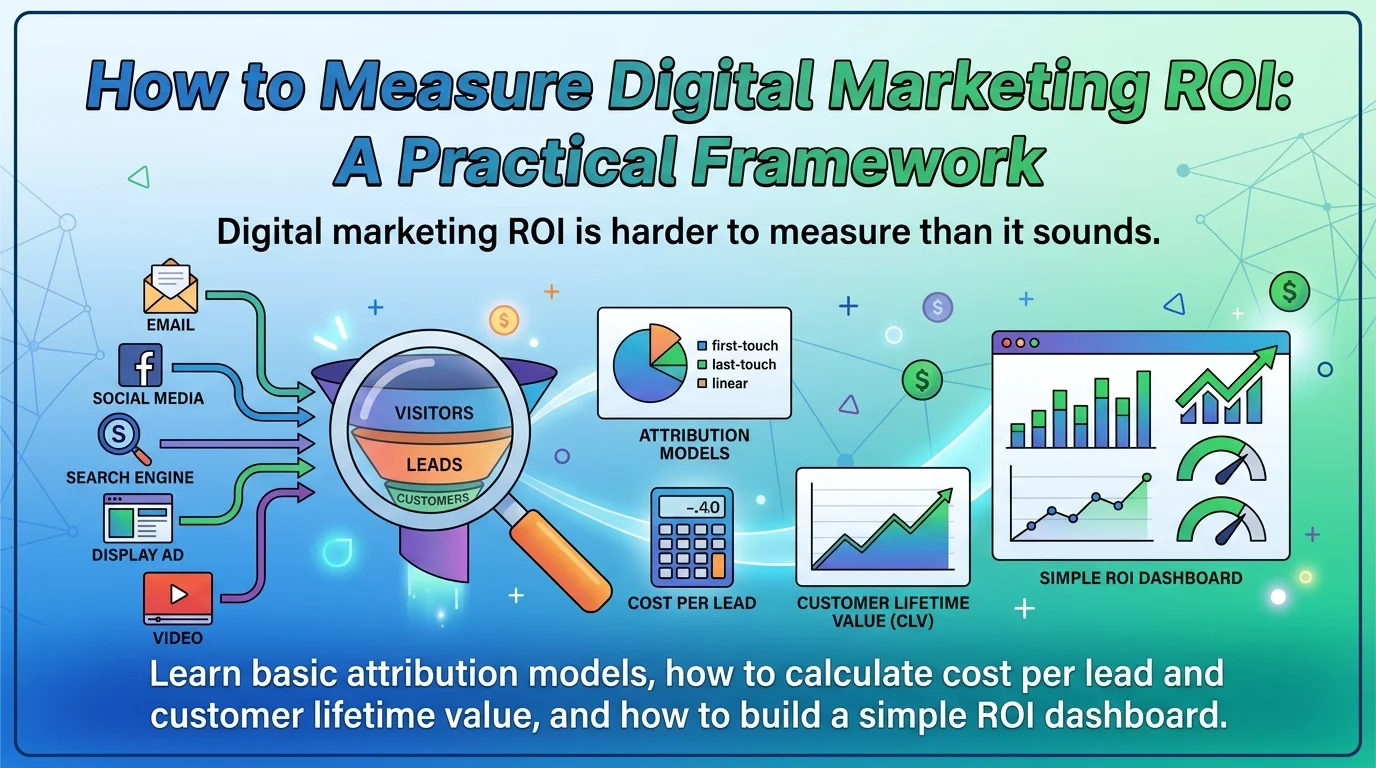
Almost every business that spends money on digital marketing eventually asks the same question: is it actually working? The honest answer usually sounds simple, since return on investment is just what came back compared with what was spent, yet measuring digital marketing ROI in practice turns out to be considerably harder than the formula suggests. Customers rarely move from a single ad straight to a purchase, sales often close weeks or months after the first interaction, and some of the most valuable conversions happen over the phone or in person where no tracking tag can see them. This article offers a practical framework for measuring digital marketing ROI honestly, without pretending the numbers are cleaner than they really are.
Why Digital Marketing ROI Is Harder to Measure Than It Sounds?
Multiple Touchpoints, One Sale
A typical customer encounters a business several times before buying: perhaps a social media post, then a search result, then an email, then a direct visit to the website. When the sale finally happens, the question of which of those touchpoints deserves credit has no single objectively correct answer, and different reasonable methods of assigning credit produce noticeably different pictures of which channels are performing. A business that credits only the last interaction before purchase will tend to overvalue channels that capture existing demand and undervalue those that create it.
Long Sales Cycles and Offline Conversions
For businesses selling higher-consideration products or services, the gap between a first marketing interaction and a closed sale can stretch across weeks or months, making it difficult to connect a specific campaign’s spend to its eventual revenue within a single reporting period. Many conversions also happen offline: a phone call, a WhatsApp conversation, or a visit to a showroom. If these are not deliberately captured and connected back to their marketing source, the reported return from digital channels will understate what those channels actually contributed.
Basic Marketing Attribution Models
Single-Touch Models
Single-touch marketing attribution models assign all the credit for a conversion to one interaction. A first-touch model credits the first interaction that introduced the customer to the business, which helps identify which channels are best at generating initial awareness. A last-touch model credits the final interaction before conversion, which helps identify which channels are best at closing. Both are simple to implement and easy to explain, but each ignores everything that happened in between, so neither tells the complete story on its own.
Multi-Touch Models
Multi-touch attribution models spread credit across several interactions in the customer’s journey. A linear model divides credit equally among all touchpoints, a time-decay model gives more credit to interactions closer to the conversion, and a position-based model gives extra weight to the first and last touches. These models better reflect how customers actually behave, but they require more sophisticated tracking and still rest on assumptions about how much each type of interaction really matters. For most small and mid-sized businesses, the practical approach is to understand what each model reveals, compare a simple first-touch view with a last-touch view, and avoid treating any single model as the absolute truth.
Calculating Cost Per Lead and Customer Lifetime Value
Cost Per Lead and Customer Acquisition Cost
The most basic digital marketing ROI building blocks are cost per lead (total marketing spend divided by the number of leads generated) and customer acquisition cost, often abbreviated CAC (total marketing and sales spend divided by the number of new customers won). Cost per lead is useful for comparing channels and campaigns on how efficiently they generate inquiries, but it says nothing about lead quality, so a channel producing cheap leads that rarely convert can look better on paper than one producing fewer, more valuable leads. Tracking how many leads from each source actually become paying customers turns cost per lead into the more meaningful CAC figure.
Customer Lifetime Value and the LTV to CAC Relationship
Customer lifetime value, often abbreviated LTV, estimates the total revenue (or ideally gross profit) a typical customer generates over the full length of their relationship with the business, including repeat purchases and referrals. Comparing LTV with CAC shows whether a business is spending a sensible amount to acquire customers: if acquiring a customer costs more than that customer is ever likely to be worth, the marketing is losing money regardless of how impressive the lead volume looks. A business with repeat customers can justify a higher acquisition cost than one relying on single, one-time purchases, which is why a one-size-fits-all benchmark for cost per lead is rarely meaningful.
Building a Simple ROI Dashboard
Which Metrics to Include?
A useful ROI dashboard stays deliberately small. A sensible core set includes total marketing spend by channel, number of leads or conversions by channel, cost per lead, the number of those leads that became customers, revenue attributed to each channel, and the resulting return on spend. A basic way to express that last figure is the revenue attributed to a channel minus its cost, divided by its cost, which shows how much return each unit of spend produced. Adding too many metrics tends to hide the important numbers rather than reveal them.
Keeping the Dashboard Honest
An ROI dashboard is only as trustworthy as the data feeding it, so it should be built on consistent definitions: what counts as a lead, what counts as a conversion, and how revenue gets matched back to its source. Where attribution is uncertain, such as offline sales or conversions that touched several channels, the dashboard should say so rather than presenting a falsely precise figure. Reviewing it on a regular schedule, and comparing trends over time rather than reacting to a single week’s movement, produces better decisions than treating any one snapshot as definitive.
Campaign Performance Tracking Setup
The Tracking Foundations Worth Getting Right First
Reliable campaign performance tracking starts with a few foundations: conversion tracking configured correctly on the website for the actions that matter (form submissions, calls, purchases), consistent campaign tagging so that traffic can be traced back to its source, and a way to record the source of offline inquiries, such as asking new customers how they heard about the business. Without these basics, even a sophisticated attribution model has nothing reliable to work with.
Connecting Marketing Data to Sales Outcomes
The most valuable step in campaign performance tracking is connecting marketing data to what actually happens in sales, since a lead is only worth something if it eventually becomes revenue. Where a business uses a CRM or even a simple spreadsheet to record which leads closed and for how much, that information can be matched back to the originating channel, turning marketing reports from a count of inquiries into an actual measure of revenue contribution.
Marketing ROI Measurement: Common Mistakes
Judging Results Too Early
Marketing ROI measurement often goes wrong when results are judged before a campaign has had enough time to influence a decision, particularly for products with longer buying cycles. Evaluating performance over a period that reflects the real sales cycle, rather than a few days or weeks, avoids prematurely cutting something that is genuinely working or doubling down on something that only looks good briefly.
Optimizing for Cheap Leads Instead of Valuable Customers
Chasing the lowest cost per lead can quietly reduce actual returns if cheaper leads are also lower quality. Looking at cost per customer and revenue per channel, rather than lead volume alone, keeps optimization aimed at what the business really cares about: profitable growth rather than a bigger pile of inquiries.
A Simple Worked Example
Putting the Numbers Together
The following figures are purely illustrative, chosen to show how the pieces connect rather than to suggest any real benchmark. Imagine a business spends 2,000 on a channel in a month and receives 40 leads. Its cost per lead is 50. If 8 of those leads become customers, the cost to acquire each customer is 250. If each customer is typically worth 1,000 in gross profit over the course of the relationship, the lifetime value is four times the acquisition cost, which suggests the channel is worth continuing. Using the simple return formula on first-year figures, 8 customers at 1,000 each produce 8,000 against a 2,000 cost, a return of 3 for every 1 spent.
What the Example Does and Does Not Prove?
Even a tidy example like this rests on assumptions: that the leads genuinely came from this channel, that the 1,000 lifetime figure is realistic, and that the customers would not have bought anyway through another route. A framework like this does not remove uncertainty; it makes the assumptions visible so they can be tested and improved over time, rather than hidden inside a single impressive-looking number.

Adapting ROI Measurement to the Lebanese and GCC Context
Capturing Conversations That Happen Off the Website
In Lebanon and across the GCC, a large share of customer inquiries move to phone calls and messaging apps rather than website forms, which means a business relying purely on website conversion tracking can substantially undercount the results its marketing produces. Giving each campaign a distinct phone number or WhatsApp entry point, and recording the source of every inquiry, helps bring these conversations back into the picture.
Accounting for Currency and Multi-Market Reporting
A business marketing across several countries may spend in one currency and earn in another, which can distort apparent returns if figures are not converted consistently. Choosing a single reporting currency and conversion approach, and applying it uniformly, keeps comparisons between markets and periods meaningful.
Frequently Asked Questions
There is no universal benchmark, since an acceptable return depends on a business’s margins, sales cycle, and customer lifetime value. A more useful question is whether the return from a given channel exceeds its cost by enough to be worth the effort and risk compared with the alternatives available.
Most small businesses do well starting with a simple comparison of first-touch and last-touch views, which together reveal both which channels generate awareness and which close sales. More complex models are worth adopting only once there is enough tracking data to support them.
Awareness is harder to tie directly to revenue, so it is usually assessed through indirect indicators such as growth in branded search, direct traffic, and overall inquiry volume over time, rather than expecting a clean, immediate return figure.
A monthly review of core metrics, with a deeper quarterly look at trends and channel contribution, suits most businesses, since weekly figures can be too noisy to support sound decisions.
Simple practices help: asking new customers how they found the business, using dedicated phone numbers or unique offer codes for specific campaigns, and recording the source of each inquiry in a shared sheet or CRM. These will not be perfect, but they narrow the gap considerably.
Ready to Find Out What Your Marketing Is Really Returning?
Measuring digital marketing ROI honestly means accepting imperfect data while still building a framework clear enough to guide real budget decisions. Creative 4 All helps businesses across Lebanon and the GCC set up tracking, choose sensible attribution approaches, and build dashboards that connect marketing spend to actual revenue. Book a Free Digital Marketing Consultation to review how your current results are being measured.