
A school or university does not sell a product that gets purchased on impulse. It sells a years-long commitment that a parent is making on behalf of their child, or a decision a prospective student is making about the next several years of their own life. That distinction shapes almost everything about how digital marketing for schools Lebanon should actually work. Enrollment decisions move slowly, involve multiple decision-makers within the same household, and cluster tightly around a predictable calendar of application deadlines and open house dates rather than spreading evenly throughout the year the way most commercial purchases do.
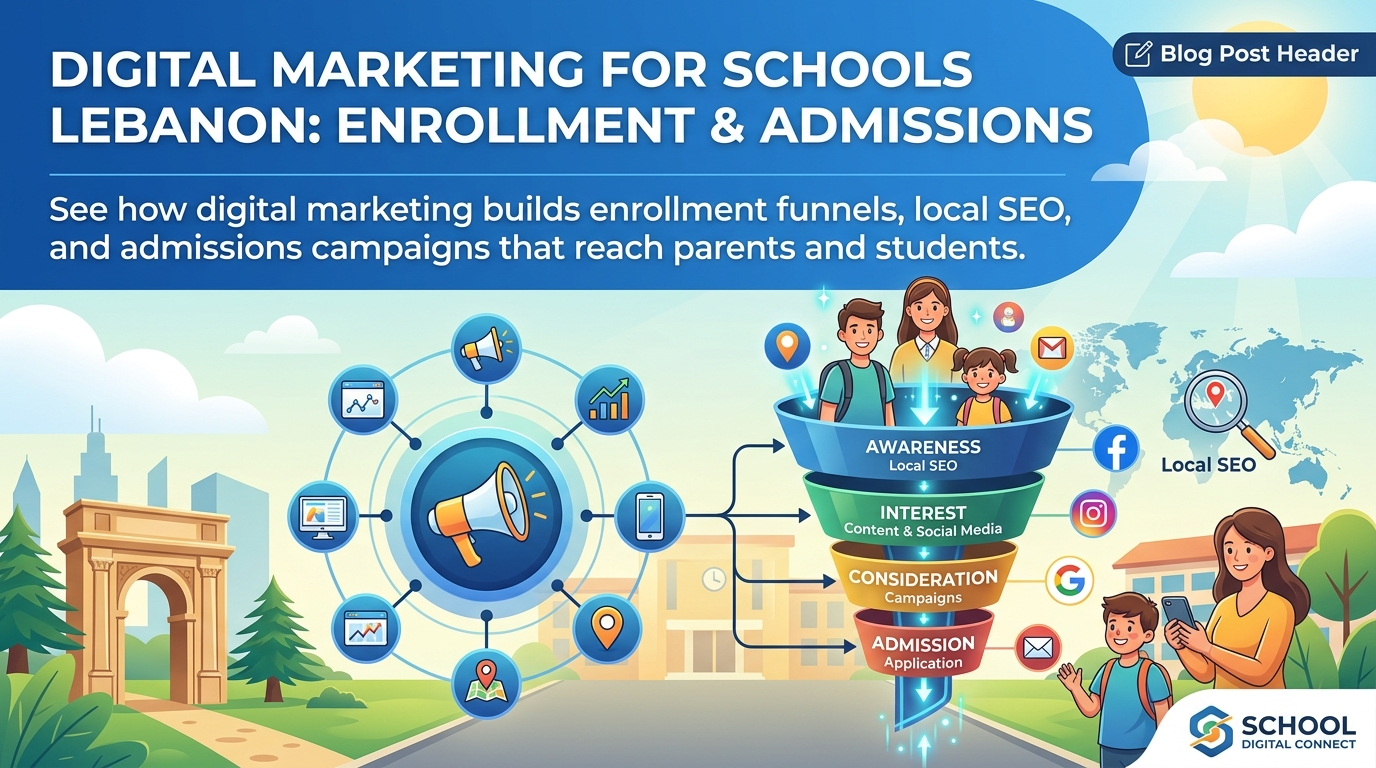
Despite this, many educational institutions in Lebanon still market themselves the way a retail business might — a generic website, occasional social posts, and no real structure connecting the moment a parent first hears about the school to the moment they submit a completed application. An effective education marketing strategy treats enrollment as a funnel with distinct stages, each requiring different content and a different message, built around the actual rhythm of the academic year rather than a constant, undifferentiated stream of generic posts.
How Education Marketing Differs From Other Verticals?
Seasonal Admissions Cycles That Drive the Calendar
Unlike most commercial categories where demand is relatively constant, education marketing follows a sharply seasonal pattern tied to the academic calendar. Awareness-building content needs to run months before applications open, informational content and open house promotion needs to peak as the admissions window approaches, and enrollment-focused messaging needs to intensify as deadlines near. A campaign calendar built around this rhythm consistently outperforms a generic always-on approach, because it meets families at the moment they are actually making decisions rather than competing for attention at a time when no decision is imminent.
Marketing to a Dual Audience: Parents and Students
Nearly every education marketing campaign has to speak to two audiences with genuinely different priorities within the same household. Parents typically weigh academic reputation, safety, cost, and long-term outcomes, while students (particularly at the secondary and university level) care more about social environment, extracurricular offerings, and whether the institution feels like a place they will actually enjoy attending. Content and messaging need to address both audiences deliberately rather than defaulting entirely to the parent perspective, since a student who feels genuinely excited about a school often becomes an internal advocate within the household decision-making process.
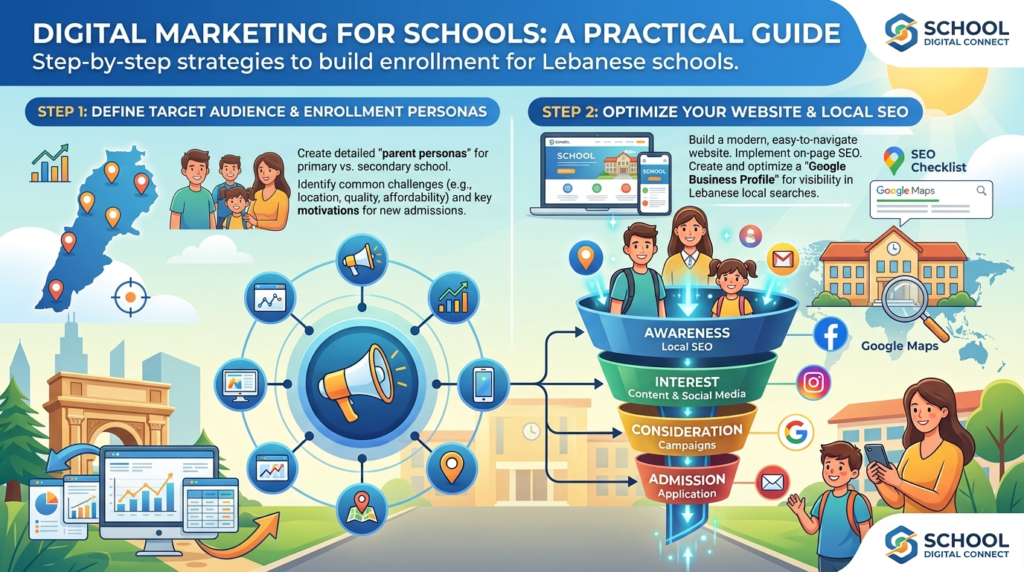
Building an Enrollment Funnel That Actually Converts
Top-of-Funnel Awareness for Prospective Families
The earliest stage of the enrollment funnel is simple awareness — making sure a prospective family knows the institution exists and has a basic sense of what distinguishes it. This stage works best with broad, easily shareable content: campus life content, student and alumni success stories, and general brand-building activity well before any specific admissions deadline is in view. Rushing straight to admissions-focused messaging at this stage tends to underperform, since families this early in the process are not yet ready to evaluate specific application details.
Middle-of-Funnel Content That Builds Confidence
Once a family has identified the institution as a genuine option, the priority shifts to building confidence: curriculum details, faculty credentials, facility tours, extracurricular programs, and outcomes data such as university placement rates or graduate employment statistics. This is also the stage where open house events and campus tours do the heaviest lifting, since nothing builds confidence in an education decision faster than seeing the actual environment and speaking directly with current staff and students.
Converting Inquiries Into Enrolled Students
The final stage of the funnel — converting an inquiry into a completed, paid enrollment — depends heavily on responsiveness and a low-friction application process. A prospective family that submits an inquiry form and waits several days for a response has often moved on to another institution by the time contact is finally made. Clear application deadlines, a straightforward digital application process, and prompt, personal follow-up from admissions staff consistently outperform institutions that treat the inquiry stage as a low-priority administrative task.
Local SEO for Campus Locations
Google Business Profile for Schools and Universities
For any institution with a physical campus, an accurately maintained Google Business Profile is one of the highest-leverage local SEO assets available, since it directly influences how the institution appears when parents search for schools near a specific neighborhood or area of Lebanon. Accurate hours, contact information, campus photos, and genuine parent or alumni reviews all contribute to how the institution appears in local search results, and this listing frequently receives more direct engagement than the institution’s own website homepage.
Location-Specific Content for Multi-Campus Institutions
Institutions operating more than one campus across Lebanon should avoid treating all locations as a single undifferentiated entity in their digital presence. Each campus benefits from its own dedicated page addressing the specific neighborhood, grade levels or programs offered at that location, and directions or transportation information relevant to families in that area. This is directly analogous to how any multi-location business should approach local SEO, and it prevents campuses from effectively competing against each other in search results for the same broad institutional keywords.
Timing Campaigns Around the Admissions Calendar
Pre-Admissions Awareness Building
Awareness content should begin well ahead of the formal application window opening, since this is when families are still exploring options rather than actively comparing shortlisted institutions. Campus life stories, faculty spotlights, and general brand content perform well here, laying groundwork that pays off once the family enters the active comparison stage closer to the admissions deadline.
Peak Admissions Season Campaigns
As the admissions window opens, messaging should shift decisively toward action: application deadlines, open house event promotion, and direct calls to schedule a campus visit or submit an inquiry. This is also the period where paid advertising tends to deliver the strongest return, since search and social audiences are actively comparing specific institutions rather than passively browsing general education content.
Post-Enrollment Retention and Referral
Marketing does not end once a student is enrolled. Communication with newly enrolled families about orientation, what to expect in the first weeks, and how to get involved in the school community both reduces early withdrawal and builds the kind of genuine satisfaction that generates referrals — still one of the strongest sources of new enrollment for most educational institutions, and one that a consistent post-enrollment communication program actively strengthens rather than leaves to chance.
Measuring What Actually Predicts Enrollment Success
Why Website Traffic Is a Misleading Primary Metric?
A school’s website can receive substantial traffic during peak admissions season without that traffic translating into completed applications, particularly if the inquiry process is buried several clicks deep or the application form itself is cumbersome. The metrics that matter more for education marketing strategy are inquiry-to-tour conversion rate, tour-to-application conversion rate, and application-to-enrollment conversion rate, tracked as a connected funnel rather than in isolation. A school that understands exactly where families drop out of this sequence can address the actual bottleneck rather than simply generating more top-of-funnel traffic that never converts.
Tracking Referral Sources Across a Multi-Touch Journey
Because enrollment decisions unfold over months and involve multiple family members researching independently, a single attribution model rarely captures the full picture of what actually influenced a family’s decision. A parent might discover the school through a Google search, later see a paid social ad reinforcing the same message, and finally decide after a campus tour recommended by a friend whose child already attends. Schools that ask new families directly how they first heard about the institution, and record this consistently during the admissions process, build a far more accurate picture of which channels and content are actually driving enrollment than digital analytics alone can provide.
Common Pitfalls in Education Marketing
Generic Messaging That Fails to Differentiate
Many schools describe themselves in nearly identical terms — “nurturing environment,” “academic excellence,” “holistic development” — language so common across the sector that it fails to give a prospective family any real basis for choosing one institution over another. Effective education marketing strategy requires identifying what is genuinely distinctive about a specific institution, whether that is a particular curriculum approach, notable outcomes data, specific extracurricular strengths, or a distinctive school culture, and building messaging around that differentiation rather than generic category language every competing school also uses.
Underinvesting in the Admissions Staff Experience
Digital marketing can generate strong inquiry volume, but if the admissions team cannot respond promptly and personally once those inquiries arrive, the investment in generating them is largely wasted. Schools should treat the admissions office’s responsiveness and follow-up process as part of the marketing funnel itself, not a separate administrative function, since a slow or impersonal response at this stage undoes much of the trust built during the awareness and consideration stages. A simple service-level commitment — responding to every inquiry within one business day, with a named staff member rather than an automated form reply — is often enough on its own to noticeably improve conversion from inquiry to scheduled tour.
Neglecting Alumni and Current-Family Advocacy
Schools frequently focus digital marketing efforts entirely on prospective families while overlooking one of the strongest assets already available to them: alumni and current families willing to speak positively about their experience. A structured program for collecting testimonials, short video interviews, and permission to feature real families in marketing content tends to outperform stock photography and generic copywriting by a wide margin, since prospective families place far more weight on the experience of people who have already made the same decision they are currently weighing.
Frequently Asked Questions
Awareness-building content should typically begin three to six months before the application window opens, with messaging intensifying as the deadline approaches. Starting cold at the point applications open misses the families who were already exploring options earlier in the cycle.
Paid advertising tends to perform best during the active admissions window, when families are actively comparing specific institutions rather than passively browsing. Running the same budget during off-peak months typically produces a weaker return, since the audience is not yet in an active decision-making mindset.
Very important. Because enrollment decisions carry significant weight and long-term commitment, genuine testimonials and reviews from current parents function as some of the strongest trust signals available, often outweighing polished marketing content alone in a family’s final decision.
Yes. Parents tend to respond to content emphasizing academic outcomes, safety, and value, typically consumed through more traditional channels and direct communication, while students respond more to visual, social-proof-driven content showing campus life and peer experiences, often through different platforms than their parents use.
Treating marketing as a constant, undifferentiated activity rather than building it around the actual admissions calendar. Institutions that align their messaging intensity with the natural rhythm of the academic year consistently see stronger results than those running the same generic campaign year-round.
Ready to Build an Enrollment Funnel That Works?
Digital marketing for schools Lebanon succeeds when it respects how families actually make enrollment decisions — seasonally, deliberately, and with input from both parents and students. Creative 4 All helps educational institutions across Lebanon build the enrollment funnels, local SEO presence, and admissions-season campaigns that turn inquiries into enrolled students. Book a Free Digital Marketing Consultation to see where your institution’s enrollment marketing stands today.