
A rebrand fails far more often from how it is executed than from the new identity itself. A new logo, a new name, or a repositioned message can be exactly right strategically and still trigger a wave of customer confusion, lost trust, and abandoned loyalty if the transition is rushed, poorly communicated, or launched without preparing the people who actually interact with the brand every day. Understanding how to rebrand a business properly means treating the transition itself as a project with as much rigor as the design work that produces the new identity.
This matters more for established businesses with an existing customer base than it does for a new company choosing its identity for the first time. A five-year-old brand already carries accumulated trust, recognition, and habit among its existing customers — assets that took years to build and that a poorly managed rebrand can dissolve in weeks. The goal of a well-run rebranding process is not simply to arrive at a new identity, but to carry existing customer trust across the transition intact, so the new identity inherits the equity of the old one rather than starting from zero.
Signs a Rebrand Is (or Isn’t) the Right Move
When a Full Rebrand Is Actually Warranted?
A full rebrand — changing the name, visual identity, and core positioning simultaneously — is typically warranted only when the existing brand actively works against the business rather than simply feeling dated. This includes situations such as a merger or acquisition creating overlapping brand identities, a business that has genuinely outgrown its original positioning (a company that started in one narrow category and has expanded well beyond it), or a legacy brand carrying reputational damage that no amount of incremental adjustment can repair. Rebranding purely because leadership is personally tired of looking at the old logo is one of the most common and most avoidable reasons a rebrand goes wrong, since it treats a subjective preference as a strategic necessity.
When a Brand Refresh Is the Better Choice?
Far more often, what a business actually needs is a brand refresh rather than a full rebrand — updating the visual execution (typography, color palette, photography style, website design) while keeping the name, core positioning, and the accumulated recognition intact. A brand refresh carries dramatically lower risk of confusing existing customers, since the underlying identity they already recognize and trust remains constant even as its execution modernizes. Understanding the difference between a brand refresh vs full rebrand at the outset prevents businesses from taking on unnecessary transition risk when a lighter-touch update would have achieved the same underlying goal.
A Phased Rebranding Process That Protects Customer Trust
Phase One: Audit Existing Brand Equity Before Changing Anything
Before any new design work begins, a proper rebranding process starts by cataloging exactly what the current brand has built: which visual elements customers actually associate with trust and recognition, which messaging resonates, and which associations (positive or negative) exist in the market today. This audit prevents the common mistake of discarding genuinely valuable brand equity simply because it looks old, and it identifies what specifically needs to carry forward into the new identity so customers retain a sense of continuity even as the surface changes.
Phase Two: Internal Alignment Before Any Public Announcement
A rebrand should never become public before the organization itself is fully aligned and prepared. Sales teams, customer service staff, and anyone who interacts directly with customers need to understand the new identity, the reasoning behind the change, and how to answer customer questions about it before a single external announcement goes out. An employee caught off guard by a customer question about a rebrand they were not briefed on creates exactly the kind of confused, inconsistent experience that damages trust during a transition that should otherwise build confidence.
Phase Three: A Gradual, Signaled Rollout Rather Than an Overnight Switch
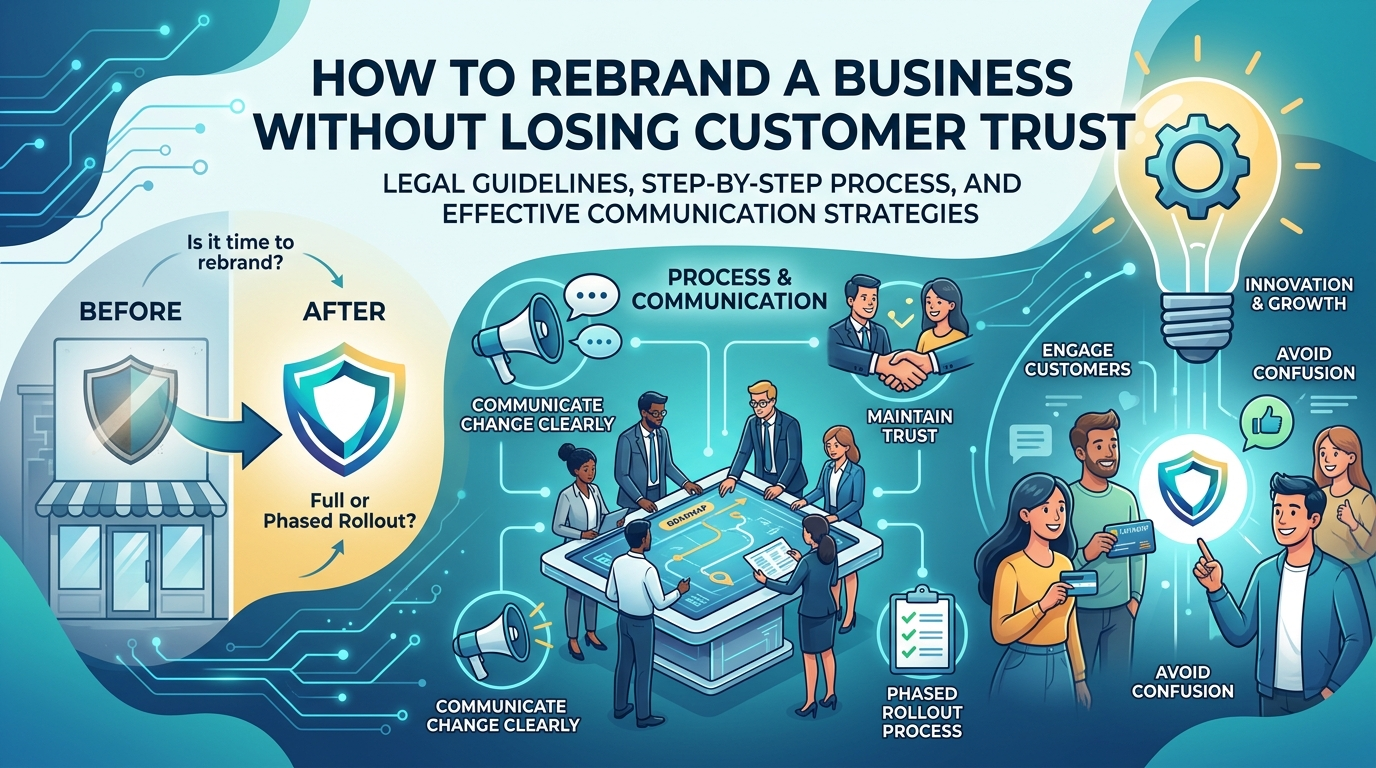
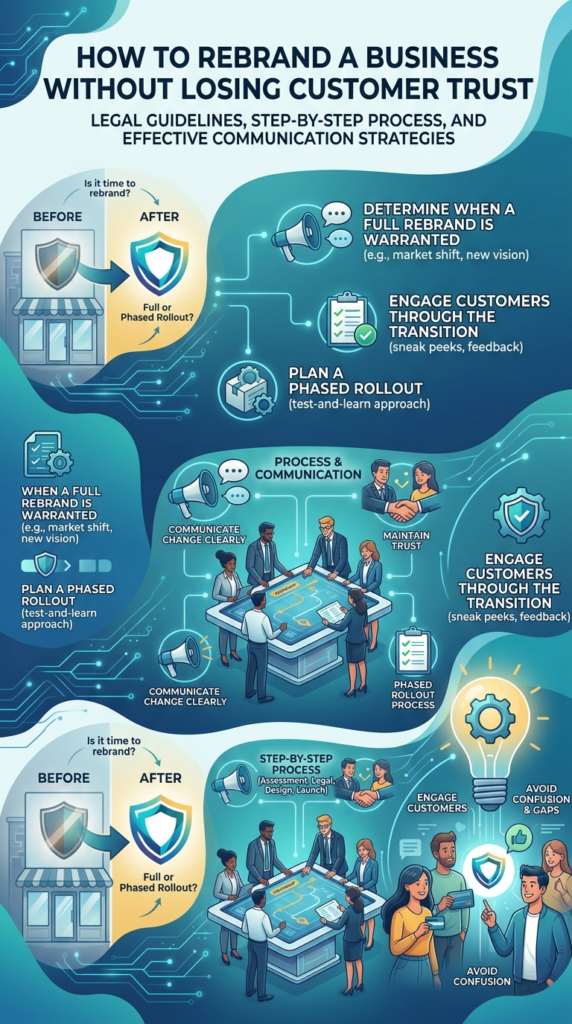
Except in cases where legal or business circumstances require an immediate switch, a phased rollout consistently outperforms an overnight change. This typically means announcing the change ahead of the full transition, running both identities in parallel for a defined period with clear signaling (“formerly known as…”), and updating high-visibility touchpoints (website, primary signage, key marketing materials) before secondary ones. This gives existing customers time to form the new association gradually rather than encountering an unexplained, sudden change that reads as either a different company entirely or a sign of instability.
Communicating the Change Internally and Externally
Preparing Employees and Frontline Staff First
Employees are the first line of brand transition communication, whether the business intends this or not. A customer who calls with a question is going to hear the explanation from whoever picks up the phone, not from a press release. Internal training on the rebrand — the reasoning, the timeline, and a simple, consistent explanation everyone can give — should happen well before external communication begins, so the message customers actually hear stays consistent regardless of who they interact with.
Messaging That Explains “Why” to Existing Customers
The most effective external communication around a rebrand answers the question customers are actually asking: why did this change, and does it mean anything is different about the product or service they already rely on. Messaging that focuses purely on the new visual identity without addressing the underlying “why” tends to generate more confusion and speculation than messaging that leads directly with the reasoning — a merger, an expanded service offering, a genuine evolution in what the business does — and explicitly reassures customers about what has not changed alongside what has.
Measuring Whether the Rebrand Actually Worked
Metrics to Track Before, During, and After
A rebrand should be measured with the same rigor as any other major business initiative, not treated as a one-time creative project with no follow-up. Useful metrics include brand recognition and recall (surveyed before and after), customer retention rates through the transition period compared to a normal baseline, direct customer feedback and sentiment during the rollout, and search volume for both the old and new brand names to track how quickly the association transfers. Establishing these baselines before the rebrand launches is essential, since without a “before” measurement there is no reliable way to know whether the transition succeeded.
Signs the Transition Needs Correction
Elevated customer service inquiries specifically about the rebrand, a measurable spike in churn immediately following the announcement, or persistent confusion in reviews and social mentions about “is this the same company” are all signals that the transition communication needs adjustment before it causes lasting damage. Catching these signals early, during the phased rollout window rather than after full completion, gives a business the chance to add clarifying communication or slow the pace of the transition before customer trust erodes further.
Protecting Legacy Brand Equity During the Transition
Identifying What Customers Actually Rely On
Legacy brand equity is not limited to the logo. It often includes things like a specific tagline customers repeat, a color associated with trust in the local market, a mascot or symbol used in word-of-mouth referrals, or even the specific sound of a jingle used in advertising for years. Before finalizing a new identity, it is worth explicitly cataloging these smaller equity elements, since discarding all of them simultaneously in pursuit of a completely clean slate often erases more goodwill than the new identity gains in return. Selectively carrying forward one or two of the most recognized elements, even in updated form, gives existing customers a visual or verbal anchor connecting the old brand to the new one.
Avoiding the “Clean Slate” Trap
A common temptation during a rebrand is to treat it as an opportunity to erase everything about the previous identity, driven by a desire for the new brand to feel completely distinct. In practice, this often works against the business, since it deliberately severs the very recognition and trust the rebrand should be building on. The most successful rebrands tend to evolve rather than erase — retaining a recognizable thread back to the previous identity while still achieving meaningfully updated positioning and visual execution.
Sequencing the Rollout Across Touchpoints
Prioritizing High-Visibility Assets First
Not every brand touchpoint needs to update simultaneously, and attempting this usually creates unnecessary cost and rushed execution. The rebranding process should prioritize the assets customers encounter most frequently and prominently — the website, primary storefront or office signage, and the most-used marketing materials — updating these first so the new identity is reinforced at every meaningful point of contact before lower-visibility assets like internal documents or older printed materials are addressed.
Managing the Transition Period Across Digital Platforms
Digital platforms deserve particular attention during a rebrand, since inconsistency here is highly visible and easily noticed by customers actively searching for the business. Search engine listings, social media profiles, third-party directory listings, and review platforms all need coordinated updates, ideally within a tight window, so a customer searching for the business does not encounter the old name on one platform and the new one on another during the same week. Redirects from old website URLs to new ones should be configured in advance to prevent broken links from undermining an otherwise well-executed transition. A dedicated checklist covering every platform where the business has a presence — mapped out before the rollout begins rather than assembled reactively — helps ensure nothing is overlooked during a period when attention is already stretched across many moving parts.
Frequently Asked Questions
There is no universal timeline, but a phased rollout for an established business with a meaningful existing customer base typically runs three to twelve months, depending on the visibility of the brand and the number of touchpoints (physical locations, packaging, signage) that need updating. Rushing this timeline to save cost usually creates more confusion than it saves in effort.
Generally after the core elements (new name, logo, key messaging) are finalized, but before the full public rollout begins. Announcing too early, while details are still unsettled, invites speculation and questions the business cannot yet answer confidently.
Treating the rebrand as purely a design and marketing exercise rather than a change management process. The visual identity is often the easiest part to get right; the harder and more important work is preparing employees, communicating clearly with existing customers, and managing the transition period itself.
Generally yes. Because a brand refresh retains the name and core positioning that customers already recognize, it carries substantially lower risk of the confusion and trust erosion that can accompany a full rebrand, making it the more conservative choice when the underlying brand itself is not the actual problem.
The phased, trust-preserving process matters more than the budget behind it. Clear internal alignment, honest communication with existing customers about the “why,” and a gradual rather than abrupt rollout can be executed at almost any budget level — the discipline of the process protects trust more than the size of the campaign announcing it.
Ready to Rebrand Without Losing What You’ve Built?
Knowing how to rebrand a business is as much about protecting existing trust as it is about designing a new identity. Creative 4 All guides businesses across Lebanon and the GCC through the full rebranding process — from auditing existing brand equity to a phased rollout that keeps customers confident throughout the transition. Book a Branding Discovery Call to talk through whether your business needs a full rebrand or a lighter-touch refresh.