
Ask most business owners what their brand is, and the answer usually starts with a logo. Ask them what their brand actually stands for, why a customer should choose them over a competitor, or how they want to sound across a website, a proposal, and a social media caption, and the answer gets noticeably vaguer. That gap is exactly what a proper brand strategy framework exists to close — branding isn’t a visual exercise wrapped around a business, it’s a structural decision about how that business positions itself, communicates, and looks, made deliberately rather than accumulated by accident over years of ad hoc design choices.
Most content on branding stays at the level of persuasion — explaining why branding matters, why consistency builds trust, why a strong brand commands premium pricing. All of that is true, but it skips the actual mechanics of how to build one. This guide provides that missing structure: a brand strategy framework built on three pillars — positioning, voice, and visual identity — along with a simple process any growing business can apply directly, not just admire from a distance.
The Three Pillars of Brand Strategy
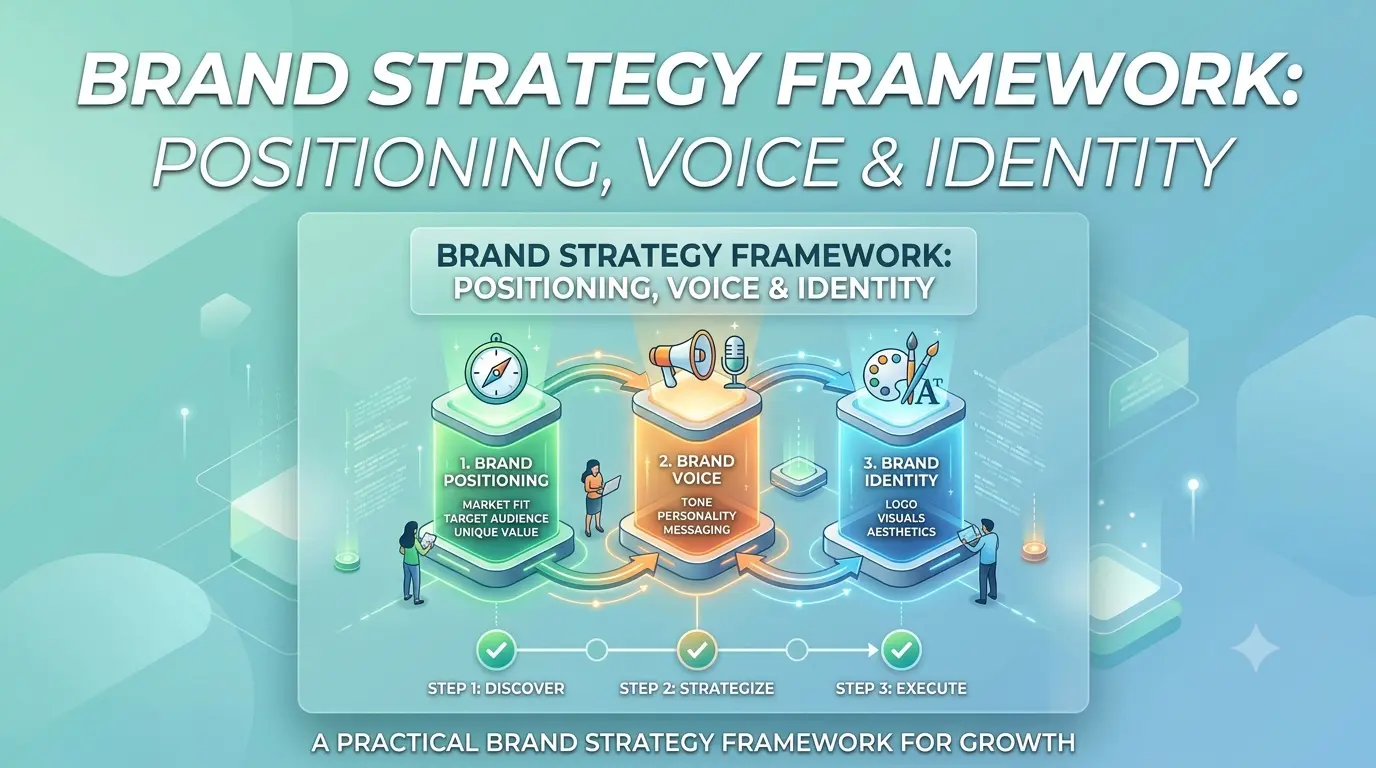
Before diving into each pillar individually, it helps to understand how they relate to each other, since treating them as separate projects is one of the most common reasons brand strategy work falls apart in practice. Positioning answers the question of what the business is and why it matters, relative to alternatives a customer could choose instead. Voice translates that positioning into language — how the business actually sounds when it communicates, in any format, to any audience. Visual identity translates the same positioning into everything visual: logo, color, typography, imagery, and the overall aesthetic a customer associates with the brand.
The critical point is that voice and visual identity should both flow directly from positioning, not exist as independent creative decisions made in parallel. A business that positions itself as the premium, trustworthy option in its category needs a voice and visual identity that reinforce that positioning consistently — a playful, casual voice or a visually chaotic identity would actively undermine a premium positioning strategy, regardless of how appealing either might look or sound in isolation. This is where a genuine brand strategy framework earns its value: it forces every downstream creative decision to answer to a single strategic foundation instead of drifting based on whatever felt right at the time.
Pillar One: Brand Positioning
The Positioning Statement
Brand positioning starts with a clear, specific answer to what the business does, for whom, and why it’s meaningfully different from the alternatives available to that customer. A useful positioning statement typically follows a structure along the lines of: for [target customer], [business name] is the [category] that [key differentiator], because [reason to believe]. This isn’t marketing copy meant for public use — it’s an internal reference point that every other brand decision gets measured against.
The most common failure at this stage is vagueness disguised as inclusiveness. A positioning statement that tries to appeal to everyone — every business size, every budget, every need — ends up meaningfully differentiating the brand from nothing, because a customer reading it can’t identify what makes this specific business the right choice for their specific situation. Strong positioning requires genuine specificity, even if that specificity means the business isn’t the right fit for every potential customer.
Target Audience Definition
Positioning only works when it’s built around a genuinely understood audience rather than a generic demographic description. This means going beyond age and industry to understand what that audience actually values, what alternatives they’re weighing, and what would make them trust one option over another. A business serving both budget-conscious small businesses and larger enterprise clients often needs to acknowledge internally that these are functionally different audiences requiring different positioning emphasis, even under one brand umbrella.
Competitive Differentiation
The final piece of positioning is a clear-eyed look at what alternatives a customer is actually comparing the business against, and what genuinely sets it apart from those alternatives — not in generic terms like “quality” or “service,” which every competitor also claims, but in terms specific enough to be falsifiable and defensible. Differentiation that any competitor could claim with equal validity isn’t differentiation at all; it’s just what happens when positioning work skips the harder step of genuine competitive analysis.
Pillar Two: Brand Voice
The voice pillar of a brand strategy framework takes positioning and gives it a consistent way of speaking across every channel.
Defining Tone Attributes
Brand voice is how positioning sounds in language, and it starts with a small set of specific tone attributes — typically three to five words that describe how the brand communicates, paired with clear examples of what that attribute looks like in practice and what it explicitly isn’t. A brand voice described only as “professional” gives a writer almost nothing to work with, since professional can mean formal and reserved, or confident and direct, or warm and consultative — all different in practice, all technically “professional.”
Messaging Pillars
Beyond tone, a brand needs a small set of core messaging pillars — the handful of key ideas the business consistently returns to across its communication, whether that’s a website, a sales conversation, or a social media post. These pillars keep messaging consistent across different team members and channels without requiring every piece of content to be centrally approved, since anyone writing on behalf of the brand can check their work against the same core ideas.
Voice Across Channels
A well-defined brand voice should flex in register without losing its core identity across different channels and formats — a technical documentation page, a sales proposal, and a social media caption all sound different in formality and structure, but should still be recognizably the same brand voice underneath those surface differences. This is one of the more subtle failure points in brand voice work: a voice guide detailed enough for one channel but too vague to actually guide decisions in the others.
Pillar Three: Visual Identity System
The visual identity pillar of a brand strategy framework is where strategy finally becomes tangible and customer-facing.
Logo, Color, and Typography
The visual elements most people associate with “branding” — logo, color palette, typography — matter, but only as an expression of the positioning and voice already established, not as the starting point of the process. A logo designed before positioning is settled tends to reflect the designer’s aesthetic preferences rather than the brand’s actual strategic direction, which is why skipping straight to visual identity work is one of the most common branding mistakes among growing businesses.
Building Visual Consistency
Beyond the core logo and color palette, a complete visual identity system defines how those elements apply across every format a business actually uses — website, social media, printed materials, signage, email signatures, and any other customer-facing surface. Consistency here is what makes a brand feel established and trustworthy over time, since a customer encountering the same visual language across multiple touchpoints develops recognition and trust far faster than one encountering visually inconsistent materials that don’t obviously belong to the same business.
Documenting Guidelines
None of this holds together without documentation. Brand guidelines that specify exact colors, approved logo usage, typography rules, and photography or illustration style give anyone working on behalf of the brand — an internal team member, a freelancer, an agency — a clear standard to follow, rather than relying on institutional memory that inevitably degrades as people change roles or leave the business.
How the Three Pillars Work Together?
The real test of a brand strategy framework is whether these three pillars actually reinforce each other in practice, rather than existing as three separate documents nobody cross-references. A business positioned around speed and responsiveness should sound direct and efficient in its voice, and look clean and uncluttered in its visual identity — a slow-loading, visually dense website would quietly contradict everything the positioning claims, regardless of how well-written the actual copy is. When positioning, voice, and visual identity are built from the same strategic foundation, they compound each other’s effect; when they’re built independently, they tend to cancel each other out in a customer’s actual perception of the brand.
A Simple Framework You Can Apply
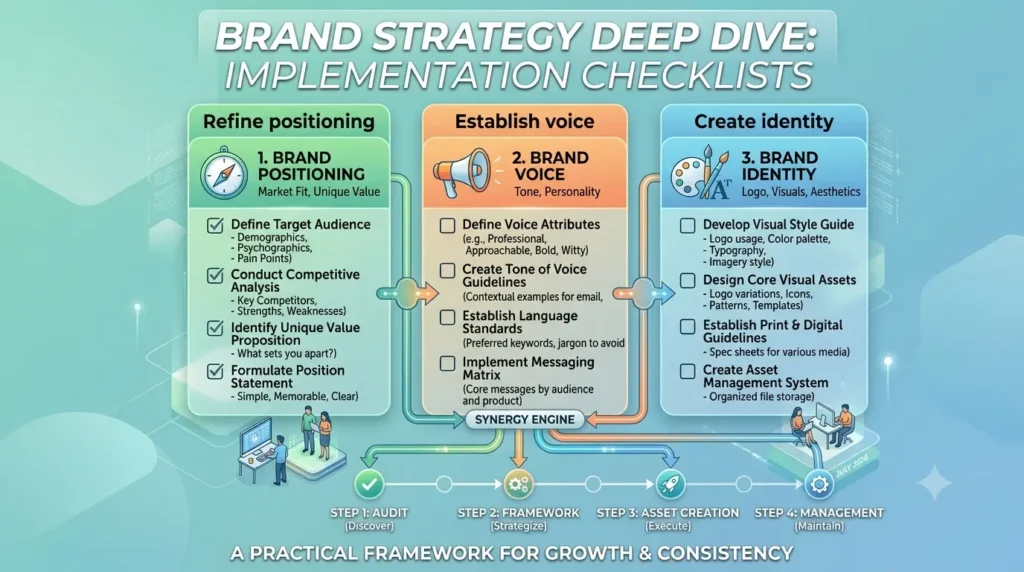
Turning this into something usable rather than theoretical means working through a sequence: first, draft a positioning statement and stress-test it against real competitors and real customer conversations, revising until it’s specific enough to be genuinely differentiating. Second, translate that positioning into three to five voice attributes with concrete examples of each. Third, define or refine the visual identity system to visually express the same positioning, rather than defaulting to generic “modern and clean” design that could belong to any business in any category. Fourth, document all three in a single reference guide that anyone working on the brand can consult directly, rather than relying on someone’s memory of a decision made months earlier.
This sequence matters — positioning first, voice second, visual identity third — because reversing the order tends to produce a visually polished brand built on a strategic foundation nobody actually agreed on.
Connecting Brand Strategy to Marketing and Sales
A clear brand strategy framework doesn’t stay contained to design and messaging; it directly shapes how marketing and sales operate day to day. Content marketing becomes faster to produce once voice and messaging pillars are defined, since a writer isn’t reinventing tone from scratch with every new piece. Sales conversations become more consistent once the team shares a common understanding of positioning, rather than each salesperson describing the business slightly differently based on personal instinct. And paid advertising creative becomes more effective once it’s built around a clear differentiation story rather than generic category claims that blend into every competitor’s ad in the same feed.
Frequently Asked Questions
For a small to mid-sized business, a focused effort typically takes several weeks to move through positioning, voice, and visual identity work properly, though the timeline varies significantly based on how much internal alignment already exists before the process starts.
Most businesses don’t need a full rebrand. Applying this framework often reveals that positioning and voice need clarification more than visual identity needs replacing, which means the process can strengthen an existing brand rather than starting over.
Leadership needs to be involved, since positioning decisions affect the whole business, but input from sales and customer-facing staff is equally valuable, since they hear directly how customers describe the business and its alternatives in their own words.
Core positioning and voice tend to stay stable for years once genuinely well-defined, but visual guidelines benefit from periodic review, particularly as new channels or formats emerge that the original guidelines didn’t anticipate.
Smaller businesses often benefit more, since a clear brand strategy helps a limited marketing budget work harder by ensuring every piece of content and every customer interaction reinforces the same positioning, rather than diluting a smaller reach across inconsistent messaging.
Ready to Build a Brand Strategy That Actually Holds Together?
A strong brand isn’t a logo — it’s a structural decision about positioning, voice, and visual identity working together. Book a branding discovery call with Creative 4 All and start building a brand strategy framework that actually reflects your business, not a generic template.