
A startup founder juggling product development, early sales, and a shoestring budget often treats branding as a luxury to address once there’s real revenue to justify it. This instinct is understandable but backwards: branding for startups done thoughtfully from the beginning, even with minimal budget, prevents the costly rebuilding that happens when an identity thrown together carelessly in month one actively works against the business by month twelve. The goal at this stage isn’t a comprehensive brand system — it’s making smart, sequenced decisions that look intentional now and scale sensibly later.
What to Prioritize First on a Limited Budget?
Positioning Before Visuals
Before spending a single dollar on a logo or color palette, a startup needs genuine clarity on positioning — who the business actually serves, what specific problem it solves better than alternatives, and why a customer should choose it over the obvious competing option. Visual identity without this clarity produces a nice-looking logo attached to a confused, generic message, while clear positioning can carry a startup surprisingly far even with visually modest branding in the earliest stage.
A Minimal Viable Logo Over Full Guidelines
A startup at this stage needs a clean, legible, reasonably distinctive logo and a simple, consistent color palette — not a comprehensive 40-page brand guidelines document covering every conceivable application. This minimal viable approach to visual identity gets a startup looking professional enough to be taken seriously without the time and cost of building out guidelines for situations (a vehicle wrap, a trade show booth, a multi-page print campaign) that may never actually materialize at this stage of the business.
Phased Brand Investment as You Grow
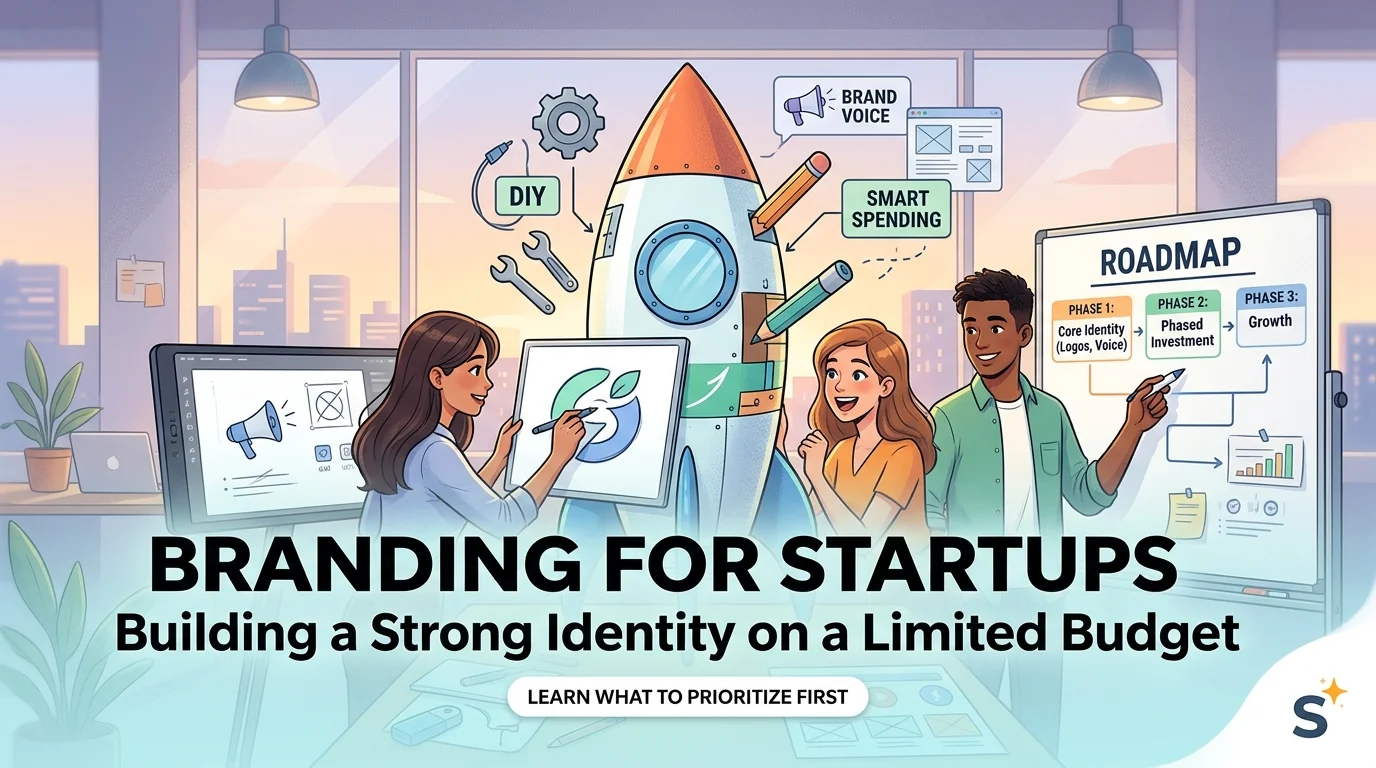
Phase One: MVP Branding
The earliest phase needs just enough identity to launch credibly: a logo, a basic color palette, simple typography choices, and a one-line positioning statement the team can actually articulate consistently. This phase should take days, not months, and cost hundreds or low thousands of dollars rather than the tens of thousands a full brand identity project might run, since the goal is functional credibility, not a finished, permanent system.
Phase Two: Building Out Guidelines
Once a startup has initial traction — paying customers, a growing team, a product that has found some real market validation — expanding into more complete brand guidelines (consistent voice and tone documentation, expanded visual applications, basic templates for common materials) becomes worthwhile, since the business now has enough scale and team size that consistency genuinely matters and informal tribal knowledge about “how we do things” stops being sufficient.
Phase Three: Full Brand System
A more mature startup with meaningful revenue, a larger team, and genuine market position can justify investing in a comprehensive brand system — a full identity refresh if the MVP branding has started to feel limiting, detailed guidelines covering every channel and application, and potentially a brand strategy engagement that goes beyond visual identity into deeper positioning and messaging work. This phase typically coincides with a startup transitioning into a more established company facing genuinely different competitive and operational pressures than it did at launch.
DIY vs. Professional Branding: Where to Draw the Line
What’s Safe to DIY?
A founder with genuine design sensibility can reasonably DIY early logo concepts, basic color selection, and simple template creation using accessible design tools, particularly in the earliest MVP phase where speed and minimal cost matter more than polish. This DIY approach works best when a founder has real visual judgment and is honest about its limits, rather than assuming enthusiasm alone substitutes for the specific skill a professional brings.
Where Professional Help Pays Off Early?
Professional involvement pays off earliest and most clearly for the positioning and strategy work underlying the visual identity, since a skilled brand strategist asking the right questions about audience and differentiation often surfaces blind spots a founder too close to their own business genuinely cannot see. Even a limited-scope engagement — a focused positioning workshop rather than a full identity project — frequently produces disproportionate value relative to its modest cost at this stage.
Common Startup Branding Mistakes
Over-Investing Too Early
Spending a disproportionate share of limited early-stage capital on a comprehensive brand identity before the business model itself has been validated risks investing heavily in visual identity for a business that may still pivot significantly, making that investment partially wasted. Matching brand investment to the startup’s actual stage of validation, rather than treating branding as something to maximize regardless of where the business actually stands, protects limited capital for where it’s needed most.
Copying Competitors Instead of Positioning Distinctly
A startup entering a crowded space sometimes defaults to visually mimicking successful competitors, assuming this signals legitimacy, when in reality this approach actively undermines the differentiation a startup needs to carve out its own market position. Genuine, even imperfect distinctiveness serves a new entrant considerably better than polished conformity to what established competitors already do, since a startup competing purely on execution polish against better-funded incumbents rarely wins that specific fight.
Setting a Realistic Startup Branding Budget
Benchmarking Against Actual Stage, Not Aspiration
A realistic startup branding budget should reflect the business’s actual current stage rather than the brand identity a founder hopes to eventually have once the company succeeds. Benchmarking spend against comparable early-stage companies at a similar point, rather than against the polished identity of an established competitor that has had years and significant funding to build theirs, keeps the budget grounded in what the current stage genuinely justifies.
Allocating Budget Across Priorities in Order
Within a limited startup branding budget, allocating funds first to positioning clarity, then to the minimal visual identity, and only later to expanded guidelines or additional applications ensures the most foundational, highest-leverage work gets funded before anything more cosmetic. A founder who reverses this order — spending heavily on polished visuals while skipping genuine positioning work — often ends up with an attractive identity that still fails to communicate anything distinctive about the business.
Lean Brand Identity as an Ongoing Philosophy
Why Lean Doesn’t Mean Low-Quality?
A lean brand identity approach does not mean accepting poor quality — it means being deliberate about scope, building only what the business genuinely needs at its current stage rather than everything a brand identity could theoretically include. A well-executed lean identity, focused tightly on what actually matters for credibility and recognition right now, often serves a startup better than an overbuilt system containing elements nobody will use for years.
Scaling Lean Branding as Needs Change
The lean approach that serves a startup well at launch should evolve deliberately as actual needs change, rather than staying permanently minimal out of habit long after the business has grown past what that minimal approach can support. Revisiting brand identity decisions periodically, tied to genuine business milestones rather than an arbitrary calendar schedule, keeps the identity appropriately scaled to the business at each point.
Early-Stage Branding Decisions That Age Well
Choosing Flexibility Over Trendy Specificity
Early-stage branding decisions age better when they favor genuinely flexible, timeless choices over whatever visual trend happens to be popular at launch, since a startup’s early identity often needs to remain functional for years without a full redesign. A distinctive but not overly trend-dependent logo and color approach avoids the awkward position of looking dated within a year or two of launch.
Documenting Decisions Even at a Minimal Stage
Even a minimal early-stage branding effort benefits from documenting the handful of decisions actually made — exact color codes, the specific logo file and its acceptable variations, the core positioning statement — in a simple shared document, rather than relying on institutional memory that gets lost as a founding team grows and changes. This small amount of documentation prevents the kind of drift that makes a later, more comprehensive branding phase considerably more complicated than it needs to be.
Frequently Asked Questions
This varies by specific situation, but a reasonable MVP branding budget often falls in the low hundreds to low thousands of dollars range, covering a logo, basic color palette, and simple typography decisions rather than a comprehensive brand system. Spending significantly more than this before the business model is validated often represents premature investment.
Either can work well depending on budget and the specific scope needed — a freelancer or small studio often provides more cost-effective MVP-stage branding, while a full agency engagement becomes more proportionate once a startup reaches the stage justifying a comprehensive brand system. Matching the provider’s scale to the project’s actual scope keeps cost reasonable at each stage.
Yes, and this is a normal, expected part of a successful startup’s growth trajectory rather than a sign the initial branding was a mistake. A functional, modest MVP identity that served its purpose during early validation is not a failure simply because the business eventually outgrows it and invests in something more comprehensive.
Even limited-scope positioning and strategy work can provide real value pre-revenue, since clarity on target audience and differentiation directly shapes product decisions, messaging, and early sales conversations, not just visual identity. This is often worth prioritizing over visual polish at the very earliest stage.
Operating with no clear positioning or visual consistency at all, rather than a deliberately minimal MVP approach, tends to produce confused messaging and a generic, forgettable presence that makes it harder to build early recognition and trust, even among a startup’s first handful of customers.
Ready to Build a Brand That Grows With Your Startup?
Branding for startups works best as a sequenced investment matched to each stage of growth, not an all-or-nothing decision made too early or skipped entirely. Creative 4 All helps early-stage businesses across Lebanon and the GCC build credible, scalable brand identities that fit a startup’s actual budget and stage. Book a Branding Discovery Call to figure out exactly what your startup needs right now.