
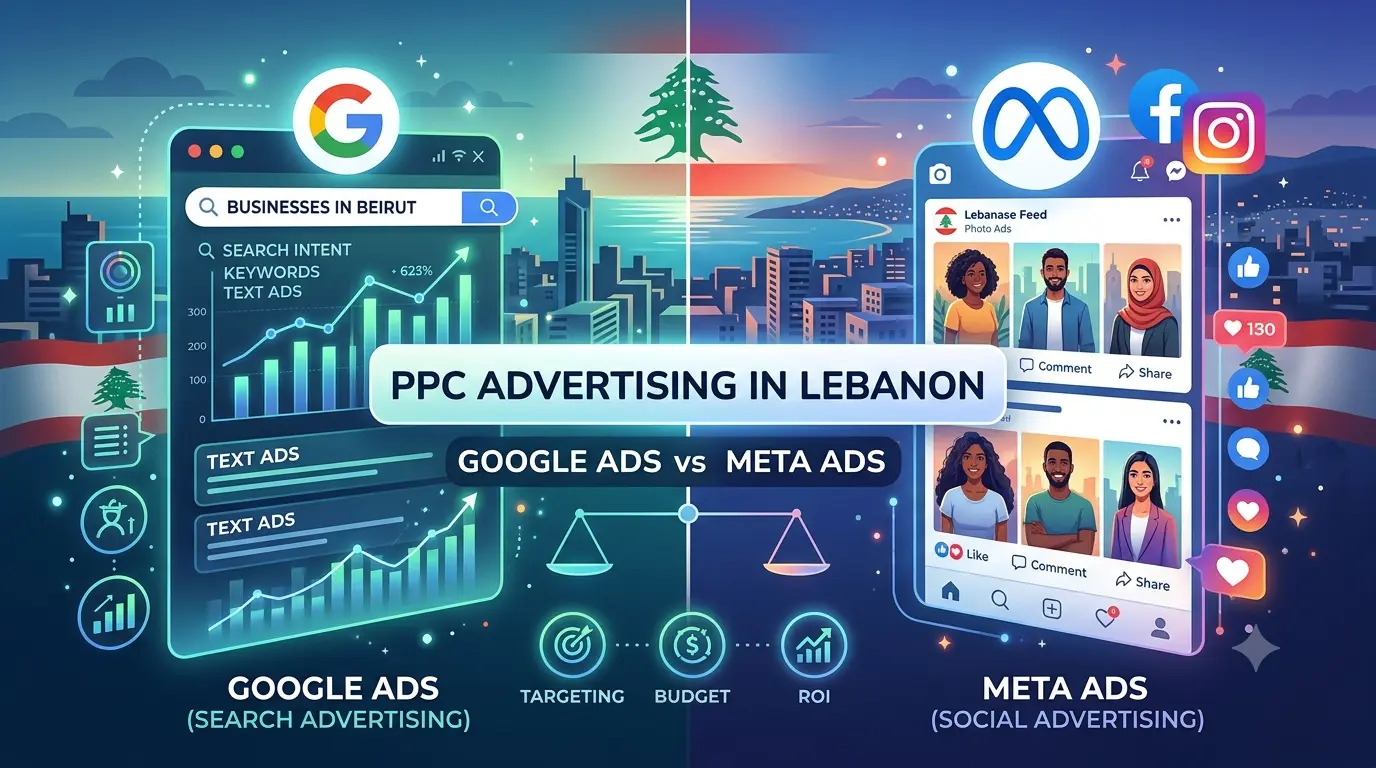
Ask a business owner in Beirut which paid advertising platform to start with, and the answer they usually get is whichever platform the person answering happens to prefer, rather than one grounded in how each platform actually works. PPC advertising Lebanon businesses run in 2026 mostly comes down to two real options — Google Ads and Meta Ads — and each one operates on a fundamentally different principle for reaching customers. Understanding that difference matters more than any tactical setting inside either platform, because it determines whether a PPC advertising Lebanon campaign is even built around the right kind of demand in the first place.
Google Ads captures intent that already exists: someone actively searching for a service, ready to act, typing the query into the search bar themselves. Meta Ads, running across Facebook and Instagram, works by surfacing a business to people who weren’t necessarily looking for it, based on demographic and behavioral targeting instead of an explicit search. Neither approach is inherently better — they solve different problems, and the right choice, or right combination, depends entirely on what a specific business is trying to achieve.
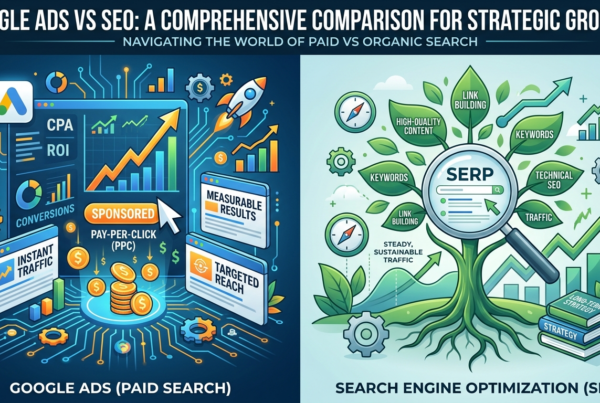
Search Intent vs Social Discovery: The Core Difference
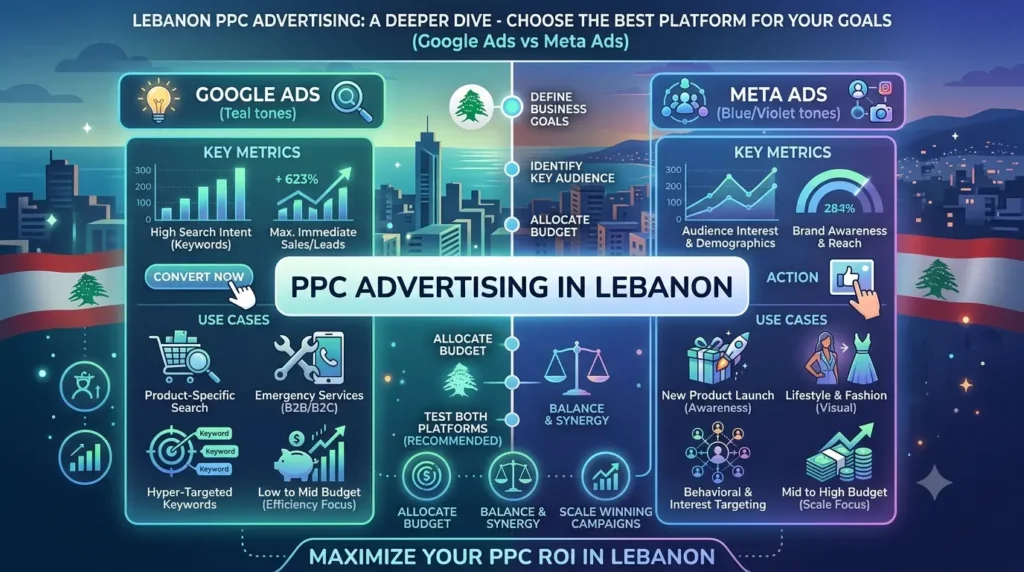
The clearest way to understand the split between these two platforms is to think about where a potential customer is in their decision process at the moment the ad reaches them. Google Ads shows up in response to a search someone has already typed — “emergency plumber Beirut,” “best web design agency Lebanon,” “buy running shoes online Lebanon” — which means the person has already identified a need and is actively looking for a solution. This is why Google Ads consistently produces higher intent traffic: the platform isn’t creating demand, it’s capturing demand that already exists.
Meta Ads works from the opposite direction. Nobody searches Instagram for “emergency plumber,” but a well-targeted ad showing a plumbing business’s fast response times and clear pricing can still catch the attention of someone in the right demographic who has a leaking pipe they haven’t yet searched for a solution to, or who will remember the brand when the need arises later. This makes Meta Ads particularly effective for building awareness, showcasing visually compelling products, and reaching people earlier in their decision process — before they’ve defined the problem in search terms at all.
For PPC advertising campaigns specifically, this distinction has real practical weight. A business offering something people actively search for — a dentist, a lawyer, an appliance repair service — usually gets stronger, faster returns from Google Ads, since the demand is already there waiting to be captured. A business selling something more discretionary or visually driven — home décor, fashion, a new restaurant concept — often benefits more from Meta Ads, since discovery and desire need to be created rather than simply captured.
When to Use Google Ads?
Google Ads makes the most sense when a business has a clear, definable service or product that people search for by name or need, and when search volume for relevant terms is meaningful enough to justify bidding on them. For most PPC advertising Lebanon campaigns built around urgent or professional services, this is the natural starting point. Emergency and urgent services, professional services with clear specializations, and any business competing directly against others who show up for the same searches all tend to perform well here, because the ad appears at the exact moment someone is ready to choose.
The tradeoff is cost per click, which can run high in competitive categories, and the fact that Google Ads requires ongoing keyword research and bid management to avoid wasting spend on searches that don’t convert. A campaign left on autopilot without regular review tends to drift toward broader, less qualified traffic over time as Google’s automated bidding optimizes for volume rather than the specific outcomes a business actually cares about.
When to Use Meta Ads?
Meta Ads fits best when a business needs to build awareness, has a visually strong product or service, or is targeting a specific demographic that can be reached through interest and behavior-based targeting rather than search terms. Ecommerce brands, restaurants, event promotions, and businesses launching a new offering with no existing search demand yet all tend to see stronger early results here than they would from Google Ads, simply because there’s no meaningful search volume yet to capture.
Meta’s targeting options — age, location, interests, behaviors, and lookalike audiences built from existing customer data — allow for a level of demographic precision that search advertising can’t replicate, since Google Ads targets based on what someone typed rather than who they are. The tradeoff is that Meta campaigns typically need more creative iteration to perform well, since ad fatigue sets in faster on social platforms than in search, where the same ad can run against the same query for months without feeling repetitive to the audience seeing it.
When to Use Both Together?
For many businesses, the strongest PPC advertising Lebanon strategy isn’t choosing one platform over the other, but sequencing them to work together, since a combined PPC advertising Lebanon approach often outperforms either channel run in isolation. Meta Ads can build awareness and interest among an audience that hasn’t started actively searching yet, while Google Ads captures that same audience later, once the need has crystallized into an actual search. A business running both platforms often sees search volume for its own brand name increase after a period of consistent Meta advertising, as more people who saw the ad later search for the business by name.
Running both also provides a useful cross-check on measurement: if Meta Ads is driving strong engagement but branded search volume on Google isn’t moving at all, that’s a signal worth investigating rather than assuming the Meta campaign is working as intended. Businesses with the budget to run both channels typically get a fuller picture of the customer journey than they would from either platform alone.
Lebanon-Specific Considerations for Running PPC
Running PPC advertising campaigns in Lebanon comes with a handful of practical wrinkles that don’t show up in generic global guides. Payment setup is one of the first hurdles — both Google Ads and Meta Ads require a valid payment method, and not every Lebanese bank card works smoothly with either platform’s billing system, which sometimes means routing ad spend through a business’s international card or a payment method specifically vetted for this purpose. Audience size is another factor worth accounting for, since Lebanon’s smaller population means highly narrow targeting on Meta Ads can shrink an audience to the point where the algorithm struggles to find enough people to serve ads to efficiently.
Currency display also matters more than it might seem. Running ads priced or reported in USD while the local market increasingly transacts and thinks in different terms can create a subtle disconnect between what a campaign’s dashboard reports and how a business owner mentally tracks performance, which is worth aligning early rather than discovering months into a campaign. None of these issues are dealbreakers for either platform, but accounting for them upfront avoids the kind of early friction that makes a business abandon a channel that would otherwise have performed well.
Realistic Budget Starting Points
For a business testing PPC advertising Lebanon for the first time, a reasonable starting budget for either platform sits in a modest, controlled range that allows for real learning without significant financial risk — enough spend to gather statistically meaningful data on which keywords, audiences, and creative variations perform, but not so much that a poorly performing initial campaign structure burns through a large budget before anyone notices the problem. Google Ads typically requires a slightly higher starting budget than Meta Ads in competitive categories, since cost per click in Lebanon’s more contested service categories can run meaningfully higher than average social ad costs.
Whatever the starting number, the first month should be treated explicitly as a testing and learning phase rather than a performance benchmark. Early campaign structures are rarely optimal on the first attempt, and judging a campaign’s viability from its first two weeks of data, before enough conversions have accumulated to draw a reliable conclusion, is one of the most common reasons businesses abandon channels that would have performed well with a few more weeks of refinement.
Measuring Early Performance
The metrics that matter differ meaningfully between the two platforms, and applying the same benchmarks to both is a common mistake. For Google Ads, cost per click and conversion rate against actual search intent are the clearest early signals — a high click-through rate with a poor conversion rate usually points to a mismatch between the ad’s promise and the landing page’s follow-through, rather than a problem with the keywords themselves. For Meta Ads, engagement metrics like click-through rate and cost per result matter, but should be weighed alongside how far down the funnel those results actually go, since a high volume of cheap clicks that never convert isn’t meaningfully different from no clicks at all.
Conversion tracking setup matters more than either platform’s native reporting suggests, since neither Google Ads nor Meta Ads can optimize toward real business outcomes — leads, calls, purchases — unless that data is properly fed back into the platform through conversion tracking or a connected CRM. A campaign judged purely on clicks or impressions, without connecting that data to actual leads or sales, gives an incomplete and often misleading picture of whether the spend is actually working.
Frequently Asked Questions
Meta Ads generally has a lower cost per click, but Google Ads often delivers higher-intent traffic that converts at a better rate for search-driven categories. Cost alone isn’t the right comparison — cost per qualified lead is the more useful metric.
Yes, though a very limited budget is usually better spent testing one platform thoroughly before splitting it across two, since spreading a small budget too thin makes it harder to gather enough data on either platform to draw reliable conclusions.
At least four to six weeks in most cases, long enough to accumulate meaningful conversion data and move past the platform’s initial learning phase, during which algorithms are still calibrating targeting and bidding.
Both can work well together for ecommerce. Meta Ads often excels at driving initial product discovery through visual ads, while Google Shopping and search ads capture people who are already comparing products or ready to purchase.
A dedicated landing page matching the ad’s specific offer consistently outperforms sending traffic to a general homepage, since it removes the extra step of a visitor needing to find the relevant information themselves.
Ready to Build a PPC Strategy That Actually Converts?
Choosing between Google Ads and Meta Ads, or running both effectively, depends entirely on your specific business, audience, and budget — and getting PPC advertising Lebanon right usually comes down to the account structure and tracking setup more than the platform itself. Get a free PPC account review from Creative 4 All and find out exactly where your ad spend should be going.