
An account can be technically well-organized — sensible campaign structure, reasonable daily budgets, decent ad copy — and still bleed money through a bidding strategy nobody examined closely. Search engine marketing spend gets wasted less often through obviously bad decisions and more often through match type settings left on defaults, a negative keyword list that was never built, and a quality score nobody bothered to understand. This article works through exactly how these three mechanics affect what an advertiser actually pays, since a sound SEM bidding strategy depends on understanding them rather than treating bid amounts as the only lever that matters.
How Keyword Match Types Affect Spend?
The Three Match Types and What They Actually Control
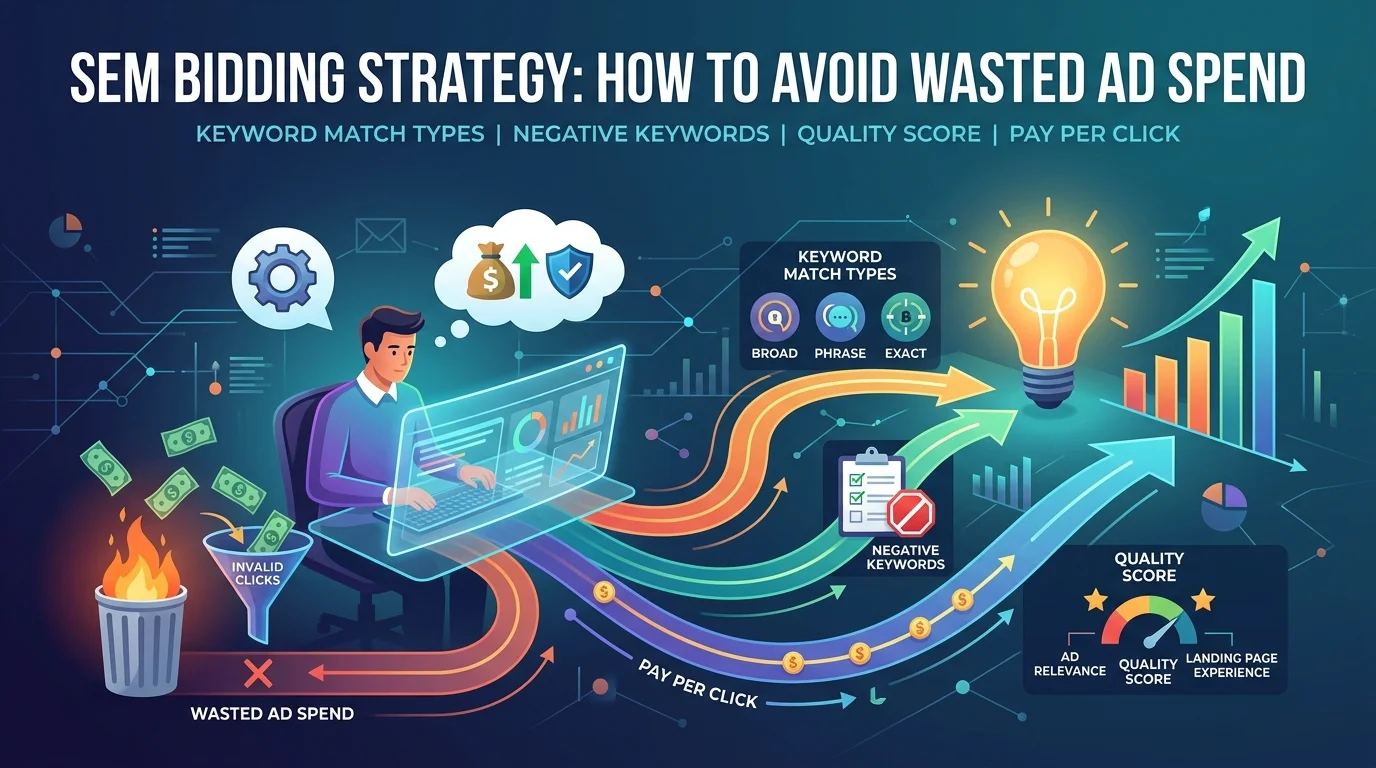
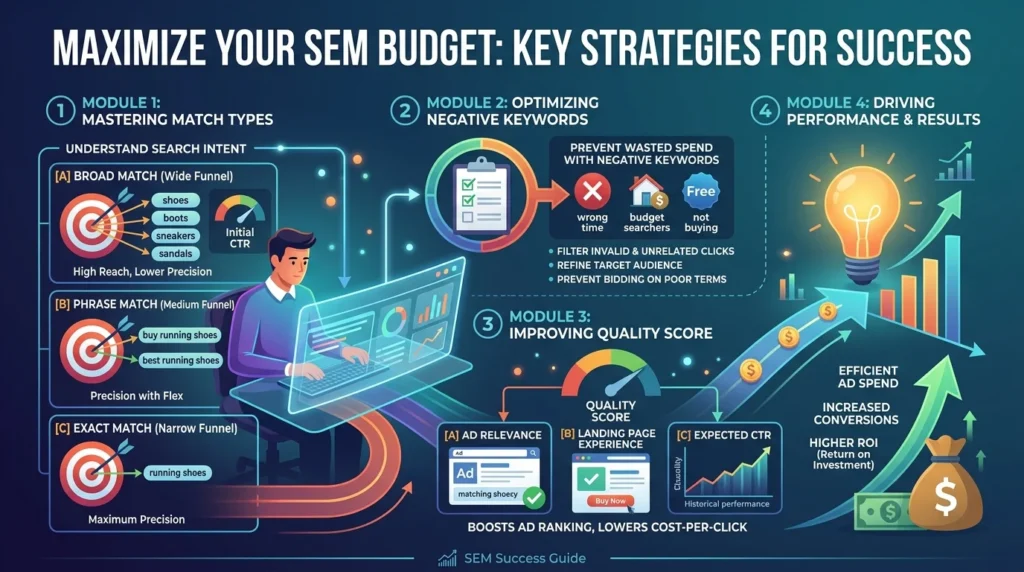
Broad match shows an ad for searches loosely related to a keyword, including many the advertiser never explicitly intended to target, which maximizes reach but frequently wastes spend on searches with weak commercial intent. Phrase match narrows this considerably, requiring the search to include the core meaning of the keyword phrase, while exact match restricts an ad to searches very close to the literal keyword itself. Each tighter match type trades some reach for considerably more control over exactly which searches trigger spend.
Choosing Match Types Based on Campaign Goals
A campaign built purely for broad awareness might reasonably lean toward broad match to maximize impression volume, while a campaign built specifically to drive qualified leads or sales typically performs better weighted toward phrase and exact match, where spend concentrates on searches genuinely likely to convert. Many advertisers default to broad match simply because it’s the easiest setting to leave unchanged, without recognizing that this default frequently produces the highest volume of low-intent, wasted clicks in an account.
The Role of Negative Keywords
What Negative Keywords Actually Prevent?
A negative keyword tells the search engine specifically not to show an ad for searches containing that term, directly preventing wasted spend on searches that technically match a targeted keyword but reflect entirely different intent. A business selling premium consulting services bidding on “consulting” without excluding “free consulting” or “consulting jobs” will inevitably pay for clicks from people looking for something the business doesn’t actually offer.
Building a Negative Keyword List Systematically
Building an effective negative keyword list starts with reviewing the search terms report — the actual searches that triggered ads — and identifying patterns of clearly irrelevant intent, then adding those terms as negatives at the campaign or account level depending on how broadly they apply. This should be an ongoing practice rather than a one-time setup task, since new irrelevant search patterns emerge continuously as an account accumulates more traffic and search behavior shifts over time.
Quality Score’s Impact on Cost
What Quality Score Actually Measures?
Quality score reflects how relevant a search engine judges an ad and landing page to be for a specific keyword, based primarily on expected click-through rate, ad relevance, and landing page experience. This score directly affects cost per click: a higher quality score can achieve the same ad position at a meaningfully lower cost per click than a lower quality score competing for the same keyword, making quality score improvement one of the most direct ways to reduce SEM spend without changing bid amounts at all.
Improving Quality Score in Practice
Improving quality score generally means tightening the relationship between keyword, ad copy, and landing page — an ad that directly addresses the specific keyword’s intent, using matching language, and a landing page that continues that same message rather than sending traffic to a generic homepage, all contribute directly to a stronger score. Advertisers who focus exclusively on bid amount while ignoring quality score often find themselves paying considerably more than competitors bidding lower but maintaining tighter keyword-ad-landing page alignment.
Common Bidding Mistakes
Bidding the Same Amount Across All Keywords
Applying a single, uniform bid across an entire keyword list ignores the reality that different keywords carry meaningfully different value — a high-intent, close-to-purchase keyword generally justifies a higher bid than a broader, earlier-stage informational keyword. Segmenting bids based on keyword intent and historical conversion performance, rather than applying one flat number everywhere, produces considerably more efficient overall spend.
Ignoring Search Term Reports
Many advertisers set up campaigns, configure keywords, and then rarely revisit the actual search terms report showing what searches genuinely triggered their ads. This report is where wasted spend becomes visible and negative keyword opportunities surface, and an account left unreviewed for months typically accumulates significant waste that a regular review cycle would have caught considerably earlier.
Chasing Position One Regardless of Cost
Assuming the top ad position always produces the best return ignores the reality that cost per click frequently increases disproportionately faster than conversion rate improves at the very top position. Testing whether a slightly lower, less expensive position actually produces a better overall return on ad spend, rather than assuming top position is automatically worth whatever it costs, frequently reveals a more cost-effective bidding target.
Keyword Bidding SEM Tools and Automation
Manual vs. Automated Bidding Approaches
Keyword bidding SEM platforms generally offer both manual bidding, where an advertiser sets a specific maximum cost per click for each keyword, and automated bidding strategies that adjust bids algorithmically based on a target outcome like conversions or return on ad spend. Manual bidding gives an advertiser precise control but requires ongoing attention, while automated bidding trades some direct control for efficiency, particularly once an account has accumulated enough conversion data for the algorithm to optimize meaningfully.
When Automated Bidding Makes Sense?
Automated bidding strategies generally perform best once a campaign has generated a reasonable volume of conversions, since these algorithms need historical data to identify patterns worth optimizing toward. A newer campaign with limited conversion history often benefits from starting with manual bidding to maintain tighter control before transitioning to an automated strategy once enough data exists to trust the algorithm’s decisions.
Quality Score Optimization as an Ongoing Discipline
Why Quality Score Requires Continuous Attention?
Quality score optimization is not a one-time fix but an ongoing discipline, since quality score is recalculated continuously based on actual performance, meaning a keyword’s score can decline if ad relevance or landing page experience deteriorates over time. Regularly reviewing quality score trends within an account, rather than checking it once during initial setup, catches declining scores before they meaningfully increase cost per click.
Prioritizing Quality Score Work by Spend Impact
Not every keyword needs equal attention when it comes to quality score optimization — focusing improvement efforts on the highest-spend keywords first produces a proportionally larger impact on overall account cost efficiency than spreading limited optimization time evenly across every keyword regardless of its actual spend volume.
Frequently Asked Questions
Most effective SEM bidding strategies use a mix, often starting new keywords in phrase or exact match to control spend, then selectively testing broader match types once solid performance data exists to justify the wider reach. Defaulting entirely to broad match without this data typically produces higher waste than a more deliberate, mixed approach.
Reviewing the search terms report at least monthly, or weekly for higher-spend accounts, catches new irrelevant search patterns before they accumulate significant wasted spend. This should be treated as an ongoing maintenance task rather than a one-time setup completed at campaign launch.
Yes, and this is often the more cost-effective path — improving ad relevance and landing page experience for a specific keyword can raise quality score and effectively lower cost per click at the same bid amount, rather than needing to increase spend to achieve better ad position.
This should be grounded in the keyword’s actual value to the business — what a conversion from that specific keyword is genuinely worth, factoring in typical conversion rate — rather than an arbitrary number or simply matching what competitors appear to be bidding. Working backward from acceptable cost per acquisition produces a more defensible bid than guessing.
A search terms report showing a significant share of spend going to clearly irrelevant searches is usually the clearest sign, along with cost per conversion that has crept up over time without a corresponding improvement in results. Both symptoms point directly back to match type settings, negative keyword gaps, or quality score issues worth investigating.
Ready to Stop Wasting Ad Spend on the Wrong Clicks?
An effective SEM bidding strategy is what separates an account that burns budget on irrelevant clicks from one that converts spend into genuine leads and sales efficiently. Creative 4 All audits and manages SEM accounts for businesses across Lebanon and the GCC, tightening match types, negative keywords, and quality score to reduce waste. Get a Free SEM Audit to see exactly where your current account is losing budget unnecessarily.