
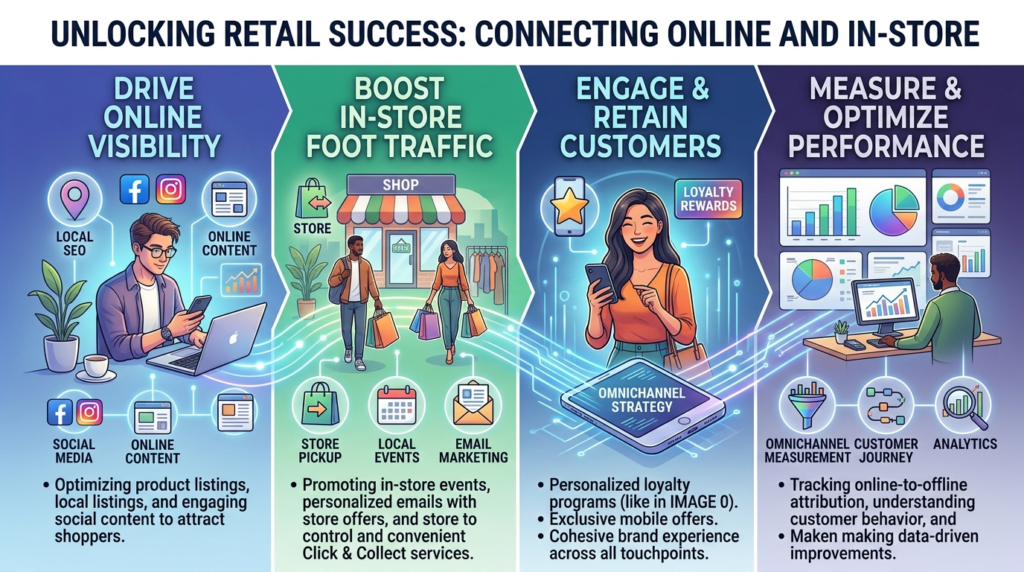
A shopper searches a product online, checks a store’s hours and stock before leaving the house, then walks in twenty minutes later to buy it in person — and a retailer treating online and in-store as two separate businesses misses exactly this customer at exactly the moment they were ready to buy. Digital marketing for retail Lebanon businesses need to succeed treats online presence and physical foot traffic as one connected system rather than two competing priorities, because that’s genuinely how most retail customers actually behave, moving fluidly between digital research and in-person purchasing rather than choosing one channel exclusively.
This guide covers why retail specifically needs both local and ecommerce visibility rather than choosing between them, how to drive foot traffic with online content and local inventory signals, multilingual considerations for digital marketing for retail Lebanon businesses run, how loyalty and repeat-visit marketing keeps existing customers coming back, and how to measure omnichannel performance across both digital and physical touchpoints.
Why Retail Needs Both Local and Ecommerce Visibility?
The False Choice Between Physical and Digital
Many retailers frame the decision as choosing between investing in a physical store presence or building out ecommerce, when the actual customer behavior driving most retail purchases doesn’t respect that division at all. A customer researching a product online before visiting a physical store, or checking in-store availability before making an online purchase decision, is engaging with a single retail brand across two channels simultaneously, and digital marketing for retail Lebanon businesses run needs to reflect that reality rather than optimizing each channel in isolation.
What Omnichannel Actually Means in Practice?
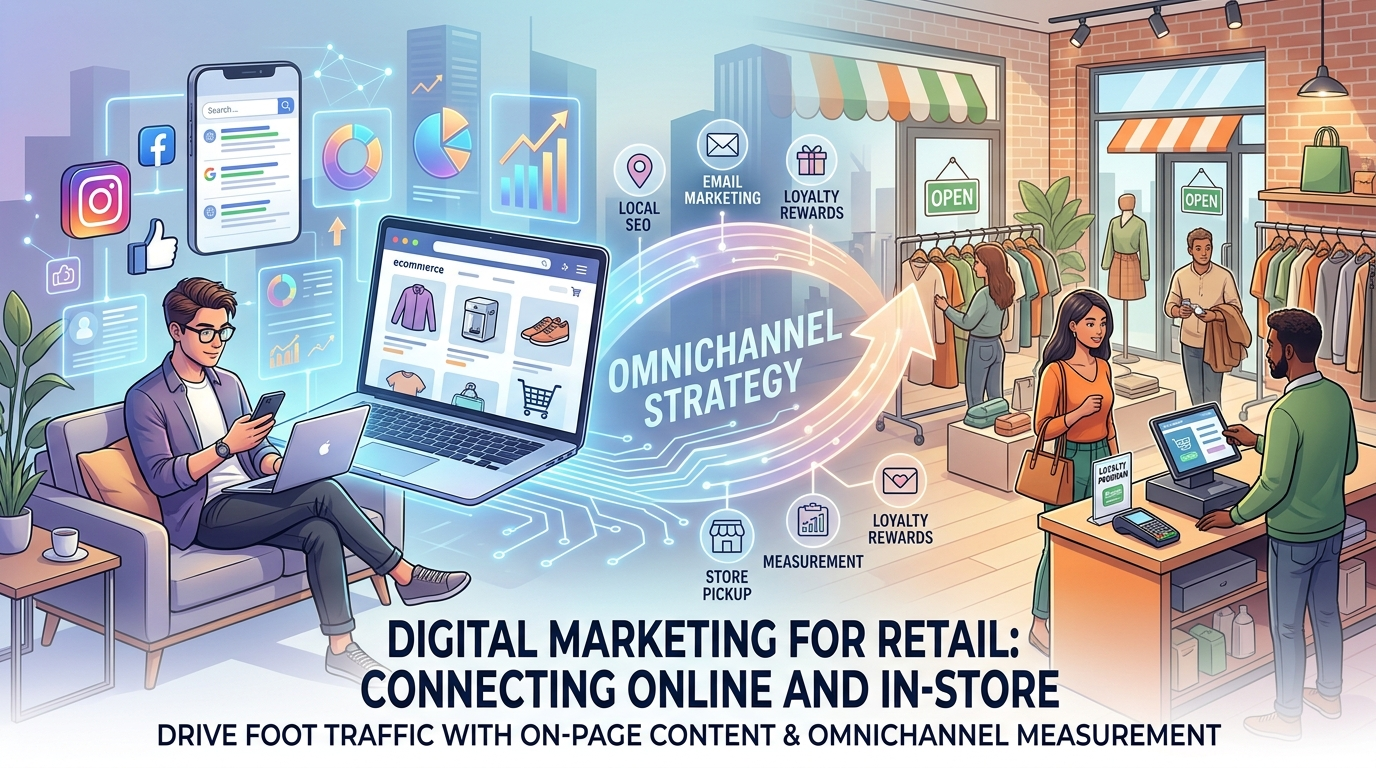
Omnichannel retail, in practical terms, means a customer’s experience with a brand feels consistent and connected whether they’re browsing a website, checking Google for local stock, or walking into a physical location — the same product information, the same pricing, and ideally the same promotional offers available across every channel rather than each channel operating with its own disconnected version of the business. This connection matters directly for conversion, since a customer who finds conflicting information between a store’s online presence and in-store reality loses trust in both, regardless of which channel they encountered the inconsistency through first.
Multilingual Considerations for Lebanese Retail
Reaching Customers Across Arabic, English, and French
Digital marketing for retail Lebanon businesses run needs to account for a customer base searching and shopping across Arabic, English, and French, and this affects both online content and in-store signage consistency. Product descriptions, promotions, and Google Business Profile content should be genuinely accessible in all three languages rather than defaulting to whichever language the business happens to find easiest, since a customer researching in Arabic deserves the same clear product and availability information as one researching in English.
Consistency Between Online and In-Store Language
Promotions and messaging communicated online should match what a customer actually encounters in-store, including language consistency where relevant — a promotion advertised in one language but only explained in another at the physical location creates exactly the kind of disconnect that undermines the omnichannel trust a retailer is trying to build. This matters specifically for businesses serving a genuinely multilingual customer base, which describes most Lebanese retail.
Driving Foot Traffic With Online Content
Local Inventory Ads and Google Business Profile
Local inventory ads, which show a specific product’s availability at a nearby physical store directly within Google search results, capture exactly the customer intent of someone who’s already decided to buy and is deciding where to buy it from — a moment where local availability information can be the deciding factor between one retailer and another. Pairing this with a well-optimized Google Business Profile, showing accurate hours, current promotions, and genuine customer photos, gives a searching customer everything needed to choose a physical visit over continuing to browse online.
Click-and-Collect as a Bridge Between Channels
Click-and-collect — ordering online and picking up in-store — functions as a genuine bridge between digital convenience and physical retail, capturing customers who want the certainty of online product research and reserved availability without waiting for delivery. Promoting click-and-collect specifically, rather than assuming customers will discover the option on their own, meaningfully increases both online conversion and in-store foot traffic simultaneously, since every click-and-collect order represents a guaranteed physical store visit that a pure online sale doesn’t generate.
Loyalty and Repeat-Visit Marketing
Building a Loyalty Program That Actually Gets Used
A loyalty program only creates value if customers actually understand and use it, which means the enrollment process needs to be genuinely frictionless — ideally captured naturally at checkout, whether online or in-store, rather than requiring a separate signup effort a customer has to actively seek out. Clear, simple reward structures that customers can easily understand and track tend to drive meaningfully more repeat engagement than complex, hard-to-follow point systems that customers lose track of and eventually ignore.
Email and SMS for Repeat-Visit Marketing
Email and SMS marketing to an existing customer base, promoting relevant new arrivals, personalized offers based on past purchase behavior, and loyalty program milestones, keeps a retail brand present in a customer’s routine between visits rather than relying purely on that customer remembering to check back independently. This kind of repeat-visit marketing tends to produce a stronger return than acquisition-focused advertising alone, since retaining and increasing purchase frequency from an existing customer is generally more cost-effective than continuously acquiring new customers from scratch.
Measuring Omnichannel Performance
Connecting Online Activity to In-Store Visits
Measuring the actual connection between digital marketing efforts and physical store visits requires deliberate tracking — using Google’s store visit conversion tracking where available, tracking click-and-collect order volume specifically, and where feasible, in-store promotions or coupon codes tied back to specific online campaigns. Without this connection, a retailer risks undervaluing digital marketing that’s genuinely driving foot traffic simply because that foot traffic doesn’t show up as an online conversion.
Metrics That Matter Across Both Channels
Beyond channel-specific metrics, overall customer lifetime value — tracked across a customer’s combined online and in-store purchase history rather than treating each channel’s spend separately — gives the clearest picture of whether an omnichannel strategy is genuinely working. A customer who researches online, buys in-store, and later makes a repeat online purchase represents real omnichannel value that channel-siloed reporting would fail to capture accurately, undercounting exactly the behavior a coordinated strategy is trying to encourage.
Frequently Asked Questions
Yes — even a small retailer benefits from customers being able to check hours, stock, and location online before visiting, and from capturing the online research phase that increasingly precedes most in-store purchases regardless of business size.
It captures customers who want certainty before making the trip, converting online browsers who might not have visited otherwise into confirmed in-store visits, while also giving existing foot traffic customers a faster, more convenient option.
A simple points-per-purchase or visit-based reward system, captured naturally at checkout without requiring extra customer effort, is generally more effective to start with than a complex tiered program that’s harder to communicate and track.
Google’s store visit conversion tracking, dedicated click-and-collect tracking, and in-store promo codes tied to specific online campaigns all provide direct signals connecting digital activity to physical visits.
Not necessarily evenly — the right split depends on the specific business’s actual sales mix between online and in-store, but most retailers benefit from investing meaningfully in both rather than concentrating entirely on one channel.
Ready to Connect Your Online and In-Store Marketing?
Retail customers move fluidly between digital research and physical visits, and your marketing should too. Book a free digital marketing consultation with Creative 4 All and build a digital marketing for retail Lebanon strategy that connects your online presence directly to foot traffic and repeat visits.