

Walk through most Lebanese manufacturers’ websites and a pattern repeats: a static “about us” page, a product catalog last updated years ago, and a contact form that clearly hasn’t generated a lead in some time. Digital marketing for manufacturers remains one of the most under-invested categories in Lebanese business online, not because manufacturers don’t have real buyers to reach, but because the industry has historically run on trade relationships, distributor networks, and referrals that never required a strong digital presence — until those channels alone stopped being enough to sustain growth.
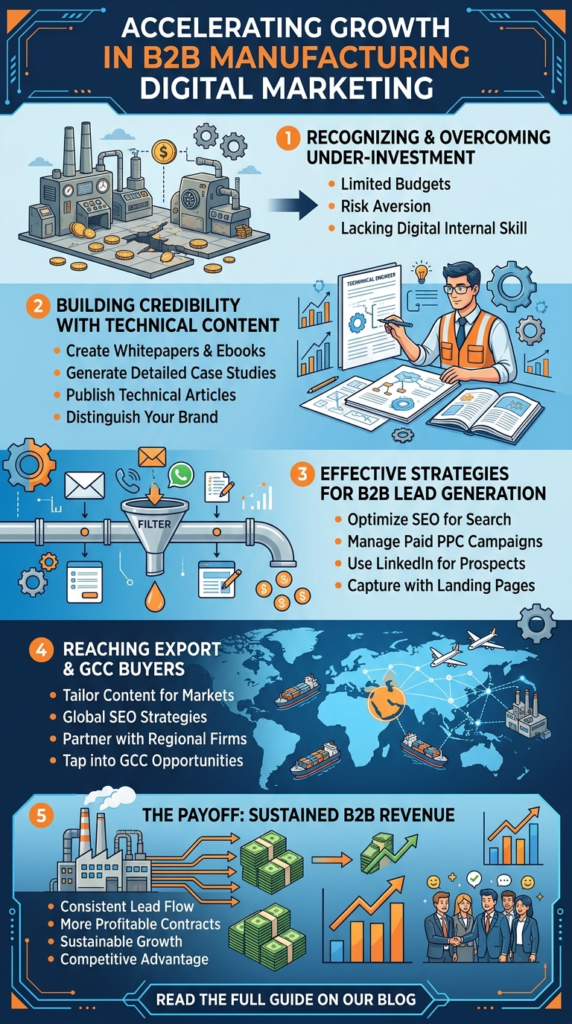
This guide covers why manufacturers under-invest in digital marketing and why that’s increasingly a costly mistake, how to build credibility with technical content that actually speaks to engineers and procurement buyers, how to reach export and GCC buyers online specifically, how to measure what actually matters, and what a realistic digital marketing for manufacturers approach looks like for a company just getting started.
Why Manufacturers Under-Invest in Digital Marketing?
The Legacy of Relationship-Based Sales
Manufacturing has long operated on a sales model built around trade shows, distributor relationships, and personal networks built over years or decades, and this model genuinely worked well for a long time — it’s not an irrational approach, it’s a reflection of how industrial buying happened for most of the industry’s history. The problem isn’t that this model stopped working entirely; it’s that it no longer works alone, since even buyers who ultimately rely on a trusted distributor relationship increasingly research and verify potential suppliers online before that relationship-based conversation even begins.
Why This Gap Is Now a Real Cost?
Digital marketing for manufacturers matters more today specifically because a growing share of procurement research happens online before any human contact occurs — an engineer specifying a component, a procurement team comparing potential suppliers, an export buyer researching Lebanese manufacturers in a specific category. A manufacturer invisible or unconvincing in that research phase loses opportunities to competitors who show up credibly, regardless of how strong the underlying product or relationship network actually is. This gap is particularly costly because it’s invisible from the inside — a manufacturer doesn’t see the buyers who researched them online, found little of substance, and quietly moved to a competitor instead.
Building Credibility With Technical Content
Speaking to Engineers and Technical Buyers Directly
Manufacturing buyers, particularly technical evaluators like engineers and quality managers, respond to specificity and genuine technical depth rather than generic marketing language — material specifications, tolerances, certifications, production capacity, and quality control processes matter far more to this audience than aspirational brand messaging. Content that speaks in the buyer’s own technical vocabulary, addressing the specific criteria a technical evaluator actually needs to assess before recommending a supplier, builds credibility in a way that polished but vague marketing copy simply cannot.
Certifications, Capabilities, and Case Studies
Documenting certifications (ISO standards, industry-specific quality certifications), detailed production capabilities (equipment, capacity, specialization), and genuine case studies of past work for comparable clients gives a technical buyer concrete evidence to evaluate rather than asking them to take marketing claims on faith. This kind of content also serves a search visibility function directly, since technical buyers frequently search for these exact specifics — a certification standard, a specific material or process capability — when researching potential suppliers, making genuinely detailed technical content a meaningful SEO asset as well as a trust-building one.
Reaching Export and GCC Buyers Online
What Export Buyers Actually Look For?
An international or GCC buyer researching a Lebanese manufacturer online is evaluating a genuinely different set of concerns than a local buyer — export logistics and shipping capability, international quality certifications recognized outside Lebanon, language accessibility (English content is often essential, alongside Arabic for GCC-specific outreach), and evidence of prior export experience with clients in comparable markets. A manufacturer’s online presence needs to directly address these export-specific concerns rather than assuming the same domestic-focused content automatically serves an international audience.
Trade Directory and B2B Marketplace Visibility
Beyond a manufacturer’s own website, visibility on relevant international trade directories and B2B marketplaces — platforms international buyers actually use to source suppliers in a specific category — extends reach well beyond what organic search alone would capture, particularly for export-focused manufacturers targeting buyers who may not be searching in a way that surfaces a Lebanese company’s own website directly. Maintaining accurate, complete, and consistently updated listings across these platforms functions as a parallel visibility channel alongside a manufacturer’s primary digital marketing efforts, worth the ongoing maintenance given how directly it connects to genuine export buying behavior.
Measuring What Actually Matters
Beyond Website Traffic
Raw traffic numbers tell a manufacturer very little on their own, since a spike in visitors from an unrelated audience segment does nothing for actual sales pipeline. More meaningful indicators for digital marketing for manufacturers include inquiries from genuinely qualified technical or procurement contacts, engagement with detailed technical content specifically (which signals a visitor evaluating real fit rather than casually browsing), and export-specific inquiries that confirm international visibility efforts are actually reaching the intended audience.
Connecting Digital Effort to the Sales Pipeline
Because manufacturing sales cycles are long and often involve an eventual handoff to a sales or business development team, tracking how digital-sourced inquiries actually progress through that pipeline — not just whether they arrived, but whether they convert into genuine opportunities — closes the loop between marketing investment and real commercial outcome. Without this connection, a manufacturer risks judging digital marketing success by vanity metrics that have little bearing on whether the investment is actually generating business.
A Realistic Starting Approach for Manufacturers
A manufacturer starting from limited or no digital marketing investment should begin with the foundational trust signals — an updated, professionally presented website with genuine product and capability detail, accurate certifications clearly documented, and basic technical content addressing the questions procurement buyers most commonly need answered — before expanding into more resource-intensive content like detailed case studies or active trade directory management. This sequencing matters because a manufacturer investing in advanced content while the foundational website itself still looks outdated undermines the credibility that content is trying to build in the first place.
Once that foundation is solid, prioritizing content and SEO around the specific product categories and capabilities that represent the manufacturer’s actual strongest commercial opportunity — rather than trying to cover every possible product line with equal depth from day one — produces faster, more concentrated results than spreading limited resources thin across an entire catalog simultaneously.
Frequently Asked Questions
Yes, increasingly — even buyers who ultimately purchase through an established distributor relationship often research and verify a manufacturer online first, and a weak or outdated online presence can quietly undermine confidence even when the underlying relationship and product quality are strong.
Manufacturer content generally needs more technical specificity — material specifications, certifications, production capabilities — since the audience frequently includes engineers and technical evaluators who need concrete detail rather than general marketing language to actually assess supplier fit.
Updating and completing foundational content — an accurate, detailed website with clear certifications and capabilities — typically produces faster credibility gains than jumping straight into advanced content, since it addresses the most basic research questions a buyer has before anything more sophisticated matters.
Yes, particularly for export-focused manufacturers, since many international buyers search directly within trade directories and B2B marketplaces specific to their sourcing category rather than starting with a general web search.
Timelines follow a similar pattern to other B2B categories — meaningful visibility and lead generation typically build over several months, reflecting both the technical content development involved and the naturally longer B2B research and evaluation cycle in manufacturing procurement.
Ready to Turn Your Manufacturing Expertise Into Online Credibility?
Manufacturers with genuinely strong products and capabilities are losing opportunities to competitors who simply show up more credibly online. Book a free digital marketing consultation with Creative 4 All and find out how digital marketing for manufacturers like yours can build a digital presence that matches the quality of what you actually produce.