
Most businesses that publish content regularly still struggle to connect that effort to actual sales. The content gets written, it gets posted, engagement metrics look reasonable enough, and yet leads and revenue never seem to move in response. This disconnect almost always traces back to the same root cause: the content calendar was built as a publishing schedule, not a content marketing strategy, and a schedule alone has no mechanism for guiding a stranger toward becoming a customer.
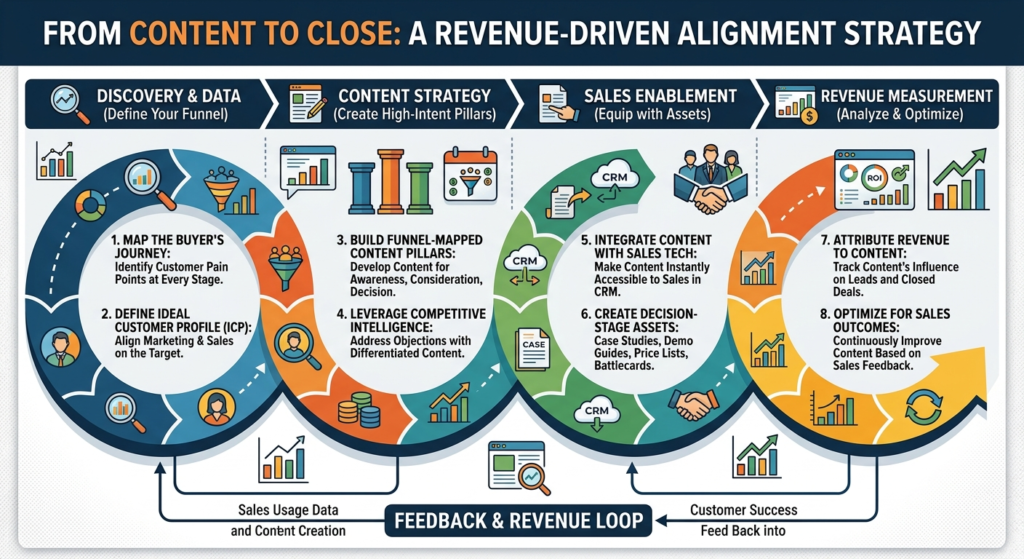
A genuine content marketing strategy starts from the buyer’s journey and works backward to what gets written and when, rather than starting from a blank calendar and filling it with topics that seem generally relevant. This article walks through why most content calendars fail to support sales, how to build content pillars around the actual questions buyers ask, how to balance SEO-driven and brand-driven content, and a simple template for mapping a calendar to the funnel it is meant to serve.
Why Most Content Calendars Fail?
Content Without a Funnel Connection
The most common failure mode in content marketing is producing pieces that are individually reasonable but collectively disconnected from any coherent path toward a sale. A blog full of general industry commentary might attract readers and even build some brand awareness, but if none of that content addresses the specific questions someone asks once they are actually considering a purchase, the content has no mechanism for converting that attention into a lead. Content marketing for lead generation requires content deliberately built at every stage a buyer passes through, not just the earliest, broadest stage.
The Difference Between a Publishing Schedule and a Strategy
A publishing schedule answers the question “what are we posting this week.” A content marketing strategy answers a different question entirely: “what does a prospective customer need to see, read, or learn at each stage of their decision, and how does our content deliver that.” The first produces a calendar full of dates and topics with no connective logic. The second produces a calendar where every piece has a specific job to do in moving a specific type of reader closer to a decision, which is the difference between content that merely exists and content that supports sales.
Building Content Pillars Around Buyer Questions
Mining Real Questions From Sales and Support
The best source of content pillar ideas is rarely keyword research alone — it is the actual questions a sales team fields on calls and the actual concerns customer support hears after a purchase. These questions reveal exactly what a real buyer is uncertain about at each stage, which is far more reliable than guessing what content “should” cover based on general industry topics. A short conversation with sales and support staff, simply asking what prospects and customers ask most often, frequently surfaces a content pillar list more useful than weeks of generic brainstorming.
Turning Questions Into a Pillar Structure
Once the real questions are gathered, they naturally cluster into a small number of pillars — recurring themes that organize related questions under a shared topic. A business selling accounting software might find its buyer questions cluster into pillars like compliance and regulation, cost and ROI, integration with existing tools, and ease of use for non-technical staff. Each pillar becomes a recurring content theme the calendar returns to regularly, ensuring the content produced actually maps to what buyers are genuinely trying to figure out rather than to whatever topic happens to come to mind on a given week. Revisiting this pillar list every few months, rather than treating it as fixed forever, keeps the structure aligned with how the business and its buyers’ concerns evolve over time.
Balancing SEO-Driven and Brand-Driven Content
When to Write for Search Intent?
SEO-driven content is built around specific keywords with meaningful search volume and clear intent, aiming to capture readers actively searching for an answer the business can provide. This content tends to work best for top-of-funnel and middle-of-funnel topics, where a prospective buyer is actively researching and comparing options, and where ranking in search results puts the business in front of people who would not have otherwise known it existed.
When to Write for Brand and Relationship Building?
Brand-driven content, by contrast, is built around what the business wants to say and how it wants to be perceived, often without a specific keyword target in mind — thought leadership pieces, behind-the-scenes stories, or commentary on industry developments. This content matters most for relationship-building with an audience that already knows the business, deepening trust and differentiation in ways that pure search-intent content usually cannot. A content marketing strategy that leans entirely on SEO-driven content risks feeling transactional and interchangeable with competitors, while one that leans entirely on brand-driven content risks never reaching new audiences in the first place. The healthiest calendars deliberately balance both.
A Simple Funnel-Mapped Planning Template
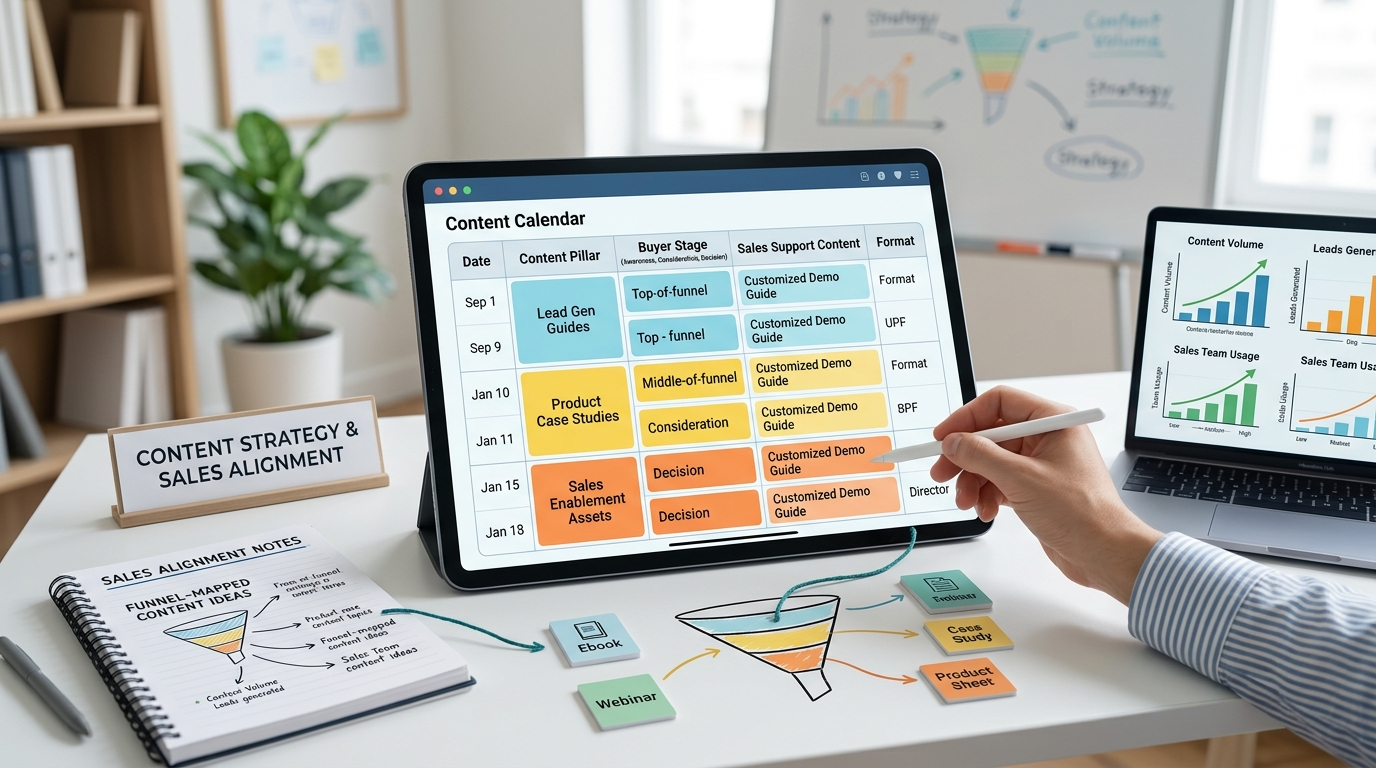
Structuring the Calendar by Funnel Stage
A practical content calendar planning template organizes upcoming content into columns for the content pillar it belongs to, the funnel stage it targets (top, middle, or bottom), the specific buyer question it answers, and the primary keyword or topic angle if SEO-driven. This structure forces every piece of content to justify its place on the calendar by pointing to a real stage in the buyer’s journey, rather than existing simply because it seemed like a reasonable thing to write about that week.
Reviewing and Adjusting the Plan Monthly
A funnel-mapped calendar should not be treated as fixed once built. A brief monthly review — checking which pieces of content are actually generating traffic, engagement, or leads at each funnel stage — reveals which pillars and formats are working and which need adjustment. This review is what keeps a content marketing strategy responsive to real audience behavior rather than locked to assumptions made when the calendar was first drafted, and it is often the single habit that separates content programs that improve over time from those that plateau after the first few months.
Adapting the Calendar for Multilingual Content
Not Every Piece Needs All Three Languages
For a business publishing in English, Arabic, and French, it is tempting to assume every piece of content needs a version in all three languages. In practice, top-of-funnel awareness content often benefits from broad language coverage, while highly specific bottom-of-funnel content addressing a narrow buyer question may only be worth producing in the language most relevant to where that specific segment of buyers actually searches. Mapping language priority onto the funnel-stage structure, rather than treating every piece identically, keeps content production focused on where the translation or localization effort genuinely pays off.
Localizing Buyer Questions, Not Just Translating Them
The buyer questions that shape content pillars do not always carry over identically across languages and markets. A question common among English-speaking prospects researching a service may not be the same question an Arabic-speaking prospect in the same market is actually asking, even for the same underlying product. Gathering buyer questions separately from sales and support interactions in each language, rather than assuming one list applies universally, keeps the pillar structure genuinely relevant to each audience segment.
Common Mistakes That Undermine Even a Good Calendar
Treating the Calendar as a One-Time Project
A content calendar built once with great care but never revisited quietly drifts out of alignment with real buyer behavior as products, market conditions, and competitor content change. Businesses that treat calendar-building as a finished project rather than an ongoing practice often find themselves publishing content that reflects buyer questions from a year or two earlier rather than the questions actual prospects are asking today.
Producing Content Without Clear Ownership
Even a well-designed funnel-mapped calendar breaks down if it is unclear who is responsible for research, drafting, review, and publishing at each stage. Assigning clear ownership for each step, even in a small team, prevents the common failure where planned content sits unfinished because responsibility for actually producing it was never explicitly assigned to anyone.
Frequently Asked Questions
Three to five pillars, drawn from the real questions sales and support teams hear most often, is a workable range for most small to mid-sized businesses. Fewer pillars keep the content calendar focused; more than five tends to spread content too thin across too many themes to build real depth in any of them.
No. SEO-driven content should target specific keywords with real search intent, but brand-driven content — thought leadership, company updates, industry commentary — often works better without forcing a keyword fit, since its purpose is relationship-building rather than search visibility.
A regular calendar typically just lists what gets published and when. A funnel-mapped calendar additionally tracks which stage of the buyer’s journey each piece serves and which specific question it answers, which is what actually connects the content to the sales process rather than treating publishing as an end in itself.
A monthly check on performance by funnel stage is a reasonable minimum, with a more thorough quarterly review of whether the content pillars themselves still reflect what buyers are actually asking. Buyer questions and market conditions shift over time, and a pillar structure that goes unreviewed for a year or more often drifts out of alignment with what the audience actually needs.
Content is being published consistently, but sales or marketing teams cannot point to specific pieces that helped move a real prospect through their decision. This usually means the calendar was built as a publishing schedule rather than a genuine content marketing strategy, and the fix is mapping existing and future content back to actual funnel stages and buyer questions.
Ready to Build a Calendar That Actually Supports Sales?
A content marketing strategy only works when it is mapped to how your buyers actually make decisions, not just to what seems reasonable to publish each week. Creative 4 All helps businesses across Lebanon and the GCC build funnel-mapped content calendars grounded in real buyer questions rather than generic topics. Book a Free Digital Marketing Consultation to build a content strategy that actually connects to your sales process.