
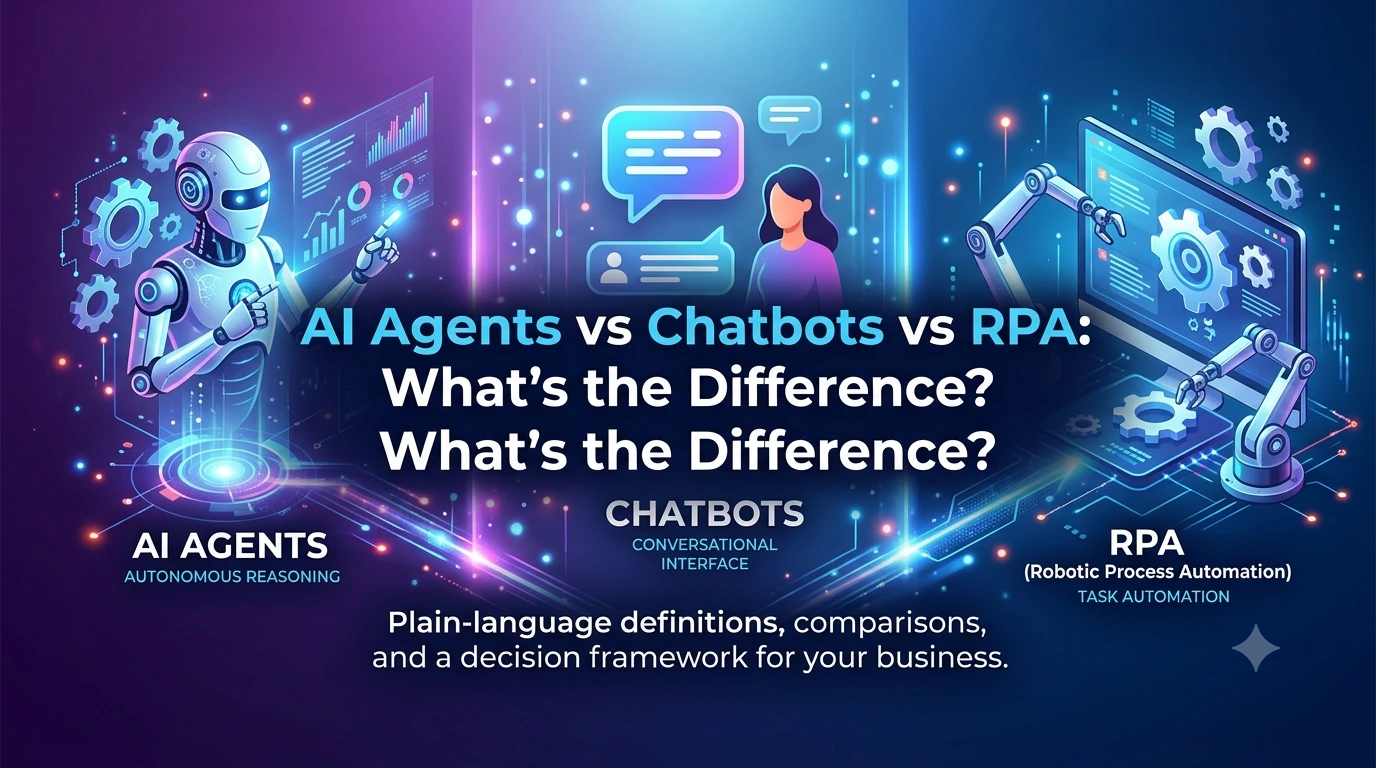
Ask three different vendors what an “AI agent” is, and there’s a real chance you’ll get three different answers, some of which are actually describing a chatbot from five years ago with a new label attached. The confusion isn’t accidental — a lot of guest content and marketing material uses AI agents vs chatbots as competing search terms without ever actually explaining how the two relate to RPA, or to each other, which leaves business owners in Lebanon evaluating automation tools without a clear sense of what they’re actually comparing. That confusion has a real cost: businesses either overpay for AI agent capability they don’t need, or underbuy a simple chatbot when their actual workflow needs something closer to an autonomous agent.
This guide clears up the AI agents vs chatbots confusion directly — plain-language definitions of chatbots, RPA, and AI agents, a side-by-side comparison of what each is actually good at, and a decision framework for figuring out which one, or which combination, fits a specific business need.
Plain-Language Definitions
Chatbots
A chatbot is a program designed to hold a conversation, typically through predefined rules or decision trees, though modern chatbots increasingly use large language models to generate more natural, flexible responses. At its core, a chatbot answers questions and guides a user through a defined set of possible paths — checking an order status, answering a common FAQ, collecting a lead’s contact information before handing off to a human. It responds to what a user types or says, but it doesn’t independently decide to take action beyond that conversation.
Robotic Process Automation (RPA)
RPA automates repetitive, rules-based digital tasks by mimicking the exact steps a human would take in software — copying data from one system into another, generating a report on a schedule, processing a form according to fixed rules. RPA doesn’t converse with anyone; it executes a predefined sequence of actions reliably and repeatedly, and it’s most valuable when a task is well-defined, repetitive, and doesn’t require judgment calls about how to proceed.
AI Agents
An AI agent goes further than either of the above: built on large language models, an AI agent can understand a goal, break it into steps, make decisions about how to proceed, and take actions across multiple systems or tools with a degree of autonomy that neither a chatbot nor RPA has. Where a chatbot answers a question and RPA executes a fixed process, an AI agent can handle a task where the exact steps aren’t predetermined — researching an answer across multiple sources, deciding which of several possible actions to take based on context, or coordinating a multi-step process that requires judgment along the way rather than a fixed script.
The distinction between AI agents vs chatbots ultimately comes down to autonomy and scope: a chatbot handles conversation within a bounded set of responses, while an AI agent can pursue a broader goal across multiple steps and systems, making decisions along the way rather than following a fixed script.
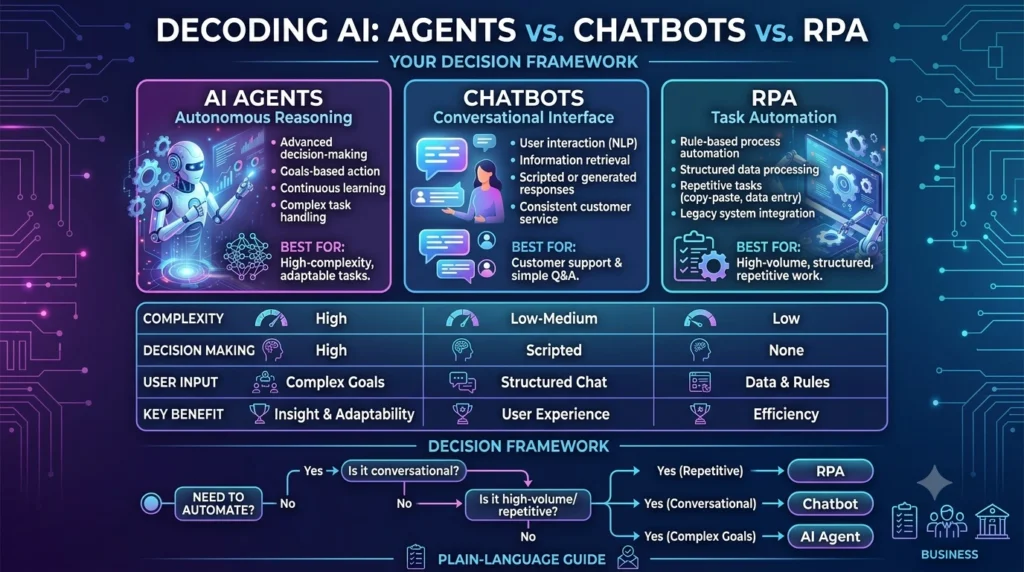
Comparing Use Cases, Cost, and Complexity
Seeing all three technologies side by side makes the practical differences clearer than definitions alone can, particularly when it comes to cost and how much setup work each one actually requires before it delivers value.
| Chatbots | RPA | AI Agents | |
|---|---|---|---|
| Best for | Answering FAQs, basic lead capture, simple support routing | Repetitive, rules-based tasks (data entry, report generation) | Multi-step tasks requiring judgment, research, or coordination across systems |
| Autonomy | Responds within a defined script or set of intents | None — follows exact predefined steps | Can plan, decide, and act toward a goal |
| Typical cost | Low to moderate | Low to moderate, scales with number of processes automated | Moderate to higher, reflecting more complex setup and ongoing refinement |
| Implementation complexity | Relatively quick to deploy | Moderate — requires mapping the exact process steps | Higher — requires defining goals, guardrails, and integration across tools |
| Common failure mode | Frustrates users when a query falls outside the script | Breaks when the underlying process or interface changes | Can take unintended actions without proper guardrails and oversight |
This comparison isn’t about ranking one technology as universally better — each is suited to a genuinely different kind of problem, and the businesses that get the most value from automation typically end up using more than one of these tools for different parts of their operation rather than trying to force one technology to solve every problem.
How to Decide What Your Business Actually Needs?
Deciding between AI agents vs chatbots, or recognizing that RPA is actually the right fit, starts with a different question than most vendors lead with. A business fielding repetitive customer questions about hours, pricing, or order status has a chatbot problem, and building a full AI agent for that use case is usually unnecessary complexity and cost. A business manually re-entering the same data between two systems every day has an RPA problem, and no amount of conversational AI sophistication solves that more efficiently than a well-built automation that simply moves the data correctly.
An AI agent becomes the right tool when a task genuinely requires judgment across multiple steps that can’t be reduced to a fixed script — researching a customer’s history across several systems before recommending a next action, coordinating a multi-step onboarding process that adapts based on what a new customer actually needs, or handling support requests that require pulling information from multiple sources and deciding how to respond rather than matching a predefined intent.
Many businesses end up needing a combination: RPA handling the purely mechanical backend tasks, a chatbot managing straightforward front-facing conversations, and an AI agent stepping in for the subset of requests that genuinely require judgment or coordination across systems. Trying to force all three problem types into a single technology, whichever one currently has the most marketing attention, tends to produce a solution that’s either overbuilt for simple tasks or too rigid for genuinely complex ones.
Why the Terminology Confusion Exists?
Part of the reason AI agent and chatbot searches turn up such inconsistent answers is that vendors have strong commercial incentives to stretch whichever term currently generates the most interest to cover their existing product. A chatbot vendor rebranding an incrementally improved product as an “AI agent” isn’t necessarily lying, but it’s blurring a distinction that matters when a business is trying to figure out what capability it’s actually purchasing. This isn’t unique to AI — the same pattern played out with “smart,” “cloud,” and “automated” in earlier technology cycles, where marketing language moved faster than the underlying capability did.
The practical takeaway is to evaluate a proposed solution based on what it actually does — does it hold a scripted conversation, does it execute a fixed process, or does it plan and act autonomously across multiple steps — rather than trusting the label a vendor applies to it. Asking a vendor to walk through a specific example of how their tool would handle a real task from your business is a far more reliable way to understand what you’re buying than comparing marketing terminology across proposals.
What This Looks Like for a Lebanese Business?
These distinctions become clearer with concrete examples drawn from common business types in Lebanon. A medical clinic fielding constant WhatsApp messages about appointment availability, clinic hours, and insurance coverage has a straightforward chatbot problem — a well-built conversational flow can handle the bulk of these repetitive questions and only escalate to a human for anything genuinely unusual. A retailer manually copying order details from an ecommerce platform into an accounting system every day has an RPA problem, where the fix is a reliable automation that moves the data correctly without needing any conversational ability at all.
An agency managing multiple client accounts, where responding to a client request might require checking project status across several tools, reviewing recent communication history, and deciding what response or next step makes sense given all of that context, is closer to an AI agent use case — the task genuinely requires judgment that can’t be reduced to a fixed decision tree, and a simple chatbot script would either give unhelpful generic answers or constantly need human intervention to actually resolve anything. Recognizing which of these three situations actually describes your business is the difference between choosing a technology because it solves your specific problem and choosing one because it’s the most talked-about option in 2026.
Frequently Asked Questions
Not exactly. A chatbot is fundamentally conversational and reactive, responding within a defined set of possible replies. An AI agent can take autonomous action across multiple steps and systems toward a goal, which is a meaningfully different capability than holding a conversation, even when both use similar underlying language models.
Yes, and this combination is increasingly common. An AI agent can handle the judgment-based decision of what needs to happen, while RPA executes the well-defined mechanical steps reliably once that decision is made, combining the strengths of both rather than forcing one technology to do the other’s job.
Chatbots and simple RPA implementations are typically the least expensive and fastest to deploy, since both operate within well-defined boundaries. AI agents generally cost more upfront because they require more careful goal definition, guardrails, and testing before reliable operation.
Not necessarily. If the chatbot is handling its intended scope of conversational tasks well, an AI agent only becomes worth adding when there’s a genuine need for autonomous, multi-step task execution that a conversational script can’t handle.
Because AI agents can take autonomous action, insufficient guardrails or oversight can lead to unintended actions or decisions the business didn’t anticipate. Proper scoping, testing, and monitoring matter more for AI agents than for chatbots or RPA, precisely because of that autonomy.
Ready to Find the Right Automation Fit for Your Business?
Choosing between a chatbot, RPA, and an AI agent — or some combination of the three — depends entirely on the actual problem you’re solving, not on which side of the AI agents vs chatbots debate sounds more impressive. Book a free AI automation assessment with Creative 4 All and get a clear recommendation based on your specific workflows, not a generic pitch for whichever technology is trending.