
If you run a 20-person accounting firm in Beirut, a manufacturing business in Zahle, or a customer-service team fielding the same WhatsApp questions all day, you have probably already heard the pitch: AI will transform your business. What almost nobody tells you is how. This guide is written for the business owner who is past the hype and wants the actual mechanics — what AI automation for SMEs realistically looks like inside a 10-to-50-person company, a five-step roadmap for implementing it without wasting budget on the wrong tools, and the honest cost, timeline, and failure points that most vendors skip over. If you have read a dozen generic “AI will change everything” articles and still don’t know where to start on Monday morning, this is the piece that answers that question.
What AI Automation Realistically Means for a 10–50 Person Business
Most SME owners picture AI automation as either a chatbot on their website or some vague, futuristic “robot workforce.” In practice, for a business this size, it means something far more specific: using AI agents and workflow automation tools to handle repetitive, rules-based tasks that currently consume staff time without requiring much judgment — data entry, appointment scheduling, invoice processing, lead qualification, inventory alerts, and first-line customer responses.
It’s worth separating three terms that get used interchangeably but aren’t the same thing: RPA (robotic process automation) executes fixed, rule-based steps exactly the same way every time; AI agents can interpret unstructured input — an email, a voice message, a messy spreadsheet — and decide what to do with it; and workflow automation is the connective layer that moves information between systems once a task is triggered. Most useful implementations for an SME combine all three rather than relying on just one.
Why This Matters More for Lebanese SMEs Specifically?
Lebanese SMEs are often understaffed relative to their workload, and hiring to cover repetitive administrative work is expensive relative to the value it produces. AI automation for SMEs in this context isn’t about replacing people — it’s about freeing the two or three staff members currently buried in repetitive tasks so they can focus on the client-facing or revenue-generating work only a person can do.
Signs Your Business Is Ready for AI Automation
Not every business benefits equally from automation at the same stage of its growth, and knowing whether the timing is right matters as much as knowing which tools to use. A few signs tend to indicate genuine readiness: the same manual task is repeated dozens of times a week by more than one staff member; growth is being held back by administrative bottlenecks rather than a lack of demand; existing systems (a CRM, an accounting platform, a booking tool) already hold reasonably clean data that an automation could act on; and leadership has the bandwidth to properly define a process rather than delegating it to whoever is least busy that month.
On the other hand, a business is usually not ready if its core processes are still informal, undocumented, or inconsistent from one staff member to the next. Automating an undefined process doesn’t fix the inconsistency — it just locks in whichever version of the process happened to get automated first, which is often not the best version. A short internal audit of how work actually flows through the business, before any AI conversation begins, saves far more money than it costs.
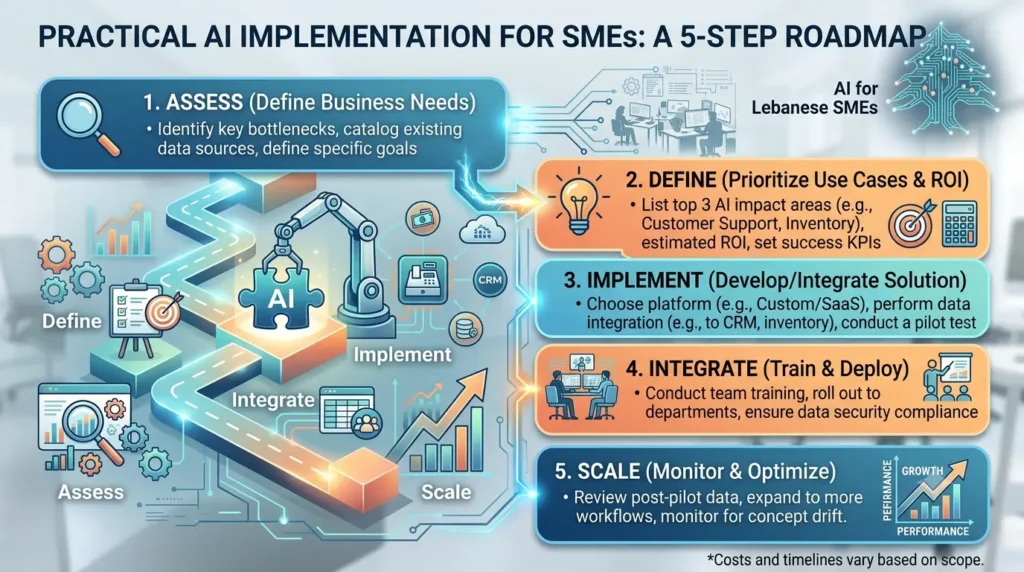
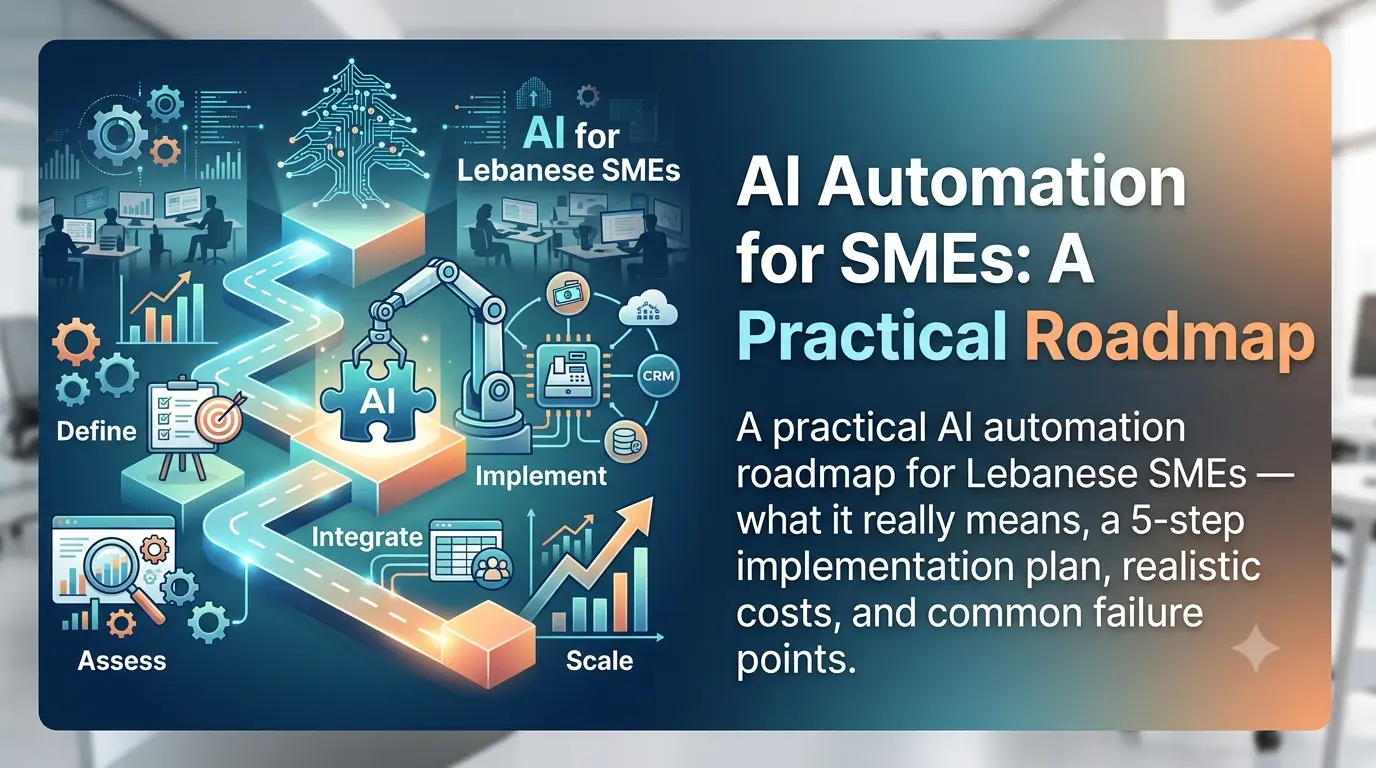
A 5-Step AI Implementation Roadmap
The businesses that get real value from automation follow roughly the same sequence. The ones that struggle almost always skip a step — usually by jumping straight to buying a tool before doing the first two.
Step 1: Identify Repetitive Tasks
Start by listing every task performed daily or weekly that follows a predictable pattern: the same type of email answered the same way, the same data copied from one system to another, the same follow-up message sent to every new lead. These are the highest-leverage automation candidates because the logic behind them is already well understood — it just hasn’t been written down or automated yet.
Step 2: Map the Workflow
Before automating anything, document the task exactly as it happens today: who does it, what triggers it, what systems it touches, and what the finished output looks like. This step gets skipped more often than any other, and it’s the single biggest predictor of whether an automation project succeeds. Automating a broken or poorly understood process just makes the business produce bad outcomes faster.
A useful workflow map doesn’t need specialized software — a simple flowchart or even a numbered list of steps is enough, as long as it’s accurate and reviewed by the person who actually performs the task day to day, not just by management’s assumption of how it works. It’s common for the documented version of a process and the actual version performed by staff to diverge in small but important ways, and those gaps are exactly what an automation build needs to surface before development starts, not after.
Step 3: Pilot on One Process
Choose one well-mapped, contained process and automate it first — not the most complex one, the clearest one. A single successful pilot, such as automating appointment confirmations or lead intake, builds internal confidence and gives the business a real, working example to learn from before expanding further.
Step 4: Measure the Result
Track hours saved, error rates before and after, and response times. This is where many SMEs fall short: without a baseline measurement taken before the pilot, it’s impossible to prove the automation actually worked, which makes it much harder to justify expanding the program afterward.
Step 5: Scale Deliberately
Once a pilot proves out, expand to adjacent processes one at a time, using the same map-pilot-measure sequence rather than automating everything simultaneously. Businesses that try to automate five processes at once, before any of them are proven, tend to end up with five half-working systems rather than one solid one.
Realistic Cost and Timeline Expectations
A single, well-scoped pilot process — something like automated lead intake and qualification, or an AI agent handling first-line WhatsApp inquiries — typically takes four to eight weeks from workflow mapping to a working pilot, depending on how many existing systems it needs to connect to. Costs vary widely depending on complexity, but the pattern that matters most isn’t the number itself: it’s that a properly scoped pilot costs a fraction of a full-scale rollout, and it’s the only way to validate ROI before committing a larger budget.
Businesses that skip the pilot and go straight to a company-wide automation platform typically spend significantly more upfront and take considerably longer to see results, simply because there’s no smaller proof point to correct course from if something doesn’t fit the business’s actual workflows.
Common Failure Points
A few patterns show up repeatedly in AI automation projects that underdeliver:
- Automating a process that was never clearly mapped, so the automation just replicates existing inefficiencies faster
- Choosing a tool before defining the workflow, which forces the business to bend its process to fit the software instead of the other way around
- No measurement baseline, making it impossible to prove or disprove ROI after launch
- Trying to automate judgment-heavy tasks that genuinely need human discretion, rather than starting with clearly rules-based work
- Treating automation as a one-time project instead of an ongoing system that needs monitoring and adjustment as the business changes
Most of these failure points trace back to the same root cause: moving to implementation before the business has honestly assessed its own workflows. A short internal AI readiness review before any tool is purchased solves the majority of these problems before they start.
How AI Automation Fits Into a Broader Digital Transformation Strategy
AI automation for SMEs works best when it isn’t treated as an isolated project bolted onto an otherwise unchanged business, but as one layer of a wider digital transformation — alongside a website and SEO strategy that actually generates qualified leads, and systems (CRM, invoicing, scheduling) clean enough for an AI agent to act on reliably. A business investing in automation while its lead-generation channels remain thin, for example, ends up with a very efficient system processing very few leads.
This is also where the choice between an AI agent, a simple chatbot, and traditional RPA becomes a strategic decision rather than a purely technical one. A business fielding varied, open-ended customer questions needs the interpretive flexibility of an AI agent; a business with a small number of highly predictable requests may only need a simple chatbot or a rules-based RPA flow, at a fraction of the cost and complexity. Getting this choice right the first time avoids the common and expensive mistake of over-building a sophisticated AI agent for a problem that a simple, rules-based tool would have solved just as well.
Book a Free AI Automation Assessment
AI automation for SMEs succeeds when it follows a disciplined sequence — identify, map, pilot, measure, scale — rather than a rushed purchase of whatever tool looks impressive in a demo. The Lebanese businesses seeing real results from automation right now are rarely the ones with the biggest technology budgets; they’re the ones that mapped their workflows honestly before automating anything. If you’re not sure which of your business’s processes are actually ready for automation, an assessment is the fastest way to find out. Book a Free AI Automation Assessment with Creative 4 All and get a clear, honest picture of where automation would genuinely move the needle in your business.
Frequently Asked Questions
Costs depend heavily on scope, but a single well-defined pilot process is always the more affordable and lower-risk starting point compared to a full platform rollout. A proper assessment will scope realistic costs against the specific processes a business wants to automate.
For most SMEs, the realistic outcome is reallocation, not replacement — automation absorbs the repetitive administrative load so existing staff can focus on client relationships, sales, and work that requires judgment.
No. Most SME-scale automation projects are implemented and managed by an external partner, with light internal involvement from whoever owns the process being automated day to day.
A basic chatbot follows a fixed decision tree and can only respond to inputs it was explicitly programmed to expect. An AI agent can interpret open-ended, unstructured input and decide on an appropriate action or response, which makes it suitable for a much wider range of real customer and operational interactions.
Lead intake and qualification is usually the best starting point, since it’s high-volume, clearly rules-based in most businesses, and directly tied to revenue — making the ROI easy to measure and easy to justify expanding from.