
If you own a clinic in Achrafieh, a restaurant in Jounieh, or a contracting business in Tripoli, the customers who matter most to you are not searching from London or Dubai — they are standing two kilometers away with their phone out, typing “best [service] near me” into Google. This is the search behavior that local SEO in Lebanon is built to capture, and it is also the search behavior that most Lebanese business websites are currently losing. National SEO gets you found when someone searches a broad term from anywhere. Local SEO gets you found by the person who is ready to visit, call, or book today — and for most Lebanese SMEs, that second group is worth far more than the first. This guide walks through exactly how Google decides who shows up in the local pack and the “near me” results, and what a business in Beirut, Tripoli, Jounieh, Zahle, or Byblos needs to do to earn that visibility.
What Is Local SEO, and How Is It Different From National SEO?
National (or organic) SEO competes for visibility in the standard “ten blue links” results, regardless of where the searcher is located. Local SEO competes for a different, more valuable piece of real estate: the map pack — the block of three business listings with a map that appears above the organic results whenever Google detects local intent.
Local intent doesn’t require the word “near me.” Searches like “dentist Achrafieh,” “web design company Beirut,” or simply “SEO agency” typed from a phone in Lebanon all trigger the same local algorithm, because Google has decided the searcher is looking for a business, not an article. This is precisely why local SEO in Lebanon needs its own strategy: winning the local pack depends on a different set of ranking factors than winning a blog-post keyword, and most agencies here treat them as the same problem.
For service businesses — clinics, contractors, retailers, professional services — the map pack is often the single highest-converting piece of real estate on the entire search results page, because everyone who clicks into it has already decided they want a business “now,” not information “eventually.”
How Google’s Local Pack Algorithm Actually Works
Google has publicly confirmed that local ranking comes down to three factors working together: relevance, distance, and prominence.
Relevance
Relevance measures how well a business profile matches what the searcher typed. This is decided almost entirely by how complete and accurate your Google Business Profile (GBP) is — the categories chosen, the services listed, and the way your business description uses the same language your customers use to search.
Distance
Distance measures how far the business is from the searcher, or from the location implied in the search (a query like “SEO agency Tripoli” implies a location even without GPS data). This is the one factor a business cannot fully control, but it is also the reason accurate address data and geo-targeted content matter — Google needs confidence in exactly where a business is located and which neighborhoods it genuinely serves.
Prominence
Prominence is Google’s confidence in how well-known and well-regarded a business is, offline and online. It’s built from review volume and quality, citation consistency, backlinks, and general web presence — including how often the business is mentioned across the web beyond its own website.
Most Lebanese businesses lose on prominence before they even get to compete on relevance, simply because the supporting signals — citations, reviews, and mentions — have never been built out deliberately.
It’s worth noting that these three factors don’t operate independently of Google’s broader quality systems. A business with strong prominence signals but a website full of thin, generic content will still struggle, because Google’s helpful content and E-E-A-T evaluations increasingly bleed into local ranking as well. The businesses that win long-term treat local SEO and content quality as one connected system, not two separate projects running on parallel tracks.
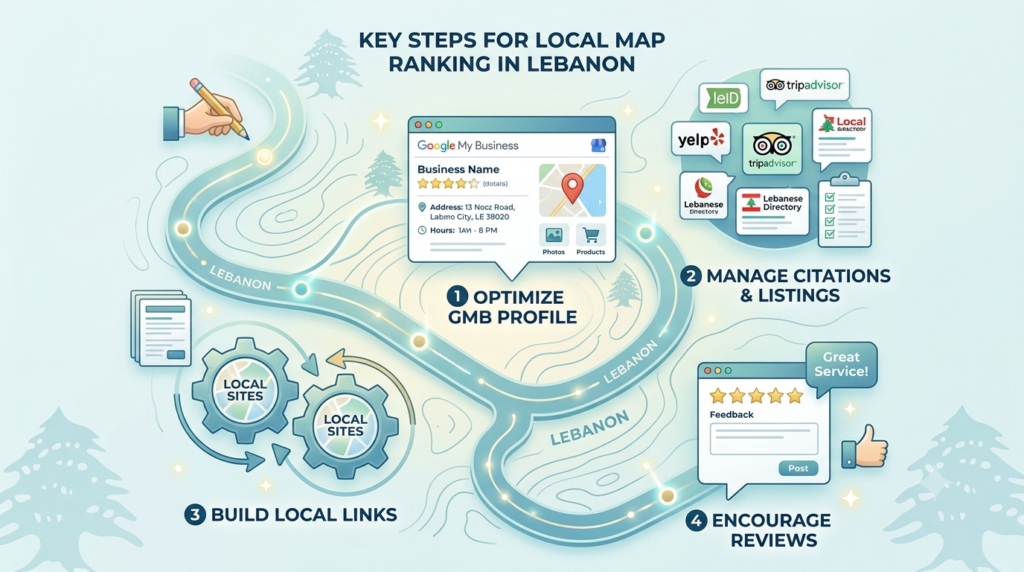
Google Business Profile Optimization: The Foundation of Local SEO in Lebanon
If a business does only one thing from this guide, it should be this: claim, verify, and fully complete a Google Business Profile.
A complete profile includes:
- The correct primary category (and secondary categories where relevant)
- A full, accurate address that matches the business’s real, physical location
- A local Lebanese phone number, correctly formatted
- Complete business hours, including holiday hours
- A written description that naturally includes the services offered and areas served
- Photos of the actual location, staff, and work — never stock imagery
- Products or services listed with clear descriptions
- Regular posts covering offers, updates, and events
Two details are worth emphasizing because they are the two most commonly mishandled aspects of local SEO in Lebanon: category selection and photo authenticity. Choosing a category that’s too broad (“Business Service” instead of “Marketing Agency,” for example) dilutes relevance signals, and stock or stolen photography is one of the fastest ways to lose trust with both Google and prospective customers.
Citations and NAP Consistency: Why They Still Matter
A citation is any online mention of a business’s Name, Address, and Phone number (NAP) — on directories, industry listings, chambers of commerce, or partner websites. NAP consistency means this information is identical, character for character, everywhere it appears.
This sounds like a minor technical detail, but it is one of the most common — and most damaging — local SEO problems for Lebanese businesses. A business listed as “Creative 4 All” on one directory, “Creative4All s.a.r.l.” on another, and with a slightly different phone number format on a third sends Google a weak, inconsistent signal about the business’s identity and legitimacy. Every inconsistency chips away at the prominence signal described above.
Building citations for a Lebanese business means prioritizing:
- Google Business Profile — the anchor citation
- Local and regional directories relevant to Lebanon and the wider Levant
- Industry-specific directories (marketing, healthcare, construction, hospitality, depending on the vertical)
- Chamber of commerce and business association listings
The goal isn’t citation volume for its own sake — a handful of accurate, consistent, authoritative citations outperforms dozens of low-quality, inconsistent ones.
Review Generation: Turning Customers Into Ranking Signals
Reviews influence both prominence (through volume and rating) and relevance (through the specific words customers use inside their reviews, which Google can associate with related search terms).
An effective, white-hat review strategy for a Lebanese business includes:
- Asking for reviews at the natural high point of the customer relationship — right after a successful project or appointment, not months later
- Making the process low-friction, with a direct link sent by WhatsApp or email
- Responding to every review, positive or negative, professionally and promptly
- Never purchasing reviews or incentivizing specific star ratings — both violate Google’s policies and risk profile suspension
A steady, ongoing trickle of genuine reviews consistently outperforms a single burst of reviews collected all at once, because Google’s systems can distinguish organic patterns from artificial ones.
Local Link Building for Lebanese Businesses
Local link building means earning links from Lebanon-relevant, contextually appropriate sources rather than generic guest posts. The strongest local links tend to come from:
- Local news coverage of openings, milestones, or community involvement
- Sponsorships of local events, sports teams, or community initiatives
- Partnerships with complementary local businesses — a web design agency and a local printing company, for example
- Membership organizations and industry associations based in Lebanon or the region
This is a deliberate departure from a pattern that has worked against many Lebanese businesses’ current link profiles: a heavy concentration of generic “[Service] in Lebanon” guest posts placed on low-authority, free-hosting domains. Those links carry little to no local-relevance weight, because they say nothing about where a business actually operates or who it actually serves within the community.
On-Page Localization for Beirut, Tripoli, Jounieh, Zahle, and Byblos
Beyond the Google Business Profile, a business’s own website needs to reinforce the same geographic signals. This means:
- A dedicated, well-written location or service-area page for each city genuinely served — rather than one generic “Lebanon” page trying to rank everywhere at once
- Embedding a Google Map on contact and location pages
- Using local landmarks, neighborhoods, and area names naturally within the content, not just in a footer
- Structured data (LocalBusiness schema) that mirrors the Google Business Profile information exactly
The mistake to avoid here is thin, duplicated location pages that swap out only the city name. Google’s helpful content systems are specifically designed to detect this pattern, and it does more harm than having no location pages at all. Each page needs to say something genuinely useful and specific about serving that particular area.
For businesses operating across Lebanon’s trilingual market, localization also means getting the technical multilingual setup right — correct hreflang tags connecting the English, Arabic, and French versions of each page, so Google serves the right language version to the right searcher instead of treating them as duplicate or competing content. A location page that ranks well in English but has no properly linked Arabic equivalent is leaving a significant share of local search demand on the table.
Common Local SEO Mistakes Lebanese Businesses Make
A few patterns show up repeatedly when auditing local SEO in Lebanon:
- Multiple, unclaimed, or duplicate Google Business Profile listings for the same business
- Inconsistent NAP data across directories, invoices, and the website itself
- No review generation system, leaving prominence signals to chance
- Location pages that are thin, duplicated, or missing entirely
- A guest posting strategy built entirely around one generic keyword phrase, with no local, review, or citation component supporting it
Fixing these issues rarely requires an enormous budget. It requires a deliberate, sequenced approach — profile first, citations second, reviews third, content and links fourth — rather than trying to do everything at once.
Frequently Asked Questions
Most businesses start seeing movement in map pack visibility within 60–90 days of a properly optimized Google Business Profile combined with consistent citation building, though competitive categories in Beirut can take longer.
Yes. Google’s guidelines require a genuine, staffed location, or a documented service-area business model — P.O. boxes and virtual offices are not eligible and can result in profile suspension if discovered.
Yes. Search behavior varies by language, and a fully multilingual local SEO approach — with genuinely translated, not machine-translated, content and consistent NAP data across all language versions — captures a wider share of Lebanon’s trilingual search market.
It’s possible but very difficult, since reviews are one of the strongest prominence signals Google uses. Competitors with even a modest number of genuine reviews will typically outrank a review-free profile.
They work together, but for local pack visibility specifically, Google Business Profile optimization carries more direct weight. A strong website still matters for organic rankings, trust, and conversion once a customer clicks through.
Get SEO Audit
Local SEO in Lebanon rewards businesses that treat their Google Business Profile, citations, reviews, and location content as a coordinated system rather than a checklist completed once and forgotten. The businesses currently winning the map pack in Beirut, Tripoli, and Jounieh are rarely the ones with the biggest marketing budgets — they are the ones with the most consistent, complete, and genuinely local presence.
If your business isn’t showing up in the map pack for the searches that matter most, a proper audit is the fastest way to find out why.