
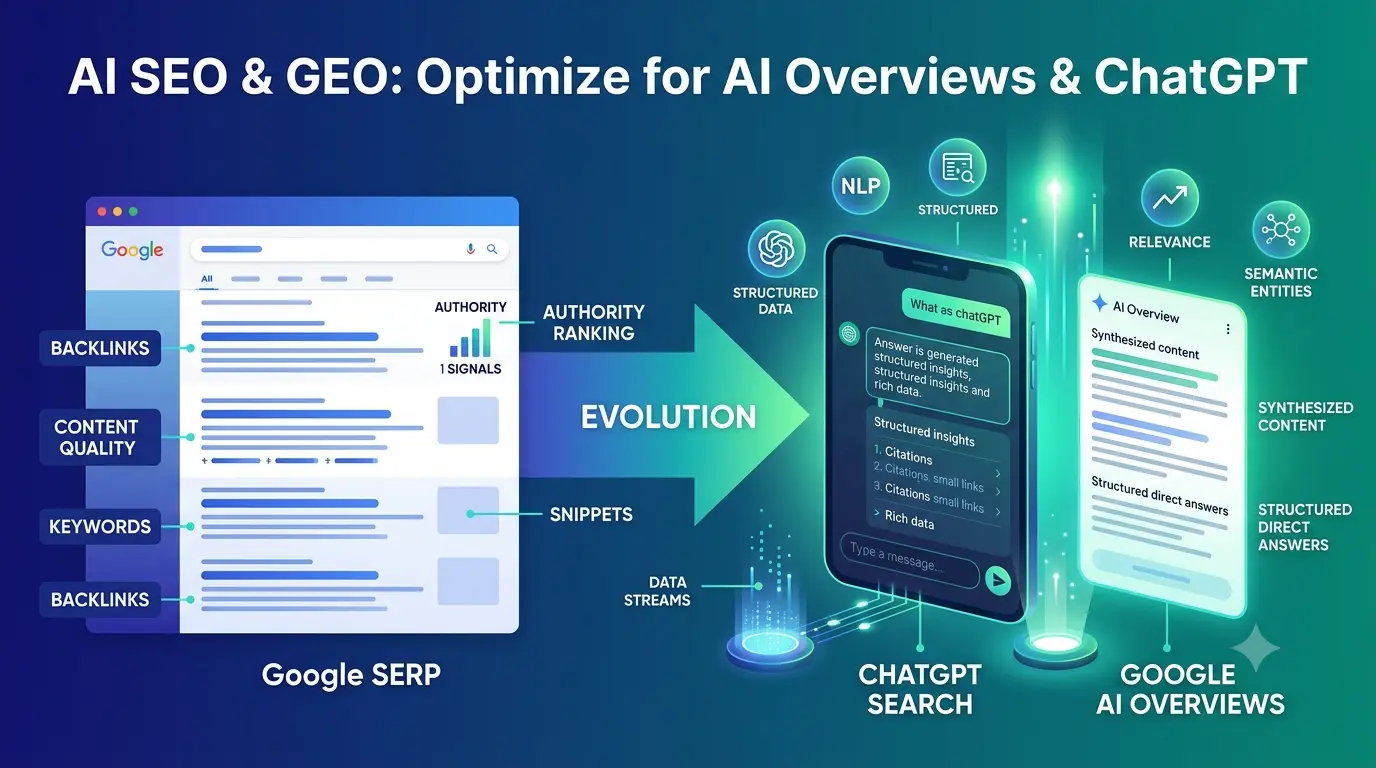
Every search conversation in 2026 eventually arrives at the same question: does traditional SEO even matter anymore when Google AI Overviews, ChatGPT Search, Gemini, and Perplexity are increasingly where people find answers before they ever click a blue link? AI SEO / GEO optimization has become one of the most searched, least understood topics in digital marketing, partly because so much of the available advice treats it as an entirely new discipline requiring entirely new tactics. Google’s own guidance, published in May 2026, says otherwise — and understanding what it actually says is the difference between chasing gimmicks and building genuine visibility in an AI-first search environment.
This guide covers how AI Overviews and other answer engines actually select which sources to cite, how topical authority and E-E-A-T connect directly to AI citation, how to structure content so it can actually be extracted and quoted, why author attribution matters more than ever, what Google’s May 2026 generative AI guidance specifically says, and a practical checklist you can apply to your site starting today.
How AI Overviews and Answer Engines Select Sources?
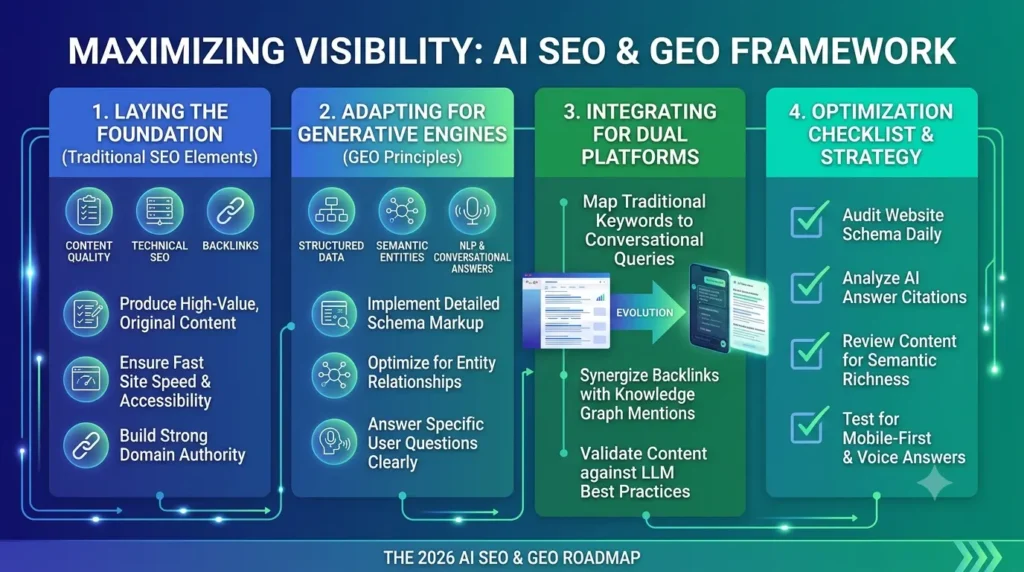
Google AI Overviews and AI Mode aren’t separate systems running independently of traditional search — they’re built directly on Google’s core Search ranking and quality systems, using techniques like retrieval-augmented generation and query fan-out to pull and synthesize content from the same index that powers regular search results. In practice, this means a page that can’t rank well in traditional search has little chance of being cited in an AI-generated answer either; AI SEO / GEO optimization doesn’t replace foundational SEO work, it depends on it entirely.
Other answer engines like ChatGPT Search and Perplexity work somewhat differently under the hood, but converge on similar priorities: they favor content that directly and clearly answers a specific question, that comes from a source with demonstrated credibility on the topic, and that can be cleanly extracted without needing to untangle vague or overly promotional language to find the actual answer. Across all of these systems, the pattern is consistent — visibility in AI-generated answers is earned by the same underlying qualities that earn strong traditional rankings, expressed in a format that’s easier for a language model to lift and cite directly.
The Link Between Topical Authority, E-E-A-T, and AI Citation
Google’s May 2026 guidance is explicit that non-commodity content — material that reflects a genuine, unique perspective, firsthand experience, and real expert depth rather than a generic summary a language model could produce on its own — performs best inside AI-generated responses. This is directly connected to E-E-A-T: an AI system deciding which source to cite for a claim is making a trust judgment much like a human reader would, and the same signals that build E-E-A-T — verifiable authorship, firsthand experience, transparent sourcing — are what make a page a credible candidate for citation in the first place.
Topical authority compounds this effect. A site that has consistently published deep, credible content across a coherent subject area becomes a more likely citation source for any new query within that area, since both traditional ranking systems and AI retrieval systems weigh a site’s demonstrated expertise in a topic, not just the individual page being considered. A single strong page on an otherwise unrelated or thin site is far less likely to be surfaced as a citation than the same content published by a site with an established pattern of expertise in that exact space.
Structuring Content for Extraction
Clear Heading Hierarchy
A logical, descriptive heading structure — one that a language model can scan to understand a page’s structure without reading every paragraph — makes content dramatically easier to extract accurately. Headings that clearly state what the following section answers, rather than vague or clever titles, give both search crawlers and generative AI systems a clean map of what a page actually covers.
Answer-First Paragraphs
Content that states the direct answer to a likely question near the beginning of a section, before elaborating with supporting detail, is far easier for an AI system to lift cleanly than content that builds up to its point through several paragraphs of context first. This doesn’t mean every piece of content needs to read like a list of bullet-point facts — it means structuring paragraphs so the core answer isn’t buried at the end of a long build-up.
Selective Use of Lists
Lists genuinely aid extraction when they summarize discrete steps, options, or criteria, but a page that’s nothing but bullet points loses the depth and nuance that also matters for E-E-A-T and genuine reader value. The most effective structure uses narrative paragraphs to build context and demonstrate real expertise, with lists reserved for the specific moments where a clean enumeration genuinely helps both the reader and an extracting AI system.
Why Author Attribution Matters More Than Ever?
As generative AI systems get better at producing plausible-sounding generic content, verifiable human authorship becomes one of the clearest signals separating genuinely trustworthy sources from content that merely resembles expertise. A named author with real, checkable credentials and a consistent publishing history gives both AI citation systems and human readers something concrete to evaluate, in a way that anonymous or generic bylines cannot. This connects directly back to E-E-A-T and reinforces why the two topics — AI SEO and trust-signal SEO — aren’t actually separate disciplines at all.
What Google’s May 2026 Generative AI Guidance Actually Says?
On May 15, 2026, Google published its first consolidated guide specifically addressing how to optimize for generative AI features in Search, covering AI Overviews, AI Mode, and the broader shift toward AI-driven search experiences. The guidance is direct about several points worth understanding clearly. Google states that its generative AI features are rooted in the same core Search ranking and quality systems as traditional search, meaning the fundamentals — crawlability, technical soundness, genuinely useful content — remain the foundation rather than being replaced by some separate AI-specific ranking system.
Google also explicitly addresses common misconceptions around terms like AEO (Answer Engine Optimization) and GEO (Generative Engine Optimization), describing them as different names for the same underlying discipline rather than entirely new channels requiring separate expertise. Perhaps most practically, Google clarified that site owners don’t need special AI-specific text files or markup — including the llms.txt files some in the industry had begun recommending — to appear in generative AI Search; crawlability and genuinely helpful content remain what matters, not new technical workarounds. The guidance does note that citation behavior in AI-generated answers can diverge somewhat from traditional rankings, which is why tracking visibility separately across AI Overviews, AI Mode, ChatGPT, and other relevant surfaces is still worth doing when a business’s buyer journey justifies that additional measurement work.
AI SEO and GEO Considerations for Multilingual Sites
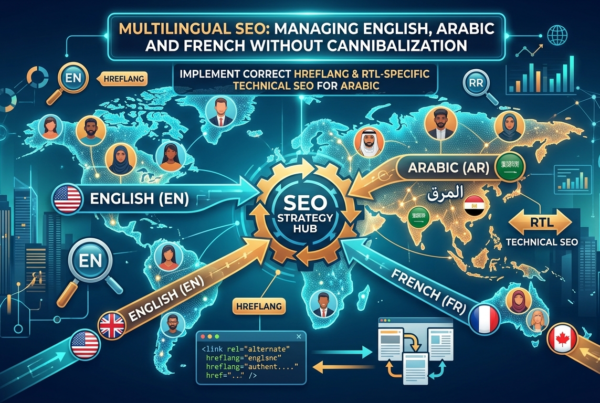
AI SEO and GEO optimization carries an added layer of complexity for a business publishing in English, Arabic, and French, since generative AI systems evaluate credibility and extract answers separately for each language rather than assuming strong performance in one language transfers automatically to another. A page with excellent structure, sourcing, and author attribution in English can be cited confidently by an AI system responding to an English query, while a mechanically translated Arabic version of the same page, stripped of that same structure and attribution, is far less likely to be surfaced as a credible source for an equivalent Arabic query.
This means the same principles — clear heading hierarchy, answer-first structure, genuine author attribution, firsthand expertise — need to be applied consistently across every language version of a page, not just the original. A business investing heavily in AI SEO for its English content while treating Arabic and French versions as an afterthought is effectively building strong AI visibility in one language while leaving real opportunity on the table in the others, particularly as GCC audiences increasingly turn to Arabic-language queries across these same AI-driven search surfaces.
A Practical AI SEO / GEO Optimization Checklist
Confirm the site passes the same technical SEO fundamentals covered in a standard audit — crawlability, indexability, clean site architecture — since none of the AI-specific advice matters if a page can’t be properly crawled and indexed in the first place. Review whether content reflects genuine firsthand expertise and a distinct point of view rather than reading as a generic synthesis of what’s already published elsewhere on the same topic. Check that key pages use a clear, descriptive heading structure and lead with direct answers before elaborating, rather than burying the core point deep in a paragraph. Confirm real author attribution with checkable credentials appears on content where expertise genuinely matters to the reader. And track visibility across AI Overviews, AI Mode, and other answer engines specifically, rather than relying solely on traditional ranking reports to understand how the site is actually performing in this shifting search landscape.
Frequently Asked Questions
No. Google’s May 2026 guidance explicitly states these aren’t necessary — standard crawlability and genuinely useful, well-structured content are what actually matter for appearing in generative AI search features.
According to Google’s own guidance, no. AEO and GEO are described as different names for optimizing the same underlying search experience, since AI Overviews and AI Mode run on Google’s core Search ranking and quality systems rather than a separate system with different rules.
The systems work somewhat differently under the hood, but both converge on favoring content with clear, credible, well-attributed answers to specific questions. Strong traditional SEO fundamentals tend to support visibility across both, though tracking each surface separately helps identify where performance actually diverges.
Not automatically. Lists help when they cleanly summarize discrete steps or facts, but content that sacrifices depth and narrative context for bullet points can lose the qualities — genuine expertise, nuance, firsthand perspective — that make it a credible citation source in the first place.
Some reduction in click-through for certain query types is a broader industry trend tied to how AI Overviews answer questions directly in the results page. Strong AI SEO and GEO practices improve the odds of being the cited, linked source within that answer, which remains valuable even as the underlying search behavior shifts.
Ready to Optimize for the Next Era of Search?
AI SEO and GEO optimization aren’t a separate strategy from SEO — they’re what strong SEO looks like in 2026. Get a free SEO audit from Creative 4 All and find out exactly where your site stands for both traditional rankings and AI-generated search visibility.